
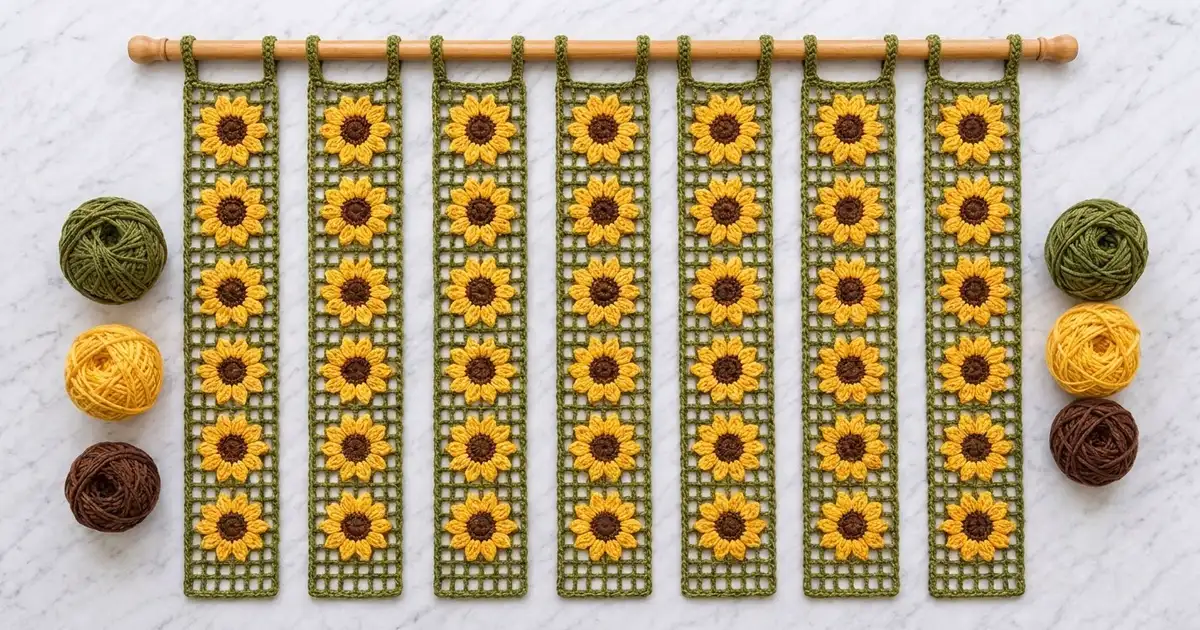
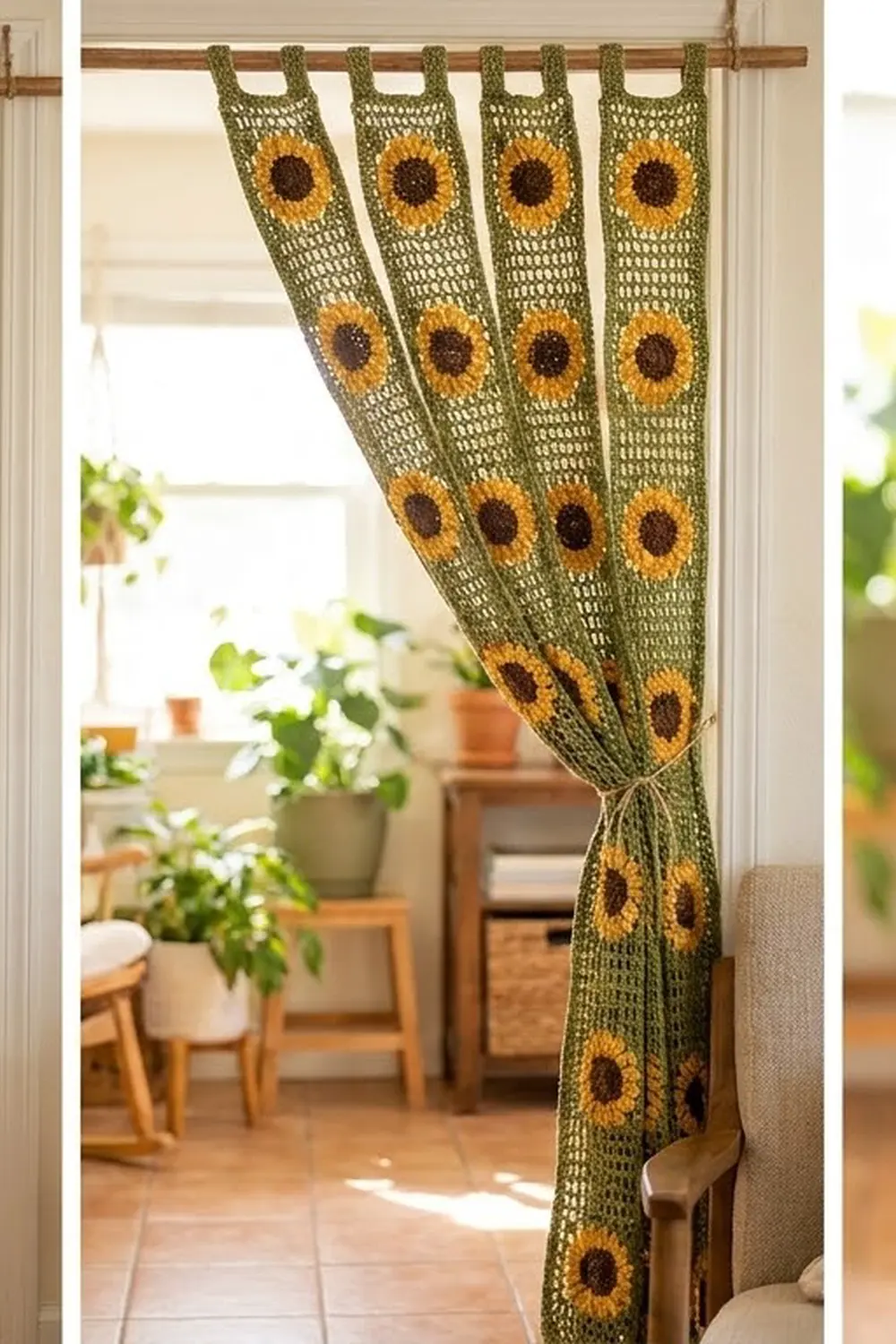
This curtain is made of seven tall strips of olive-green filet mesh, each with a column of golden sunflowers down the middle. The open mesh lets light and air through, and the sunflowers stay bold and readable from across the room. The strips hang separately, so you can walk through them or tie one aside.
The palette uses three colors: olive green for the mesh, golden yellow for the petals and chocolate brown for the textured flower centers. The look is cheerful, slightly retro and farmhouse-friendly.
The pattern uses US crochet terms. Each finished strip measures 5 in (12.7 cm) wide and 54.5 in (138.4 cm) long, plus hanging tabs. Seven strips spaced about 0.5 in (1.3 cm) apart cover about 38 in (96.5 cm) of rod.
For construction, you work each strip as a filet mesh rectangle and edge it with one round of single crochet, then add two loop tabs. You crochet the sunflowers separately and sew them on.
Finished Size and Construction
- Strip size: 5 in x 54.5 in (12.7 cm x 138.4 cm)
- Hanging length with tabs: about 56 in (142.2 cm)
- Curtain width as hung: about 38 in (96.5 cm)
- Skill level: Easy (advanced beginner)
- Terminology: US
- Yarn weight: Worsted (#4), cotton or cotton blend
- Hook: 5.0 mm (H-8)
- Number of pieces: 7 mesh strips + 70 sunflower appliqués
- Layout: 7 strips side by side, 10 sunflowers per strip, strips not joined to each other
- Strip size before border: 4.5 in x 54 in (11.4 cm x 137.2 cm), 6 squares x 72 rows
- Border depth: 0.25 in (0.6 cm), 1 round
- Sunflower diameter: 3.75 in (9.5 cm)
Materials
Use a smooth worsted cotton or cotton blend. Cotton hangs straight, doesn’t stretch much and holds the mesh squares crisply. Avoid fuzzy yarns because they blur the open squares.
These amounts assume yarn with about 190 m per 100 g:
- Olive green (mesh, border, tabs): 500 g / 950 m
- Golden yellow (petals): 250 g / 475 m
- Chocolate brown (centers): 150 g / 285 m
The quantities include a margin of about 10–15% for gauge swatches and sewing.
Tools:
– 5.0 mm (H-8) crochet hook
– Tapestry needle
– Stitch markers
– Measuring tape
– Rust-proof pins and a blocking surface
– Curtain rod at least 42 in (106.7 cm) long and up to 1.25 in (3.2 cm) in diameter
Abbreviations (US Terms)
- ch – chain
- sl st – slip stitch
- sc – single crochet
- hdc – half double crochet
- dc – double crochet
- sk – skip
- sp – space
- st(s) – stitch(es)
- RS – right side
Special stitch – Mesh square: one dc plus ch 2. A row of 6 squares has 7 dc and 6 ch-2 spaces.
Gauge and Checkpoints
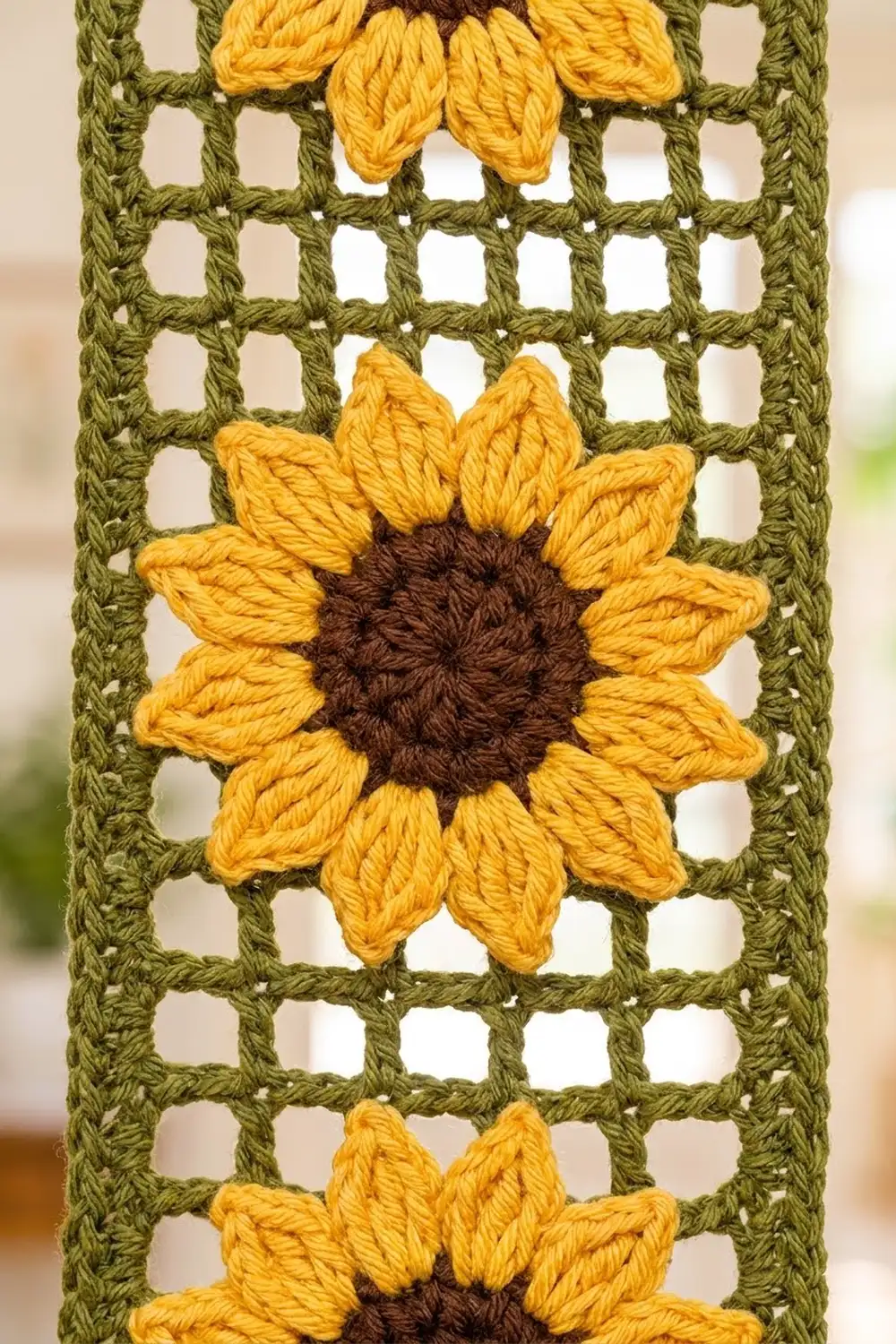
Mesh gauge: 4 squares = 3 in (7.6 cm) wide, and 4 rows = 3 in (7.6 cm) tall. Each square is 0.75 in (1.9 cm) both ways.
Border gauge: 16 sc = 4 in (10.2 cm), which is 4 sc per inch.
Make one complete test piece first: one strip of the first 12 rows plus one sunflower. Check it against these numbers:
- Strip after Row 1: 4.5 in (11.4 cm) wide
- Strip after Row 12: 9 in (22.9 cm) long
- Sunflower after Rnd 1: about 1 in (2.5 cm)
- Sunflower after Rnd 2: 1.75 in (4.4 cm)
- Sunflower after Rnd 3: 3.75 in (9.5 cm)
If your pieces are too big, go down 0.5 mm. If they’re too small, go up 0.5 mm. If the width matches but the rows are too short, make your dc a little taller rather than changing hooks. Square holes are what you’re aiming for.
Mesh Strip (make 7)
Use olive green.
Foundation: Ch 24.
Row 1 (RS): Dc in the 9th ch from hook. The 8 skipped ch count as the first dc, a ch-2 space and the base of the first square. [Ch 2, sk 2 ch, dc in next ch] 5 times. Turn. (6 squares: 7 dc, 6 ch-2 sps)
Row 2: Ch 5 (counts as dc + ch 2), dc in next dc, [ch 2, dc in next dc] 4 times, ch 2, dc in 3rd ch of turning ch. Turn. (6 squares: 7 dc, 6 ch-2 sps)
Rows 3–72: Repeat Row 2. (Each row: 6 squares: 7 dc, 6 ch-2 sps)
Check the length after Row 36: it should be 27 in (68.6 cm). After Row 72, the strip should measure 4.5 in x 54 in (11.4 cm x 137.2 cm). Don’t fasten off.
Strip Border
The middle sc of each 3-sc corner group is that side’s corner stitch. Side counts below run from corner to corner and include both corners.
Border Rnd 1: Ch 1, do not turn.
- Top edge: 3 sc in the first dc (corner), [2 sc in next ch-2 sp, sc in next dc] 5 times, 2 sc in last ch-2 sp, 3 sc in top of turning ch (corner).
- Side 1: 2 sc in the end of Row 72, 3 sc around the post of each row-end for Rows 71–2 (70 rows), 2 sc in the end of Row 1.
- Bottom edge: working into the foundation ch, 3 sc in the base of the first dc (corner), sc in each of the next 17 chains (each ch-2 sp gives 2 sc and each dc base gives 1), 3 sc in the base of the last dc (corner).
- Side 2: work as Side 1.
Join with sl st to the first sc.
Counts per side:
- Top and bottom: 17 + 2 (outer sc of corner groups) + 2 corners = 21 sts each.
- Sides: 214 (2 + 210 + 2) + 2 + 2 corners = 218 sts each.
- Round total: 12 corner-group sc + 34 + 428 = 474 sc
Why the math works: Each 0.75 in (1.9 cm) mesh square gets 3 sc along the top or bottom (2 in the space and 1 in the dc). Each 0.75 in (1.9 cm) row-end gets 3 sc. That works out to 4 sc per inch on every edge, which matches the border gauge, so the edges lie flat without ruffling or cupping.
After the border, the strip measures 5 in x 54.5 in (12.7 cm x 138.4 cm). Don’t fasten off.
Hanging Tabs
The top edge has 21 sts. Number them 1–21, with st 1 at the corner where you start the tabs.
Tab A: Sl st along the top to st 2. Ch 14, sk sts 3–5, sl st in st 6. Turn, work 20 sc into the ch-14 loop, then sl st in st 2. Fasten off.
Tab B: Join with sl st in st 16. Ch 14, sk sts 17–19, sl st in st 20. Turn, work 20 sc into the loop, then sl st in st 16. Fasten off.
Each tab forms a loop about 1.5 in (3.8 cm) tall, which fits a rod up to 1.25 in (3.2 cm) across. Weave in all ends.
Sunflower Appliqué (make 70)
Rnd 1 (brown): Make a magic ring. Ch 3 (counts as dc), 11 dc in the ring, then join with sl st to the top of ch-3. (12 dc)
Rnd 2 (brown): Ch 3 (counts as dc), dc in the same st, then 2 dc in each st around. Join. (24 dc) Fasten off brown. The center should measure 1.75 in (4.4 cm).
Rnd 3 (yellow, petals): Join yellow with sl st in any st.
Ch 6. Working back down the chain: sc in the 2nd ch from hook, hdc in next ch, dc in each of the next 2 ch, hdc in last ch. Sk next st of Rnd 2, sl st in next st. Repeat from * to * 11 more times, working the last sl st into the joining st. (12 petals)
Each petal uses 2 sts of Rnd 2, so 12 petals x 2 = 24 sts. Each petal is about 1 in (2.5 cm) long, wider in the middle and pointed at the tip. The finished flower is 3.75 in (9.5 cm) across: a 1.75 in center plus two 1 in petals (4.4 cm + 2 x 2.5 cm).
Leave a 12 in (30.5 cm) yellow tail for sewing.
Make All Pieces
- Olive green: 7 mesh strips, each bordered and tabbed
- Brown and yellow: 70 sunflowers (10 per strip)
Flower placement on each strip: Row 1 and Row 72 are plain margins. Rows 2–71 form 10 blocks of 7 rows, and one flower is centered on each block. Flower centers sit on the middle (4th) dc of Rows 5, 12, 19, 26, 33, 40, 47, 54, 61 and 68.
Flowers repeat every 5.25 in (13.3 cm). Each flower is 3.75 in (9.5 cm) across, which leaves 1.5 in (3.8 cm) of open mesh between flowers.
Layout as hung (S = strip, ✿ = sunflower):
 S1  S2  S3  S4  S5  S6  S7
 ✿   ✿   ✿   ✿   ✿   ✿   ✿    row 5
 ✿   ✿   ✿   ✿   ✿   ✿   ✿    row 12
 ✿   ✿   ✿   ✿   ✿   ✿   ✿    row 19
 ...  (10 flowers per strip)
 ✿   ✿   ✿   ✿   ✿   ✿   ✿    row 68
Joining: Attaching Sunflowers and Hanging
The strips are not joined to each other. “Joining” here means sewing the flowers onto the strips and arranging the strips on the rod.
Method: Pin each flower RS up with its brown center over the target dc. Using the yellow tail, whipstitch the base of each petal (the sl st between petals) to the mesh bar directly underneath. Then add one small stitch at each petal tip, which keeps the petals from flipping.
Sew through yarn only, not across open squares, so the stitches don’t show.
Stitch logic: The 12 sl sts between petals sit on a circle about 1.75 in (4.4 cm) across. That matches roughly 2.5 mesh squares, so every petal base lands on a dc post or a ch-2 bar you can catch.
Tension: Sew snugly but don’t pull. If you pull too tight, the mesh puckers into a dimple behind the flower. Lay the strip flat after each flower and smooth it out.
Size checkpoint: After attaching all flowers, the strip should still measure 5 in x 54.5 in (12.7 cm x 138.4 cm). If it measures shorter, your stitching is too tight.
Hanging: Thread each strip’s two tabs onto the rod in order S1–S7. Space the strips about 0.5 in (1.3 cm) apart, which gives 7 x 5 in + 6 x 0.5 in = 38 in (96.5 cm).
Final Blocking
- Weave in and trim all ends on every strip and flower.
- Soak each strip in cool water for 10 minutes and press the water out gently. Don’t wring.
- Roll each strip in a towel to remove excess water.
- Lay it flat and pin it to 5 in x 54.5 in (12.7 cm x 138.4 cm).
- Pin along the edges every 3 in (7.6 cm), squaring up the mesh holes with your fingers.
- Pat each sunflower into a circle 3.75 in (9.5 cm) across and spread out the petals.
- Let everything dry completely before unpinning.
- Hang the strips and let them settle for a day. Gravity finishes the blocking.
Final Quality-Control Checklist
- Each strip has 72 rows of 6 squares (7 dc, 6 ch-2 spaces per row).
- Each strip has a 474-sc border: 21 sts top and bottom, 218 sts per side.
- Each strip has 2 tabs, each with 20 sc.
- Each flower has 24 dc in the center and 12 petals.
- Each strip has 10 flowers centered on Rows 5, 12, 19, 26, 33, 40, 47, 54, 61 and 68.
- All strips are the same length to within 0.5 in (1.3 cm).
- No ends are visible from either side.
Troubleshooting
- The mesh holes are rectangles, not squares: Your dc are too short or too tall compared with the chain spaces. Adjust your dc height, or change the ch-2 to a looser or tighter chain.
- The strip slants: You missed the turning-chain dc at the end of a row. Count to 7 dc on every row.
- The border ruffles: You worked more than 3 sc per row-end. Recount the side, which should be 218 sts.
- The border pulls in: Your sc are too tight. Go up 0.5 mm for the border round only.
- The flowers cup: Rnd 2 is too tight. Go up 0.5 mm for the brown center.
- Petals curl forward: Steam-block them flat and add a tack stitch at each tip.
- The strips hang at different lengths: Steam the shorter strips and let them hang, or add or remove a plain row at Row 72 before working the border.
Care
Hand wash in cool water with mild soap, roll in a towel and dry flat. Re-shape the sunflowers while damp, and keep the curtain out of direct, intense sun to prevent fading.
Final Notes
Each measurement depends on the one before. A mesh square of 0.75 in (1.9 cm) gives a 6-square, 72-row strip of 4.5 in x 54 in (11.4 cm x 137.2 cm). One round of border at 4 sc per inch brings it to 5 in x 54.5 in (12.7 cm x 138.4 cm). Ten 3.75 in (9.5 cm) sunflowers repeat every 5.25 in (13.3 cm). Seven strips spaced 0.5 in (1.3 cm) apart fill about 38 in (96.5 cm) of rod.
Check your gauge at every stage and the curtain will come out the right size.
Happy crocheting!