

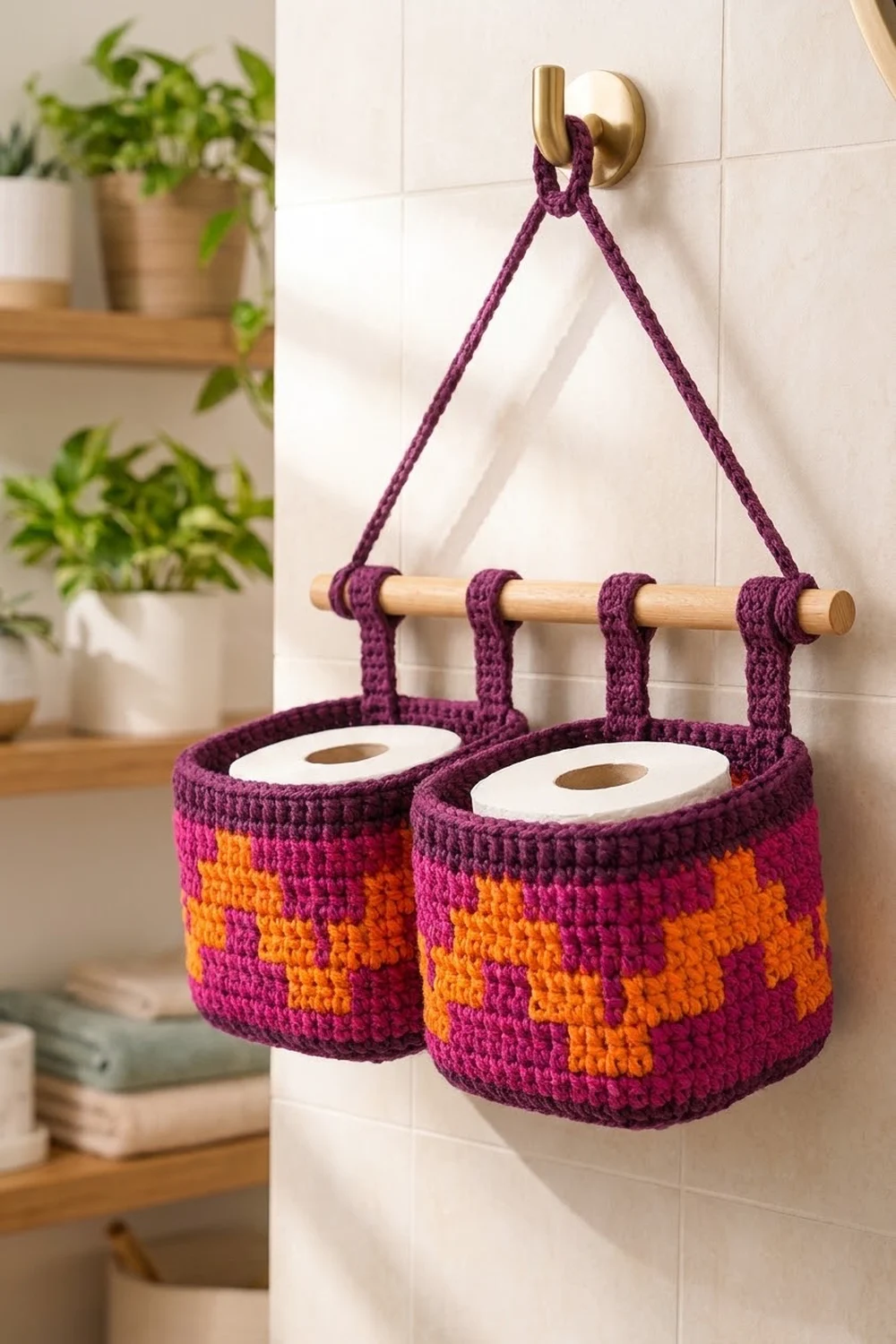
This double hanging basket adds bold color to a small bathroom and keeps spare toilet rolls within reach. Two rounded-square baskets hang side by side from a wooden dowel. Each has a stepped orange zigzag on a bright magenta wall, with deep plum bands at the top and bottom.
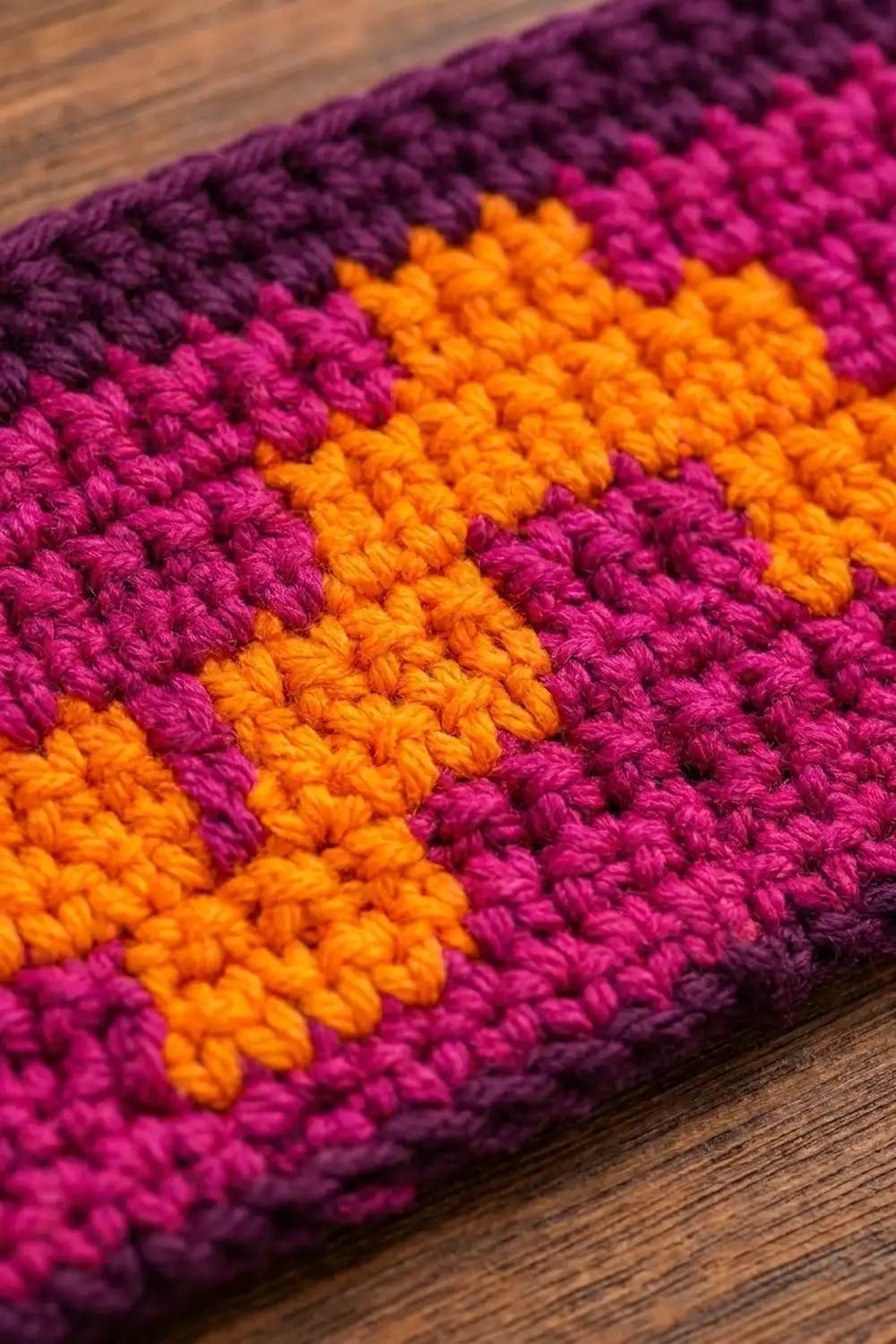
The colors are warm and saturated: dark plum, hot magenta, and vivid orange. The fabric is dense single crochet tapestry, so the walls hold their shape and you can read the motif from across the room.
The pattern uses US crochet terms. Each finished basket measures 6 in (15.2 cm) square at the base and about 5 in (12.7 cm) tall. The hanging set is 16 in (40.6 cm) wide at the dowel.
You build each basket from three parts. First you crochet a solid plum base in joined rounds and a flat tapestry wall panel in rows. Then you seam the panel into a tube, join it to the base with a plum ridge, and add a two-round rim. Four plum tabs and a crocheted triangular cord connect the two baskets into one hanging unit.
Finished Size and Construction
- Finished size (one basket): 6 x 6 in (15.2 x 15.2 cm) base, about 5 in (12.7 cm) tall
- Assembled width: 16 in (40.6 cm) at the dowel
- Skill level: Intermediate (tapestry crochet, seaming)
- Terminology: US
- Yarn weight: Worsted (Category 4) cotton
- Hook: 4.0 mm (G-6)
- Number of pieces: 9 crocheted pieces (2 bases, 2 wall panels, 4 tabs, 1 cord) plus 1 dowel
- Layout: 2 baskets side by side, 1 in (2.5 cm) apart
- Piece size: base 6 x 6 in (15.2 x 15.2 cm); wall panel 24 x 4.4 in (61.0 x 11.2 cm)
- Size before rim: 6 x 6 x 4.6 in (15.2 x 15.2 x 11.7 cm)
- Rim depth: 0.4 in (1.0 cm)
Materials
Use a smooth, firm worsted-weight cotton or cotton blend. Cotton holds the basket shape, handles bathroom humidity, and shows the tapestry steps crisply. Avoid fuzzy or very stretchy yarns; they blur the zigzag and let the walls sag.
- Color A, dark plum: 200 g (360 m)
- Color B, magenta: 150 g (270 m)
- Color C, orange: 100 g (180 m)
These amounts assume a cotton of about 90 m per 50 g. They include a margin of roughly 10 percent for swatching and for the carried strands in the tapestry rows.
Tools
- 4.0 mm (G-6) crochet hook
- Tapestry needle
- 4 stitch markers
- Wooden dowel, 1/2 in (1.3 cm) diameter, 16 in (40.6 cm) long
- Measuring tape and scissors
- Clips or pins for seaming
Abbreviations (US Terms)
- ch: chain
- sc: single crochet
- sl st: slip stitch
- st(s): stitch(es)
- sk: skip
- sp: space
- rnd: round
- RS / WS: right side / wrong side
- rev sc: reverse single crochet (crab stitch)
Tapestry color change: Work the last sc before a color change until 2 loops remain on the hook. Drop the old color and pull the new color through both loops. Lay the unused color along the tops of the next stitches and work over it so it stays hidden.
Reverse single crochet: Working from left to right (if you crochet right-handed), insert the hook into the next stitch to the right, yarn over, pull up a loop, yarn over, and pull through both loops.
Gauge and Checkpoints
Gauge: 16 sc and 18 rows = 4 in (10.2 cm) in firm single crochet.
Make one complete base before anything else and use it as your gauge swatch. Each side should work out to 4 sts per inch.
- After Rnd 4 (32 sts, 8 per side): about 2 in (5.1 cm) across
- After Rnd 8 (64 sts, 16 per side): about 4 in (10.2 cm) across
- After Rnd 12 (96 sts, 24 per side): 6 in (15.2 cm) across, within 1/4 in (0.6 cm)
- Wall panel after Row 10: about 2.2 in (5.6 cm) tall
- Wall panel after Row 20: 24 in (61.0 cm) long, about 4.4 in (11.2 cm) tall
If the base is too big, go down half a hook size. If it’s too small, go up half a size. Don’t change the stitch counts. The base and wall fit together only because both have 96 stitches.
Base (Make 2)
Use Color A and work joined rounds with the RS facing. The ch-1 at the start of each round doesn’t count as a stitch. Put a marker in the center stitch of each 3-sc corner group, and move the markers up every round.
Rnd 1: Make a magic ring, ch 1, work 8 sc in the ring, and join with a sl st to the first sc. (8 sts)
Rnd 2: Ch 1, [sc in next st, 3 sc in next st] 4 times, join. (16 sts; 4 per side)
Rnd 3: Ch 1, [sc in each st to the marked corner st, 3 sc in corner st] 4 times, sc in each remaining st, join. (24 sts)
Rnds 4–12: Repeat Rnd 3. Each round adds 8 sts, 2 at each corner.
Round totals: Rnd 4: 32. Rnd 5: 40. Rnd 6: 48. Rnd 7: 56. Rnd 8: 64. Rnd 9: 72. Rnd 10: 80. Rnd 11: 88. Rnd 12: 96.
In this pattern, one side = 24 sts: 23 side stitches plus one corner center stitch, with each corner counted only once. Four sides x 24 = 96. Leave the corner markers in place. Fasten off and weave in the end. The corners will round off softly once you attach the wall.
Wall Panel (Make 2)
You work the panel flat in rows. Chain 1 and turn at the end of every row; the turning chain doesn’t count as a stitch. Rows 1–2 and 19–20 are plain Color A. Rows 3–4 and 17–18 are plain Color B. Rows 5–16 are the zigzag, worked as six 16-st repeats across the row.
Foundation: With Color A, ch 97.
Row 1 (RS): Sc in 2nd ch from hook and in each ch across. (96 sts)
Row 2: Sc across. (96 sts) Change to Color B on the last stitch.
Rows 3–4: With Color B, sc across. (96 sts) On the last stitch of Row 4, pick up Color C and start carrying it.
Zigzag Rows 5–16: Every row is 96 sts: six repeats of the 16-st sequence below. B is magenta and C is orange. The rows come in pairs: work each sequence on two rows in a row. On RS rows, work the sequence as written. On WS rows, work it in reverse order so the zigzag lines up with the row below.
- Rows 5–6: 2 C, 14 B (orange 12, magenta 84)
- Rows 7–8: 4 C, 10 B, 2 C (orange 36, magenta 60)
- Rows 9–10: 2 B, 4 C, 6 B, 4 C (orange 48, magenta 48)
- Rows 11–12: 4 B, 4 C, 2 B, 4 C, 2 B (orange 48, magenta 48)
- Rows 13–14: 6 B, 6 C, 4 B (orange 36, magenta 60)
- Rows 15–16: 8 B, 2 C, 6 B (orange 12, magenta 84)
Each repeat steps up and down in blocks 2 sts wide and 2 rows tall, which gives the stair-step zigzag. Its peak sits over stitches 9–10 of the repeat and its valley over stitches 1–2. Because 96 ÷ 16 = 6, the pattern continues unbroken across the seam.
At the end of Row 16, cut Color C and leave a 6 in (15.2 cm) tail.
Rows 17–18: With Color B, sc across. (96 sts) Change to Color A on the last stitch.
Rows 19–20: With Color A, sc across. (96 sts)
Fasten off. Leave a 20 in (50.8 cm) Color A tail for seaming.
Tabs (Make 4)
Foundation: With Color A, ch 6.
Row 1: Sc in 2nd ch from hook and in each ch across. (5 sts)
Rows 2–16: Sc across. (5 sts)
Row 17 (slot): Sc 1, ch 3, sk 3 sts, sc 1. (2 sc + ch-3 sp)
Row 18: Sc 1, 3 sc in ch-3 sp, sc 1. (5 sts)
Rows 19–20: Sc across. (5 sts)
Each tab measures 1.25 x 4.4 in (3.2 x 11.2 cm). The slot is 0.75 in (1.9 cm) wide, so the 1/2 in (1.3 cm) dowel slides through easily. Leave a 12 in (30.5 cm) tail for sewing.
Hanging Cord (Make 1)
With Color A, chain until the chain measures 48 in (121.9 cm). Sl st into the back bump of each chain back to the start. This makes a firm, flat cord that won’t stretch. Fasten off.
Make All Pieces
- Color A: 2 bases, 4 tabs, 1 cord, plus plum rows on both panels
- Colors A, B, C: 2 wall panels
- Not crocheted: 1 dowel
Layout as seen from the front:
      o            <- cord apex loop
     / \
    /   \
 X=[T]=[T]===[T]=[T]=X   <- dowel, 16 in (40.6 cm); X = cord knots
   |  BASKET 1 | | BASKET 2 |
   |  6 in     | |  6 in    |
   1.5 in | 6 in | 1 in | 6 in | 1.5 in
Joining
Step 1: close the wall. Fold the panel in half with RS together so the short ends line up row for row. Use the Color A tail to whipstitch the 20 rows together, matching the colors at each row. Turn the tube RS out.
Step 2: attach the base. Hold the base inside the bottom edge of the tube with the WS of both pieces together. Line up the panel seam with one corner marker on the base. With Color A, join through the corner stitch and the foundation chain of the panel. Ch 1, then sc through one base stitch and one foundation chain at a time all the way around. Join. (96 sts; 24 per side)
This joining is strictly one to one: 96 base stitches to 96 panel chains, with nothing added at the seam. Each base side of 24 sts lines up with exactly 24 panel stitches, which is 1.5 zigzag repeats per side. The joining round leaves a raised plum ridge around the bottom of the basket.
Keep your tension the same as the base. If you work this round too tightly, the bottom pulls in; if it’s too loose, the corners flare.
Size checkpoint: before you add the rim, the basket should measure 6 x 6 x 4.6 in (15.2 x 15.2 x 11.7 cm).
Border (Rim)
Rim gauge is the same as the body: 4 sts per inch. That keeps the top edge at a 24 in (61.0 cm) circumference, matching the base.
Rnd 1: With RS facing and Color A, join at the panel seam. Ch 1, sc in each st of Row 20 around. Join. (96 sts; 24 per side)
Rnd 2: Ch 1, rev sc in each st around. Join. (96 sts; 24 per side)
Fasten off and weave in the end.
Why the math works: The rim adds no stitches, so all four layers have the same count. Base Rnd 12, the panel width, the joining round, and both rim rounds each have 96 sts, or 4 x 24. At 4 sts per inch, 24 sts per side gives a 6 in (15.2 cm) side every time. Together, Rows 19–20 and the two rim rounds make the thick plum band at the top, about 0.8 in (2.0 cm) deep.
Final Blocking
- Lightly mist each basket with water inside and out.
- Stuff it firmly with a towel or put a 6 in (15.2 cm) square box inside.
- Push the corners out gently so they form soft, even curves.
- Line up the zigzag rows so they run straight around the basket.
- Pat the rim into an even round, rope-like edge.
- Let it dry completely, about 24 hours.
- Block the tabs flat with pins and let them dry.
Assembly
- On the back wall of each basket, place the tabs over stitches 4–8 and 17–21 of that 24-st side, with the slot end up.
- Overlap the bottom 1 in (2.5 cm) of each tab, about Rows 1–4, onto the rim and upper wall. Sew all the way around the overlapped part.
- Slide the dowel through all four slots. Leave a 1 in (2.5 cm) gap between the baskets and 1.5 in (3.8 cm) of dowel free at each end.
- Fold the cord in half and tie an overhand knot 1 in (2.5 cm) from the fold to form the top loop.
- Tie each cord end around one dowel end with a double knot. Lay the remaining cord along the dowel between the two knots and sew the ends together.
Final Quality-Control Checklist
- Each base has 96 sts, 24 per side, and measures 6 in (15.2 cm).
- Each panel has 20 rows and 96 sts, with 6 complete zigzag repeats.
- The zigzag continues across the side seam.
- No carried strands show on the RS.
- The joining round has 96 sts, with the seam at a corner.
- Both rim rounds have 96 sts.
- The tabs are sewn level and evenly spaced.
- The cord knots are tight and the dowel is level.
Troubleshooting
- Orange shows through magenta: Keep the carried strand flat and tension it gently. Hold both strands toward the back on WS rows.
- Wall leans inward: The joining round is too tight. Redo it with a hook half a size larger.
- Pattern breaks at the seam: Count your repeats. Each row must be exactly 96 sts.
- Base cups or ruffles: Check that each round has exactly 3 sc in each corner and 8 more sts than the round before.
- Basket sags when filled: Use a firmer cotton or a smaller hook to get a denser fabric.
- Rim flares: Work the reverse sc more tightly.
Care
Hand wash in cool water and lay flat to dry, reshaping over a box. Take the dowel out before washing.
Final Notes
The measurements all follow from one gauge. At 4 sts per inch, the 96-stitch base is 24 in (61.0 cm) around. The 96-stitch panel is the same length, the joining round and both rim rounds keep the 96 sts, and each side stays at 24 sts, or 6 in (15.2 cm). Get the gauge right on the first base and everything else will fit.
Happy crocheting!