

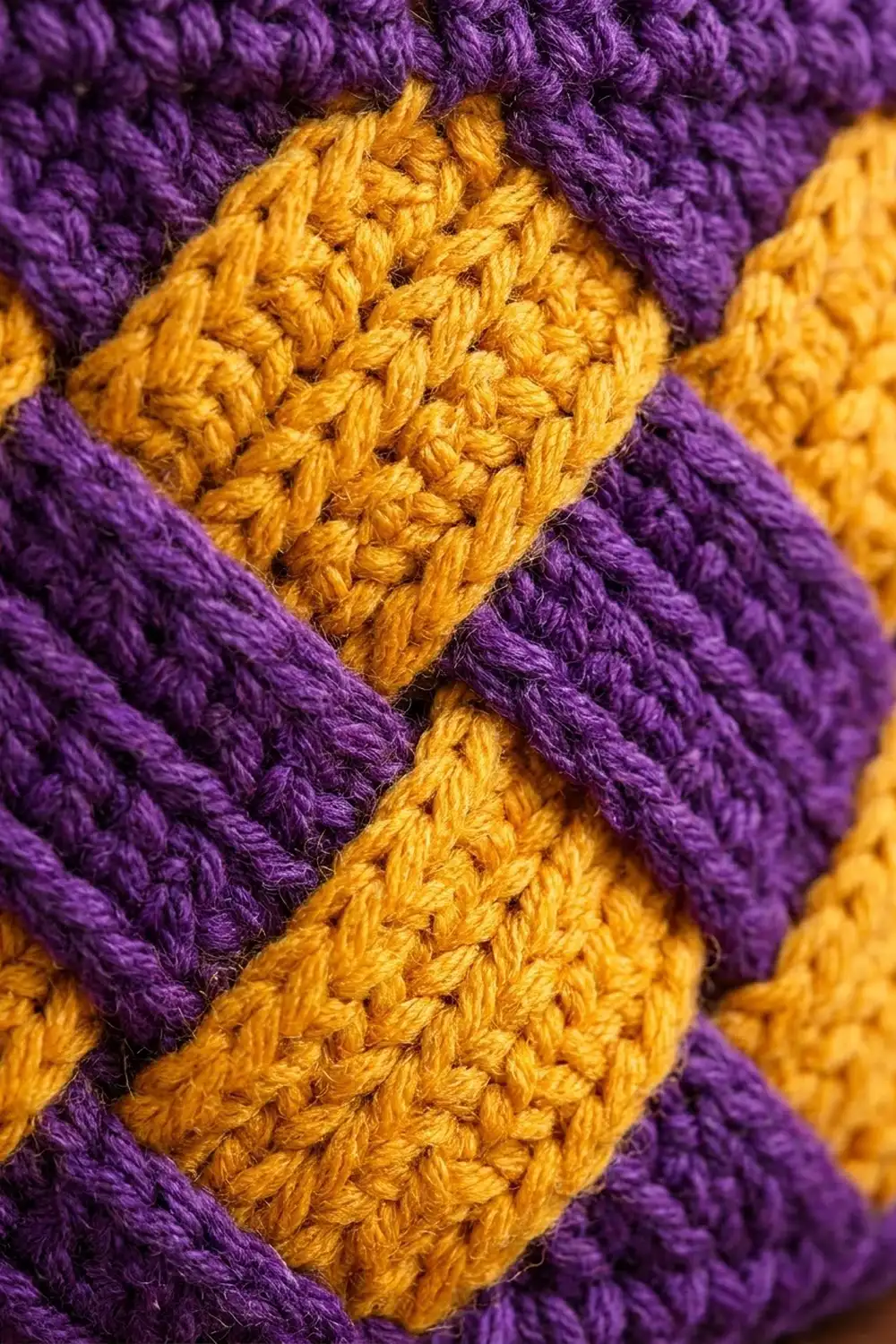
The Royal Weave Hanging Basket looks woven, but it is crocheted from start to finish. Deep purple and warm golden-yellow blocks lean in opposite directions to form a diagonal basket-weave check. The woven section sits between a solid purple oval base and a plain purple rim. Two purple straps with gold D-rings let the basket hang from wall hooks.
The basket holds two standard toilet rolls side by side, so it works well in a bathroom. It is just as useful for small towels, toiletries, or craft supplies. All stitches use US crochet terms.
The finished basket measures about 10 in (25.4 cm) long, 5.25 in (13.3 cm) deep, and 6 in (15.2 cm) tall. The straps add about 5.25 in (13.3 cm) of hanging length above the rim.
You make four pieces: a single crochet oval base, a flat woven panel in Tunisian entrelac, and two straps. You seam the panel into a ring, add a purple bottom band, and join it to the base. A purple top band finishes the rim, and two small tabs hold the D-rings.
Finished Size and Construction
- Finished size: 10 in (25.4 cm) long x 5.25 in (13.3 cm) deep x 6 in (15.2 cm) tall
- Skill level: Intermediate
- Terminology: US crochet terms
- Yarn weight: Worsted (#4)
- Hook: 5.0 mm (H-8) standard hook for every piece
- Number of pieces: 4 (1 base, 1 woven panel, 2 straps)
- Layout: oval base topped by a panel ring with 13 diagonal sections around it
- Piece size: base 9.75 in x 5 in (24.8 cm x 12.7 cm); panel 26 in x 4 in (66.0 cm x 10.2 cm)
- Size before border: walls about 4.9 in (12.4 cm) tall, including the bottom band
- Border depth: top band 1.1 in (2.8 cm)
Materials
Choose a smooth, firm worsted yarn. Cotton or a cotton blend holds its shape best. Acrylic also works, but the walls will be slightly softer. Avoid fuzzy yarns, which blur the woven blocks.
- Purple: 100 g / 183 m (base, panel base and top triangles, Tier 2, bands, straps, tabs)
- Golden yellow: 50 g / 92 m (Tiers 1 and 3 of the panel)
The quantities include a margin of about 20 percent.
Tools:
– 5.0 mm (H-8) crochet hook
– 2 gold D-rings, 1 in (2.5 cm) inside width
– 2 wall hooks, with screws and wall anchors
– Stitch markers
– Tapestry needle
– Scissors and a measuring tape
Abbreviations (US Terms)
- ch – chain
- sl st – slip stitch
- sc – single crochet
- st(s) – stitch(es)
- rnd – round
- yo – yarn over
- RS / WS – right side / wrong side
- Tss – Tunisian simple stitch: insert the hook from right to left under the next front vertical bar, yo, and pull up a loop. Leave the loop on the hook.
- Return pass – yo and pull through 1 loop, then [yo, pull through 2 loops] until 1 loop remains.
- Tss2tog – insert the hook under the next 2 vertical bars together, yo, and pull up a loop.
- Bind-off – [insert the hook under the next vertical bar, yo, pull through the bar and the loop on the hook] 5 times, then sl st into the next anchor stitch. This gives every triangle and block a top edge of 6 stitches.
One Tunisian “row” means one forward pass plus one return pass.
Gauge and Checkpoints
- Single crochet: 16 sc and 18 rows = 4 in (10.2 cm), worked firmly
- Entrelac block: 6 loops x 6 rows = 1.4 in (3.6 cm) square, about 2 in (5.1 cm) across the diagonal
Make the base first and use it as your gauge test.
- After Rnd 6: about 7.5 in (19.1 cm) long x 2.75 in (7.0 cm) wide
- After Rnd 11: 9.75 in (24.8 cm) long x 5 in (12.7 cm) wide, 104 sts
- After panel Tier 1: about 2 in (5.1 cm) tall
- Finished panel: 26 in (66.0 cm) long x 4 in (10.2 cm) tall
If your pieces come out too big, go down 0.5 mm. If they come out too small, go up 0.5 mm. Match the block size closely. If each block is off by 0.1 in (0.3 cm), the ring will be off by more than 1.5 in (3.8 cm).
Oval Base (Purple)
Ch 22.
Rnd 1: Sc in 2nd ch from hook, sc in next 19 ch, 3 sc in last ch. Working along the underside of the chain, sc in next 19 ch, 2 sc in the same ch as the first sc. Join to the first sc with a sl st. (44 sts: 19 on each straight side + 3 at each end)
Work the remaining rounds in a spiral without joining. Move a marker to the first st of each round.
Rnd 2: 2 sc in first st, sc in next 19, 2 sc in each of next 3, sc in next 19, 2 sc in each of last 2. (50 sts)
Rnds 3–11: [Sc in next X sts, 2 sc in next st] once, sc in next 19, [sc in next X sts, 2 sc in next st] 3 times, sc in next 19, [sc in next X sts, 2 sc in next st] 2 times. X is 1 on Rnd 3 and grows by 1 each round, so X is 9 on Rnd 11.
Each round adds 3 sts at each curved end, 6 sts in total:
- Rnd 3: 56 sts
- Rnd 4: 62 sts
- Rnd 5: 68 sts
- Rnd 6: 74 sts
- Rnd 7: 80 sts
- Rnd 8: 86 sts
- Rnd 9: 92 sts
- Rnd 10: 98 sts
- Rnd 11: 104 sts
Sl st in the next st and fasten off. You now have 19 sts on each straight side and 33 sts around each curved end (19 + 33 + 19 + 33 = 104).
Woven Panel (Tunisian Entrelac)
The panel is worked flat. It has 13 base triangles, three tiers of blocks, and 13 top triangles. The tiers change color and lean in alternating directions, which creates the woven look. Turn the work at the end of each tier.
Base Triangles (Purple)
Ch 79 loosely. This gives 13 sections of 6 ch plus 1 turning ch.
First triangle:
– Row 1: Pull up a loop in 2nd ch from hook (2 loops), then work a return pass.
– Rows 2–5: Tss in each bar, then pull up a loop in the next ch. You gain 1 loop per row (3, 4, 5, 6 loops). Work a return pass.
– Row 6: Tss in each bar (6 loops), then work a return pass.
– Bind off, using the next ch as the anchor stitch.
Triangles 2–13: With the loop already on the hook, Row 1: pull up a loop in the next ch (2 loops), then work a return pass. Work Rows 2–6 and the bind-off as for the first triangle.
Each triangle uses 6 ch: 5 for picking up and 1 as the anchor. 13 x 6 = 78 ch, plus 1 turning ch = 79. Fasten off purple.
Tier 1 (Yellow): Side Triangle, 12 Blocks, Side Triangle
Start side triangle: Join yellow at the panel edge, ch 2.
– Row 1: Pull up a loop in 2nd ch from hook (2 loops), then work a return pass.
– Rows 2–5: Tss in the edge bar to increase, then Tss across. For the last loop, insert the hook under the last bar and through the next bound-off st of the base triangle, and pull up a loop (3, 4, 5, 6 loops). Work a return pass.
– Bind off, anchoring into the last bound-off st.
Block (make 12):
– Setup row: With the loop on the hook, pick up 5 loops evenly along the 6 row-ends of the piece below (6 loops). Work a return pass.
– Rows 1–5: Tss in next 4 bars. Insert the hook under the last bar and through the next bound-off st of the neighboring piece, and pull up a loop (6 loops). Work a return pass.
– Bind off, anchoring into the 6th bound-off st.
Each block uses all 6 sts of its neighbor’s bound-off edge: 5 joins plus 1 anchor.
End side triangle: Pick up 5 loops along the row-ends of the last base triangle (6 loops), then work a return pass. Rows 1–5: Tss2tog at the inner edge, then Tss across (5, 4, 3, 2, 1 loops). Work a return pass. Fasten off.
Tier 2 (Purple): 13 Blocks
Work 13 blocks exactly as in Tier 1, picking up along each yellow piece and joining into the next one. These blocks lean the opposite way and form the purple strands of the weave. Fasten off.
Tier 3 (Yellow)
Repeat Tier 1: start side triangle, 12 blocks, end side triangle.
Top Triangles (Purple)
Work 13 triangles. For each one:
– Setup row: Pick up 5 loops along the row-ends (6 loops), then work a return pass.
– Rows 1–5: Tss2tog, Tss across, and join the last loop into the next bound-off st of the neighbor (5, 4, 3, 2, 1 loops). Work a return pass.
– Sl st into the 6th bound-off st.
The top edge is now straight. Fasten off. After a light steam, the panel measures 26 in x 4 in (66.0 cm x 10.2 cm).
Straps (Make 2, Purple)
Ch 6.
– Row 1: Sc in 2nd ch from hook and in each ch across. (5 sc)
– Rows 2–36: Ch 1, turn, sc in each st. (5 sc)
Fasten off. Each strap measures 1.25 in x 8 in (3.2 cm x 20.3 cm).
Wrap one end of each strap around the straight bar of a D-ring. Fold it over by 0.75 in (1.9 cm) and sew it down. Fold the other end over by 2 in (5.1 cm) and sew across the tip only. This leaves a 1 in (2.5 cm) hanging loop.
Make All Pieces
- Purple: 1 base; the base triangles, Tier 2, and top triangles of the panel; 2 straps
- Yellow: Tiers 1 and 3 of the panel
Assembly layout, from the top of the basket down:
[ strap ]                 [ strap ]
[D-ring ]                 [D-ring ]
[  tab  ]                 [  tab  ]
| top band, 5 rnds, 104 sts         |
| top triangles x 13       purple   |
| Tier 3: side + 12 + side  yellow  |
| Tier 2: 13 blocks        purple   |
| Tier 1: side + 12 + side  yellow  |
| base triangles x 13      purple   |
| bottom band, 3 rnds, 104 sts      |
| joining rnd, 104 sts              |
(        oval base, 104 sts         )
Joining
Seam the ring: Hold the two short edges of the panel RS together. Each edge is 4 in (10.2 cm) tall. Sl st through the matching row-ends, one to one. Keep the seam loose so it stretches like the rest of the fabric. Turn the ring RS out.
Bottom band: Join purple at the seam along the edge of the base triangles.
– Rnd 1: Work 8 sc evenly across each of the 13 base-triangle sections. (104 sc)
– Rnds 2–3: Sc in each st. (104 sc)
Join the base: Line up the panel seam with the center of one long straight side of the base. That side becomes the back. Hold the base and the band WS together, with the base facing you. Sc through both layers all the way around, one band st to one base st. (104 sc) Fasten off.
Because 104 band sts meet 104 base sts one to one, the join will not gather or ruffle. Keep your tension even, the same as in the base. The walls should now stand about 4.9 in (12.4 cm) tall.
Border (Top Band, Purple)
Border gauge: 4 sc and 4.5 rnds per 1 in (2.5 cm).
- Rnd 1: Join at the seam. Work 8 sc evenly across the top edge of each of the 13 top triangles. (104 sc: 52 on the front half, 52 on the back half)
- Rnds 2–5: Sc in each st. (104 sc)
Join with a sl st and fasten off. The band is 1.1 in (2.8 cm) deep.
Tabs: Center the two tabs on the back wall, 24 sts (6 in, 15.2 cm) apart. For each tab, join purple on the inside of Rnd 5 and sc in 5 sts. Work 7 more rows of 5 sc, for 8 rows in total. Pass the tab through a strap’s D-ring, fold it to the inside, and sew it down.
Why the math works: each top triangle spans 2 in (5.1 cm). At 4 sc per inch, that is 8 sc per section, and 13 x 8 = 104. This matches base Rnd 11 and the panel’s 26 in (66.0 cm) length (26 x 4 = 104).
Final Blocking
- Weave in all ends through stitches of the same color.
- Stuff the basket firmly with towels to set the oval shape.
- Steam the woven section lightly, holding the iron 1 in (2.5 cm) above the fabric. Never press acrylic.
- Pat the blocks into even diamonds and straighten the band lines.
- Pin the straps flat at 8 in (20.3 cm).
- Let everything dry completely, for at least 12 hours.
Final Quality-Control Checklist
- The base lies flat and measures 9.75 in x 5 in (24.8 cm x 12.7 cm).
- The bottom band, joining round, and top band each have 104 sts.
- The blocks alternate cleanly: yellow leans one way and purple leans the other.
- The ring seam sits at center back.
- The rim is level at 6 in (15.2 cm) all the way around.
- The tabs are 6 in (15.2 cm) apart and securely sewn.
- Both hanging loops are the same size.
Troubleshooting
- The panel curls: Tunisian stitches curl naturally. Keep your return passes relaxed and steam the panel.
- The ring is shorter than 26 in (66.0 cm): The foundation chain was too tight. Chain it again with a 6.0 mm hook.
- The base cups: Your stitches are too tight. Use a larger hook for Rnds 6–11.
- The base ruffles: Your stitches are too loose. Go down one hook size.
- There are gaps at block joins: Insert the hook through both loops of each bound-off stitch.
- The basket tilts when hung: Make the two hanging loops the same size.
Care
Hand wash in cool water. Reshape the basket around a rolled towel and let it dry flat. Do not tumble dry.

Final Notes
Every measurement in this pattern builds on the one before it. The 16-sc gauge produces a base of 104 sts. Thirteen entrelac sections, each 2 in (5.1 cm) wide, make a 26 in (66.0 cm) panel that matches the base. Eight sc per section give each band 104 sts, so the bands join the base one stitch to one stitch. If you check these numbers at each stage, your basket will hang straight and keep its shape.
Happy crocheting!