
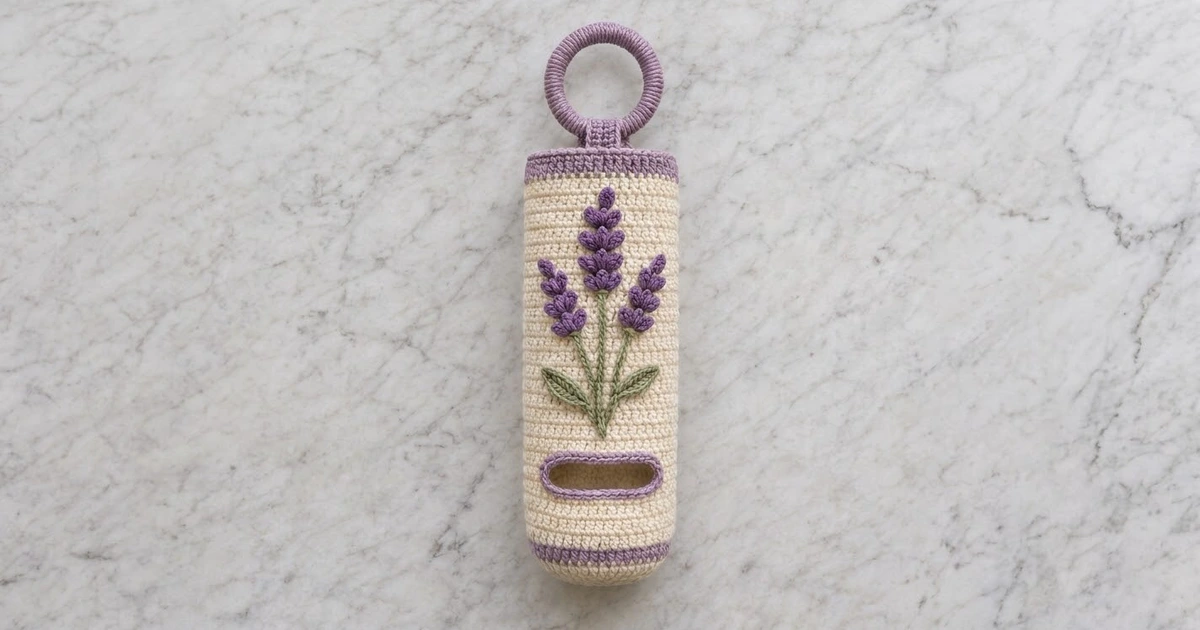
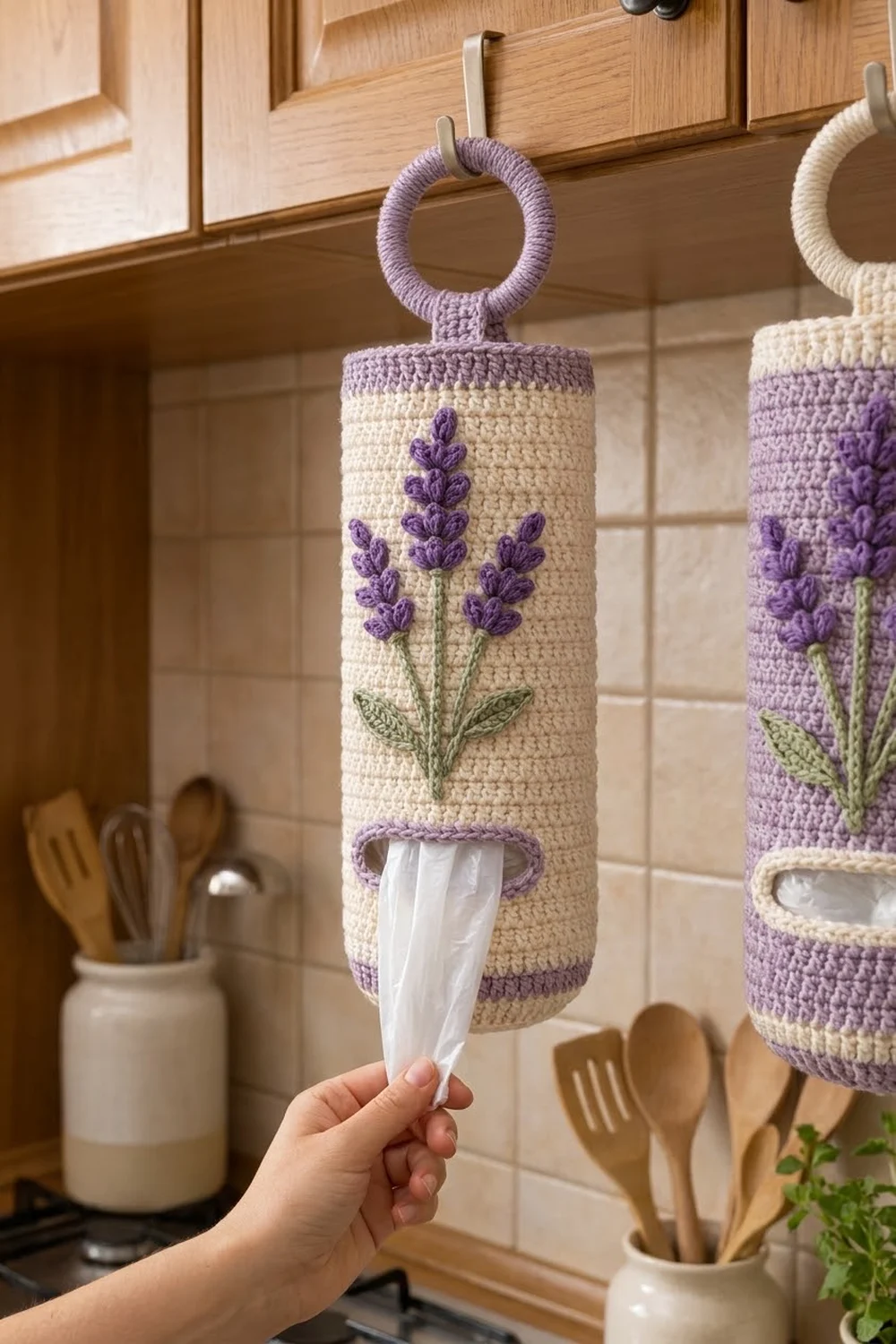
This plastic bag holder is a tall cream tube with soft lavender trim and a raised bouquet of three lavender sprigs on the front. You stuff bags in through the open top and pull them out through a wide oval slot near the bottom. A covered ring and a short tab let it hang from a cabinet knob or hook.
The holder uses four colors. The body is cream. Light heather lavender is used for the top band, the stripe near the base, the slot edging, the tab and the ring cover. Deep violet makes the bobbled flower spikes, and sage green makes the stems and leaves. The style is calm and French-country.
This pattern uses US crochet terms. Laid flat, the finished holder measures 6.5 in (16.5 cm) wide and 16 in (40.6 cm) tall, not counting the ring. With the tab and ring it hangs about 20 in (50.8 cm) long.
You crochet an oval base, then work the body in joined rounds of single crochet. The slot is made with a few turned rows and a closing chain. Then you add the top band and slot edging, and finally sew on the ring, tab and appliqués.
Finished Size and Construction
- Finished size: 6.5 in (16.5 cm) wide flat x 16 in (40.6 cm) tall; about 20 in (50.8 cm) with the ring
- Skill level: Intermediate
- Terminology: US
- Yarn weight: Worsted (#4)
- Hooks: 5.0 mm (H-8) for the body; 4.0 mm (G-6) for the appliqués
- Number of pieces: 1 body, 1 tab, 1 covered ring, 3 flower spikes, 3 stems, 2 leaves
- Layout: One holder, with the bouquet centered on the front above the slot
- Body circumference: 52 sts = 13 in (33.0 cm)
- Size before top band: 6.5 in (16.5 cm) x 15.3 in (38.9 cm)
- Top band depth: 3 rounds = 0.7 in (1.8 cm)
Materials
Use a smooth worsted cotton or cotton blend. Cotton holds its shape, so the tube won’t sag when it’s full of bags. Acrylic also works but stretches more.
- Cream (body): 120 g / 220 m
- Light lavender (band, stripe, slot edge, tab, ring): 40 g / 70 m
- Deep violet (flower spikes): 20 g / 35 m
- Sage green (stems, leaves): 15 g / 25 m
These quantities include about 20 percent extra for swatching and for differences between yarns.
Tools:
- 5.0 mm (H-8) and 4.0 mm (G-6) crochet hooks
- One 3 in (7.6 cm) plastic or metal ring
- Stitch markers
- Tapestry needle
- Pins
- Measuring tape
Abbreviations (US Terms)
- ch: chain
- sl st: slip stitch
- sc: single crochet
- hdc: half double crochet
- dc: double crochet
- BLO: back loop only
- inc: 2 sc in the same st
- st(s): stitch(es)
- RS / WS: right side / wrong side
Mini bobble (mb): Yarn over, insert the hook in the st, yarn over and pull up a loop, then yarn over and pull through 2 loops. Repeat 2 more times in the same st (4 loops on hook). Yarn over, pull through all 4 loops, then ch 1 to close.
Gauge and Checkpoints
Gauge: 16 sc and 18 rounds = 4 in (10.2 cm) with the 5.0 mm hook, worked in the round.
Use the base as your test piece. Measure it after Rnd 5, before you start the long body.
Checkpoints:
- After Rnd 5 (base): about 5 x 2.5 in (12.7 x 6.4 cm), lying flat
- After Rnd 15: 2.2 in (5.6 cm) of body height and 6.5 in (16.5 cm) flattened width
- After Rnd 20: the slot is 4.5 in (11.4 cm) wide x 0.9 in (2.3 cm) tall
- After Rnd 41: 8 in (20.3 cm) of body height
- After Rnd 74: 15.3 in (38.9 cm) of body height
If it’s too big: Go down to a 4.5 mm hook. Don’t change the stitch count, because the slot placement depends on 52 sts.
If it’s too small: Go up to a 5.5 mm hook.
If only the height is off, add or remove plain cream rounds between Rnd 22 and Rnd 74. Each 4.5 rounds changes the height by 1 in (2.5 cm).
Body
Work in joined rounds. Each round starts with ch 1, which does not count as a st, and ends with a sl st to the first sc. Keep the RS facing out unless the pattern tells you to turn.
Oval Base
With the 5.0 mm hook and cream, ch 14.
Rnd 1: Sc in the 2nd ch from the hook, sc in the next 11 ch, then 3 sc in the last ch. Working along the other side of the chain, sc in the next 11 ch, then 2 sc in the same ch as the first sc. Join. (28 sts)
Rnd 2: Inc in the first st, sc in the next 11, inc in each of the next 3, sc in the next 11, inc in each of the last 2. Join. (34 sts)
Rnd 3: Sc 1, inc, sc in the next 11, (sc 1, inc) 3 times, sc in the next 11, (sc 1, inc) 2 times. Join. (40 sts)
Rnd 4: Sc 2, inc, sc in the next 11, (sc 2, inc) 3 times, sc in the next 11, (sc 2, inc) 2 times. Join. (46 sts)
Rnd 5: Sc 3, inc, sc in the next 11, (sc 3, inc) 3 times, sc in the next 11, (sc 3, inc) 2 times. Join. (52 sts)
Each round adds 6 sts, 3 at each curved end. That rate suits this gauge, so the base lies flat. The two straight runs of 11 sc are the long sides. The first run (sts 6–16) is the front.
Lower Body and Stripe
Rnd 6: Sc in the BLO of each st around. Join. (52 sts) This round makes a crisp fold where the base turns up into the wall.
Rnds 7–9: Sc in each st around. (52 sts)
Rnds 10–11: Change to light lavender. Sc in each st around. (52 sts)
Rnds 12–15: Change to cream. Sc in each st around. (52 sts) Fasten off the cream.
Bag Slot
The slot sits over sts 3–20 of Rnd 15, centered on the front long side.
Row 16 (RS): Join cream with a standing sc in the 21st st of Rnd 15. Sc in the next 31 sts to the end of the round, then sc in the first 2 sts of the round. (34 sc) Leave sts 3–20 unworked. Turn.
Rows 17–19: Ch 1, sc in each st across, turn. (34 sc)
When Row 19 is done, the WS is facing you and you are at the edge of the slot. Turn so the RS faces you.
Rnd 20: Ch 1, sc in each of the 34 sts, ch 18, then join with a sl st to the first sc. (34 sc + 18 ch = 52) The ch-18 forms the top edge of the slot.
Rnd 21: Sc in each sc and in each ch. Join. (52 sts)
Upper Body
Rnds 22–74: Sc in each st around. (52 sts) Fasten off the cream after Rnd 74.
Counting from Rnd 6, the body is now 69 rounds tall, which is 15.3 in (38.9 cm).
Hanging Tab and Ring
Ring cover: With light lavender and the 5.0 mm hook, attach the yarn to the ring with a sl st. Work sc over the ring, packing the sts tightly, until the ring is fully covered (about 56–60 sc). Join and fasten off. Turn the sts so their tops face the inside of the ring.
Tab: With light lavender, ch 7.
Row 1: Sc in the 2nd ch from the hook and in each ch across. (6 sc)
Rows 2–20: Ch 1, turn, sc in each st across. (6 sc)
The tab measures 1.5 in (3.8 cm) x 4.4 in (11.2 cm). Fasten off, leaving a 12 in (30.5 cm) tail.
Lavender Appliqués
Use the 4.0 mm hook for all the appliqués so they’re firm and stand out from the body. Leave long tails for sewing.
Flower Spikes (Make 3: 1 Large, 2 Small)
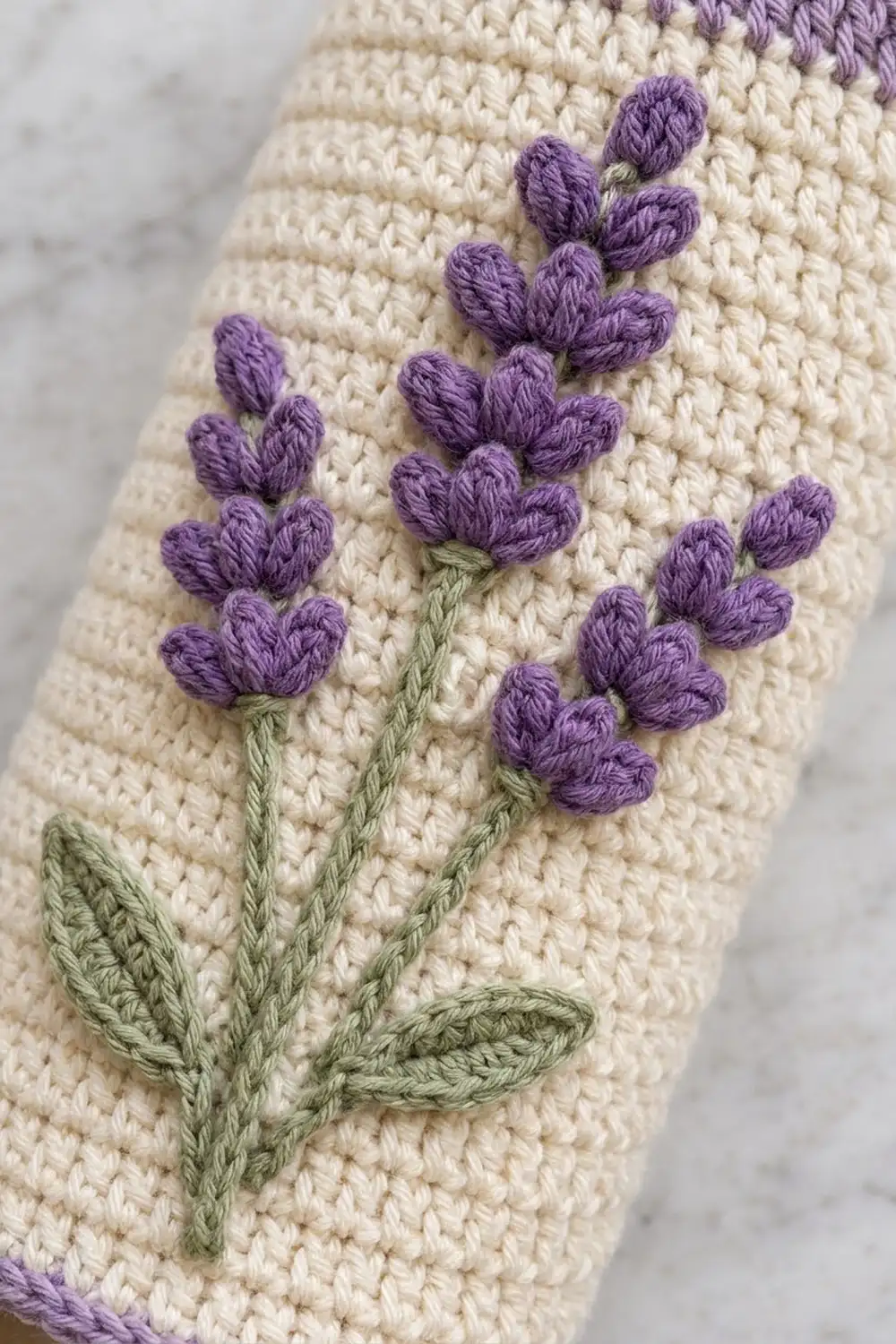
Large spike: With deep violet, ch 10. Mb in the 2nd ch from the hook (this is the tip). (Sl st in the next ch, mb in the same ch) 7 times, then sl st in the last ch. Rotate the piece. Working in the free loops along the other side, (sl st in the next ch, mb in the same ch) 7 times, then sl st in the tip ch. (15 mb) The spike is about 2.5 in (6.4 cm) long.
Small spike (make 2): With deep violet, ch 9. Mb in the 2nd ch from the hook. (Sl st in the next ch, mb in the same ch) 6 times, then sl st in the last ch. Rotate. Along the other side, (sl st in the next ch, mb in the same ch) 6 times, then sl st in the tip ch. (13 mb) Each small spike is about 2.25 in (5.7 cm) long.
The bobbles sit in pairs on both sides of the chain, with a single bobble at the tip. Pinch each spike gently so it narrows to a point.
Stems (Make 3)
Center stem: With sage, ch 36. Sl st in the back bump of the 2nd ch from the hook and in each ch across. (35 sl st) The stem is about 6.5 in (16.5 cm) long.
Side stems (make 2): With sage, ch 31. Sl st in the back bump of the 2nd ch from the hook and in each ch across. (30 sl st) Each side stem is about 5.5 in (14.0 cm) long.
Leaves (Make 2)
With sage, ch 9.
Rnd 1: Sl st in the 2nd ch from the hook, sc in the next ch, hdc in the next ch, dc in the next 2 ch, hdc in the next ch, sc in the next ch, then 3 sc in the last ch. Working along the other side of the chain: sc in the next ch, hdc in the next ch, dc in the next 2 ch, hdc in the next ch, sc in the next ch, then sl st in the last ch. (17 sts)
Tip: Ch 2, sl st in the 2nd ch from the hook, then sl st in the first sl st. Fasten off.
Each leaf is 2 in (5.1 cm) long and 0.75 in (1.9 cm) wide.
Placing the Bouquet
- Flatten the holder with the slot centered on the front.
- Pin the center stem straight up the middle, with its bottom end 1 in (2.5 cm) above the top of the slot.
- Pin the two side stems so they start from the same point and fan outward at about 20 degrees.
- Sew a spike to the top of each stem, putting the large spike on the center stem.
- Pin one leaf on each side of the stem base, angled up and out.
- Whipstitch around each piece with its own tail. Sew through the front wall only so you don’t stitch the tube closed.
The top of the center spike should end about 2.2 in (5.6 cm) below the top band.
Top Band and Slot Edging
This holder doesn’t have a flat border. Its edgings are the top band and the slot edging, both in light lavender. They use the same gauge as the body: 4 sc per 1 in (2.5 cm).
Top Band
Rnds 75–77: Join light lavender where the rounds begin. Sc in each st around. (52 sts per round = 26 sts per flattened side) Join, and fasten off after Rnd 77.
Why it works: The band has the same stitch count and gauge as the body, so it stays 13 in (33.0 cm) around and doesn’t flare or pucker. Its 3 rounds add 0.7 in (1.8 cm), taking the height from 15.3 in (38.9 cm) to 16 in (40.6 cm).
Slot Edging
With the RS facing, join light lavender in the first unworked st of Rnd 15 along the bottom of the slot.
Rnd 1: Sc in each of the 18 unworked sts along the bottom. Work 4 sc up the side, 1 in each row end. Work 18 sc into the underside of the ch-18 along the top, then 4 sc down the other side. Join. (18 + 4 + 18 + 4 = 44 sc)
Why it works: Each long edge gets exactly 1 sc per stitch, so the slot stays 4.5 in (11.4 cm) wide. Each short edge gets 1 sc per row, so the ends curve into a smooth oval without bunching.
Attaching the Tab
Fold the tab around the bottom of the covered ring. Place one end on the outside of the back wall and the other end on the inside, centered over the top band and overlapping it by 1 in (2.5 cm). Backstitch through all the layers twice, because this seam carries the full weight.
Final Blocking
- Weave in all the ends, hiding each one in stitches of the same color.
- Mist the holder until it is damp but not soaked.
- Put a rolled towel inside to shape the tube.
- Pat the body to 6.5 in (16.5 cm) wide (flattened) and 16 in (40.6 cm) tall.
- Shape the slot into a smooth oval with your fingers.
- Press the appliqués flat and fluff up the bobbles.
- Let it dry completely, standing upright on its base.
Final Quality-Control Checklist
- The base lies flat and the BLO fold is even all the way around.
- Every body round has 52 sts.
- The lavender stripe sits 0.9 in (2.3 cm) above the base fold.
- The slot is centered on the front and is 4.5 in (11.4 cm) wide.
- The slot edging has 44 sc and lies flat.
- The top band is 3 rounds and doesn’t flare.
- The bouquet is centered and sewn through the front wall only.
- The tab is sewn firmly through all its layers.
- The total length with the ring is about 20 in (50.8 cm).
Troubleshooting
The base cups upward: Your increases are too tight. Work Rnds 1–5 with the next hook size up.
The base ruffles: Your tension is loose. Work Rnds 1–5 with the next hook size down.
The join line slants: Always join into the first sc, never into the ch-1. Blocking will straighten a small slant.
There are gaps at the slot corners: Close them with a couple of stitches using the yarn tail.
The bobbles lie flat: Push each bobble out to the RS with a fingertip before you sew the spike on.
The holder sags when full: Use cotton yarn, or add a 4th round to the top band.
Care
Hand wash in cool water and lay flat to dry, reshaping the tube while it’s damp. Take off a metal ring before washing.
Final Notes
Each stage of this pattern sets up the next one. The 5-round base gives 52 sts, which is 13 in (33.0 cm) around. Rnd 6 turns the base up into the wall, and 69 body rounds bring the holder to 15.3 in (38.9 cm). Leaving 18 sts unworked makes a 4.5 in (11.4 cm) slot. The 3-round band brings the height to 16 in (40.6 cm), and the tab and ring add about 4 in (10.2 cm) for hanging.
Happy crocheting!