

The Ivory Lattice Diamond Table Runner is a light, airy runner made from small lace diamonds joined point to point. Each diamond has an open center ring and four tall petals that point to the four tips. A solid single crochet frame runs around the edge, with a small chain loop at every tip. Where four diamonds meet, a diamond-shaped window opens up, so the whole runner reads as a clean lattice.
The runner is worked in one color, soft ivory cotton, which keeps the look calm and classic. It suits a farmhouse table, a wedding setting or a simple everyday centerpiece. A plump tassel hangs from each point at both short ends.
This pattern uses US crochet terms. After the border, the finished runner measures 15.5 x 40.5 inches (39.4 x 102.9 cm), not counting the tassels.
Construction is simple. You crochet one complete motif, then join each new motif on its last round, so there is no sewing. The 24 motifs sit in a grid 3 wide and 8 long, set on point. One border round evens the tension around the outside, and six tassels finish the ends.
Finished Size and Construction
- Finished size: 15.5 x 40.5 in (39.4 x 102.9 cm), not counting tassels
- Skill level: Easy intermediate
- Terminology: US crochet terms
- Yarn weight: Worsted weight (#4) cotton
- Hook: 5 mm (H-8)
- Number of pieces: 24 identical diamond motifs
- Layout: 3 motifs wide x 8 motifs long, set on point, joined tip to tip
- Motif size: 3.25 in (8.3 cm) per side; 5 in (12.7 cm) tip to tip, including tip loops
- Size before border: 15 x 40 in (38.1 x 101.6 cm)
- Border depth: 0.25 in (0.6 cm) per edge
- Tassels: 6, each 4 in (10.2 cm) long
Materials
Choose a smooth mercerized or combed worsted weight cotton. Cotton keeps the diamond edges crisp and washes well. Avoid fuzzy or very stretchy yarns, because the open lattice can sag.
- Ivory (main color): 250 g, about 425 m (465 yd), for example five 50 g balls of about 85 m (93 yd) each
Approximate yarn use: motifs about 144 g (240 m), border about 12 g (23 m), tassels about 20 g (39 m). The listed amount includes a margin of about 40% for gauge differences and tassel trimming.
Tools:
- 5 mm (H-8) crochet hook
- Tapestry needle
- Scissors
- Stitch marker
- Stiff card 4.25 in (10.8 cm) tall, for tassels
- Rust-proof pins, blocking mats and a spray bottle
Abbreviations (US Terms)
- ch – chain
- sl st – slip stitch
- sc – single crochet
- dc – double crochet
- tr – treble crochet
- sp – space
- sk – skip
- beg – beginning
- rep – repeat
Special stitch – petal gap: “Between 2nd and 3rd tr” means putting the hook into the space between the posts of the 2nd and 3rd tr of a 4-tr petal, below the top loops, not into a stitch top.
Joining loop: On a joined tip, replace the ch 4 with: ch 2, sl st into the matching ch-4 loop of the finished motif, ch 2.
Gauge and Checkpoints
Gauge is measured on one motif. Make a test motif first, block it lightly and measure it before you go on.
- After Rnd 1: about 1.5 in (3.8 cm) across
- After Rnd 2: about 3 in (7.6 cm) from one petal tip to the opposite petal tip
- After Rnd 3: about 4.25 in (10.8 cm) tip to tip, including ch-5 loops
- After Rnd 4: 3.25 in (8.3 cm) per straight side; 5 in (12.7 cm) tip to tip, including tip loops
If your motif is larger than 5 in (12.7 cm) tip to tip, go down one hook size. If it is smaller, go up one hook size. Being off by only 0.25 in (0.6 cm) per motif adds up to 2 in (5.1 cm) over the 8-motif length, so this check matters.
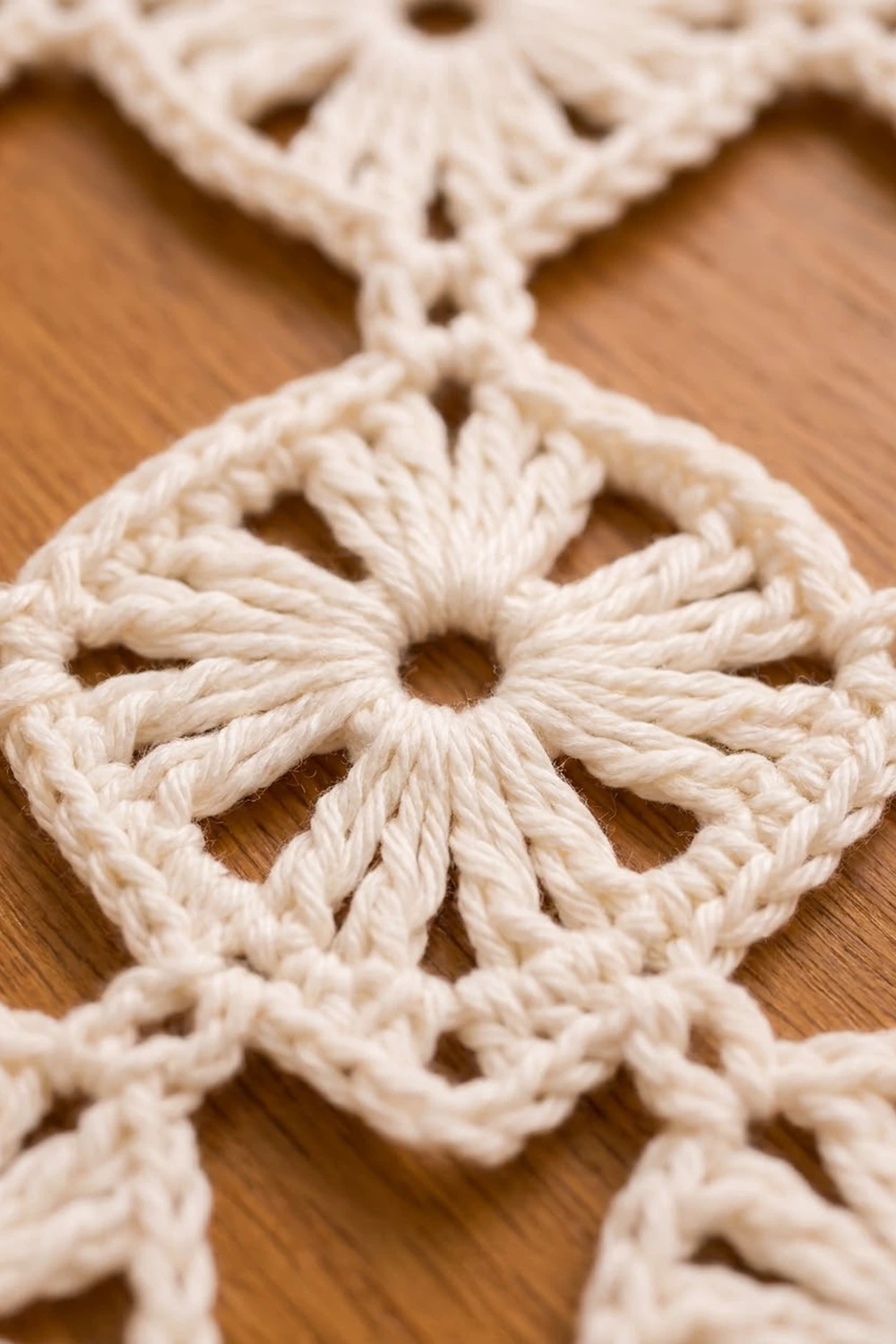
Diamond Motif
Work the motif in joined rounds with the right side facing. The tips are named for where they sit when the finished motif is on point: top, left, bottom, right.
Rnd 1: Ch 6, sl st in first ch to form a ring. Ch 3 (counts as dc), 15 dc in ring, sl st in top of beg ch-3. (16 dc)
The chain ring stays open, which makes the visible hole in the center.
Rnd 2 (petals): Ch 4 (counts as tr), tr in same st, 2 tr in next st, ch 3, sk next 2 sts. 2 tr in next st, 2 tr in next st, ch 3, sk next 2 sts; rep from * 2 more times. Sl st in top of beg ch-4. (16 tr in 4 petals of 4 tr; 4 ch-3 sps)*
Each petal is a fan of 4 tr worked over 2 stitches. Each petal will point to one tip.
Rnd 3 (tips and windows): Sl st in next tr, then sl st in the gap between the 2nd and 3rd tr of this petal. Ch 3 (counts as dc), dc in same gap, ch 5, 2 dc in same gap, ch 3, sc in next ch-3 sp, ch 3. (2 dc, ch 5, 2 dc) between 2nd and 3rd tr of next petal, ch 3, sc in next ch-3 sp, ch 3; rep from * 2 more times. Sl st in top of beg ch-3. (16 dc, 4 sc, 4 ch-5 tip sps, 8 ch-3 sps)*
The ch-3 spans leave small open gaps between the petals and the frame. Place a marker in the first ch-5 sp. This is the top tip.
Rnd 4 (frame): Sl st in next dc, sl st in ch-5 sp. Ch 1, (2 sc, ch 4, 2 sc) in same sp, sc in next 2 dc, 3 sc in next ch-3 sp, sc in next sc, 3 sc in next ch-3 sp, sc in next 2 dc. (2 sc, ch 4, 2 sc) in next ch-5 sp, sc in next 2 dc, 3 sc in next ch-3 sp, sc in next sc, 3 sc in next ch-3 sp, sc in next 2 dc; rep from * 2 more times. Sl st in first sc. Fasten off. (60 sc, 4 ch-4 tip loops)*
Per-side count: Each straight side between two tip loops has 2 + 2 + 3 + 1 + 3 + 2 + 2 = 15 sc. This count already includes the 2 sc on each side of the tip loops, and they are not counted again anywhere else. Four sides x 15 sc = 60 sc, which matches the round total.
Working counterclockwise from the marker, the tips come in this order: top, left, bottom, right.
Make All Pieces
You need 24 motifs, all in ivory. Make motif 1 in full. Join motifs 2 to 24 on Rnd 4.
Layout grid (each D is one diamond, numbered in working order):
 D1   D2   D3
 D4   D5   D6
 D7   D8   D9
D10  D11  D12
D13  D14  D15
D16  D17  D18
D19  D20  D21
D22  D23  D24
Each D touches its neighbors only at its tips. Its right tip joins the next motif’s left tip, and its bottom tip joins the top tip of the motif below.
Joining
Use join-as-you-go on Rnd 4. Work Rnds 1 to 3 of the new motif as usual. On Rnd 4, when you reach a tip that needs to join, work the joining loop instead of the ch 4:
(2 sc, ch 2, sl st in ch-4 loop of finished motif, ch 2, 2 sc) in ch-5 sp.
The ch 2 + sl st + ch 2 takes the place of the ch 4, so the stitch counts don’t change. Each motif still has 60 sc, 4 tip loops and 15 sc per side.
Which tips to join:
- Motifs 2 and 3: join the left tip to the right tip of the motif before.
- Motifs 4, 7, 10, 13, 16, 19, 22: join the top tip to the bottom tip of the motif above.
- All other motifs: join the top tip to the motif above, then the left tip to the motif on the left.
Rnd 4 starts at the top tip and works counterclockwise. That means the top tip is joined first and the left tip comes next, so you never need to break the yarn and rejoin.
Tension: Make the joining chains at the same tension as a regular ch 4. Tight joins pull the tips inward and pucker the windows. Loose joins make the lattice droop.
Size checkpoint: Two joined motifs should measure 10 in (25.4 cm) tip to tip. The first full row of 3 motifs should measure 15 in (38.1 cm) wide. When all 24 are joined, the runner should measure 15 x 40 in (38.1 x 101.6 cm) before the border.
Border
Border gauge: 15 sc per 3.25 in (8.3 cm) side, about 4.6 sc per inch (1.8 sc per cm). The border keeps this gauge, so it follows the zigzag outline without ruffling or pulling in.
The outer edge is a zigzag of motif sides, with three kinds of spots:
- Outer sides: straight motif sides that face outward (15 sc each)
- Peaks: free ch-4 tip loops that point outward
- Valleys: joined tip loops between two edge motifs
Number of outer sides: 4 corner motifs x 3 sides + 12 middle motifs on the long edges x 2 sides + 2 middle motifs on the short ends x 2 sides = 12 + 24 + 4 = 40 sides.
Border Rnd 1: Join yarn in the ch-4 loop at the top tip of D1. Ch 1. Working all the way around the runner:
- In each peak: (sc, ch 3, sc)
- In each outer-side sc: sc
- In each valley: 1 sc through the joined loop pair
Sl st in first sc. Fasten off.
Counts per edge:
- Each long edge (left or right), from the first corner peak through the last corner peak: 14 outer sides x 15 sc = 210 sc, plus 8 peaks x 2 sc = 16 sc, plus 7 valleys x 1 sc = 7 sc. Total 233 sc and 8 ch-3 picots.
- Each short end (top or bottom), the stitches not already counted on the long edges: 3 motifs x 2 sides x 15 sc = 90 sc, plus 3 peaks x 2 sc = 6 sc, plus 2 valleys x 1 sc = 2 sc. Total 98 sc and 3 ch-3 picots.
Round total: 233 + 233 + 98 + 98 = 662 sc and 22 ch-3 picots.
Why the math works: Each long edge counts 14 sides, not 16, because the side of each corner motif that runs toward the short end is counted only once, in the short-end total. Check: 14 + 14 + 6 + 6 = 40 outer sides, and 40 x 15 sc = 600 sc. Add 22 peaks x 2 sc = 44 sc and 18 valleys x 1 sc = 18 sc: 600 + 44 + 18 = 662 sc. Every outer-side stitch gets exactly one sc, so the edge doesn’t grow, and the picots add only 0.25 in (0.6 cm) per edge.
Tassels
Make 6 tassels. Wrap yarn 30 times around the 4.25 in (10.8 cm) card. Tie the top with a 12 in (30.5 cm) strand, then cut the loops at the bottom. Wrap a neck 0.75 in (1.9 cm) below the top and trim the tassel to 4 in (10.2 cm). Tie one tassel to the ch-3 picot on each of the 3 top peaks and each of the 3 bottom peaks.
Final Blocking
- Weave in all ends along the sc frames, never across the open windows.
- Soak the runner in cool water for 10 minutes, then roll it in a towel to press out the water. Do not wring.
- Lay it flat on blocking mats, right side up.
- Pin the 4 outer corners to 15.5 x 40.5 in (39.4 x 102.9 cm).
- Pin every peak and valley so each side is straight and each window is an even diamond.
- Put a pin through each center ring to keep it round.
- Let it dry completely, at least 24 hours.
- Unpin, then comb out the tassels and trim them again to 4 in (10.2 cm).
Final Quality-Control Checklist
- All 24 motifs have 60 sc and 4 tip loops
- Every side has 15 sc
- Center rings are open and round
- Each joining loop sits right at the tip, with no twists
- All windows are matching diamonds
- The border has 662 sc and 22 picots
- The runner measures 15.5 x 40.5 in (39.4 x 102.9 cm)
- All six tassels are the same length and firmly tied
- No loose ends show on the right side
Troubleshooting
- Petals curl forward: Your tr are too tight. Loosen your tension, or go up one hook size for Rnd 2 only.
- Center hole closes up: Chain more loosely for the starting ring, or use ch 7 for the ring.
- Motif sides bow inward: Check that each ch-3 sp in Rnd 4 has 3 sc, not 2.
- Runner is too long: Your motifs are bigger than 5 in (12.7 cm). If the difference is small, go down one hook size for the motifs you haven’t made yet. If it is large, remake them.
- Border ruffles: You worked extra sc in the valleys. Use exactly 1 sc per valley.
- Tassels look thin: Add 5 to 10 more wraps.
Care
Hand wash in cool water with mild soap and dry flat, pinning again if needed. If you want to press it, use a warm iron through a cloth and keep it away from the tassels.

Final Notes
The whole runner depends on one chain of measurements. A 3.25 in (8.3 cm) side with 15 sc gives a 5 in (12.7 cm) motif. Three motifs give 15 in (38.1 cm) of width, and eight give 40 in (101.6 cm) of length. One border round adds 0.25 in (0.6 cm) per edge, for a finished runner of 15.5 x 40.5 in (39.4 x 102.9 cm). Measure your first motif carefully, and the rest will fall into place.
Happy crocheting!