

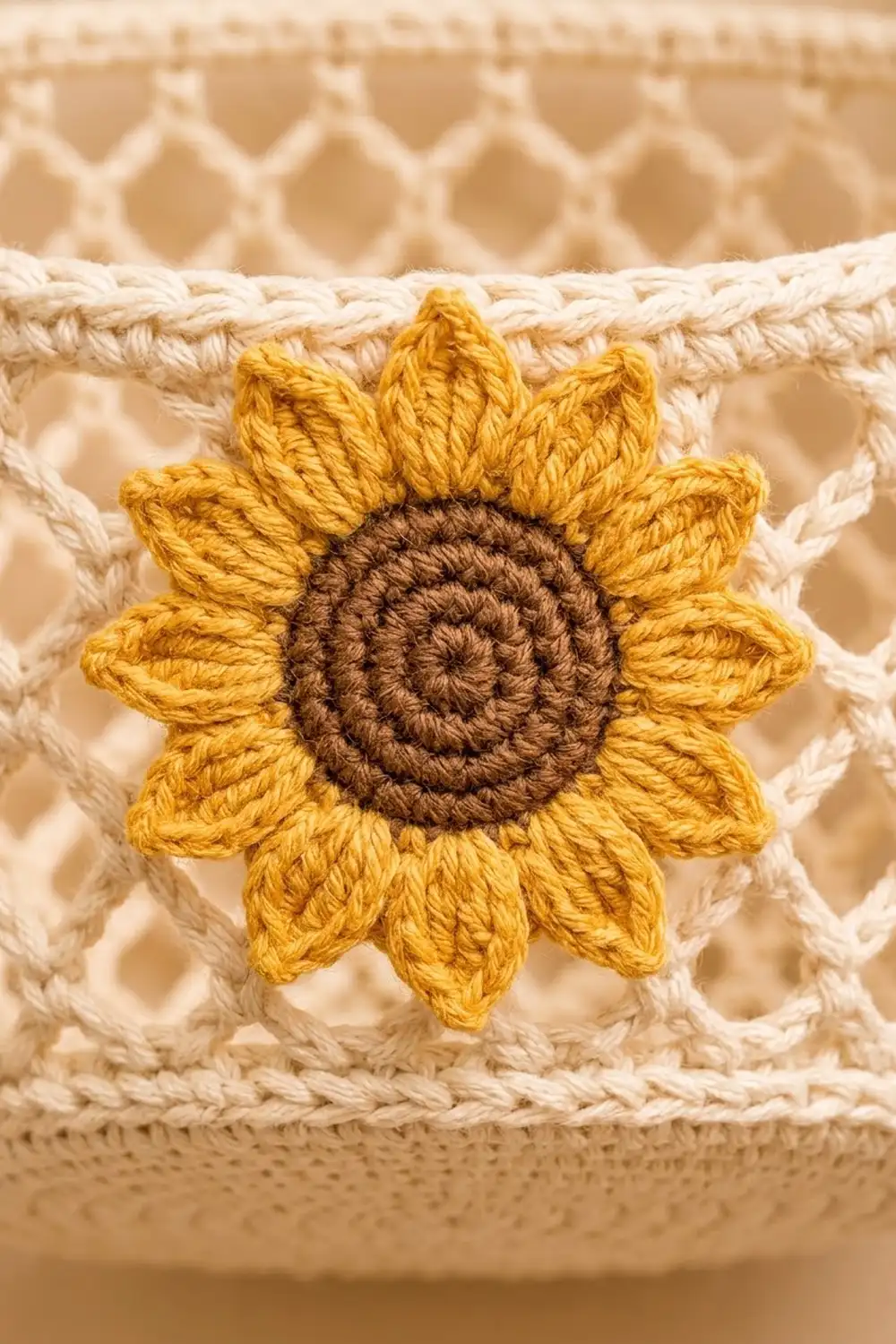
This hanging organizer has three round, deep pockets stacked down a wall. Each one has a solid base, airy diamond-mesh sides and a chunky corded rim. A golden sunflower on the front of each pocket brightens the soft ivory cotton.
The palette is simple: ivory for the structure, warm golden yellow for the petals and brown for the flower centers. The style is light farmhouse with a little boho. It works well in a bathroom for rolled towels, soaps, brushes and bottles.
The pattern uses US crochet terms. The finished organizer is about 11.6 in (29.5 cm) wide and 18 in (45.7 cm) from dowel to bottom. Including the hanging band, it’s about 25 in (63.5 cm) tall. Each pocket is 8 in (20.3 cm) in diameter and 5 in (12.7 cm) deep.
Construction is simple. Each pocket starts as a flat circle in joined rounds. A back-loop round turns the edge upward, mesh rounds build the walls, and dense rounds form the rim. You then make two straps, sew them to the sides of the pockets, wrap the straps over a dowel and add a hanging band. Finally, sew a sunflower to each pocket.
Finished Size and Construction
- Finished size: 11.6 in (29.5 cm) wide × 18 in (45.7 cm) below the dowel; about 25 in (63.5 cm) with the hanging band
- Skill level: Intermediate
- Terminology: US
- Yarn weight: Bulky (#5) cotton or cotton-blend cord
- Hook: 6 mm (J-10)
- Number of pieces: 3 pockets, 2 straps, 1 hanging band, 3 sunflowers
- Layout: 1 column of 3 pockets, with 1 in (2.5 cm) gaps between them
- Piece size: pocket 8 in (20.3 cm) diameter × 5 in (12.7 cm) deep
- Size before rim: pocket walls about 3.75 in (9.5 cm) tall
- Rim depth: about 1.25 in (3.2 cm)
Materials
Choose a firm, smooth bulky cotton or cotton blend. Cotton holds the pocket shape, can handle bathroom humidity and shows the mesh clearly. Avoid very soft or stretchy acrylic, because the pockets will sag under weight.
- Ivory (main): 500 g, about 650 m (711 yd)
- Warm golden yellow (petals): 50 g, about 65 m (71 yd)
- Brown (centers): 20 g, about 26 m (28 yd)
These quantities include a margin of about 15% for gauge swatches and differences in tension.
Tools:
– 6 mm (J-10) crochet hook
– Wooden dowel, 14 in (35.6 cm) long, 0.75 in (1.9 cm) in diameter
– Tapestry needle
– 6 locking stitch markers
– Scissors and a tape measure
– Pins and a blocking mat
– Wall peg or hook
Abbreviations (US Terms)
- ch – chain
- sl st – slip stitch
- sc – single crochet
- hdc – half double crochet
- dc – double crochet
- tr – treble crochet
- BLO / FLO – back loop only / front loop only
- sk – skip
- st(s) – stitch(es)
- rev sc – reverse single crochet
Special stitch – reverse sc (crab stitch): Work sc from left to right (right to left if you crochet left-handed). Insert the hook into the next stitch to the right, yarn over, pull up a loop, yarn over and pull through both loops. This creates the twisted, corded rim.
Front petal: (hdc, dc, ch 2, sl st in 2nd ch from hook, dc, hdc) all in the same st.
Back petal: (dc, tr, ch 2, sl st in 2nd ch from hook, tr, dc) all in the same st.
Gauge and Checkpoints
Gauge: 11 sc and 12 sc rounds = 4 in (10.2 cm), worked firmly.
Make one complete pocket before you start the others. Check these measurements as you go:
- After Round 6 (36 sts): base diameter 4 in (10.2 cm)
- After Round 12 (72 sts): base diameter 8 in (20.3 cm), lying flat
- After Round 18 (last mesh round): wall height about 3.75 in (9.5 cm)
- After Round 22 (rim done): total depth 5 in (12.7 cm)
If your base is too big, go down 0.5 mm in hook size. If it’s too small, go up 0.5 mm. If the base ruffles, you’re working too tightly; if it cups, you’re working too loosely. Fix the flat base first, because the wall stitch count depends on it.
Pocket (Make 3)
Use ivory. Join each round with a sl st to the first sc. The ch 1 at the start of each round doesn’t count as a stitch.
Base
Round 1: Make a magic ring. Ch 1, work 6 sc in the ring, join. (6 sts)
Round 2: Ch 1, 2 sc in each st, join. (12 sts)
Round 3: Ch 1, sc in next st, 2 sc in next st; repeat from * 6 times total, join. (18 sts)
Round 4: Ch 1, sc in next 2 sts, 2 sc in next st; repeat 6 times, join. (24 sts)
Round 5: Ch 1, sc in next 3 sts, 2 sc in next st; repeat 6 times, join. (30 sts)
Round 6: Ch 1, sc in next 4 sts, 2 sc in next st; repeat 6 times, join. (36 sts)
Checkpoint: the base should be 4 in (10.2 cm) across.
Rounds 7–12: Keep increasing 6 sts per round, working one more sc between increases each round. Round 7 has 42 sts, Round 8 has 48, Round 9 has 54, Round 10 has 60, Round 11 has 66 and Round 12 has 72.
Checkpoint: the base should be 8 in (20.3 cm) across and lie flat. Its circumference is about 25.1 in (63.8 cm).
Walls
Round 13 (turning round): Ch 1, sc in BLO of each st, join. (72 sts) The unused front loops form a neat ridge, and the edge begins to stand up.
Round 14: Ch 1, sc in each st, join. (72 sts)
Round 15 (mesh set-up): Ch 1, sc in first st, ch 5, sk 3 sts, sc in next st; repeat from * 17 times. Then ch 2, sk 3 sts and dc in the first sc. The ch 2 plus dc forms the 18th loop and leaves your hook at the top center of that loop. (18 loops: 72 sts ÷ 4 = 18)
Rounds 16–18: Ch 1, sc in the same loop (the one formed by the ch 2 and dc). Ch 5, sc in next ch-5 loop; repeat from * 17 times. Ch 2, dc in the first sc. (18 loops each round)
The loops in each round stagger over the loops of the round below, creating the diamond trellis. Checkpoint: the walls should be about 3.75 in (9.5 cm) tall.
Rim
See the Border section below for Rounds 19–22. Work them on each pocket before you fasten off.
Make All Pieces
Totals:
– Ivory: 3 pockets, 2 straps, 1 hanging band
– Brown: 3 sunflower centers
– Golden yellow: 3 sets of front and back petals
Strap (Make 2)
Use ivory. Ch 6.
Row 1: Sc in 2nd ch from hook and in each ch across, turn. (5 sts)
Rows 2–63: Ch 1, sc in each st across, turn. (5 sts)
The strap should be 1.8 in (4.6 cm) wide and 21 in (53.3 cm) long. Don’t fasten off yet; the strap edging is in the Border section.
Hanging Band (Make 1)
Use ivory. Ch 4. Sc in 2nd ch from hook and across (3 sts). Work 54 rows of sc in total, which gives 18 in (45.7 cm). Fasten off and leave a 12 in (30.5 cm) tail.
Sunflower (Make 3)
Round 1: Using brown, make a magic ring. Ch 1, work 8 sc in the ring, join. (8 sts)
Round 2: Ch 1, 2 sc in each st, join. (16 sts)
Round 3: Ch 1, sc in next st, 2 sc in next st; repeat 8 times, join. (24 sts) Fasten off brown. The center should measure 2 in (5.1 cm).
Round 4 (front petals): Join golden yellow in the FLO of any st. Sl st in FLO of that st, then work 1 front petal in FLO of the next st; repeat 12 times. Join. (12 petals)
Round 5 (back petals): Fold the front petals forward. Join golden yellow in the BLO of a st that holds a front petal. Work 1 back petal in that BLO, then sl st in BLO of the next st; repeat 12 times. Join and fasten off. (12 petals)
Each back petal sits directly behind a front petal, but it’s longer and wider, so it shows as a second layer. Work the back petals into the sl-st loops instead if you want them offset between the front petals. The finished flower is about 4 in (10.2 cm) across.
Layout Grid
          /\  hanging band
         /  \
  ==[strap]==dowel==[strap]==
    | S |  Pocket 1  | S |
    | S |  (1 in gap)| S |
    | S |  Pocket 2  | S |
    | S |  (1 in gap)| S |
    | S |  Pocket 3  | S |
Joining
Method: Whipstitch with ivory and a tapestry needle, working through both loops.
Marking the pockets: On each rim, count Round 22 starting at the join. Mark st 18 and st 54. These marks are exactly opposite each other and become the side seams. St 36 is the center front, where the sunflower goes.
Positions on each strap (counted from Row 1 at the bottom):
- Pocket 3: rows 1–15, which is 5 in (12.7 cm)
- Gap: rows 16–18, which is 1 in (2.5 cm)
- Pocket 2: rows 19–33
- Gap: rows 34–36
- Pocket 1: rows 37–51
- Gap below dowel: rows 52–54
- Dowel loop: rows 55–63, which is 3 in (7.6 cm)
Stitch-to-stitch logic: A pocket is 22 rounds deep, and the 5 in (12.7 cm) of wall and base edge match 15 strap rows (3 rows per inch). Hold the strap upright against the outside of the pocket. Center the strap over the marked rim stitch, and line up the strap’s top row for that pocket with the rim. Sew the strap’s center column to the wall, going down through the wall rounds to the Round 13 ridge. Make one stitch per strap row, which gives 15 tacking stitches.
Tension: Pull each stitch snug but not tight. The strap should lie flat with no puckering, and the mesh should stay open.
Dowel: Slide the dowel across the front of the straps at row 54. Wrap rows 55–63 over the dowel to the back, then sew Row 63 to the back of rows 52–54.
Hanging band: Sew each end of the band to the outer face of a strap loop, just above the dowel.
Size checkpoint: The organizer should measure 11.6 in (29.5 cm) from the outer edge of one strap to the outer edge of the other. The pocket is 8 in plus two straps of 1.8 in each. It should hang 18 in (45.7 cm) below the dowel.
Border
This section covers the pocket rims and the strap edging.
Border gauge: 11 sc = 4 in (10.2 cm), the same as the base.
Pocket Rim (Rounds 19–22)
Round 19 (conversion round): Ch 1. Work 2 sc around the post of the dc that closes the final loop. Then work 4 sc in the next ch-5 loop; repeat 17 times. Finish with 2 sc in the first (dc) loop, then join. That’s 2 + (17 × 4) + 2 = 72 sts. The front half (sts 19–54) has 36 sts and the back half has 36 sts.
Rounds 20–21: Ch 1, sc in each st, join. (72 sts)
Round 22: Ch 1, rev sc in each st, join. (72 sts) Fasten off and weave in the ends.
Why the math works: Each mesh loop sits over exactly 4 base stitches. Putting 4 sc back into each loop restores the base’s 72 stitches. That keeps the rim circumference equal to the base circumference, so the walls rise straight instead of flaring out or pulling in.
Strap Edging
With the strap still on your hook, sl st loosely along the side in this order:
- 63 sl st down the first long side (1 per row)
- 5 sl st across the short end
- 63 sl st up the other long side
- 5 sl st across the top
That’s 136 sl st in total. Ch 1 at each corner; the ch doesn’t count. Join and fasten off. The slip stitches give the strap a rope-like edge without adding width.
Final Blocking
- Lightly spray each pocket with water.
- Stuff each pocket firmly with a towel so it holds a cylinder shape 8 in (20.3 cm) across and 5 in (12.7 cm) deep.
- Gently open the mesh diamonds with your fingers so they’re even.
- Pin the sunflowers flat, face down. Pin out the petal tips, then let them dry.
- Pin the straps flat to 1.8 in (4.6 cm) by 21 in (53.3 cm).
- Let everything dry completely before you sew the pieces together.
- Once everything is joined, hang the organizer and straighten the pockets.
Center each sunflower over st 36. The bottom of the brown center should sit on mesh Round 16, and the top petals should overlap the bottom edge of the rim. Sew around the brown center and tack down each back petal tip.
Final Quality-Control Checklist
- Each base lies flat and measures 8 in (20.3 cm).
- Every rim has 72 sts, and its rev sc rope is even.
- Every mesh round has 18 loops.
- Both straps have 63 rows and are 21 in (53.3 cm) long.
- The gaps between pockets match on the left and right.
- The dowel is level, and the pockets hang straight.
- The sunflowers are centered and their petals lie flat.
- All ends are woven in securely.
Troubleshooting
Base ruffles: You’ve added too many stitches or you’re working too tightly. Go up one hook size, and check that Round 12 has 72 sts.
Base cups: Your stitches are too loose. Go down a hook size.
Mesh diamonds are uneven: You may have miscounted the skipped stitches in Round 15. There must be 3 skipped sts between sc.
Pocket flares out: Round 19 needs exactly 4 sc per loop. Recount it.
Pocket sags: Your cotton is too soft. Add a fifth round of sc to the rim.
Organizer hangs crooked: The strap rows don’t line up. Recount the placement rows.
Petals curl: Block them damp and pinned.
Care
Hand wash in cool water with mild soap. Press out the water in a towel, reshape the pockets and let them dry flat, away from direct heat.

Final Notes
The measurements build on each other:
- The gauge of 11 sts per 4 in gives an 8 in (20.3 cm) base of 72 sts.
- The 72 sts divide into 18 mesh loops.
- The rim converts the loops back to 72 sts, keeping the walls straight.
- Each 5 in (12.7 cm) pocket matches 15 strap rows.
- Three pockets plus two 1 in (2.5 cm) gaps hang 18 in (45.7 cm) below the dowel.
If you check each stage against these numbers, the organizer will turn out the right size.
Happy crocheting!