

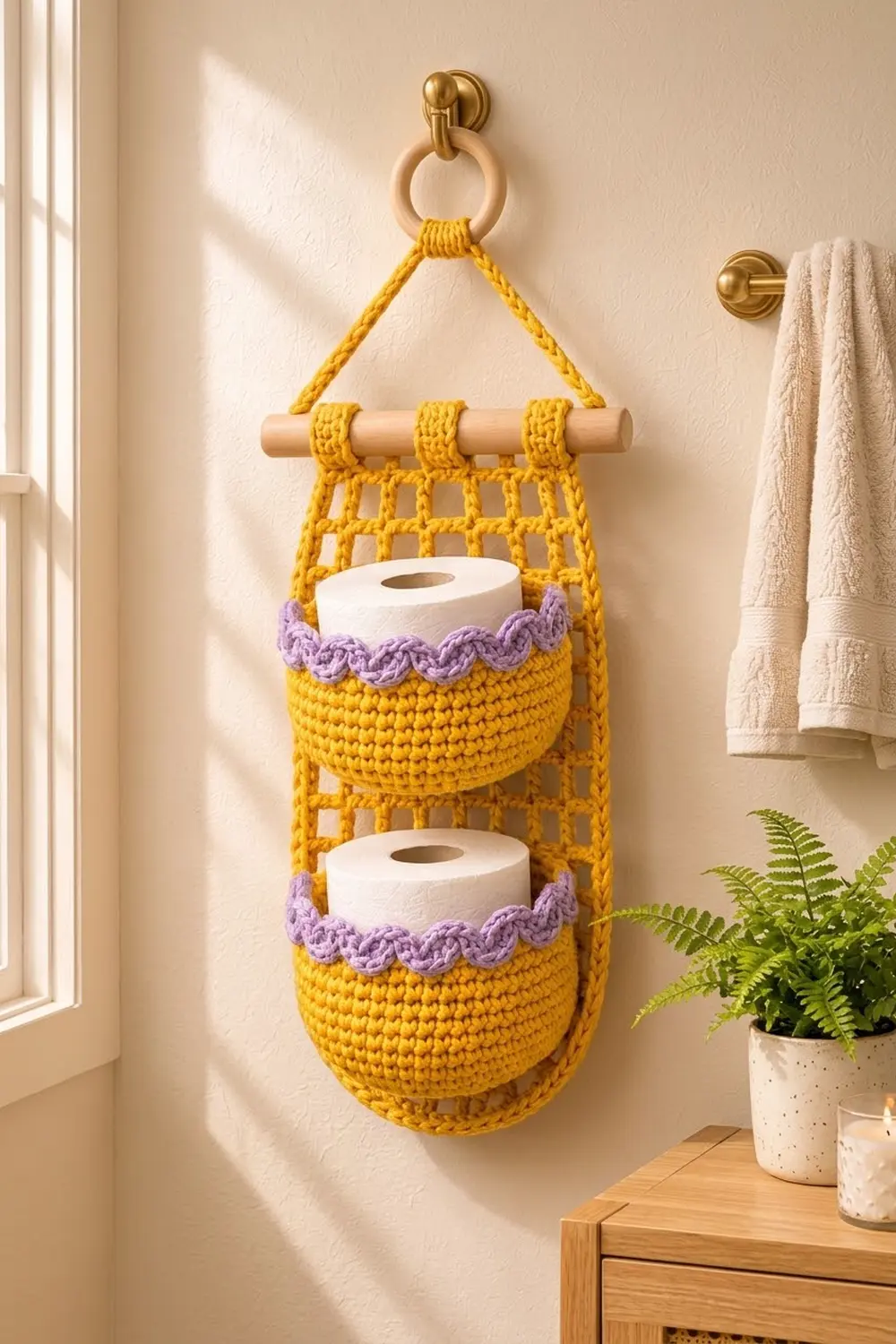
This cheerful organizer keeps two spare rolls off the floor and in easy reach. A light filet mesh panel hangs from a wooden dowel, and two snug single-crochet baskets sit stacked on its front. Each basket has a soft lavender scallop trim at the rim.
The palette is warm mustard yellow with a lavender accent. The style is simple and practical: open grid squares, a rope-textured edging and solid, sturdy cups. It suits a bright bathroom, a guest room or a small apartment where floor space counts.
The pattern uses US crochet terms. The finished panel measures 7¼ in (18.4 cm) wide by 15.4 in (39.1 cm) long. Each basket is 5.1 in (13.0 cm) across and 3.8 in (9.7 cm) tall, trim included.
Construction is straightforward. You work the mesh panel flat from the top down, with short rows at the end that shape the rounded bottom. A two-round border adds the rope edge. Each basket is worked in the round from the center of the base up the wall. Then you sew the tabs, baskets and cord in place.
Finished Size and Construction
- Finished panel size: 7¼ in × 15.4 in (18.4 cm × 39.1 cm)
- Skill level: Intermediate
- Terminology: US
- Yarn weight: Bulky (#5) cotton or cotton blend
- Hook: 6.0 mm (US J-10)
- Number of pieces: 7 (1 mesh panel, 2 baskets, 3 tabs, 1 hanging cord)
- Layout: baskets stacked vertically on one panel
- Basket size: 5.1 in (13.0 cm) diameter × 3.8 in (9.7 cm) tall
- Panel size before border: 6¼ in × 14.4 in (15.9 cm × 36.6 cm)
- Border depth: about 0.5 in (1.3 cm) on every edge
Materials
Choose a firm, smooth bulky cotton or cotton blend, about 137 m per 100 g. Cotton holds its shape under the weight of the rolls and copes well with bathroom humidity. Avoid very fuzzy or stretchy acrylics, because the baskets will sag.
- Color A, Mustard Yellow: 200 g (about 274 m), for the panel, baskets, tabs and cord
- Color B, Lavender: 20 g (about 27 m), for the basket trims
The quantities include a margin of about 15%.
Tools:
– 6.0 mm (US J-10) crochet hook
– Wooden dowel, ¾ in (1.9 cm) thick and 9 in (22.9 cm) long
– Wooden ring, 2 in (5.1 cm) diameter
– Tapestry needle
– Stitch markers
– Scissors
– Measuring tape
– Rust-proof pins and a blocking mat
Abbreviations (US Terms)
- ch: chain
- sl st: slip stitch
- sc: single crochet
- hdc: half double crochet
- dc: double crochet
- BLO: back loop only
- sk: skip
- sp: space
- st(s): stitch(es)
- rev sc: reverse single crochet (crab stitch)
Special stitch, rev sc: Work from left to right (right to left if you are left-handed). Insert the hook into the next stitch to the right, yarn over, pull up a loop, then yarn over and pull through both loops. This makes a twisted, rope-like edge.
Mesh square: one dc post plus ch 2. Each square spans 3 stitches.
Gauge and Checkpoints
Single crochet gauge: 12 sc × 13 rounds = 4 in (10.2 cm).
Mesh gauge: 6 squares (19 sts) = 6¼ in (15.9 cm) wide, and 5 rows = 4 in (10.2 cm). Each mesh row is 0.8 in (2.0 cm) tall.
Make one basket first, because it is the best gauge test. Measure at each of these points:
- After Round 4: the base is 2.5 in (6.4 cm) across.
- After Round 8: the base is 5.1 in (13.0 cm) across, with a circumference of 16 in (40.6 cm).
- After Round 18: the wall is 3.1 in (7.9 cm) tall.
- Panel after Row 5: 6¼ in (15.9 cm) wide and 4 in (10.2 cm) long.
If your pieces come out too big, go down half a hook size. If they come out too small, go up half a size. A standard roll is about 4.5 in (11.4 cm) across, so the basket base must be at least 4.75 in (12.1 cm) across to hold it.
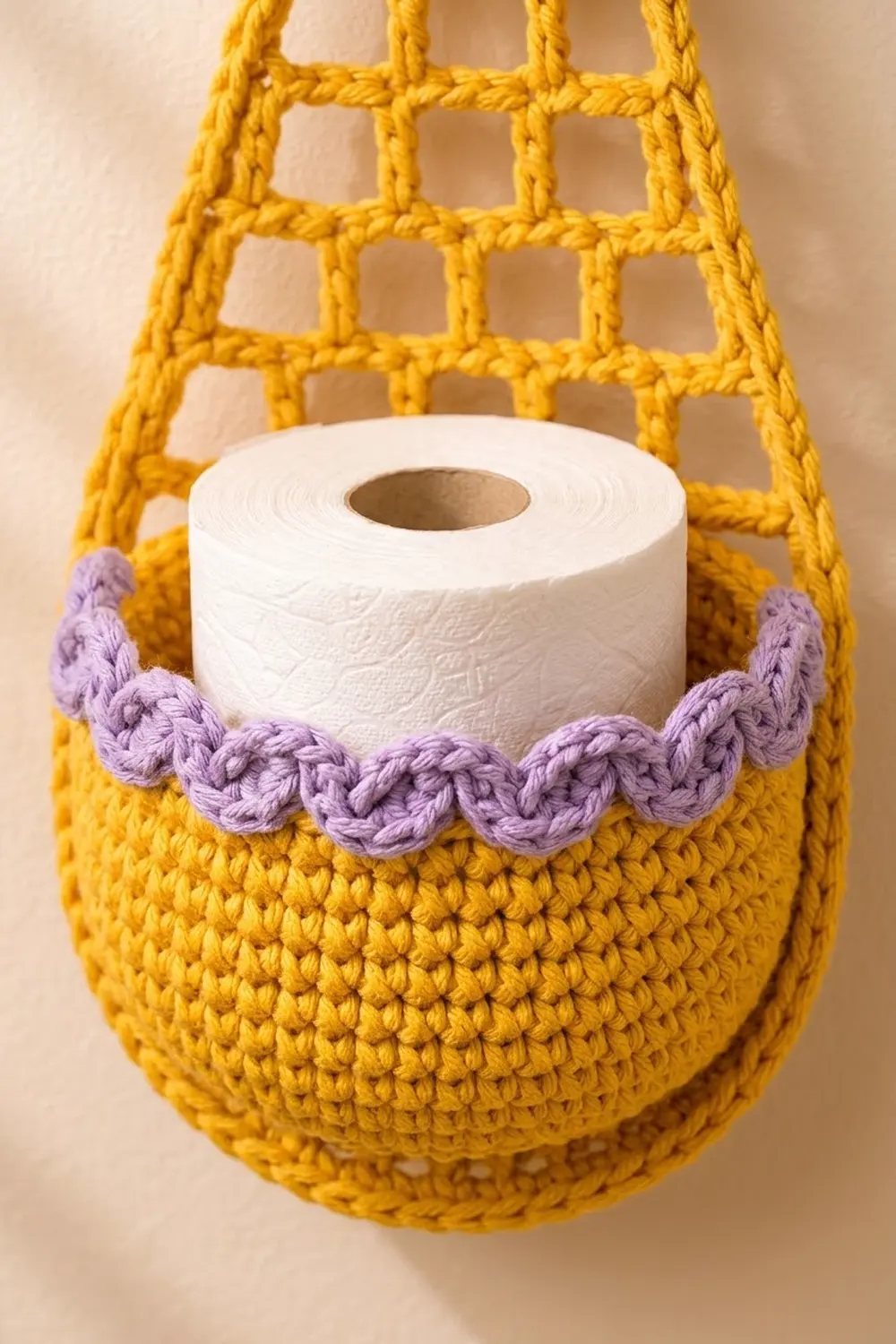
Basket (Make 2)
With Color A, work in continuous rounds. Mark the first stitch of each round.
Round 1: Make a magic ring and work 6 sc into it. (6 sts)
Round 2: 2 sc in each st around. (12 sts)
Round 3: sc in next st, 2 sc in next st around. (18 sts)
Round 4: sc in next 2 sts, 2 sc in next st around. (24 sts)
Round 5: sc in next 3 sts, 2 sc in next st around. (30 sts)
Round 6: sc in next 4 sts, 2 sc in next st around. (36 sts)
Round 7: sc in next 5 sts, 2 sc in next st around. (42 sts)
Round 8: sc in next 6 sts, 2 sc in next st around. (48 sts)
Checkpoint: the flat base is 5.1 in (13.0 cm) across.
Round 9 (turning ridge): sc BLO in each st around. (48 sts) The unused front loops form the crisp ridge where the base meets the wall.
Rounds 10–18: sc in each st around. (48 sts each round)
The wall is now 10 rounds (Rounds 9–18), or 3.1 in (7.9 cm) tall. Sl st into the next st and fasten off Color A.
Round 19: Join Color B in any st. Ch 1, sc in each st around, and join with a sl st to the first sc. (48 sts)
Round 20 (scallops): sl st in next st, sk next st, 4 hdc in next st 16 times. Join with a sl st to the first sl st. (16 sl st + 64 hdc = 80 sts, 16 scallops)
Each repeat uses 3 stitches, and 16 × 3 = 48, so the scallops close evenly with no leftover stitches. The trim adds about 0.7 in (1.8 cm), which brings the total basket height to 3.8 in (9.7 cm).
Fasten off, leaving a long Color A tail at the Round 18 join for sewing later. Weave in the Color B ends.
Mesh Panel (Make 1)
With Color A, the panel is worked flat from the top edge down.
Foundation: Ch 23.
Row 1: Dc in the 8th ch from hook (counts as a dc, ch 2 and the first square), then ch 2, sk 2 ch, dc in next ch 5 times. Turn. (6 squares; 7 posts + 12 ch = 19 sts)
Row 2: Ch 5 (counts as dc + ch 2), dc in the next dc, ch 2, dc in next dc 4 times, ch 2, then dc in the 3rd ch of the turning chain. Turn. (6 squares, 19 sts)
Rows 3–16: Repeat Row 2. (6 squares, 19 sts each row)
Checkpoint: the panel is 6¼ in (15.9 cm) wide and 12.8 in (32.5 cm) long.
Row 17 (shaping): Sl st in the first dc, 2 sl st in the next ch-2 sp, sl st in the next dc. Ch 5 (counts as dc + ch 2), dc in the next dc, ch 2, dc in next dc 3 times. Leave the last square unworked. Turn. (4 squares; 5 posts + 8 ch = 13 sts)
Row 18 (shaping): Sl st in the first dc, 2 sl st in the next ch-2 sp, sl st in the next dc. Ch 5, dc in the next dc, ch 2, dc in the next dc. Leave the last square unworked. Turn. (2 squares; 3 posts + 4 ch = 7 sts)
Do not fasten off. Rows 17 and 18 step in by one square on each side, which creates the base of the U-shaped bottom. The border rounds it off.
The panel is now 14.4 in (36.6 cm) long at the center.
Make All Pieces
Color A:
– 1 mesh panel
– 2 baskets (Rounds 1–18)
– 3 tabs: ch 6. Row 1: sc in the 2nd ch from hook and in each ch across (5 sts). Rows 2–10: ch 1, turn, sc across (5 sts). Each tab is 1.7 in × 3.1 in (4.3 cm × 7.9 cm).
– 1 hanging cord: chain until it measures 24 in (61.0 cm), then sl st in the back bump of each ch.
Color B:
– 2 basket trims (Rounds 19–20)
Layout (front view):
            ( ring )
           /        \
  ==[tab]===[tab]===[tab]==   dowel
  | mesh rows 1-5         |
  | UPPER BASKET rows 6-10|
  | mesh rows 11-13       |
  | LOWER BASKET rows 14-18|
   \_____ rounded bottom__/
Border
Continue with the loop from Row 18. Work the border before joining anything.
Border gauge: 3 sc = 1 in (2.5 cm).
Round 1 (sc): Ch 1 and work along the bottom curve first.
- Bottom curve, 31 sc: On the first half, work 3 sc along the top of Row 18 at the first step, 3 sc in the end of Row 17, 3 sc along the exposed outer square of Row 16, and 3 sc in the end of Row 16’s inner step. Then work 7 sc across Row 18 (1 in each dc and 2 in each ch-2 sp). Mirror the 12 sc on the other half. (12 + 7 + 12 = 31)
- Side, 40 sc: Work 3 sc in the end of each even row and 2 sc in the end of each odd row for Rows 16 to 1. (8 × 3 + 8 × 2 = 40)
- Top, 23 sc: Work along the foundation edge. Put 3 sc in the first corner post, 1 sc in each of the next 5 posts and 2 sc in each of the 6 ch-2 sps, then 3 sc in the last corner post. (3 + 5 + 12 + 3 = 23)
- Second side, 40 sc: Work as for the first side.
Join with a sl st to the first sc. (31 + 40 + 23 + 40 = 134 sts)
Round 2 (rope edge): Ch 1, then rev sc in each st around and join. (134 sts) This round adds no stitches, which keeps the edge flat.
Why the math works: Each mesh row is 0.8 in (2.0 cm) tall. Five sc over 2 rows gives 2.5 sc per 0.8 in, or about 3.1 sc per inch, which matches the 3 sc border gauge, so the sides lie flat. The top has 19 base stitches, or 6.33 in (16.1 cm) at border gauge, matching the 6¼ in (15.9 cm) panel. The 3-sc corners turn the corner without adding width. The two rounds add about 0.5 in (1.3 cm) per edge, so the panel finishes at 7¼ in × 15.4 in (18.4 cm × 39.1 cm). Fasten off.
Joining
Tabs: Count across the top border (23 sts). Center the tabs over stitches 2–6, 10–14 and 18–22. Sew one short end of each tab to the back of the top border. Wrap the tab over the dowel and sew the other end in the same place. Leave room for the ¾ in (1.9 cm) dowel to slide through.
Baskets: Whipstitch with the Color A tail. Use one strand of yarn and keep the tension snug.
Each basket’s back quarter is 12 of its 48 stitches, or 4 in (10.2 cm). Sew it across the 4 center mesh squares, which measure 4.17 in (10.6 cm). Work about 3 basket stitches per square, and catch each of the 5 dc posts once.
- Upper basket: Sew Round 17 along Row 6, then tack the back edge of the base to Row 10.
- Lower basket: Sew Round 17 along Row 14, and rest the base on the bottom border. Tack it in 3 places.
Keep the tension even. If you pull tight, the mesh puckers. If you leave it loose, the baskets tip forward.
Cord: Tie one end of the cord around the left end of the dowel. Thread it through the ring, then tie it to the right end. Wrap the two strands together just below the ring with a short length of yarn.
Size checkpoint: the panel should still measure 7¼ in (18.4 cm) wide.
Final Blocking
- Lightly mist the panel. Do not soak the baskets.
- Pin the panel to 7¼ in × 15.4 in (18.4 cm × 39.1 cm).
- Ease the bottom into a smooth U shape, using a dinner plate as a guide.
- Square up the mesh openings, and pin the sides straight.
- Stuff each basket with a towel to round it, and set the scallops upright.
- Let everything dry completely, about 24 hours.
Final Quality-Control Checklist
- Each basket base has 48 stitches and measures 5.1 in (13.0 cm) across.
- Each basket wall is 10 rounds high, with a visible turning ridge.
- Each trim has 16 even scallops.
- The panel has 18 rows, and the last two step in symmetrically.
- The border has 134 stitches, with a twisted rope edge.
- The tabs are centered and the dowel slides through them.
- Neither basket tips forward when it holds a roll.
- All ends are woven in securely.
Troubleshooting
- The base cups or ruffles: Check the increases. Each round should add exactly 6 stitches.
- The roll does not fit: The base is too small. Go up a hook size.
- The mesh is slanted: Check that every row starts with ch 5 and ends in the turning chain.
- The bottom looks stepped: Re-block it over a plate. Make sure each step has its full 3 sc.
- The side edges ruffle: Use 2 sc per row end throughout and recount the sides.
- The baskets sag: Add another tack stitch at the base, or use a firmer yarn.
Care
Hand wash in cool water and lay flat to dry, reshaping the baskets while damp. Take the dowel out before washing.
Final Notes
The measurement chain is simple:
- Gauge gives a 5.1 in (13.0 cm) base.
- Ten wall rounds give 3.1 in (7.9 cm), and the trim brings the basket to 3.8 in (9.7 cm).
- The 6-square mesh measures 6¼ in × 14.4 in (15.9 cm × 36.6 cm).
- A 134-stitch border finishes the panel at 7¼ in × 15.4 in (18.4 cm × 39.1 cm).
Check each stage before moving on, and the parts will fit together neatly.
Happy crocheting!