

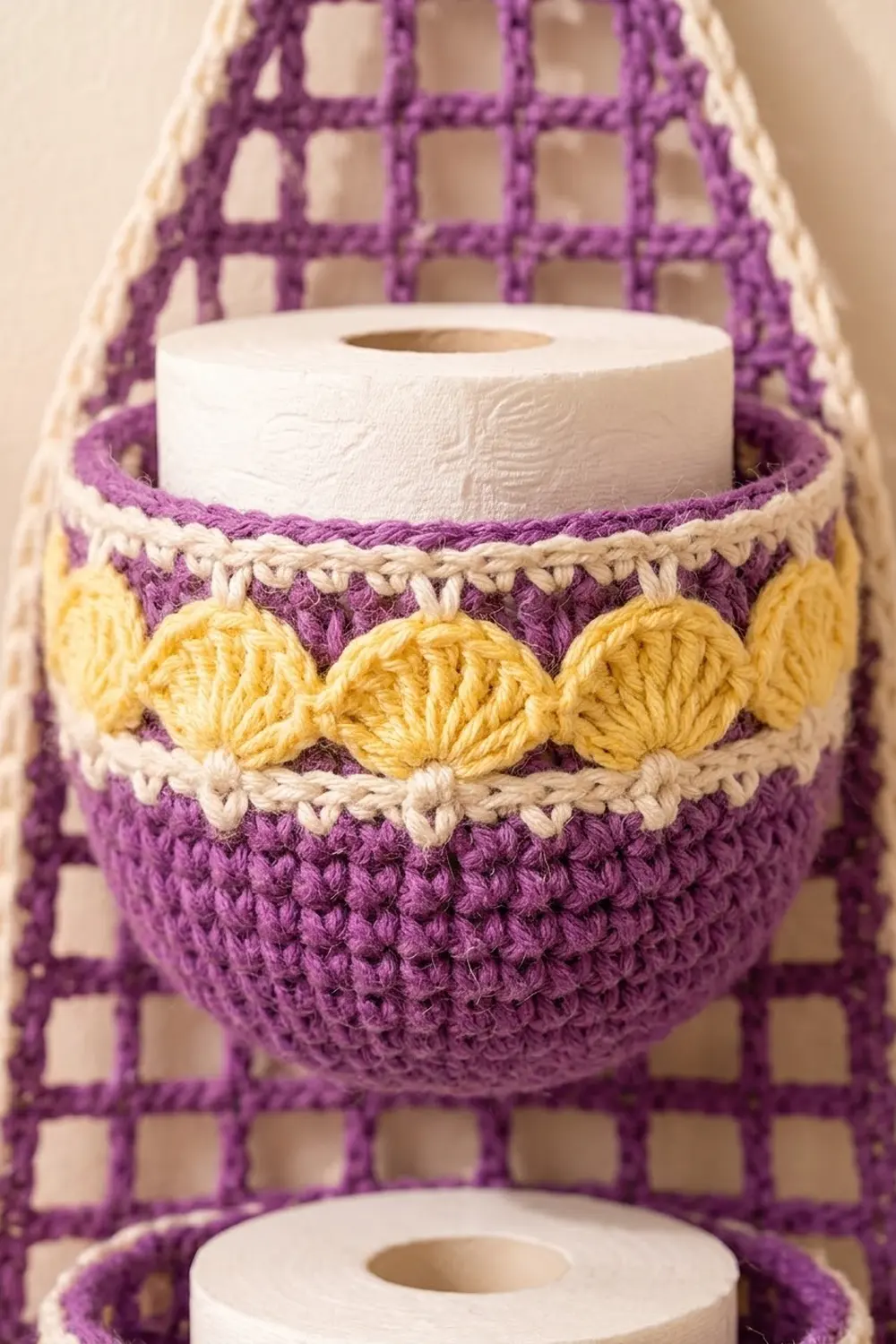
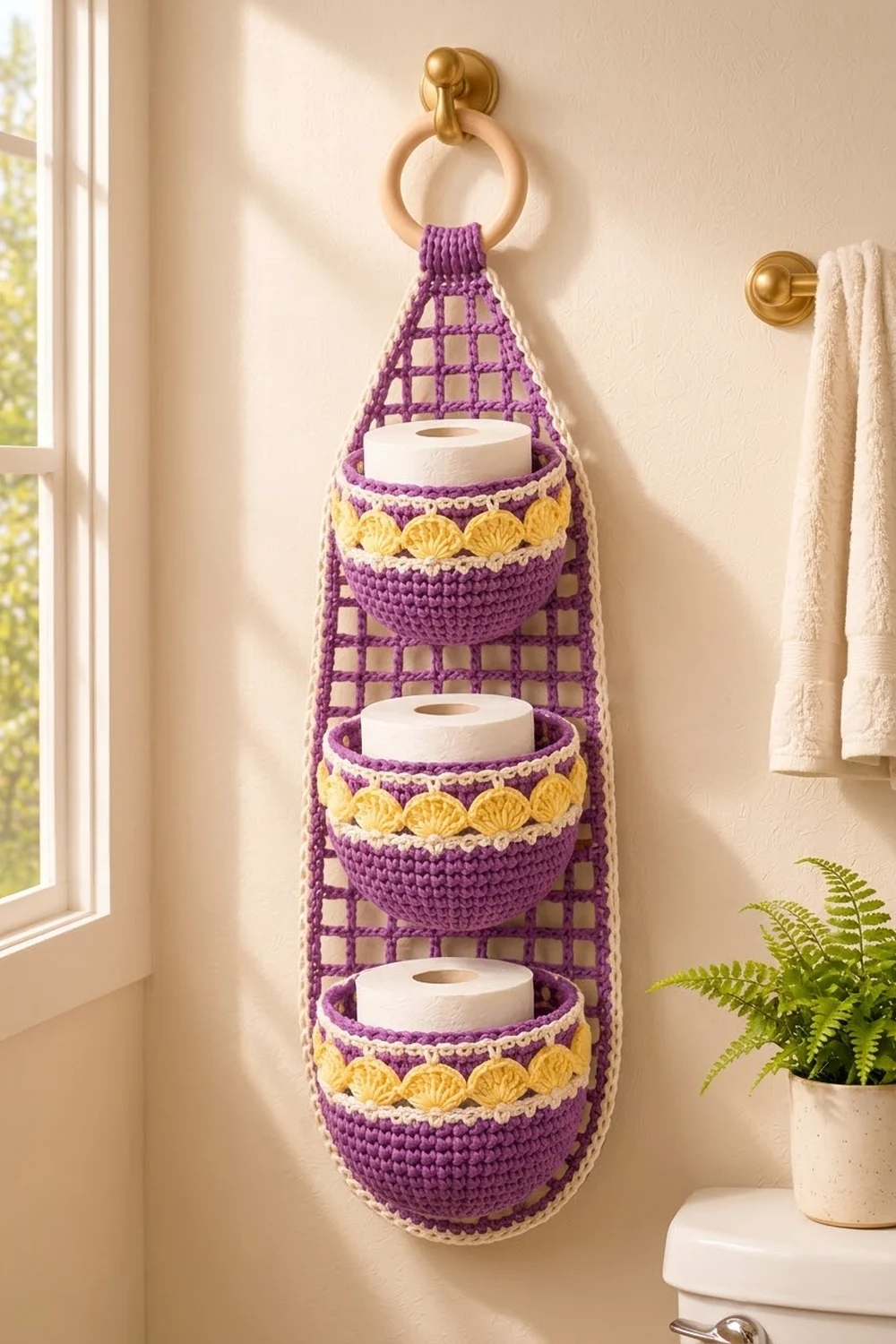
This hanging holder stores three spare toilet rolls on a tall filet mesh panel. The panel is a long, narrow teardrop with a rounded bottom and straight sides. At the top it narrows to a short tab that wraps around a wooden ring. Three half-oval pockets are sewn to the front, one above the other, and each holds one standard roll upright.
The mesh and pocket bodies are violet purple, and cream outlines the panel and the pocket bands. Each pocket also has a band of buttery yellow shells. It works well on a bathroom wall and looks tidy whether the pockets are full or empty.
The pattern uses US crochet terms. The bordered panel measures 7 in (17.8 cm) wide by 28.5 in (72.4 cm) tall. Each pocket is 7.25 in (18.4 cm) wide and 4.25 in (10.8 cm) high.
You will crochet the mesh panel from the bottom up and make three pockets with oval bases in joined rounds. Then you sew the pockets on, add a two-row cream border, and fold the tab around the ring.
Finished Size and Construction
- Finished size: 7 in (17.8 cm) x 28.5 in (72.4 cm) for the bordered panel; about 32.25 in (81.9 cm) to the top of the ring
- Skill level: Intermediate
- Terminology: US crochet terms
- Yarn weight: Worsted (#4) cotton
- Hook: 5.0 mm (H-8)
- Number of pieces: 4 crocheted pieces (1 back panel and 3 pockets), plus 1 wooden ring
- Layout: 3 pockets stacked in one vertical column on the panel
- Pocket size: 7.25 in (18.4 cm) wide x 4.25 in (10.8 cm) high x 4.75 in (12.1 cm) front to back
- Panel size before border: 6 in (15.2 cm) x 28 in (71.1 cm), not counting the tab
- Border depth: 0.5 in (1.3 cm), two sc rows
Materials
Use a smooth worsted-weight cotton or cotton blend with about 190 m per 100 g. Cotton holds the pocket shape and keeps the mesh crisp. Stretchy acrylic lets the pockets sag.
- Purple (Color A): 250 g, about 475 m
- Cream (Color B): 100 g, about 190 m
- Yellow (Color C): 50 g, about 95 m
These amounts include a comfortable margin.
Tools:
- 5.0 mm (H-8) crochet hook
- Wooden ring, 2.75 in (7.0 cm) outer diameter
- Tapestry needle and 6 locking stitch markers
- Scissors and tape measure
- Rust-proof pins and a blocking mat
Abbreviations (US Terms)
- ch: chain
- sl st: slip stitch
- sc: single crochet
- dc: double crochet
- trtr: triple treble crochet (yarn over 4 times, insert hook, pull up a loop, then [yarn over, pull through 2 loops] 5 times)
- BLO: back loop only
- sk: skip
- sp: space
- st(s): stitch(es)
Special stitches
- Mesh square: one ch-2 between two dc posts. A row of n squares has 3n + 1 sts, counting both dc and ch.
- Beg inc (beginning increase): Ch 7, then dc in the first dc. The first 2 ch form the base of the new square, the next 3 ch form its outer post, and the last 2 ch form its top. This adds 1 square at the start of the row.
- End inc (end increase): Ch 2, then trtr in the same st as the last dc. This adds 1 square at the end of the row.
- Shell: 5 dc in the same st.
Gauge and Checkpoints
- Mesh: 4 squares (13 sts) = 3 in (7.6 cm) wide, and 4 rows = 3 in (7.6 cm) tall. One square is 0.75 in (1.9 cm).
- Single crochet: 16 sc and 16 rows = 4 in (10.2 cm). One sc row is 0.25 in (0.6 cm).
Make one pocket first. It is the best gauge test. After Rnd 9 the base should measure 7 in (17.8 cm) x 4.75 in (12.1 cm), and the finished pocket should stand 4.25 in (10.8 cm) tall.
Check the panel at these points:
- After Row 4: 6 in (15.2 cm) wide
- After Row 10: 7 in (17.8 cm) tall
- After Row 32: 23.5 in (59.7 cm) tall
- After Row 38: 28 in (71.1 cm) tall
If your work is too big, go down 0.5 mm. If it is too small, go up 0.5 mm. A small pocket won’t fit a roll, and a big one lets the roll tip forward.
Back Panel
Use Color A. Each mesh row starts with ch 5, which counts as dc + ch 2, unless the row starts with a beg inc. Work the last dc of each row into the 3rd ch of the turning chain, or into the top ch of the outer post on beg-inc rows.
Row 1: Ch 14, sc in 2nd ch from hook and in each ch across, turn. (13 sc)
Row 2: Ch 5, sk next 2 sc, dc in next sc, [ch 2, sk 2 sc, dc in next sc] 3 times, turn. (4 squares, 13 sts)
Row 3: Beg inc, [ch 2, sk 2 ch, dc in next dc] 4 times, end inc, turn. (6 squares, 19 sts)
Row 4: Beg inc, [ch 2, sk 2 ch, dc in next dc] 6 times, end inc, turn. (8 squares, 25 sts)
Over 1.5 in (3.8 cm), these rows widen the panel from 3 in (7.6 cm) to 6 in (15.2 cm). The border then rounds this into the curved bottom.
Rows 5–32: Ch 5, sk 2 ch, dc in next dc, [ch 2, sk 2 ch, dc in next dc] 6 times, turn. (8 squares, 25 sts)
Row 33 (decrease): Sl st in next 2 ch and next dc, ch 5, sk 2 ch, dc in next dc, [ch 2, sk 2 ch, dc in next dc] 5 times, turn. Leave the last square unworked. (6 squares, 19 sts)
Row 34: Ch 5, sk 2 ch, dc in next dc, [ch 2, sk 2 ch, dc in next dc] 4 times, turn. (6 squares, 19 sts)
Row 35 (decrease): Sl st in next 2 ch and next dc, ch 5, sk 2 ch, dc in next dc, [ch 2, sk 2 ch, dc in next dc] 3 times, turn. Leave the last square unworked. (4 squares, 13 sts)
Row 36: Ch 5, sk 2 ch, dc in next dc, [ch 2, sk 2 ch, dc in next dc] 2 times, turn. (4 squares, 13 sts)
Row 37 (decrease): Sl st in next 2 ch and next dc, ch 5, sk 2 ch, dc in next dc, ch 2, sk 2 ch, dc in next dc, turn. Leave the last square unworked. (2 squares, 7 sts)
Row 38: Ch 5, sk 2 ch, dc in next dc, ch 2, sk 2 ch, dc in turning ch, turn. (2 squares, 7 sts)
The panel is now 6 in (15.2 cm) x 28 in (71.1 cm). That is Row 1 at 0.25 in (0.6 cm) plus 37 mesh rows of 0.75 in (1.9 cm).
Hanging tab
Row 39: Ch 1, sc in first dc, 2 sc in ch-2 sp, sc in next dc, 2 sc in ch-2 sp, sc in turning ch, turn. (7 sc)
Rows 40–46: Ch 1, sc in each st across, turn. (7 sc)
Fasten off and leave a 12 in (30.5 cm) tail. The tab is 2 in (5.1 cm) long.
Pockets (make 3)
Work in joined rounds. At the end of each round, sl st to the first st, then ch 1 to start the next round; the ch 1 does not count as a st. Do not turn. To change color, fasten off and join the new color with a sl st.
Oval base (Color A)
Rnd 1: Ch 11, sc in 2nd ch from hook, sc in next 8 ch, 3 sc in last ch. Working along the other side of the chain, sc in next 8 ch, then 2 sc in the same ch as the first sc. (22 sc)
Rnd 2: 2 sc in first st, sc in next 8, 2 sc in each of next 3, sc in next 8, 2 sc in each of last 2. (28 sc)
Rnds 3–9: In these rounds, n is the round number.
Sc in first (n − 2) sts, 2 sc in next st, sc in next 8, [sc in next (n − 2), 2 sc in next] 3 times, sc in next 8, [sc in next (n − 2), 2 sc in next] 2 times.
Each round adds 6 sc, 3 at each curved end.
Round totals: Rnd 3: 34, Rnd 4: 40, Rnd 5: 46, Rnd 6: 52, Rnd 7: 58, Rnd 8: 64, Rnd 9: 70 sc.
Checkpoint: the base lies flat and measures 7 in (17.8 cm) x 4.75 in (12.1 cm).
Sides
Rnd 10 (A): Sc in BLO of each st. (70 sc) This forms the turning ridge.
Rnds 11–14 (A): Sc in each st. (70 sc)
Rnd 15 (B): [Sc in next 34 sts, 2 sc in next st] 2 times. (70 sts worked 1-per-st + 2 extra = 72 sc)
Rnd 16 (C): Join in the first st. Ch 1, sc in same st, sk 2, shell in next st, sk 2, sc in next st. Repeat from * 10 more times, then sk 2, shell in next st, sk 2, sl st to first sc. (12 shells, 12 sc)
Rnd 17 (B): Join in any sc between shells. Ch 5 (counts as dc + ch 2), sc in center dc of next shell, ch 2, dc in next sc, ch 2, sc in center dc of next shell, ch 2. Repeat from * 10 more times, then sl st to 3rd ch of ch-5. (12 dc, 12 sc, 24 ch-2 sps) The dc between the shells make the cream dots.
Rnd 18 (B): Sc in each dc and each sc, 2 sc in each ch-2 sp. (12 + 12 + 48 = 72 sc)
Rnds 19–21 (A): Sc in each st. (72 sc)
Rnd 22 (B): Sc in each st. (72 sc) Fasten off and leave a 36 in (91.4 cm) tail.
Checkpoint: the pocket is 4.25 in (10.8 cm) tall, and the rim is about 18 in (45.7 cm) around.
Make All Pieces
- Back panel: 1, in Color A
- Pockets: 3, each using Colors A, B, and C
      [ ring ]
       [tab]
      /mesh\        Rows 33–38 taper
     | mesh |       Rows 29–32
     |POCKET|  3    rim at top of Row 28
     | mesh |
     |POCKET|  2    rim at top of Row 18
     | mesh |
     |POCKET|  1    rim at top of Row 8
      \mesh/        Rows 1–4 rounded bottom
Joining
Sew each pocket on with its cream tail, using whipstitch. Rim heights are measured from the bottom edge of the panel before the border:
- Pocket 1: top of Row 8, 5.5 in (14.0 cm) up
- Pocket 2: top of Row 18, 13 in (33.0 cm) up
- Pocket 3: top of Row 28, 20.5 in (52.1 cm) up
Each pocket hangs 4.25 in (10.8 cm) below its rim, so the bases sit at 1.25 in (3.2 cm), 8.75 in (22.2 cm), and 16.25 in (41.3 cm). The taper starts at 24.25 in (61.6 cm), above all three pockets.
Stitch-to-stitch logic: Mark 24 rim sts centered on one long side of the pocket; this side is the back. The target mesh row has 25 sts: 9 dc tops and 16 ch. Whipstitch one rim st to each mesh st from edge to edge, and work twice into the last rim st. That way the 24 rim sts cover all 25 mesh sts, across the full 6 in (15.2 cm) width.
Base tacking: Tack the Rnd 10 ridge to the mesh posts 4.25 in (10.8 cm) below the rim in three places: at the back center and 1.5 in (3.8 cm) to each side.
Tension: Keep the stitches snug but not tight. If the mesh puckers behind a pocket, take out the seam and sew it again more loosely.
Size checkpoint: After joining, the panel should still be 6 in (15.2 cm) wide.
Border
Work the border in Color B down one long side, across the bottom, and up the other side. Stop at the base of the tab.
Border gauge: Work 3 sc per mesh row-end and 3 sc across each 1-square step. That equals 4 sc per 1 in (2.5 cm), which matches the sc gauge.
Border Row 1: With the right side facing, join at the left base of the tab, at the top of the Row 38 edge. Ch 1.
Left side:
- 3 sc around each mesh row-end post for Rows 38 to 2: 37 rows, 111 sc
- 3 sc across each of the 5 steps (3 decrease steps and 2 increase steps): 15 sc
- 1 sc in the Row 1 row-end: 1 sc
Left side total: 127 sc.
Bottom: work in the free loops of the foundation chain. 2 sc in first loop, sc in next 11, 2 sc in last loop. (15 sc) The doubled sts are the corner sts, and they count only toward the bottom.
Right side: mirror the left side up to the right base of the tab. (127 sc)
Row 1 total: 127 + 15 + 127 = 269 sc. Turn.
Border Row 2: Ch 1, sc in each sc, working 2 sc in each of the 4 bottom-corner sts. (269 sts worked 1-per-st + 4 extra = 273 sc: 127 per side and 19 across the bottom) Fasten off.
Why the math works: One mesh row is 0.75 in (1.9 cm) tall, and 3 sc at 4 sc per inch also cover 0.75 in (1.9 cm), so the edge stays flat. The 4 extra sts sit on the outer curve and round off the bottom. Two sc rows add 0.5 in (1.3 cm) on each edge, so the panel finishes at 7 in (17.8 cm) x 28.5 in (72.4 cm).
Ring: Fold the tab around the ring from front to back, then whipstitch Row 46 to the back of Row 39.
Final Blocking
- Mist the piece lightly until it is damp.
- Pin the panel face up to 7 in (17.8 cm) x 28.5 in (72.4 cm), squaring each mesh opening.
- Shape the curved bottom and the taper so both sides match.
- Put a toilet roll wrapped in a plastic bag inside each pocket to hold its shape.
- Let it dry completely, for at least 24 hours.
- Unpin it, take out the rolls, and steam any curled shells.
Final Quality-Control Checklist
- Panel measures 7 in (17.8 cm) x 28.5 in (72.4 cm), and the sides are parallel
- Mesh squares are even, 0.75 in (1.9 cm) each
- Border Row 2 has 127 sc on each side and 19 across the bottom
- Each pocket has 72 rim sts and 12 shells
- Pocket rims are level at Rows 8, 18, and 28
- Each pocket base is tacked in three places
- The tab is secure and the ring hangs straight
- All ends are woven into solid sc areas
Troubleshooting
- Base cups: Your tension is too tight. Loosen up, or go up 0.5 mm.
- Base ripples: Recount each round. There should be exactly 6 increases per round.
- Roll won’t fit: The base is under 7 in (17.8 cm). Remake it with a larger hook.
- Mesh leans: Each ch-2 must skip exactly 2 sts. Block the panel square.
- Border waves: You have more than 3 sc per row-end.
- Border pinches: Your tension is too tight. Go up 0.5 mm for the border only.
- Shells crowd together: Rnd 15 must have 72 sts.
- Pocket droops: Add a fourth tacking point at the base.
Care
Hand wash in cool water with mild soap, roll it in a towel to press out the water, and dry it flat. Reshape the pockets while damp.
Final Notes
Each measurement builds on the one before. Mesh squares of 0.75 in (1.9 cm) give a 6 in (15.2 cm) x 28 in (71.1 cm) panel. A 0.5 in (1.3 cm) border brings it to 7 in (17.8 cm) x 28.5 in (72.4 cm). Three 72-stitch pockets, each 4.25 in (10.8 cm) tall, are sewn across the full width at Rows 8, 18, and 28. Check your gauge on the first pocket and keep every count exact.
Happy crocheting!