

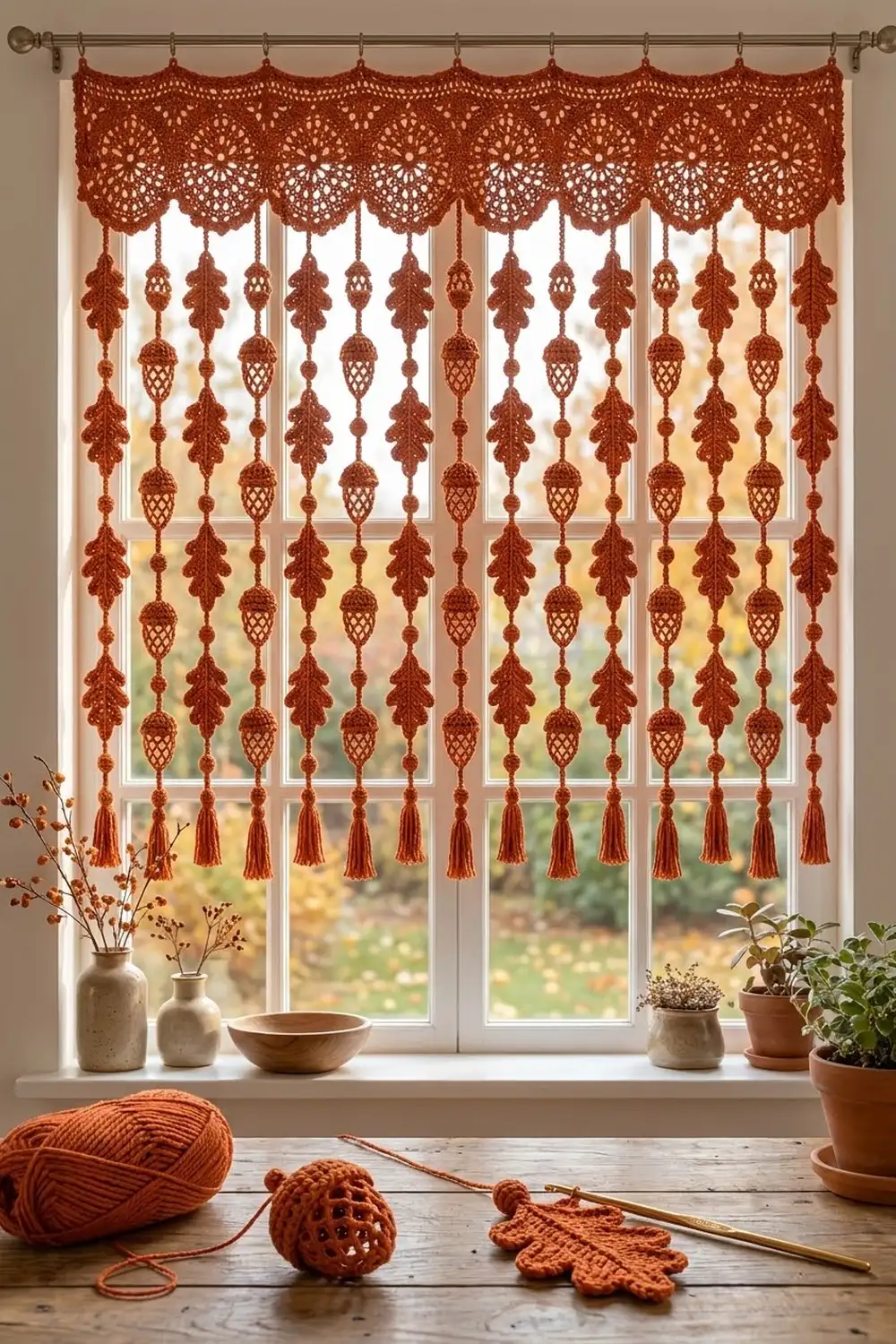
This curtain brings autumn to your window. A straight top band holds a row of lacy half-circle scallops. Long strands of lobed oak leaves, net-bottomed acorns, round beads, and full tassels hang below them.
Everything is worked in one warm rust orange. With a single color, the textures stand out: raised leaf veins, a solid acorn cap over an open diamond mesh, and a picot edge on every scallop. The style is rustic and airy, and daylight still comes through.
The pattern uses US crochet terms. The finished curtain is 36 in (91.4 cm) wide and 26.5 in (67.3 cm) long from the top of the rod pocket to the tassel ends. It fits a café or tension rod up to 1/2 in (1.3 cm) across.
Construction is modular. You make 9 scallops and join them side by side. Then you work a top band across them and fold it into a rod pocket. Finally you sew leaves, acorns, beads, and tassels into 17 strands and attach them under the scallops.
Finished Size and Construction
- Finished size: 36 in (91.4 cm) wide x 26.5 in (67.3 cm) long
- Skill level: Intermediate
- Terminology: US crochet terms
- Yarn weight: Worsted (#4) cotton
- Hook: 4.0 mm (G-6)
- Number of pieces: 9 scallops, 43 leaves, 42 acorns, 85 beads, 17 tassels
- Layout: 9 scallops in one row, with 17 strands below
- Scallop size: 4 in (10.2 cm) wide x 2 in (5.1 cm) deep
- Size before band: 36 in (91.4 cm) x 2 in (5.1 cm)
- Band depth: 1 in (2.5 cm) visible, folded double for the rod pocket
Materials
Use a smooth mercerized or combed cotton. Cotton keeps the leaf lobes and acorn mesh crisp and hangs straight. Fuzzy yarns blur the lace.
Yarn
- Rust orange: 500 g, about 850 m (930 yd), based on 170 m per 100 g
These quantities include a margin of about 15% for gauge differences, sewing tails, and test pieces.
Tools
- 4.0 mm (G-6) hook
- Yarn needle
- Scissors and stitch markers
- Small amount of fiberfill
- Card 4 in (10.2 cm) wide for tassels
- Tape measure, blocking mats, rust-proof pins
- Optional: spray starch
Abbreviations (US Terms)
- ch – chain
- sl st – slip stitch
- sc – single crochet
- hdc – half double crochet
- dc – double crochet
- sc2tog – single crochet 2 together
- st(s) – stitch(es)
- sp – space
- BLO / FLO – back loop only / front loop only
- RS / WS – right side / wrong side
- rep – repeat
Picot (special stitch): Ch 3, then sl st in the 3rd ch from the hook.
Magic ring: Make an adjustable loop, work the first round into it, then pull the tail to close it.
Gauge and Checkpoints
Gauge: 16 sc and 20 rows = 4 in (10.2 cm), worked in rows.
Before anything else, make one scallop, one leaf, one acorn, and one bead. Between them they use every stitch in the pattern.
Checkpoints:
- Scallop after Row 2: about 2.5 in (6.4 cm) across the straight edge
- Finished scallop: 4 in (10.2 cm) x 2 in (5.1 cm)
- Leaf: 3.5 in (8.9 cm) long including the stem, 2.25 in (5.7 cm) wide
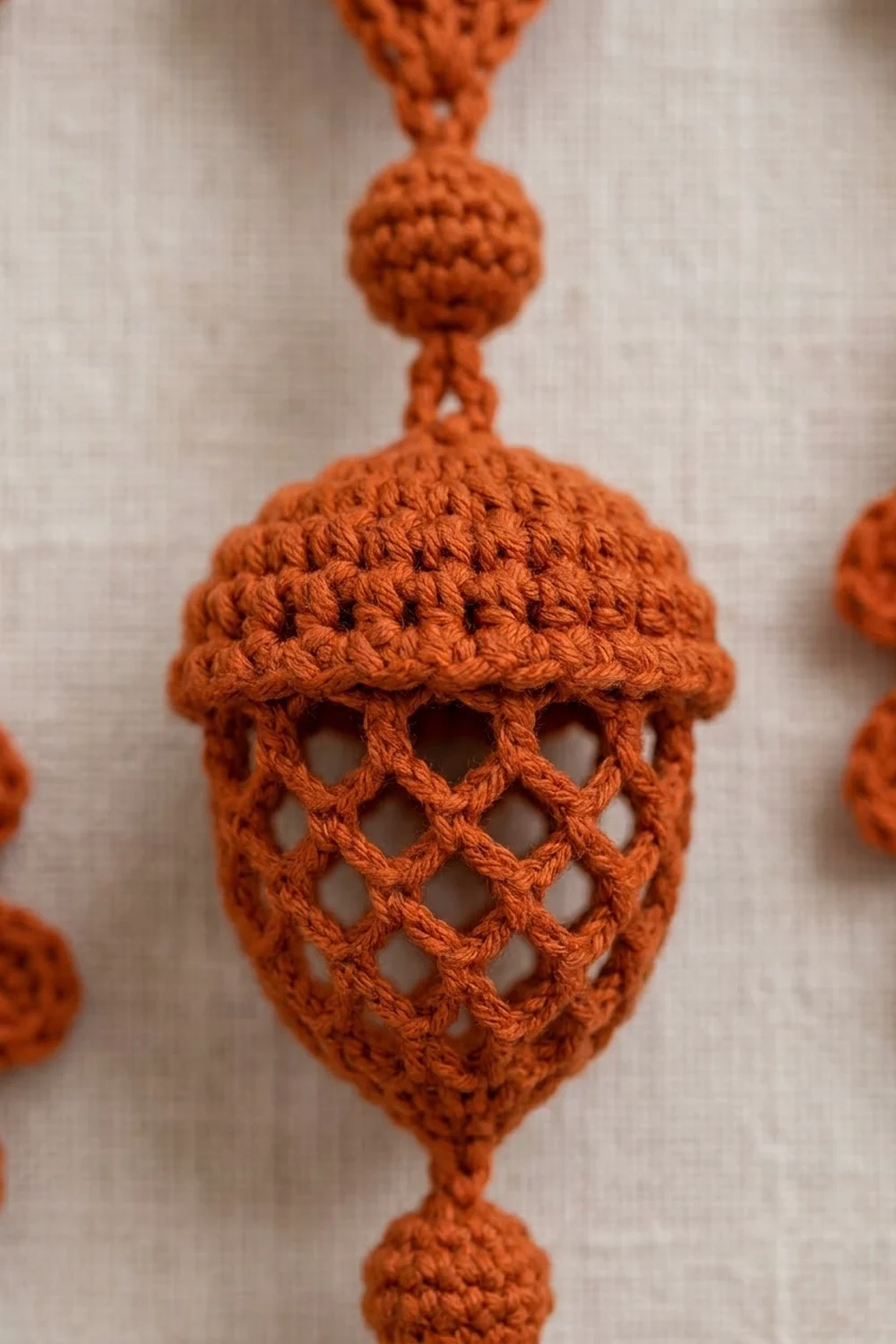
- Acorn: 2.25 in (5.7 cm) long, 1.5 in (3.8 cm) wide
- Bead: 0.75 in (1.9 cm) across
- Valance with band: 36 in (91.4 cm) wide
If your pieces are too big, go down a hook size. If they are too small, go up a size. A scallop that is 1/4 in (0.6 cm) off adds up to 2.25 in (5.7 cm) across the valance, so fix your gauge now.
Scallop (make 9)
Each scallop is a half circle worked in turned rows from a magic ring. The straight edge becomes the top.
Row 1 (RS): Make a magic ring. Ch 3 (counts as dc), then work 6 dc in the ring. Pull the ring closed and turn. (7 dc)
Row 2: Ch 3 (counts as dc). Dc in the first st, then 2 dc in each st across, ending in the top of the turning ch. Turn. (14 dc)
Row 3: Ch 4 (counts as dc + ch 1), dc in next dc, *ch 1, dc in next dc; rep from * across, ending in the top of the turning ch. Turn. (14 dc, 13 ch-1 sps)
Row 4: Ch 1, sc in first dc, *(sc, picot) in next ch-1 sp, sc in next dc; rep from * 12 more times. Work the last sc in the 3rd ch of the turning ch. Turn so the RS faces you. (27 sc, 13 picots)
Row 5 (top edge): Ch 1 and rotate to work along the straight edge. Work into the row ends as follows: 1 sc in the end of Row 4, 2 sc in Row 3, 2 sc in Row 2, 2 sc in Row 1, 2 sc in the ring center, 2 sc in Row 1, 2 sc in Row 2, 2 sc in Row 3, 1 sc in Row 4. Fasten off. (16 sc)
These 16 sc include both corner stitches. They are the top count for each scallop.
Oak Leaf (make 43)
The leaf is worked around a foundation chain. Round 1 makes the oval and Round 2 adds three lobes to each side.
Ch 13.
Rnd 1: Sc in 2nd ch from hook, hdc in next ch, dc in next 8 ch, hdc in next ch, sc in last ch. (12 sts on side 1)
Ch 1 for the stem corner. Rotate and work in the free loops of the foundation: sc, hdc, dc in next 8 ch, hdc, then sc in the same ch as the first sc. (12 sts on side 2)
Ch 2 for the tip and sl st in the first sc. (24 sts, ch-1 stem sp, ch-2 tip sp)
Rnd 2: Work the lobe repeat 3 times along side 1, starting in the first sc: sl st in next st, sc in next st, (hdc, dc, hdc) in next st, sc in next st. (18 sts, 3 lobes)
In the ch-1 sp, work sc, ch 3, sl st in the 2nd and 3rd ch from the hook (this is the stem), sc. Work the lobe repeat 3 times along side 2. (18 sts, 3 lobes)
In the ch-2 sp, work hdc, picot, hdc. Sl st in the first sl st. Fasten off and leave an 8 in (20.3 cm) tail.
Each lobe uses 4 stitches and makes 6, so 3 lobes use exactly the 12 stitches on each side. The sl st at the start of each lobe makes the notch.
Vein: With the RS facing, surface sl st from the stem to the tip along the foundation line (12 sl sts).
Acorn (make 42)
Cap
Rnd 1: 6 sc in a magic ring. (6)
Rnd 2: 2 sc in each st. (12)
Rnd 3: *Sc in next st, 2 sc in next st; rep from * around. (18)
Rnds 4–5: Sc in each st. (18)
Rnd 6 (rim): Working in the FLO, *sc in next 2 sts, 2 sc in next st; rep from * around. Sl st to join and fasten off. (18 sc worked 1 per st + 6 added = 24 sc)
Nut mesh (worked into the free back loops of Rnd 5)
Rnd 1: Join yarn in any back loop. Ch 1 and sc in the same loop, then *ch 4, skip 2 loops, sc in next loop; rep from * 4 more times. Ch 4, skip 2, and sl st in the first sc. (6 sc, 6 ch-4 loops)
Rnds 2–3: Sl st in the first 2 ch of the next loop and sc in that loop, then *ch 4, sc in next loop; rep from * 4 more times. Ch 4 and sl st in the first sc. (6 ch-4 loops)
Rnd 4: Repeat Rnd 2, using ch 3 instead of ch 4. (6 ch-3 loops)
Rnd 5: Repeat Rnd 2, using ch 2 instead of ch 4. (6 ch-2 loops)
Rnd 6: Sc in each loop. (6 sc) Gather the round closed and leave an 8 in (20.3 cm) tail.
Starting each round in the middle of a loop staggers the points, which creates the diamond net.
Bead (make 85)
Rnd 1: 6 sc in a magic ring. (6)
Rnd 2: 2 sc in each st. (12)
Rnd 3: Sc in each st. (12)
Rnd 4: Sc2tog 6 times. (6)
Stuff the bead firmly, gather it closed, and leave an 8 in (20.3 cm) tail.
Tassel (make 17)
Wrap yarn 30 times around the 4 in (10.2 cm) card. Tie the top with a 10 in (25.4 cm) strand and cut the bottom loops. Wrap the bundle 6 times, 1/2 in (1.3 cm) below the top, and knot. Trim to 3.5 in (8.9 cm).
Make All Pieces
- Scallops: 9
- Strand A (make 9): 3 leaves, 2 acorns, 5 beads, 1 tassel
- Strand B (make 8): 3 acorns, 2 leaves, 5 beads, 1 tassel
- Leaves: 9 x 3 + 8 x 2 = 43
- Acorns: 9 x 2 + 8 x 3 = 42
- Beads: 17 x 5 = 85
- Tassels: 17
Layout grid (left to right):
VALANCE: S1  S2  S3  S4  S5  S6  S7  S8  S9
STRANDS: A B A B A B A B A B A B A B A B A
Strand A hangs from the center of each scallop. Strand B hangs from each join between two scallops.
Strand order (top to bottom):
STRAND A: CORD 5 CH - LEAF - BEAD - ACORN - BEAD - LEAF - BEAD - ACORN - BEAD - LEAF - BEAD - TASSEL
STRAND B: CORD 18 CH - ACORN - BEAD - LEAF - BEAD - ACORN - BEAD - LEAF - BEAD - ACORN - BEAD - TASSEL
Strand A: The 1.25 in (3.2 cm) cord, plus 3 leaves at 3.5 in (8.9 cm), 2 acorns at 2.25 in (5.7 cm), 5 beads at 0.75 in (1.9 cm), and the 3.5 in (8.9 cm) tassel = 23.5 in (59.7 cm).
Strand B: The 4.5 in (11.4 cm) cord, plus 3 acorns, 2 leaves, 5 beads, and the tassel = 25.5 in (64.8 cm).
Strand A starts 3 in (7.6 cm) below the top of the band, and Strand B starts 1 in (2.5 cm) below it. Both end at 26.5 in (67.3 cm), so all the tassels hang level.
Joining
Scallops: Lay the 9 scallops RS up in a row with the straight edges at the top. Use 2 firm whipstitches to sew the Row 4 end of each scallop to the Row 4 end of the next one. Sew only these corner points, so all 16 sc of each Row 5 stay free for the band.
Strands: Sew each strand from the top down with the 8 in (20.3 cm) tails, butting each piece against the next with no gap. Pass the needle through the center of each bead, and stitch into Rnd 1 at the center of each acorn cap. Tie each tassel’s top strands through the last bead and knot them inside.
At every connection, take 3 small stitches, pull them snug, and bury the tail in the next piece. Loose joins let the strands twist and stretch.
Cords: For Strand A, join yarn at the scallop’s center picot (on the 14th sc of Row 4), ch 5, and sew the cord to the stem of the first leaf. For Strand B, join yarn at a whipstitched corner, ch 18, and sew the cord to the first acorn cap. At 4 ch per inch, these chains measure 1.25 in (3.2 cm) and 4.5 in (11.4 cm).
Size checkpoint: One finished Strand A should measure 23.5 in (59.7 cm). If yours is longer, tighten the connections before you make the rest.
Border: Top Band and Rod Pocket
Border gauge: 16 sc and 20 rows = 4 in (10.2 cm).
Row 1 (RS): Join yarn in the first sc of Row 5 on the rightmost scallop. Ch 1, then sc in each of the 16 sc on each of the 9 scallops. Turn. (144 sc)
Rows 2–10: Ch 1, sc in each st across. Turn. (144 sc)
Fasten off and leave a 4 yd (3.7 m) tail.
Fold: Fold Rows 6–10 to the WS along the line between Rows 5 and 6. Whipstitch each stitch of Row 10 to the matching stitch of Row 1, 144 to 144. Leave both ends open for the rod.
Why the math works: Each scallop has exactly 16 top stitches, corners included. The seams are sewn at Row 4, so they add no stitches. 9 x 16 = 144 sc, and 144 ÷ 16 sc per 4 in = 36 in (91.4 cm). Folding the 10 rows leaves 5 rows on the front, which is 1 in (2.5 cm).
Final Blocking
- Soak all the pieces in cool water, then roll them in a towel to press out the excess.
- Pin the valance flat at 36 in (91.4 cm) wide, with each scallop 2 in (5.1 cm) deep. Open every picot.
- Pin the leaves flat with the lobes spread and the veins straight.
- Fill each acorn mesh with a ball of fiberfill to round it. Starch it lightly if you want a firmer net.
- Lay the strands flat at their full length.
- Let everything dry completely, then remove the pins and the fiberfill.
Final Quality-Control Checklist
- 9 scallops, each 4 in (10.2 cm) wide with 16 top sc
- 144 sc on every band row
- Valance is 36 in (91.4 cm) wide
- Rod pocket is open at both ends
- Strands alternate A and B, 17 in total
- All connections are snug, with no thread showing
- Tassels are level at 26.5 in (67.3 cm)
- All tails are woven in
Troubleshooting
- Scallop ruffles: Your dc are short. Go up a hook size for Rows 2–3.
- Scallop cups: Your dc are tall. Go down a hook size for Rows 2–3.
- Band waves: A scallop has more or fewer than 16 stitches under the band. Recount each section.
- Uneven lobes: Make sure each lobe uses exactly 4 stitches.
- Mesh collapses: Starch it, or make each loop 1 ch shorter.
- Strand twists: A join is loose or off-center. Re-sew it through the center of the pieces.
Care
Hand wash in cool water with mild soap and lay flat to dry. Re-block and re-starch the acorns if needed.
Final Notes
The measurement chain is short. At 16 sc per 4 in, each scallop is 4 in (10.2 cm) wide with 16 top stitches. Nine scallops make 144 band stitches and 36 in (91.4 cm) of width. The band adds 1 in (2.5 cm) and the scallops add 2 in (5.1 cm). The strands then bring every tassel down to 26.5 in (67.3 cm).
Check your first set of test pieces, and the rest of the curtain will follow. Happy crocheting!