

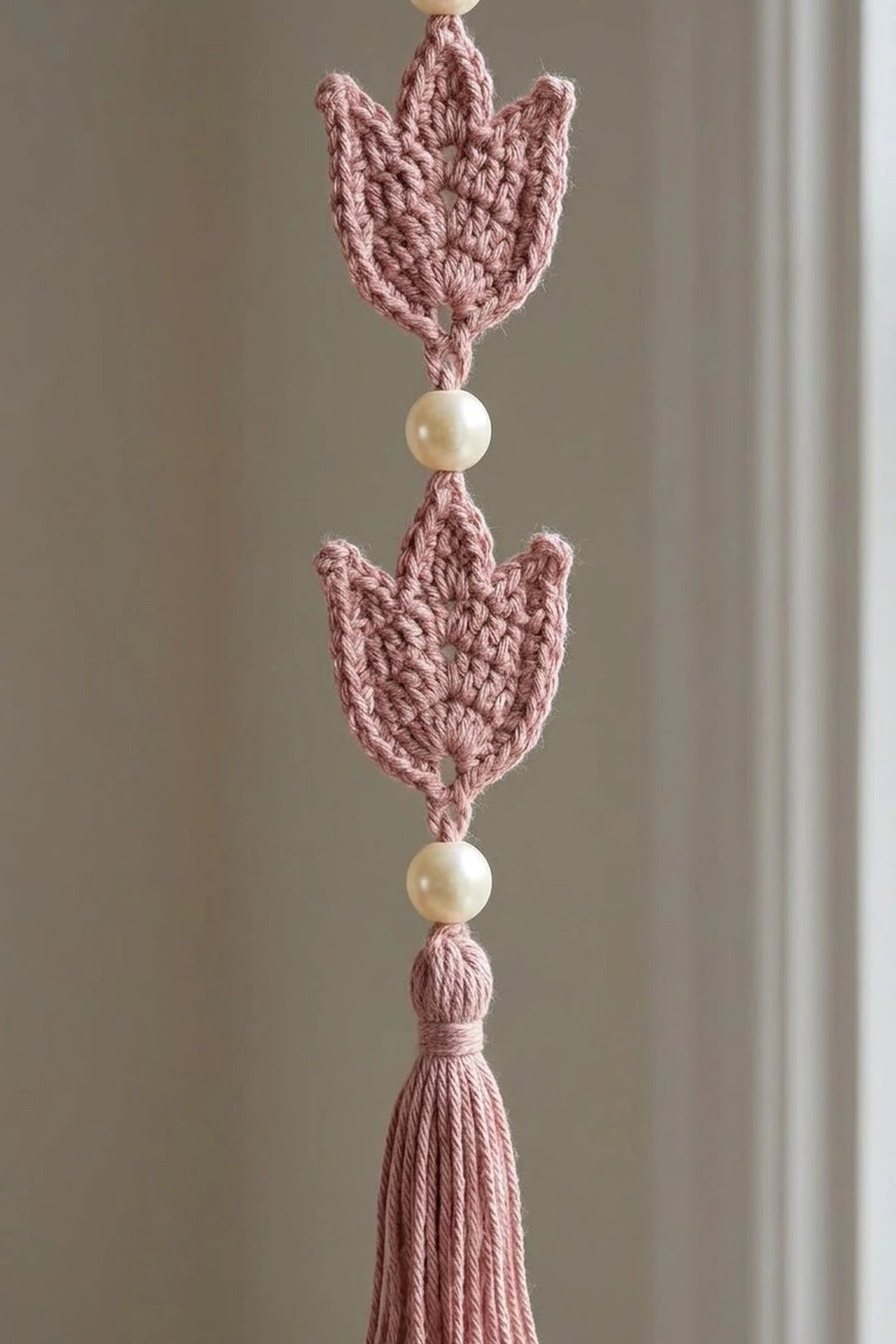
The Rose Tulip Cascade is a single crocheted curtain panel for a doorway. An openwork lace header runs across the top and finishes in a row of scalloped shells. Sixteen vertical strands hang from the scallop points. Each strand alternates small pointed tulips with cream beads and ends in a soft tassel.
The yarn is a dusty rose/mauve cotton, and the beads are cream. The look is romantic and boho. Because the strands are three different lengths, the tassels hang at staggered heights and move when someone walks through.
This pattern uses US crochet terms. The finished panel is 32¾ in (83.2 cm) wide. It is 72 in (182.9 cm) long at the longest strands, 60 in (152.4 cm) at the medium strands, and 48 in (121.9 cm) at the shortest.
You work the header flat in rows from the top edge down: a lace net, then a shell row. Each strand is then crocheted straight down from a shell tip, with beads pre-threaded and tulips worked in line. A border adds side edging and a row of rod spaces. Tassels are tied on last. The result is one continuous piece.
Finished Size and Construction
- Finished size: 32¾ in (83.2 cm) wide × 72 in (182.9 cm) at longest point
- Skill level: Intermediate
- Terminology: US
- Yarn weight: #4 worsted cotton
- Hook: 5 mm (H-8)
- Number of pieces: 1 (header with 16 strands worked directly from it, plus 16 tied-on tassels)
- Layout: Lace header across the top, 16 strands spaced 2 in (5.1 cm) apart
- Header size before border: 32¼ × 6 in (81.9 × 15.2 cm)
- Header size after border: 32¾ × 6¾ in (83.2 × 17.1 cm)
- Border depth: ¾ in (1.9 cm) at the top, ¼ in (0.6 cm) at each side
Materials
Use a smooth, mercerized or combed worsted cotton. Cotton hangs straight, shows the tulip points clearly, and resists stretching better than acrylic. Avoid fuzzy yarn, because it hides the lace.
- Dusty Rose worsted cotton: 300 g (510 m)
- Cream beads: 300 beads, 10 mm, wooden or acrylic pearl, with a 4–5 mm hole (272 are needed)
Tools:
- 5 mm (H-8) hook
- Tapestry needle
- Big-eye beading needle or dental floss threader, for loading beads
- Stitch markers
- Stiff card, 4 in (10.2 cm) tall, for tassels
- Rust-proof pins and a blocking surface
- Slim tension rod or café rod, up to ½ in (1.3 cm) in diameter
All quantities include a margin of about 10–15%.
Abbreviations (US Terms)
- ch – chain
- sl st – slip stitch
- sc – single crochet
- hdc – half double crochet
- dc – double crochet
- tr – treble crochet
- st(s) – stitch(es)
- sp – space
- sk – skip
- rep – repeat
- RS – right side
Special stitches:
- BCh (bead chain): Slide 1 bead up against the hook, yo, and pull through. The bead is locked inside the chain.
- Picot-3 / Picot-4: Ch 3 (or 4), then sl st in the 3rd (or 4th) ch from the hook.
- Shell: 9 dc in the same st.
Gauge and Checkpoints
Gauge: 16 sc and 18 rows = 4 in (10.2 cm) in sc. Chains measure 4 ch = 1 in (2.5 cm) when hanging relaxed.
Test first: Before starting the header, make a 4 in (10.2 cm) sc swatch. Then make a test strand of two full units (see Strands) from a short chain. Two units should hang at 12 in (30.5 cm) and use 4 beads. One tulip should measure 2 in (5.1 cm) tall and 1½ in (3.8 cm) wide.
Checkpoints:
- After Row 1: 32¼ in (81.9 cm) wide
- After Row 6: 4 in (10.2 cm) deep
- After Row 8: 4¾ in (12.1 cm) deep
- After Row 9: 6 in (15.2 cm) deep to the scallop tips
- Shell tips: 2 in (5.1 cm) apart
Too big? Go down 0.5 mm in hook size.
Too small? Go up 0.5 mm in hook size.
If your chains are loose but your sc matches gauge, work only the strand chains with a hook 0.5 mm smaller.
Header
Ch 130.
Row 1: Sc in 2nd ch from hook and in each ch across. Turn. (129 sc)
Row 2: Ch 1, sc in first st, *ch 5, sk 3, sc in next st; rep from * across. Turn. (33 sc, 32 ch-5 loops)
Row 3: Ch 5 (counts as dc + ch 2), sc in first ch-5 loop, *ch 5, sc in next loop; rep from * 30 more times, ch 2, dc in last sc. Turn. (31 full ch-5 loops, plus a ch-2 sp at each end)
Row 4: Ch 1, sc in first dc, *ch 5, sc in next ch-5 loop; rep from * 30 more times, ch 5, sc in 3rd ch of turning ch. Turn. (33 sc, 32 ch-5 loops)
Rows 5–6: Repeat Rows 3–4.
Checkpoint: the header should be 4 in (10.2 cm) deep.
Row 7 (conversion row): Ch 3 (counts as dc), *3 dc in next ch-5 loop, dc in next sc; rep from * across. Turn.
Count: 33 dc (1 per sc) + 96 dc (3 per loop × 32) = 129 dc.
Row 8: Ch 1, sc in each st across. Turn. (129 sc)
Checkpoint: the header should be 4¾ in (12.1 cm) deep.
Row 9 (scallops): Ch 1, sc in first st, *sk 3, shell in next st, sk 3, sc in next st; rep from * across. Do not fasten off yet if you plan to start the border here. Otherwise, fasten off.
Count: 16 shells and 17 sc. Each repeat is 8 sts, so 16 × 8 + 1 = 129.
Place a marker in the 5th (center) dc of each shell. These 16 marked sts are the strand points.
Strands
Each strand is worked downward from one shell tip.
Strand lengths (measured from the scallop tip to the bottom of the tassel):
- S (short): 6 units – 41¼ in (104.8 cm), 13 beads
- M (medium): 8 units – 53¼ in (135.3 cm), 17 beads
- L (long): 10 units – 65¼ in (165.7 cm), 21 beads
Strand order, RS facing, right to left, strands 1–16:
L, M, S, M, L, M, S, M, M, S, M, L, M, S, M, L
That gives 4 L, 8 M, and 4 S strands. The pattern is symmetrical, so the panel reads as a soft wave.
Tulip (worked in line):
- Ch 7.
- Working up the chain: sl st in 2nd ch from hook, sc in next ch, hdc in next ch, dc in next ch, (dc, tr) in next ch.
- In the last ch (the one closest to the strand above), work: tr, picot-3, tr, picot-4, tr, picot-3, tr.
- Rotate and work down the other side of the chain: (tr, dc) in next ch, dc in next ch, hdc in next ch, sc in next ch, sl st in next ch.
- Sl st in the skipped bottom ch.
This makes a narrow base and a wide top with three points: two side picots and a taller center picot.
Unit (6 in / 15.2 cm): Ch 6, BCh, ch 2, BCh, ch 4, Tulip.
That is ch 6 at 1½ in (3.8 cm), plus a bead at ½ in (1.3 cm), plus ch 2 at ½ in (1.3 cm), plus a bead at ½ in (1.3 cm), plus ch 4 at 1 in (2.5 cm), plus a tulip at 2 in (5.1 cm). Total: 6 in.
To make each strand:
- Cut a length of yarn, but do not cut it from the ball. Thread the strand’s full bead count onto it with the beading needle.
- Join with a sl st in the marked center dc of the shell.
- Work the required number of units.
- End spacer: ch 1, BCh, ch 2. This adds 1¼ in (3.2 cm).
- Fasten off, leaving a 12 in (30.5 cm) tail for the tassel.
Checkpoint: hang the header and check each strand against its length before adding tassels. L strands should hang 61¼ in (155.6 cm) from the scallop tip to the last ch.
Border
The border is worked at the same gauge as the header: 4 sc/in. The side counts below do not include the corner groups. Each corner group is counted in the top total.
Border Row 1: With RS facing, join at the right side edge at the top of Row 8. Work up the side edge into the row ends:
- 1 sc in Row 8
- 2 sc in Row 7
- 3 sc in each net row (Rows 6–2), for 15 sc
- 1 sc in Row 1
That is 19 sc for the side. Then, working into the free loops of the foundation chain:
- 3 sc in the first loop
- 1 sc in each of the next 127 loops
- 3 sc in the last loop
Work down the left side to match (19 sc). Fasten off.
Counts:
- Right side: 19 sc
- Top: 129 sts worked 1 per loop, plus 4 extra corner sts, for 133 sc
- Left side: 19 sc
- Total: 171 sts
Border Row 2 (rod spaces, top edge only): Join in the first sc of the top 133. Ch 6 (counts as dc + ch 3), sk 3, *dc in next st, ch 3, sk 3; rep from * to the last st, dc in last st. Fasten off. (34 dc, 33 ch-3 sps)
Why the math works:
- Each side covers 4¾ in (12.1 cm), and 19 sc ÷ 4¾ in = 4 sc/in, which matches gauge. The sides lie flat with no flaring or pulling.
- The top uses each of the 129 foundation loops once. The corner groups add only the 4 extra sts needed to turn the corners.
- The rod-space repeat is 4 sts, and 133 = 4 × 33 + 1. The spaces fall evenly, with a dc at each end.
Weave the rod in and out through the ch-3 spaces.
Tassels (Make 16)
- Wrap yarn 30 times around the 4 in (10.2 cm) card.
- Slide an 8 in (20.3 cm) strand under the wraps at the top and tie it tightly.
- Cut the wraps at the bottom.
- Wrap the neck ½ in (1.3 cm) below the top 6 times, tie, and bury the ends inside the tassel.
- Trim the bottom to 4 in (10.2 cm).
Thread each strand’s tail through the top of a tassel. Tie it securely to the last ch, then bury the tail in the tassel.
Final Blocking
- Wet the header only, and gently press out the water.
- Pin the header to 32¾ × 6¾ in (83.2 × 17.1 cm).
- Pin each scallop point so the tips sit 2 in (5.1 cm) apart.
- Pin the net loops open into even diamonds.
- Let the header dry completely.
- Hang the panel. Mist the strands, then pin each tulip flat on a towel to sharpen its three points.
- Steam the tassels lightly and comb them straight. Re-trim if needed.
Final Quality-Control Checklist
- Header width is 32¾ in (83.2 cm) and depth is 6¾ in (17.1 cm).
- There are 16 scallops, each with 9 dc.
- There are 16 strands, in the order L, M, S, M, L, M, S, M, M, S, M, L, M, S, M, L.
- Strand lengths are 65¼ in, 53¼ in, and 41¼ in (165.7 cm, 135.3 cm, and 104.8 cm).
- There are 128 tulips in total, all with three points facing up.
- All 272 beads are locked in chains, with none sliding.
- Every tassel is 4 in (10.2 cm) and tied securely.
- All ends are woven in at least 1 in (2.5 cm).
Troubleshooting
- Header too wide: Your sc is loose. Redo it with a smaller hook so 129 sc measures 32¼ in (81.9 cm).
- Net rows sag: Keep each ch-5 even. Don’t stretch the loops while working the sc into them.
- Beads won’t slide: The holes are too small. Use beads with a 5 mm hole, or move the beads ahead in short batches.
- Tulips curl: The side chains are too tight. Work the ch 7 with a hook 0.5 mm larger.
- Strands twist: Hang the panel and let each strand untwist, then mist it and let it dry while hanging.
- Strand the wrong length: Count units against the bead count. Each unit uses 2 beads, plus 1 bead in the end spacer.
Care
Hand wash in cool water with mild soap. Press out the water and dry the panel flat or hanging. Spot-clean only if you used wooden beads.

Final Notes
The measurement chain starts with 129 sc measuring 32¼ in (81.9 cm). The header grows to 6 in (15.2 cm) deep at the 16 scallop tips, which sit 2 in (5.1 cm) apart. Each strand is built from 6 in (15.2 cm) units, plus a 1¼ in (3.2 cm) end spacer and a 4 in (10.2 cm) tassel. The border brings the header to 32¾ × 6¾ in (83.2 × 17.1 cm), so the drops reach 48, 60, and 72 in (121.9, 152.4, and 182.9 cm) overall.
Optional: for a wider doorway, add one 8-st repeat to the header (2 in / 5.1 cm) and one strand for each extra scallop.
Happy crocheting!