

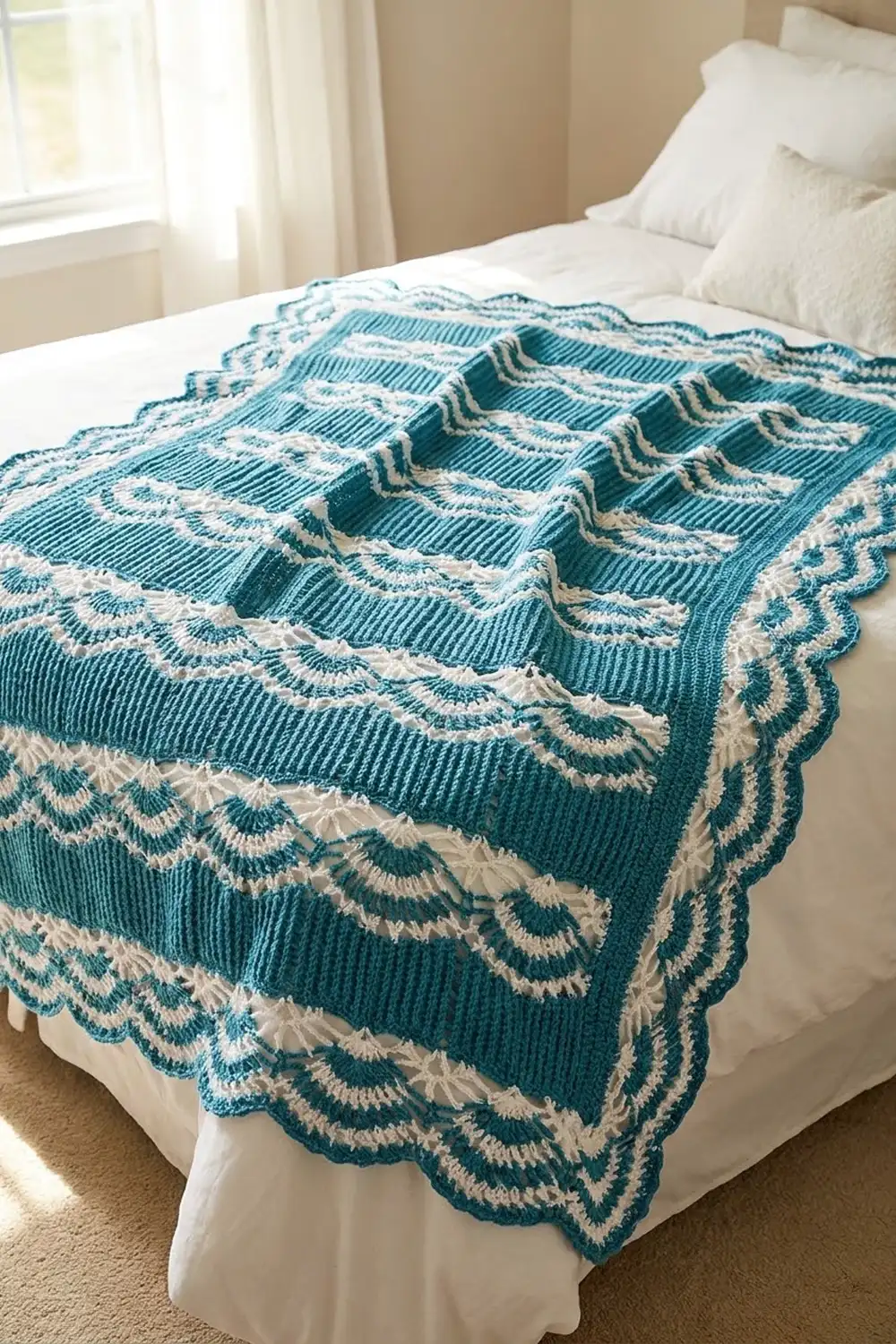
The Seafan Lace Throw is a single large rectangular blanket made from rows of ribbed fan motifs set into an airy chain lattice. Laid over a bed, the open spaces let the sheet underneath show through. The effect is light and elegant rather than heavy.
The body is worked in teal blue. A crisp white accent round sits inside the scalloped border, and the outer edge is a row of fan-shaped shells that echo the motifs in the body. Each fan is built from separate double-crochet spokes divided by small gaps, which gives the ribbed, radiating texture you see up close.
This pattern uses US crochet terms. The finished blanket measures 41.75 in x 57.25 in (106.0 cm x 145.4 cm) after blocking.
The blanket is made in one piece, worked flat in rows from the bottom edge up. Fan rows alternate with chain-lattice rows, and each new fan row is offset by half a repeat so the fans stagger. A leveling row squares off the top. Three border rounds finish the edge with a scalloped trim.
Finished Size and Construction
- Finished size: 41.75 in x 57.25 in (106.0 cm x 145.4 cm)
- Skill level: Intermediate
- Terminology: US crochet terms
- Yarn weight: Worsted (#4)
- Hook: 5.0 mm (H-8)
- Number of pieces: 1, a single rectangular panel
- Layout: 13 pattern repeats wide; 2 set-up rows, 21 four-row repeats, and 1 leveling row tall (87 rows)
- Piece size before border: 39.25 in x 54.75 in (99.7 cm x 139.1 cm)
- Border depth: 1.25 in (3.2 cm) per edge, which adds 2.5 in (6.4 cm) to each dimension
Materials
Yarn advice: Choose a smooth worsted-weight cotton or cotton blend so the lace drapes and the fan spokes stay crisp. Fuzzy or very stretchy yarns blur the ribs and let the lattice sag. Quantities below assume roughly 170 m per 100 g.
- Teal (main color): 1,200 g, about 2,040 m
- White (accent): 50 g, about 85 m
These quantities include a margin of about 10% for gauge variation and the swatch.
Tools:
– 5.0 mm (H-8) crochet hook
– Tapestry needle
– 6 locking stitch markers
– Scissors
– Measuring tape
– Blocking mats or a large padded surface, rust-proof pins, and a spray bottle
Abbreviations (US Terms)
- ch: chain
- sl st: slip stitch
- sc: single crochet
- hdc: half double crochet
- dc: double crochet
- tr: treble crochet
- sk: skip
- st(s): stitch(es)
- sp(s): space(s)
- RS / WS: right side / wrong side
- rep: repeat
Special stitches
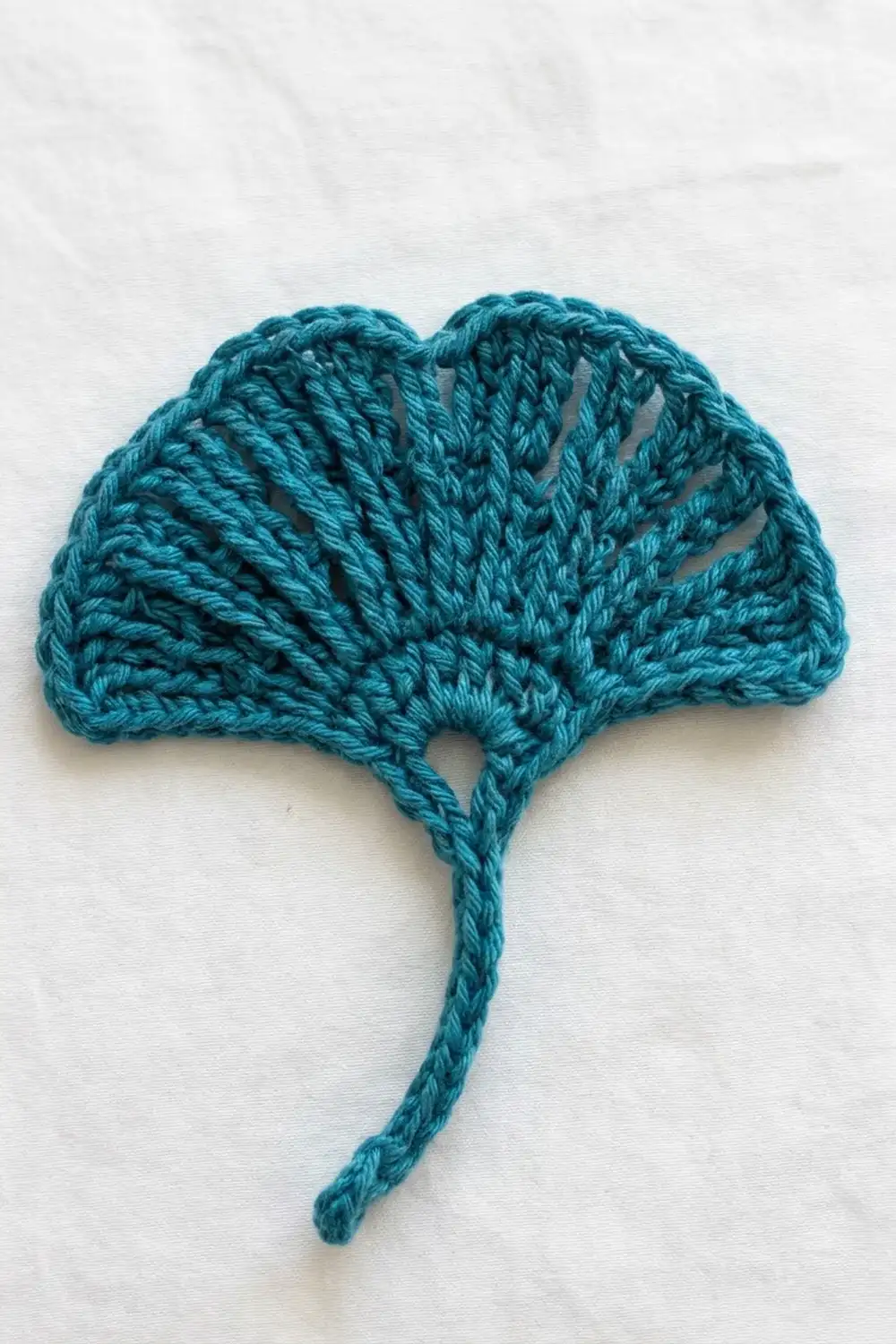
- Fan: (dc, ch 1) 6 times, dc, all in the same st. This makes 7 dc and 6 ch-1 sps. The 4th dc is the center.
- Half fan (row start): ch 3 (counts as dc), (ch 1, dc) 3 times in the same st. This makes 4 dc.
- Half fan (row end): (dc, ch 1) 3 times, dc, all in the same st. This makes 4 dc.
- Border shell: (dc, ch 1) 4 times, dc, all in the same st. This makes 5 dc.
- Corner shell: (dc, ch 1) 6 times, dc, all in the same corner sp. This makes 7 dc.
Gauge and Checkpoints
Base gauge: 16 sc = 4 in (10.2 cm) in Row 1.
Pattern gauge:
– One 12-st repeat = 3 in (7.6 cm) wide.
– Rows 1–2 = 1.75 in (4.4 cm) tall.
– One four-row repeat (Rows 3–6) = 2.5 in (6.4 cm) tall.
– The leveling row = 0.5 in (1.3 cm) tall.
Test swatch first. Ch 38. Work Rows 1–2, then Rows 3–6 twice, then the leveling row. Use 3 repeats in place of 13 throughout. Lightly block the swatch. It should measure 9.25 in x 7.25 in (23.5 cm x 18.4 cm).
Checkpoints for the blanket:
– Row 1: 39.25 in (99.7 cm) wide
– Row 2: 1.75 in (4.4 cm) tall
– Row 22: 14.25 in (36.2 cm) tall
– Row 46: 29.25 in (74.3 cm) tall
– Row 86: 54.25 in (137.8 cm) tall
– Row 87: 54.75 in (139.1 cm) tall
If your gauge is off:
– If your swatch is too big, go down 0.5 mm.
– If it is too small, go up 0.5 mm.
– If the width matches but the height does not, adjust how high you pull up your dc loops rather than changing hooks. The border math depends on both measurements.
Blanket Body
All of the body is worked in teal. Fans are worked into single stitches. The ch-5 lattice loops are skipped on fan rows, and they stay open to form the windows of the lace.
Foundation: Ch 158.
Row 1 (WS): Sc in 2nd ch from hook and in each ch across, turn. (157 sc)
Row 2 (RS): Work a half fan in the first sc. Sk 5 sc, sc in next sc, sk 5 sc, fan in next sc. Rep from * 11 more times. Sk 5 sc, sc in next sc, sk 5 sc, then work a row-end half fan in the last sc. Turn.
(12 fans, 2 half fans, 13 sc)*
Row 3 (WS, lattice): Ch 1, sc in first dc. Ch 5, dc in next sc, ch 5, sc in center dc of next fan. Rep from * across, ending ch 5, dc in last sc, ch 5, sc in 3rd ch of turning ch. Turn.
(14 sc, 13 dc, 26 ch-5 loops = 157 sts)*
Row 4 (RS, offset fans): Ch 1, sc in first sc. Fan in next dc, sc in next sc. Rep from * across, skipping all ch-5 loops. Turn.
(13 fans, 14 sc)*
Row 5 (WS, lattice): Ch 3 (counts as dc). Ch 5, sc in center dc of next fan, ch 5, dc in next sc. Rep from * across. Turn.
(14 dc, 13 sc, 26 ch-5 loops = 157 sts)*
Row 6 (RS, fans): Work a half fan in the first dc. Sc in next sc, fan in next dc. Rep from * 11 more times. Sc in next sc, then work a row-end half fan in the top of the turning ch. Turn.
(12 fans, 2 half fans, 13 sc, matching Row 2)*
The fans now sit back above the Row 2 fans. Row 4 fans sit between them, which creates the stagger.
Rows 7–86: Rep Rows 3–6 twenty more times, for 21 repeats in total. Row 86 is a Row 6-type fan row. The piece now measures 54.25 in (137.8 cm) tall.
Row 87 (WS, leveling): Ch 1, sc in first dc.
– *Ch 2, hdc in 2nd dc before next sc.
– Ch 2, tr in sc.
– Ch 2, hdc in 2nd dc of next fan.
– Ch 2, sc in center dc of the same fan.
– Rep from * across.
In the last repeat, the hdc goes into the 2nd dc of the half fan, and the final sc goes into the top of the turning ch. Do not turn. Fasten off teal only if you prefer to start the border at a corner.
(14 sc, 26 hdc, 13 tr, 52 ch-2 sps = 157 sts)
The tr fills each valley and the sc sits on each peak, so the top edge is straight. The body measures 39.25 in x 54.75 in (99.7 cm x 139.1 cm).
Border
Border gauge: 4 sc per inch on every edge. This is the same density as Row 1, so the border lies flat without stretching or ruffling the body.
Round 1 (teal): With the RS facing, work around the whole blanket. Work (sc, ch 2, sc) into each of the 4 corner sts: the first and last sts of Row 87, and the first and last foundation ch loops.
- Top edge: Work 1 sc in each st and 2 sc in each ch-2 sp. That gives 155 sc between the corner sts. Every 12-st repeat yields 12 sc.
- Bottom edge: Work 1 sc in each of the 155 foundation ch loops between the corners.
- Long sides: Work 219 sc evenly along the row ends between the corners:
- 7 sc across Rows 1–2
- 10 sc per four-row repeat (21 x 10 = 210)
- 2 sc across Row 87
This matches 54.75 in x 4 sc/in = 219.
Sl st to the first sc to join.
Count:
– Each short side between corner ch-2 sps: 1 + 155 + 1 = 157 sc
– Each long side: 1 + 219 + 1 = 221 sc
– Total: 2 x 157 + 2 x 221 = 756 sc, plus 4 ch-2 sps
Fasten off teal.
Round 2 (white, conversion round): Join white in any corner sp. Work 1 sc in each sc around, and (sc, ch 2, sc) in each corner sp. Join and fasten off.
Count:
– 756 sc worked 1-per-stitch + 8 corner sc = 764 sc
– Each short side between corner sps: 159 sc
– Each long side: 223 sc
Round 3 (teal, scallops): Join teal in any corner sp and work a corner shell there, beginning with ch 4 to count as dc plus ch 1.
Along each side: *Sk 3 sc, sc in next sc, sk 3 sc, border shell in next sc. Rep from * to the last 7 sc before the corner. Sk 3 sc, sc in next sc, sk 3 sc, corner shell in the corner sp.
Continue around and join to the 3rd ch of the beginning ch-4. Fasten off.
Count:
– Each short side: 19 border shells and 20 sc
– Each long side: 27 border shells and 28 sc
– Plus 4 corner shells, for 96 scallops around
Why the math works: Each side follows the sequence sk 3, sc, sk 3, then (shell, sk 3, sc, sk 3) repeated. That is 7 + 8 x (number of shells) stitches.
– Short sides: 7 + 8 x 19 = 159 ✓
– Long sides: 7 + 8 x 27 = 223 ✓
No partial shells are needed, so every corner turns cleanly.
The three rounds add 1.25 in (3.2 cm) per edge: about 0.25 in (0.6 cm) each for Rounds 1 and 2, and 0.75 in (1.9 cm) for the scallops.
Final Blocking
- Weave in all ends along the stitch posts. Never weave through the lattice loops.
- Soak the blanket in cool water for 15 minutes, then press out the water. Do not wring it.
- Roll it in towels to remove excess moisture.
- Lay it flat and shape it to 41.75 in x 57.25 in (106.0 cm x 145.4 cm). Pin the 4 corners first.
- Pin the midpoints of each side, then pin every border scallop at its center dc.
- Gently open each body fan so the spokes fan out evenly and the ch-5 windows are open.
- Let it dry completely, usually 24–48 hours, before unpinning.
Final Quality-Control Checklist
- The body has 13 repeats across and 87 rows.
- Row 87 is level, with no dips at the tr valleys.
- Both long sides measure 54.75 in (139.1 cm) before the border.
- The border counts are correct: 159 and 223 sc per side in Round 2.
- There are 96 scallops in total, and each corner has a 7-dc corner shell.
- The finished blanket measures 41.75 in x 57.25 in (106.0 cm x 145.4 cm).
- No lattice loops are twisted or caught by fans.
- All ends are secure and invisible from the RS.
Troubleshooting
- Fans cup or curl: Your ch-1 sps are too tight. Loosen them, or use a slightly looser tension on fan rows only.
- Fans ruffle: Your dc are too loose. Snug the yarn on each yarn-over.
- Width grows row by row: Recount 157 sts on each lattice row. A missed skip on a fan row is the usual cause.
- Fans don’t stagger: Make sure fans always go into the dc of the lattice row and never into the sc.
- Lattice loops sag: Use a firmer yarn, or check that each loop is exactly ch 5.
- Border ruffles: Recheck the 219 side sc in Round 1. Add or remove stitches evenly to match 4 sc/in.
- Border pulls in: You likely worked fewer than 2 sc in the top ch-2 sps.
- Scallops don’t fit at a corner: Recount Round 2 to 159 or 223 sc per side before starting Round 3.
Care
Hand wash or machine wash on a cool, gentle cycle in a mesh bag. Lay flat to dry and reshape the fans and scallops while damp.
Final Notes
The whole blanket rests on one measurement chain. Start with 16 sc = 4 in (10.2 cm) and 3 in (7.6 cm) per 12-st repeat, giving 157 sts = 39.25 in (99.7 cm). Rows 1–2 measure 1.75 in (4.4 cm), each four-row repeat measures 2.5 in (6.4 cm), and the leveling row adds 0.5 in (1.3 cm), for a body length of 54.75 in (139.1 cm).
The border uses the same 4 sc/in density: 157 and 221 sc per side in Round 1, then 159 and 223 in Round 2. Both fit the 8-st scallop repeat exactly. The 1.25 in (3.2 cm) border brings the blanket to 41.75 in x 57.25 in (106.0 cm x 145.4 cm).
Check your measurements at every checkpoint and the finished throw will block out square and even.
Happy crocheting!