

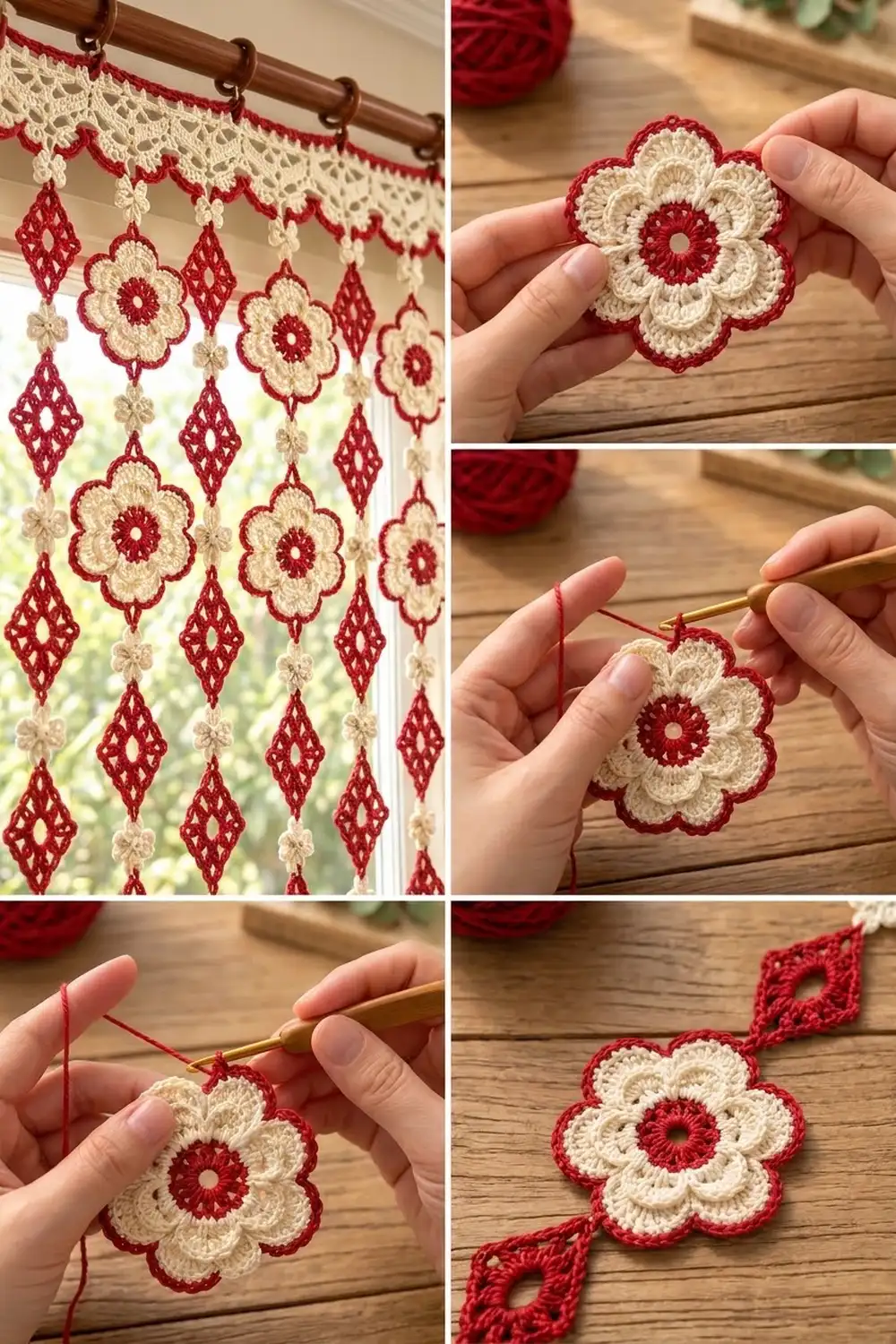
This curtain gives a window a soft, folk-style look. A cream lace header with a red scalloped edge holds nine hanging strands. Red openwork diamonds, layered cream-and-red flowers and tiny cream puff florets alternate down each strand, and light shines through the gaps between them.
The palette uses just two colors, a deep cranberry red and a warm cream. Red outlines every flower and forms every diamond. Cream carries the lace and the florets. The look is cottage-style and a little festive, and it works all year.
The pattern uses US crochet terms. The finished curtain measures 36.2 in (91.9 cm) wide and 34 in (86.4 cm) long, including a 4 in (10.2 cm) header.
You make three small motifs: flowers, diamonds and florets. You build each strand from the top down and join the pieces as you go, so there is very little sewing. You crochet the header last, and its scallop row picks up the top of every strand.
Finished Size and Construction
- Finished size: 36.2 in (91.9 cm) wide x 34 in (86.4 cm) long
- Skill level: Intermediate
- Terminology: US crochet terms
- Yarn weight: DK (weight 3) cotton
- Hook: 3.5 mm (E-4)
- Number of pieces: 117 motifs (8 flowers, 46 diamonds, 63 florets) plus 1 header
- Layout: 9 strands hanging 4 in (10.2 cm) apart from one header
- Piece size: flower 4 in (10.2 cm) across; diamond 2.25 x 3.75 in (5.7 x 9.5 cm); floret 1 in (2.5 cm)
- Size before border: strands 29.5–30 in (74.9–76.2 cm) long
- Border depth: header 4 in (10.2 cm) deep, including scallops
Materials
Use a smooth, mercerized DK cotton with about 120 m per 50 g. Cotton keeps the diamonds crisp and hangs straight. Avoid soft, stretchy yarns, because the strands will lengthen over time.
- Red (cranberry): 250 g, about 600 m
- Cream (ivory): 150 g, about 360 m
These amounts include a margin of about 15 percent for test motifs and joining tails.
Tools:
– 3.5 mm (E-4) crochet hook
– Tapestry needle
– Scissors
– 10 curtain rings, about 1 in (2.5 cm) inner diameter
– Rust-proof pins and a blocking mat
– Spray bottle
– Measuring tape
Abbreviations (US Terms)
- ch – chain
- sl st – slip stitch
- sc – single crochet
- hdc – half double crochet
- dc – double crochet
- tr – treble crochet
- sp – space
- st(s) – stitch(es)
- RS – right side
Special stitches:
– Shell: (dc, ch 1, dc, ch 1, dc) in the same st.
– Puff: (yo, insert hook in ring, yo, pull up a loop) 3 times, yo and pull through all 7 loops on hook.
– Join loop: wherever the pattern calls for a ch-3 loop, work ch 1, sl st into the named loop on the neighboring piece, ch 1 instead.
– Drop-stitch join: take the hook out of the working loop, insert it from front to back through the named loop, pick up the dropped loop and pull it through.
Gauge and Checkpoints
Gauge: 18 sc = 4 in (10.2 cm) in the header base rows.
Make one flower and one diamond first. They show your gauge faster than a swatch, and you crochet them at the same tension as the strands.
Flower checkpoints:
– After Round 1: 1.25 in (3.2 cm) across
– After Round 3: 2.5 in (6.4 cm) across the inner petals
– After Round 6: 4 in (10.2 cm) across opposite picots
Diamond checkpoints:
– After Round 2: 1.75 in (4.4 cm) wide x 3.25 in (8.3 cm) tall
– After Round 3: 2.25 in (5.7 cm) wide x 3.75 in (9.5 cm) tall
Floret checkpoint: 1 in (2.5 cm) across.
If your motifs come out more than 0.5 in (1.3 cm) too big, go down half a hook size. If they are too small, go up half a size. Small motif differences only change strand length. The header width does matter, so check the 18 sc gauge before you start the header.
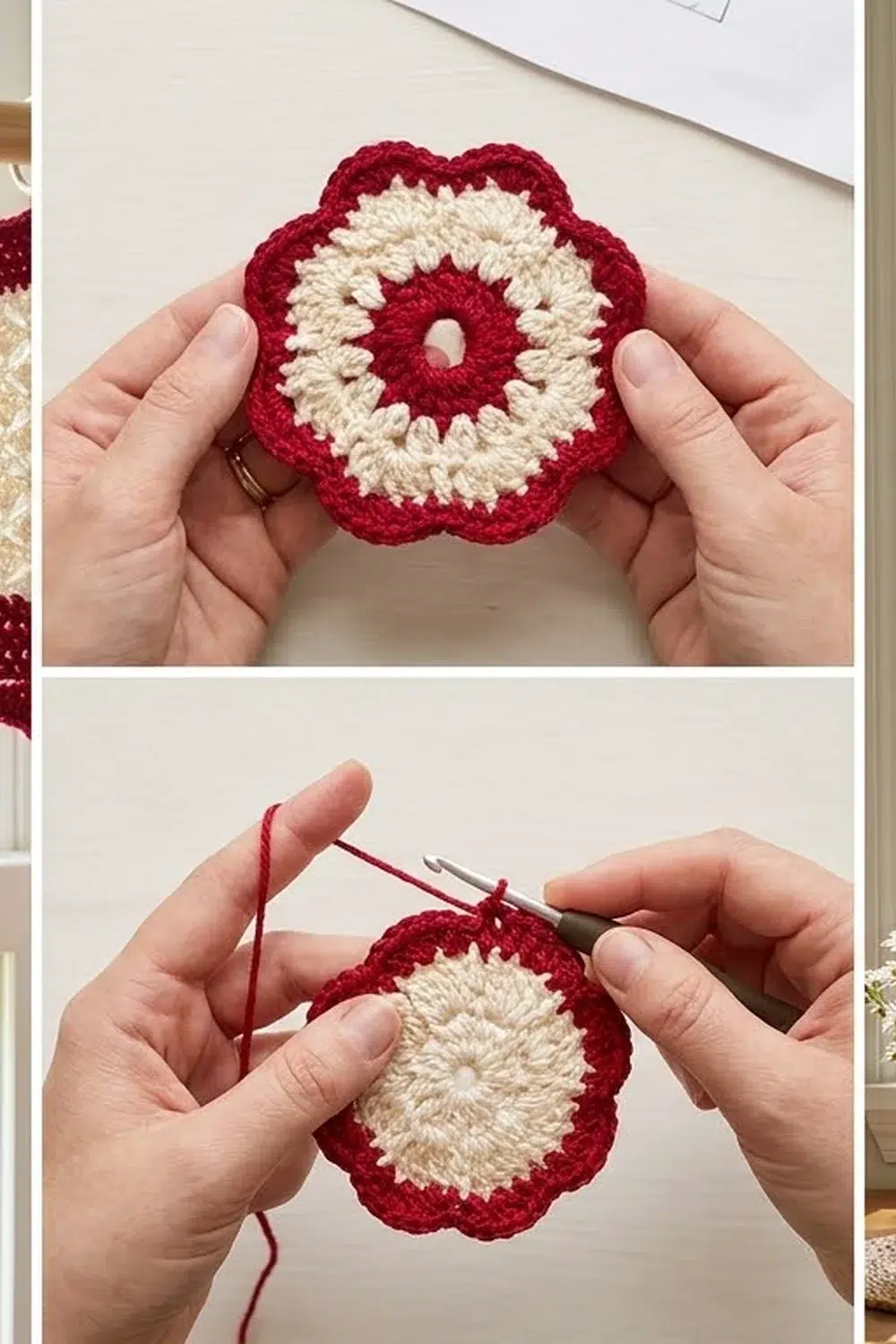
Flower Motif (make 8)
Round 1 (red): Ch 6, sl st to first ch to form a ring. Ch 3 (counts as dc), 17 dc in ring, sl st to top of ch-3. (18 dc) Fasten off. The center of the ring stays open.
Round 2 (cream): Join cream in any dc. Ch 1, sc in same st, ch 3, skip 2 dc, sc in next dc; repeat from * 4 more times, ch 3, skip 2 dc, sl st to first sc. (6 sc, 6 ch-3 sps)*
Round 3 (cream, inner petals): In each ch-3 sp work (sc, hdc, 3 dc, hdc, sc). Sl st to first sc. (6 petals, 7 sts each, 42 sts)
Round 4 (cream, back loops): Fold the petals forward. Working behind them, ch 1, sc around the post of the first Round 2 sc from the back, ch 5, sc around the post of the next Round 2 sc, ch 5; repeat from * 4 more times, sl st to first sc. (6 sc, 6 ch-5 loops)* Each ch-5 loop sits directly behind one inner petal.
Round 5 (cream, outer petals): In each ch-5 loop work (sc, hdc, 2 dc, 3 tr, 2 dc, hdc, sc). Sl st to first sc. (6 petals, 11 sts each, 66 sts) Fasten off. The larger outer petals show behind the inner petals, which gives the layered look.
Round 6 (red, outline): Join red in the first sc of any outer petal. Ch 1, sc in each st around, working (sc, ch 3, sc) in the center tr of each petal. Sl st to first sc. (66 sc worked 1 per st + 6 extra sc = 72 sc, plus 6 ch-3 picots) Each petal now has 12 sc.
When a flower hangs below a floret, replace the ch 3 at the top petal with a join loop into that floret’s bottom loop. Fasten off.
Diamond Motif (make 46)
Round 1 (red): Ch 6, sl st to form a ring. Ch 1, sc in ring, ch 7, sc in ring, ch 3; repeat from * once more, sl st to first sc. (4 sc, 2 ch-7 loops, 2 ch-3 loops)* The ch-7 loops become the long top and bottom points. The ch-3 loops become the short side points.
Round 2: Sl st into next ch-7 loop. Ch 3 (counts as dc), (4 dc, ch 3, 5 dc) in same loop, (2 dc, ch 2, 2 dc) in next ch-3 loop, (5 dc, ch 3, 5 dc) in next ch-7 loop, (2 dc, ch 2, 2 dc) in last ch-3 loop, sl st to top of ch-3. (28 dc, 2 ch-3 point sps, 2 ch-2 side sps)
Round 3: Ch 1, sc in each dc around, working (2 sc, ch 3, 2 sc) in each ch-3 point sp and 3 sc in each ch-2 side sp. Sl st to first sc. (28 sc worked 1 per st + 14 sc worked into spaces = 42 sc, plus 2 ch-3 point loops)
When a diamond hangs below a floret, replace the top ch 3 with a join loop into the floret’s bottom loop. Leave the bottom ch-3 loop free for the next floret. Fasten off.
Floret (make 63)
Round 1 (cream): Make a magic ring. Ch 2, puff in ring (ch-2 does not count). Ch 3, puff in ring; repeat from * 2 more times, ch 3, sl st to top of first puff. Pull ring closed. (4 puffs, 4 ch-3 loops)*
Loop 1 (between puffs 1 and 2) is the top loop. Loop 3 (between puffs 3 and 4) is the bottom loop, directly opposite.
To join a floret below a motif, work loop 1 as a join loop into that motif’s bottom ch-3 loop. Make the 9 top florets with a plain loop 1.
Make All Pieces
| Piece | Color(s) | Quantity |
|---|---|---|
| Flower | red + cream | 8 |
| Diamond | red | 46 |
| Floret | cream | 63 |
Strand A (diamond strand, make 5): 7 florets + 6 diamonds.
Length: 7 x 1 in + 6 x 3.75 in = 29.5 in (74.9 cm).
Strand B (flower strand, make 4): 7 florets + 2 flowers + 4 diamonds.
Length: 7 x 1 in + 2 x 4 in + 4 x 3.75 in = 30 in (76.2 cm).
Totals: diamonds 5 x 6 + 4 x 4 = 46; flowers 4 x 2 = 8; florets 9 x 7 = 63.
Layout grid (F = floret, D = diamond, Fl = flower; read each strand top to bottom):
Position:  1  2  3  4  5  6  7  8  9
Strand:    A  B  A  B  A  B  A  B  A

A = F-D-F-D-F-D-F-D-F-D-F-D-F
B = F-Fl-F-Fl-F-D-F-D-F-D-F-D-F
Joining the Strands
You make every join on a piece’s last round, so build each strand from the top down.
- Make one floret with a plain top loop. This is the top of the strand.
- Work the next motif up to its last round. On that round, replace the top ch 3 with a join loop into the floret’s bottom loop.
- Make the next floret, working its top loop as a join loop into the motif’s bottom ch-3 loop.
- Repeat steps 2–3 down the strand, following the grid. End with a floret.
Stitch-to-stitch logic: each join connects one ch-3 loop to one ch-3 loop. The join loop (ch 1, sl st, ch 1) takes the place of exactly one ch 3. No stitches are added or lost, so every motif keeps its stated count.
Tension: work the join chains at the same tension as a normal ch 3. Tight joins pucker the points, and loose joins let the motifs twist.
Size checkpoint: lay each strand flat without stretching it. Strand A should measure 29.5 in (74.9 cm) and Strand B 30 in (76.2 cm), within 0.5 in (1.3 cm).
Border: Header Valance
The header is the curtain’s only border. At 18 sc = 4 in (10.2 cm), each 18-st section of the header equals one 4 in (10.2 cm) strand spacing.
Row 1 (red): Ch 164, sc in 2nd ch from hook and in each ch across. Turn. (163 sc)
Row 2 (red): Ch 1, sc in each st across. Turn. (163 sc) Fasten off.
Row 3 (cream): Join cream. Ch 1, sc in first st, skip 2, shell in next st, skip 2, sc in next st; repeat from * across. Turn. (27 shells, 28 sc)*
Row 4 (cream): Ch 5 (counts as dc and ch 2), sc in center dc of next shell, ch 2, dc in next sc, ch 2; repeat from * across, ending at . Turn. (28 dc, 27 sc, 54 ch-2 sps)*
Row 5 (cream): Ch 1, sc in first dc, shell in next sc, sc in next dc; repeat from * across. Turn. (27 shells, 28 sc)*
Rows 6–7 (cream): Repeat Rows 4 and 5. Fasten off.
Row 8 (red): Join red. Ch 1, sc in first sc, sc in each of the 5 sts of the next shell (dc, ch-1 sp, dc, ch-1 sp, dc), sc in next sc; repeat from * across. Turn. (1 + 27 x 6 = 163 sc)*
Row 9 (red, scallops and strand join): Ch 1, sc in first st, skip 2, 7 dc in next st, skip 2, sc in next st; repeat from * across. (27 scallops of 7 dc, 28 sc)*
On scallops 2, 5, 8, 11, 14, 17, 20, 23 and 26, attach a strand after the 4th dc with a drop-stitch join through the top loop of the strand’s top floret. Attach the strands in order A, B, A, B, A, B, A, B, A. Fasten off.
Short ends: each end is 9 rows tall. Work 1 row of red sc along each end, about 18 sc per end, to neaten the color changes.
Why the math works: 163 sc = 1 + 27 repeats of 6 sts, so the shells and scallops fit exactly. Three scallops cover 18 sts, which is 4 in (10.2 cm). Strands on every third scallop therefore hang 4 in (10.2 cm) apart. Eight gaps x 4 in = 32 in (81.3 cm) between the outer strands, leaving about 2 in (5.1 cm) at each end, for 36.2 in (91.9 cm) total. The drop-stitch join adds no stitches, so each scallop keeps 7 dc.
Rings: sew 10 rings to the top edge of Row 1 at sts 1, 19, 37, 55, 73, 91, 109, 127, 145 and 163, one every 18 sts.
Final Blocking
- Lay the curtain face down on a large mat or a towel-covered bed.
- Pin the header straight to 36.2 x 4 in (91.9 x 10.2 cm).
- Pin each scallop into an even curve.
- Straighten each strand below its scallop, keeping the strands 4 in (10.2 cm) apart.
- Pin each diamond at its top and bottom points to 3.75 in (9.5 cm) tall.
- Pin each flower at its 6 picots to 4 in (10.2 cm) across. Lift the inner petals slightly so both layers stay visible.
- Spray until damp but not soaked.
- Let it dry completely, at least 12 hours, before you unpin it.
Final Quality-Control Checklist
- Header is 36.2 in (91.9 cm) wide and 4 in (10.2 cm) deep.
- Header has 27 scallops, with strands on scallops 2, 5, 8, 11, 14, 17, 20, 23 and 26.
- Strands alternate A, B, A, B, A, B, A, B, A.
- Every flower has 72 sc and 6 picots in its red outline.
- Every diamond has 42 sc and sharp top and bottom points.
- Every floret has 4 puffs and is joined through opposite loops.
- No joins are twisted, and every motif faces RS out.
- All tails are woven in at least 1 in (2.5 cm).
- The 10 rings are evenly spaced 4 in (10.2 cm) apart.
Troubleshooting
Flower cups instead of lying flat: the Round 4 chains are too tight. Rework them as ch-6 loops, or go up half a hook size for that round.
Inner petals hide the outer petals: make sure you work Round 4 around the Round 2 posts from the back, not into Round 3.
Diamonds look square: check that the top and bottom loops in Round 1 are ch 7 and the side loops are ch 3.
Strand twists: a motif was joined wrong side out. Undo that join and redo it with RS facing.
Header ruffles: the scallop row is too loose. Rework Row 9 with a smaller hook.
Header too narrow or too wide: recheck the 18 sc gauge and change hooks before you redo Row 1.
Care
Hand wash in cool water with mild soap. Roll it in a towel to remove water, then dry it flat and re-pin the points if needed. Don’t hang the curtain while it’s wet, because the weight stretches the strands.
Final Notes
Here is the measurement chain. Flowers measure 4 in (10.2 cm) across, diamonds 3.75 in (9.5 cm) tall and florets 1 in (2.5 cm). Together they make strands of 29.5–30 in (74.9–76.2 cm). The 163-stitch header gives 27 scallops and spaces the strands 4 in (10.2 cm) apart, for a finished curtain of 36.2 x 34 in (91.9 x 86.4 cm). Check each stage as you go, and the curtain will hang straight and even.
Happy crocheting!