

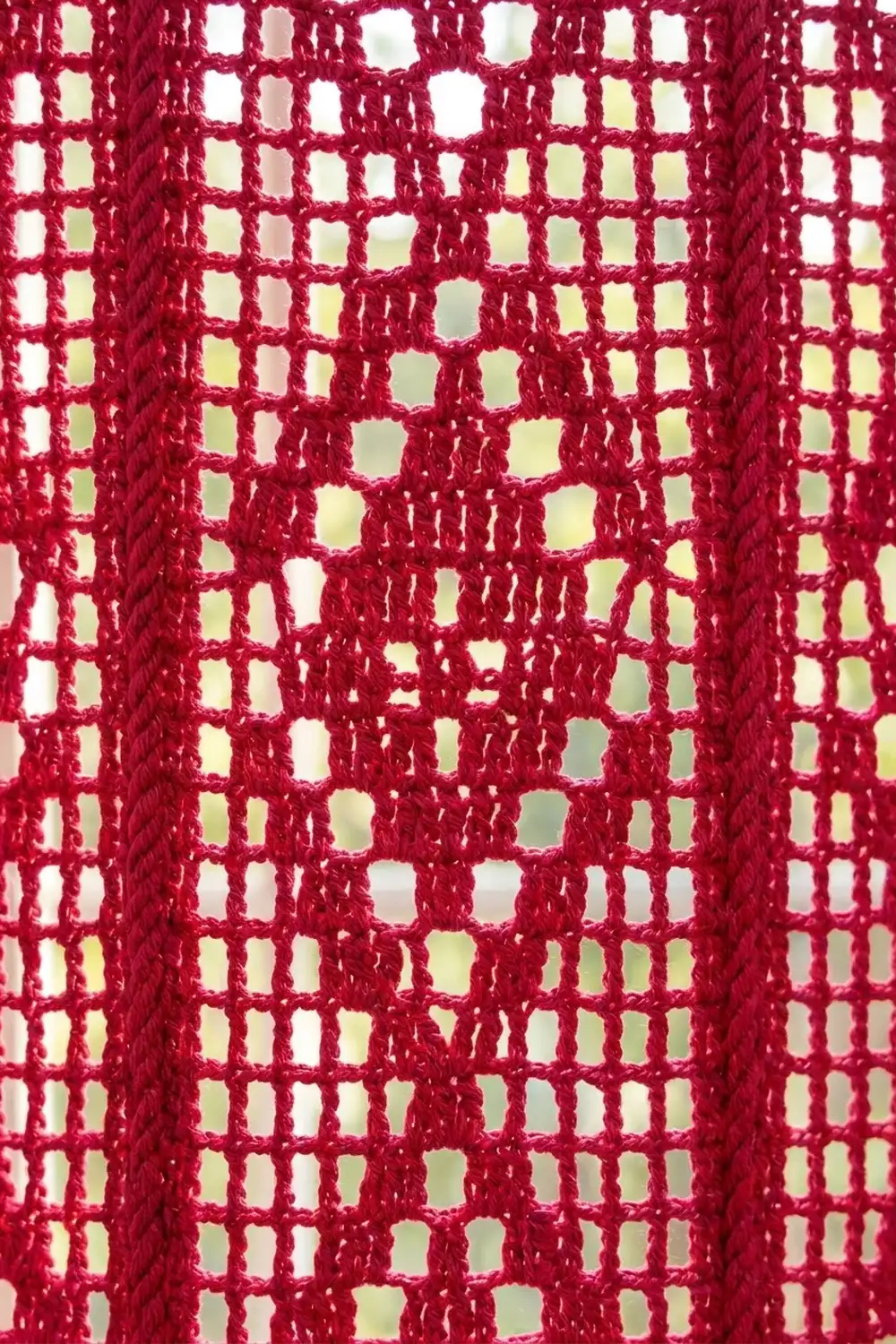
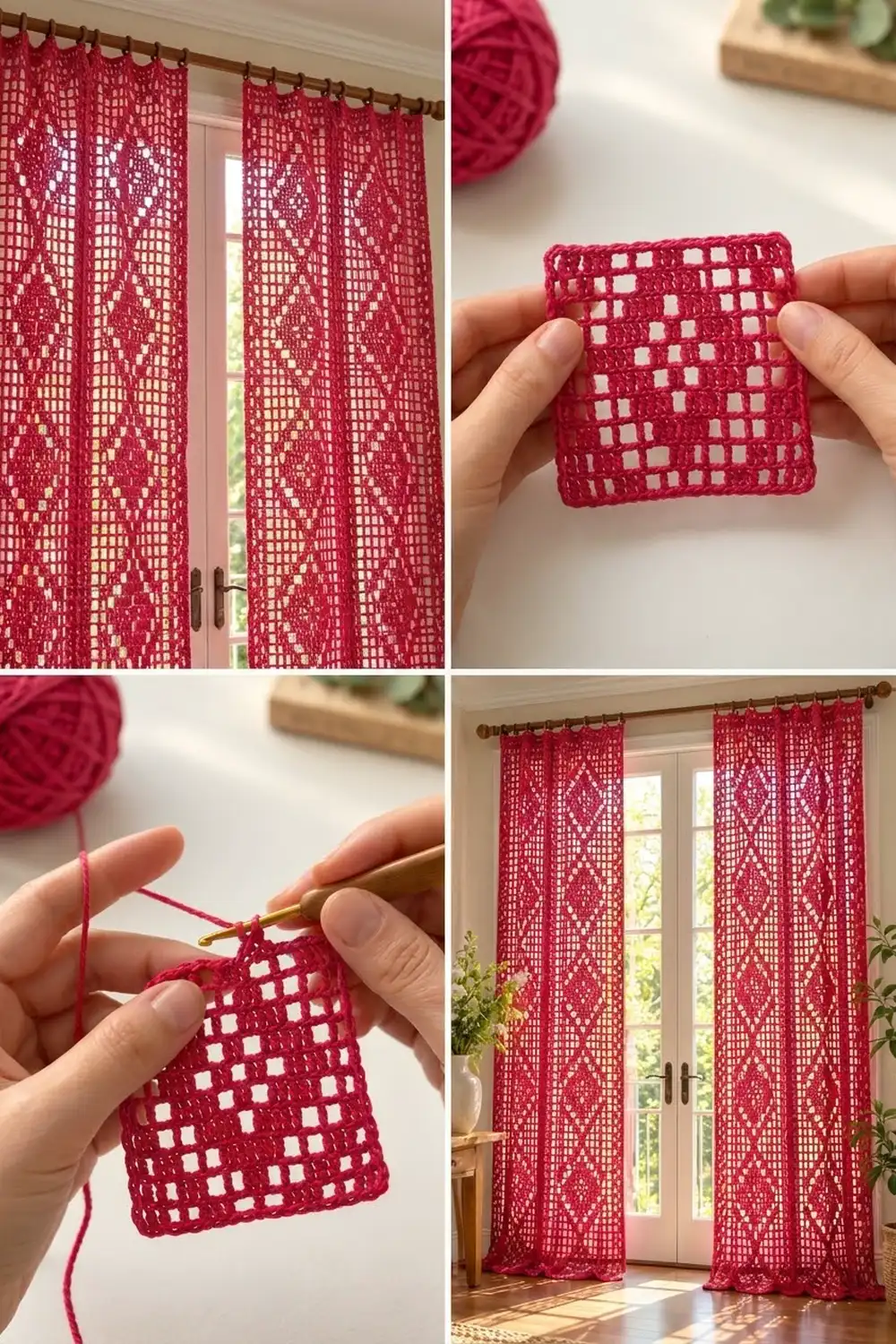
These curtain panels are worked in classic filet crochet. That means an open grid of double crochet mesh, with solid blocks that draw a pattern. Each panel has two vertical columns of stacked diamonds. Every diamond is a large lattice outline with a solid small diamond in its center. The outlines meet tip to tip, so the columns read as a continuous lattice of crossing diagonals.
The panels use one color, a deep raspberry red cotton, which glows when daylight comes through the open mesh. Solid one-square bars run along both side edges and down the middle of each panel, framing the two diamond columns. A narrow corded border finishes the edges, and crocheted loop tabs at the top slide straight onto a curtain rod.
This pattern uses US crochet terms. Each panel measures 31.75 in (80.6 cm) wide by 85.75 in (217.8 cm) long, plus 3 in (7.6 cm) loop tabs above the top edge. The pattern is written for one panel; make two for a pair.
Construction is simple. Each panel is worked flat in rows from the bottom up as one single piece, following a written 16-row diamond repeat. A three-round border goes around all four sides. The tabs are worked straight off the top border, so you don’t need any separate pieces.
Finished Size and Construction
- Finished panel size: 31.75 in x 85.75 in (80.6 cm x 217.8 cm), not counting tabs
- Hanging length including tabs: about 88.75 in (225.4 cm)
- Skill level: Intermediate (easy stitches, long project, needs careful counting)
- Terminology: US crochet terms
- Yarn weight: DK / light worsted (#3) cotton
- Hook: 4.0 mm (US G-6)
- Number of pieces: 2 separate panels, each worked in one piece; they are not joined to each other
- Layout: each panel is 41 squares wide x 113 rows long
- Piece size before border: 30.75 in x 84.75 in (78.1 cm x 215.3 cm)
- Border depth: 0.5 in (1.3 cm) on each side
Materials
Use a smooth mercerized or combed cotton in DK weight. Cotton holds the crisp square grid of filet much better than acrylic or wool, and it doesn’t fuzz in sunlight. Buy one dye lot for both panels.
- Raspberry red DK cotton: 650 g (1,495 m) per panel; 1,300 g (2,990 m) for a pair (based on 50 g / 115 m balls)
Tools:
- 4.0 mm (US G-6) crochet hook
- Tapestry needle
- At least 18 locking stitch markers (4 for the corners and 1 for the start of each of the 9 tabs; reuse them between steps)
- Measuring tape
- Rust-proof pins and blocking mats, or a large clean floor area covered with towels
- Spray bottle
The yarn amounts include a margin of about 10% for the gauge swatch, tension differences, and weaving in ends.
Abbreviations (US Terms)
- ch = chain
- sc = single crochet
- dc = double crochet
- st(s) = stitch(es)
- sp = space
- BLO / FLO = back loop only / front loop only
- rev sc = reverse single crochet (crab stitch)
- RS / WS = right side / wrong side
Filet squares. Every row starts with ch 3, which counts as the first dc. Each square after that is worked over the next 3 sts:
- O (open square): ch 2, skip next 2 sts, dc in next st.
- B (block): dc in next 3 sts. Over an open square, this means 2 dc in the ch-2 sp and dc in the next dc.
The first square of every row is a B. Work it as: ch 3, turn, dc in next 3 sts. The last dc of each row goes into the top of the turning ch.
Rev sc (crab stitch): working left to right, insert hook in the next st to the right, yarn over, pull up a loop, yarn over, pull through both loops.
Gauge and Checkpoints
- Filet gauge: 8 squares x 8 rows = 6 in x 6 in (15.2 cm x 15.2 cm), so each square is 0.75 in (1.9 cm) both ways.
- Stitch gauge: 16 sc = 4 in (10.2 cm). Filet also works out to 4 sts per inch (3 sts per 0.75 in square).
Test swatch first. Ch 27. Row 1: dc in 4th ch from hook and next 2 ch (first B), then O, O, O, O, O, O, B. That makes 25 sts, or 8 squares. Row 2: B, O, B, B, B, B, O, B. Repeat Rows 1 and 2 three more times for 8 rows. Block the swatch flat and measure.
- Too big (over 6.25 in / 15.9 cm): use a 3.75 mm hook.
- Too small (under 5.75 in / 14.6 cm): use a 4.5 mm hook.
Being off by just 0.25 in (0.6 cm) on the swatch adds up to about 1.3 in (3.3 cm) across the panel width, which is why the swatch matters.
Checkpoints on the panel (measured flat, unstretched):
- After Row 1: 30.75 in (78.1 cm) wide
- After Row 16: 12 in (30.5 cm) long
- After Row 48: 36 in (91.4 cm) long
- After Row 113: 84.75 in (215.3 cm) long
Panel Pattern
Row Layout
Every row of the panel is 41 squares, always arranged like this:
B, O, [Motif Row, 17 squares], O, B, O, [Motif Row, 17 squares], O, B
So 1 + 1 + 17 + 1 + 1 + 1 + 17 + 1 + 1 = 41 squares. Squares 1, 21, and 41 are always blocks; they form the two edge bars and the center bar. Squares 2, 20, 22, and 40 are always open.
Stitch count for every row: 124 sts (41 squares x 3 sts + 1 starting post). The count never changes, because a B and an O both use exactly 3 sts.
Each motif row is symmetrical, so it reads the same from the RS and the WS. Work every row exactly as written; you never need to reverse anything.
Motif Rows (17 squares each)
- M1: 8 O, B, 8 O
- M2: 7 O, B, O, B, 7 O
- M3: 6 O, B, 3 O, B, 6 O
- M4: 5 O, B, 5 O, B, 5 O
- M5: 4 O, B, 7 O, B, 4 O
- M6: 3 O, B, 4 O, B, 4 O, B, 3 O
- M7: 2 O, B, 4 O, 3 B, 4 O, B, 2 O
- M8: O, B, 4 O, 5 B, 4 O, B, O
- M9: B, 4 O, 7 B, 4 O, B
- M10: same as M8
- M11: same as M7
- M12: same as M6
- M13: same as M5
- M14: same as M4
- M15: same as M3
- M16: same as M2
Rows M1 to M9 build the top half of the lattice outline and the solid center diamond. M10 to M16 mirror them. The single block in M1 is the shared tip where one diamond meets the next. That’s what makes the diagonals cross in an X between diamonds.
The solid center diamond is 7 squares wide at its widest point (M9) and 7 rows tall (M6 to M12). The outline is 17 squares wide and touches the column edges in M9.
Foundation and Row 1
Ch 126.
Row 1 (M1): Dc in 4th ch from hook and next 2 ch (the skipped ch count as the first dc; first B made). Continue across the chain following the Row Layout, with M1 in both motif positions: O, 8 O, B, 8 O, O, B, O, 8 O, B, 8 O, O, B. On the chain, an O is ch 2, skip 2 ch, dc in next ch. (124 sts)
Check that the row measures 30.75 in (78.1 cm) wide.
Rows 2 to 113
Rows 2 to 16: Work M2 through M16 in order, each inside the Row Layout. (124 sts each row)
Rows 17 to 112: Repeat Rows 1 to 16 six more times, starting each repeat with M1. This gives seven full diamonds in each column.
Row 113: Work one more M1 row to close the tip of the last diamond. (124 sts) Do not fasten off.
The body now measures 30.75 in x 84.75 in (78.1 cm x 215.3 cm). The last row you worked is the top of the curtain.
Make the Second Panel
Make a second panel exactly like the first: Foundation through Row 113, then the border and tabs below. Use 650 g (1,495 m) of raspberry red for each panel.
The panels hang side by side on the rod and are not joined:
[ Panel 1 ] [ Panel 2 ]
 41 x 113    41 x 113
Border
Border gauge: 16 sc = 4 in (10.2 cm). The three border rounds add 0.5 in (1.3 cm) on each side.
Rnd 1 (RS): Ch 1, do not turn.
- Across the top of Row 113: 3 sc in first st (corner), sc in next 122 sts, 3 sc in last st (corner).
- Rotate and work down the side: 3 sc around each of the 113 row-end posts (339 sc).
- Rotate and work across the foundation chain: 3 sc in first ch (corner), sc in next 122 ch, 3 sc in last ch (corner).
- Work up the second side: 3 sc around each of the 113 row-end posts (339 sc).
Join with sl st to first sc. Stitch counts:
- Top: 128 sc (including both 3-sc corner groups)
- Each side: 339 sc (between corner groups)
- Bottom: 128 sc (including both 3-sc corner groups)
- Total: 934 sc. Place a marker in the center sc of each corner group.
Rnd 2: Ch 1, sc in each sc around, with 3 sc in each marked corner sc. Move markers up. Join.
- Top: 132 sc (5 at each corner plus 122 straight)
- Each side: 339 sc
- Bottom: 132 sc
- Total: 942 sc (934 + 2 at each of 4 corners)
Fasten off. Work the tabs next, before Rnd 3.
Loop Tabs (9 per panel)
The tabs go across the 122 straight sts along the top of Rnd 2, between the 5-st corner groups. Placement: skip 2 sts, then make 9 tabs of 6 sts each with 8 sts between tabs, ending with 2 sts. Check: 2 + (9 x 6) + (8 x 8) + 2 = 122.
Before you start, place a locking marker in the first st of each tab position.
Each tab: With RS facing, join yarn in BLO of the first st of the tab position.
- Row 1: Ch 1, sc in BLO of same st and next 5 sts. (6 sc)
- Rows 2 to 30: Ch 1, turn, sc in each sc across. (6 sc)
Fasten off, leaving a 12 in (30.5 cm) tail. Each tab is 1.5 in (3.8 cm) wide and 6 in (15.2 cm) long. Fold it toward the WS and whipstitch Row 30 to the WS of Rnd 1, directly behind the tab base. This makes a 3 in (7.6 cm) loop that fits a rod up to about 1.75 in (4.4 cm) in diameter.
The gaps between tabs are 2 in (5.1 cm).
Rnd 3: With RS facing, join yarn in any sc on a side. Ch 1, rev sc in each st around. Where a tab sits, work into the free front loops left by the BLO tab rows. Do not increase at the corners; the corded edge rounds them slightly. (942 rev sc) Join and fasten off.
Why the math works: Each filet row is 0.75 in (1.9 cm) tall, so 3 sc per row end gives 4 sc per inch, which matches the border gauge. Across the top and bottom, filet already works out to 4 sts per inch, so 1 sc per st lies flat. The 3-sc corner groups add 2 sts per corner per round, which turns each corner without cupping. Rnd 3 is worked 1 per st, so it neither pulls in nor ruffles.
Final Blocking
- Weave in all ends along solid blocks or the border, where they hide best.
- Soak the panel in cool water with a little wool wash for 15 minutes.
- Gently press out the water and roll the panel in towels. Do not wring.
- Lay it flat on mats or a towel-covered floor, RS up.
- Pin the corners first, to 31.75 in x 85.75 in (80.6 cm x 217.8 cm).
- Pin along each edge every 3 in (7.6 cm), keeping the edge bars straight.
- Nudge the mesh so each square sits square and the diamond diagonals run true.
- Let it dry completely, then unpin. Steam the tabs flat if they curl.
Final Quality-Control Checklist
- Every row has 124 sts and 41 squares.
- Squares 1, 21, and 41 are solid blocks in every row.
- Each column has 7 complete diamonds with matching tips.
- The center diamonds are 7 squares wide and 7 rows tall.
- The body measured 30.75 in x 84.75 in (78.1 cm x 215.3 cm) before the border.
- Border totals are 934, 942, and 942 sts.
- The 9 tabs are evenly spaced, with 2 in (5.1 cm) gaps.
- Both panels match in length to within 0.5 in (1.3 cm).
Troubleshooting
- Squares look like tall rectangles: your dc stitches are taller than your chains. Chain slightly looser or pull your dc loops lower. Rows should stay 0.75 in (1.9 cm) tall.
- The panel narrows toward the top: you are missing the last dc into the turning ch. Count 124 sts every few rows.
- A diamond is off-center: a motif row was misread. Each motif row must total 17 squares, so count before moving on.
- The border ruffles: go down one hook size for the border only, keeping the stitch counts the same.
- The border pulls in: loosen your tension, or work the border with a 4.5 mm hook.
- The tabs twist: whipstitch across the full width of Row 30, not just the corners.
- The panels are different lengths: block the shorter panel to match. Cotton filet stretches up to 1 in (2.5 cm) when wet.
Care
Hand wash in cool water, or machine wash on a gentle cycle in a mesh bag, then reshape and dry flat. Expect the panels to drop slightly while they hang; re-block once a year if they lengthen.
Final Notes
The measurement chain is short and reliable:
- A 6 in (15.2 cm) swatch gives 0.75 in (1.9 cm) squares.
- 41 squares make a 30.75 in (78.1 cm) row, and 113 rows make 84.75 in (215.3 cm).
- The 0.5 in (1.3 cm) border brings each panel to 31.75 in x 85.75 in (80.6 cm x 217.8 cm).
- The 3 in (7.6 cm) tabs bring the hanging length to 88.75 in (225.4 cm).
Check each link as you go, and both panels will hang straight and match.
Happy crocheting!