

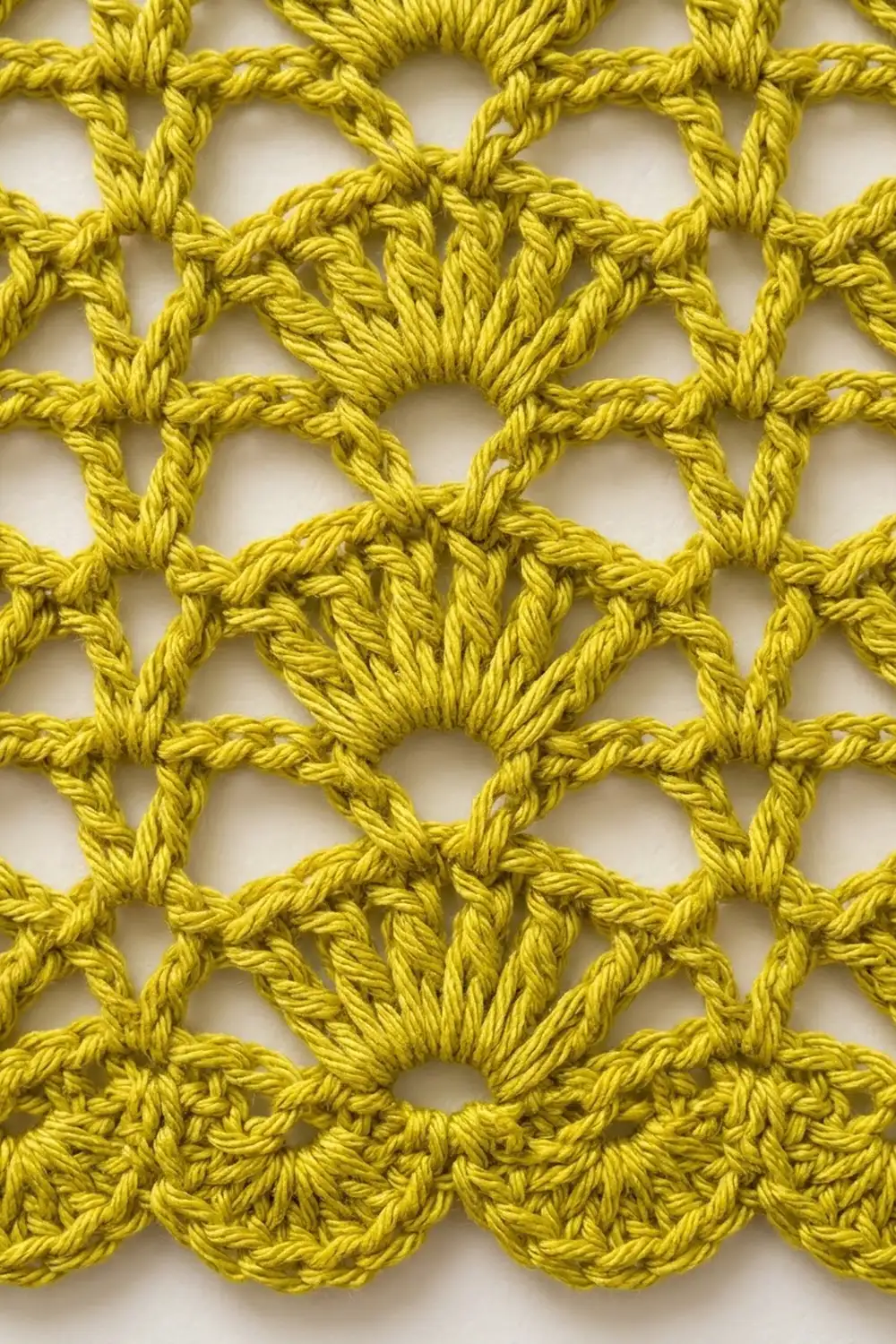
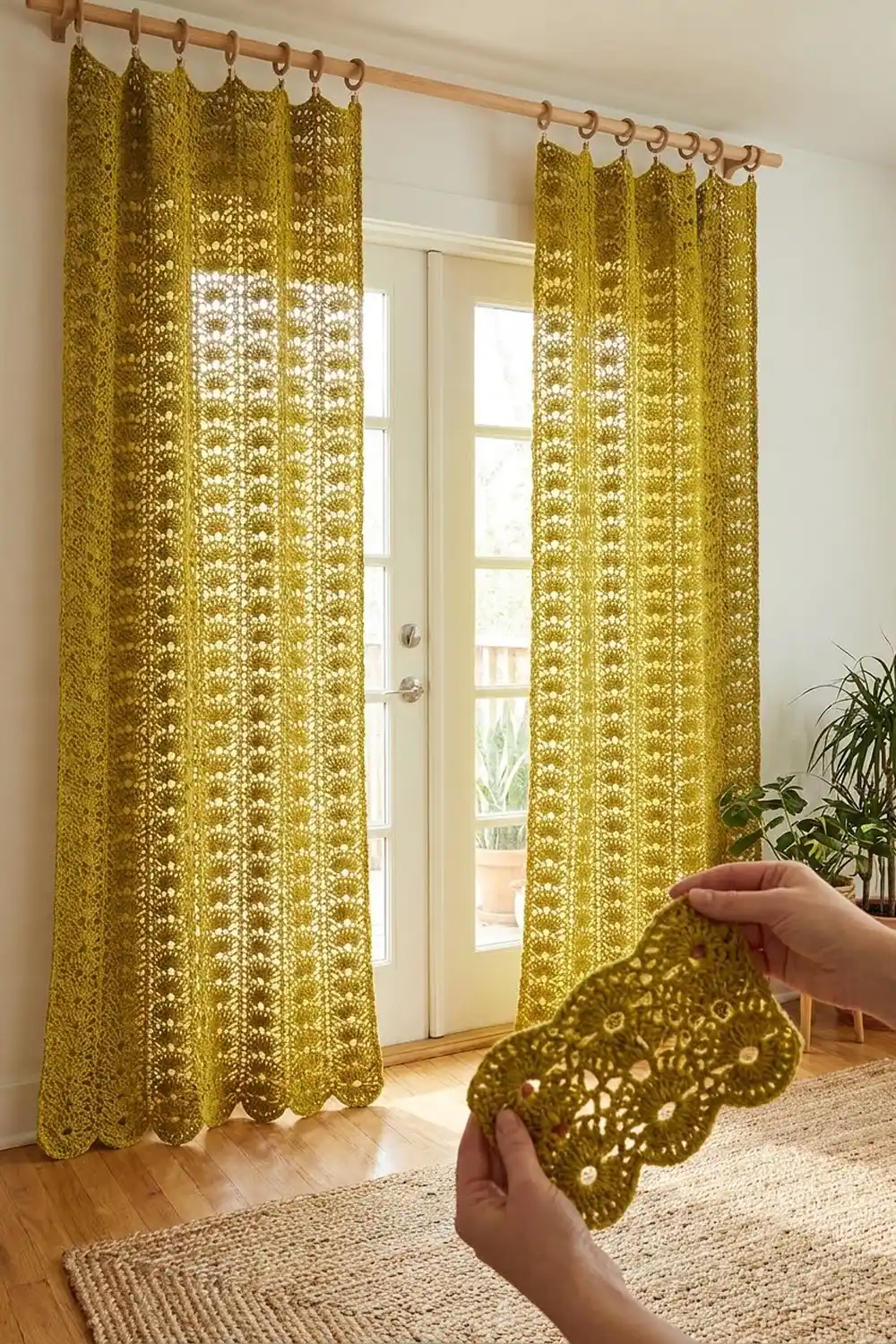
The Golden Hour curtain panel is a tall, airy sheet of fan lace in a warm chartreuse yellow. Rows of nine-stitch fans alternate with small chain arches, so sunlight comes through in a regular pattern of little windows. At the bottom, the last row of fans forms a soft scalloped hem.
The look is cottage-modern: one solid color and one simple two-row repeat. When the panel hangs, the lace falls into loose vertical folds. A pair of panels framing a window or French door is just two copies of this pattern. The panels are separate and are never joined.
This pattern uses US crochet terms. Each finished panel measures 43 in (109.2 cm) wide by 81.5 in (207.0 cm) long after blocking, including a narrow single crochet border.
You work each panel in one piece from the top down. The foundation chain becomes the straight top edge, which is where the clip rings attach. You finish on a full-fan row, so the scallops form at the hem without extra shaping. Two rounds of single crochet go around the whole panel to firm up the edges.
Finished Size and Construction
- Finished size (one panel): 43 in (109.2 cm) wide x 81.5 in (207.0 cm) long
- Skill level: Intermediate (the repeat is easy, but the project is long)
- Terminology: US
- Yarn weight: DK (weight 3)
- Hook: 4.0 mm (G-6)
- Number of pieces: 1 piece per panel. Make 2 identical panels for a pair.
- Layout: each panel hangs on its own. Panels are not joined.
- Panel size before border: 42 in (106.7 cm) x 80.5 in (204.5 cm)
- Border depth: 0.5 in (1.3 cm) on every side, 2 rounds
Materials
Yarn: Choose a smooth DK cotton or cotton-linen blend. Plant fibers hold the fan shapes crisply, hold up well in sunlight and don’t pill when the panel brushes a window frame. Avoid fuzzy yarns, because they blur the openwork.
- Chartreuse yellow: 850 g / about 2,125 m (2,324 yd) per panel, based on 100 g = 250 m (273 yd)
- For a pair: 1,700 g / about 4,250 m (4,648 yd)
These quantities include a margin of about 10% for the swatch, small tension differences and weaving in ends. Buy all the yarn from one dye lot.
Tools:
- 4.0 mm (G-6) crochet hook
- Tapestry needle
- Stitch markers (at least 10)
- Measuring tape
- Blocking mats or a clean carpet, rust-proof pins and a spray bottle
- 15 curtain clip rings per panel
Abbreviations (US Terms)
- ch – chain
- sc – single crochet
- dc – double crochet
- sk – skip
- sl st – slip stitch
- sp – space
- st(s) – stitch(es)
- rep – repeat
- RS / WS – right side / wrong side
Special stitch – Fan: 9 dc worked into the same stitch.
Half fan: 5 dc worked into the same stitch. At the start of a row, the ch-3 counts as the first of the 5 dc.
Gauge and Checkpoints
Gauge in fan lace: one 12-chain repeat = 3 in (7.6 cm) wide, and 4 rows = 2 in (5.1 cm) tall, measured after blocking.
Border gauge: 20 sc = 4 in (10.2 cm), and 4 sc rounds = 1 in (2.5 cm).
Test one piece first. Chain 38 and work Rows 1–3 as written, then repeat Rows 2–3 three more times, for 9 rows in total. This gives 3 full repeats. Wet-block the swatch and let it dry flat.
- Swatch target: 9 in (22.9 cm) wide x 4.5 in (11.4 cm) tall.
- Too big: go down to a 3.75 mm hook.
- Too small: go up to a 4.5 mm hook.
- If the width is right but the height is off, check your dc height. Pull each dc up to its full height.
Panel checkpoints (measure flat, without stretching):
- After Row 1: 42 in (106.7 cm) wide
- After Row 20: 10 in (25.4 cm) long
- After Row 81: 40.5 in (102.9 cm) long
- After Row 161: 80.5 in (204.5 cm) long
- After the border: 43 in (109.2 cm) x 81.5 in (207.0 cm)
Expect up to 1 in (2.5 cm) of extra length once the panel hangs.
Panel Pattern
The panel is 14 repeats wide. The foundation needs a multiple of 12 chains + 1, plus 1 turning chain.
Foundation: Ch 170 loosely. If your foundation chains tend to be tight, use a hook one size larger for this step only. The chain is the top edge of the curtain, and it must not pull in.
Row 1 (RS): Sc in 2nd ch from hook. Sk 5 ch, fan (9 dc) in next ch, sk 5 ch, sc in next ch. Rep from * across. Turn.
Count: 14 fans (126 dc) + 15 sc = 141 sts.*
Each repeat uses exactly 12 chains, and the first sc uses 1, so 14 x 12 + 1 = 169 chains are used, plus the turning chain. Place a marker in every 2nd fan to make counting easier.
Row 2 (WS): Ch 3 (counts as dc), 4 dc in first sc (half fan made). Ch 3, sk next 4 dc (and the ch-3 sp, in later rows), sc in center (5th) dc of fan, ch 3, sk next 4 dc (and the ch-3 sp, in later rows), fan in next sc. Rep from * 12 more times. Ch 3, sk 4 dc (and ch-3 sp), sc in center dc of last fan, ch 3, sk 4 dc (and ch-3 sp), 5 dc in last sc (half fan made). Turn.
Count: 2 half fans (10 dc) + 13 fans (117 dc) + 14 sc = 141 sts, plus 28 ch-3 sps.*
Row 3 (RS): Ch 1, sc in first dc. Ch 3, sk next 4 dc and ch-3 sp, fan in next sc, ch 3, sk ch-3 sp and next 4 dc, sc in next dc (the center dc of a fan or the outer dc of a half fan). Rep from * across. The last sc goes in the top of the turning ch-3. Turn.
Count: 14 fans (126 dc) + 15 sc = 141 sts, plus 28 ch-3 sps.*
The fans now sit directly below the fans of Row 1, and the sc sit below the sc. That alignment creates the neat vertical columns that show when the panel hangs.
Rows 4–161: Rep Rows 2–3 another 79 times. In total, Rows 2–161 are 80 pairs of Rows 2 and 3. Every row counts 141 sts, and every row after Row 1 has 28 ch-3 sps.
You finish on Row 161, a RS full-fan row. Its 14 fans hang downward and form the scalloped hem. Do not fasten off. Go straight on to the border.
Mid-panel check: At Row 81, the panel should measure 42 in (106.7 cm) wide and 40.5 in (102.9 cm) long. If it is more than 1 in (2.5 cm) short, make your dc slightly taller for the rest of the panel, or add one more Row 2 + Row 3 pair at the end. Always end on a Row 3.
Second panel: Work a second panel exactly the same way, with the same hook. Compare both panels at Row 81.
Border
The border is worked in rounds around the whole panel. Corners get 3 sc. In the per-side counts below, the center sc of each corner is included on both sides it touches. The round totals count each corner only once.
Round 1 (RS): Do not turn after Row 161. Ch 1, 3 sc in the last sc of Row 161 (corner). Rotate to work along the side edge, toward the top.
- Side 1: Work 2 sc in the end of each odd (sc) row and 3 sc in the end of each even (dc) row. That is 81 x 2 + 80 x 3 = 162 + 240 = 402 sc between corners.
- Top corner: 3 sc in the first foundation ch.
- Top: Sc in each of the next 167 ch, then 3 sc in the last ch (corner).
- Side 2: 402 sc along the row ends, worked the same way as Side 1, then 3 sc in the first sc of Row 161 (corner).
- Bottom: *3 sc in next ch-3 sp, sc in each of 9 dc of fan, 3 sc in next ch-3 sp, sc in next sc. Rep from * 12 more times. Then 3 sc in next ch-3 sp, sc in each of 9 dc, 3 sc in last ch-3 sp. Sl st to the first sc of the round.
Counts, including both corner center sts:
– Top: 169 sc
– Each side: 404 sc
– Bottom: 225 sc (14 repeats x 15 + 13 valley sc = 223 between corners)
– Round total: 167 + 402 + 402 + 223 + 12 corner sc = 1,206 sc
Round 2: Ch 1, sc in each sc around, working 3 sc in the center sc of each corner. Sl st to the first sc. Fasten off.
Counts, including both corner center sts:
– Top: 171 sc
– Each side: 406 sc
– Bottom: 227 sc
– Round total: 1,206 + 8 = 1,214 sc
Why the math works:
- Sides: There are 402 sc over 80.5 in (204.5 cm), which is 4.99 sc per inch. That matches the border gauge of 5 sc per 1 in (2.5 cm), so the edges neither ruffle nor pull in.
- Top: The top edge is worked 1 sc per foundation chain, so it copies the chain exactly and can’t change the width.
- Bottom: Along the hem, every fan dc gets 1 sc and every ch-3 sp gets 3 sc, which matches its 3 chains. The border therefore follows each scallop without flattening it.
- Round 2: This round only adds 2 sts per side, at the corners, which is exactly what a flat square-cornered round needs.
The two rounds add 0.5 in (1.3 cm) to each edge. That takes the panel from 42 in x 80.5 in (106.7 cm x 204.5 cm) to 43 in x 81.5 in (109.2 cm x 207.0 cm).
Final Blocking
- Weave in all ends along solid stitches, such as fan dc or the border sc, never across the open arches.
- Soak the panel in cool water with a little mild soap for 20 minutes.
- Press the water out gently. Roll the panel in towels in sections. Do not wring it.
- Lay it flat. Pin the top edge straight to 43 in (109.2 cm).
- Pin both sides straight to 81.5 in (207.0 cm), with a pin every 6 in (15.2 cm).
- Pin out each of the 14 bottom scallops. Put one pin at the lowest point of each fan and one in each valley sc.
- Open the arches with your fingertips so each ch-3 sp sits as an even window.
- Let it dry completely, which usually takes 24–48 hours. Then unpin.
- Clip one ring above each of the 15 sc of Row 1, so the rings are 3 in (7.6 cm) apart along the top border.
Final Quality-Control Checklist
- 141 sts in every row, and 14 fans in every odd row
- Fans aligned in straight vertical columns from top to hem
- Row 161 is a full-fan row, with 14 clean scallops at the hem
- Border Round 2 has 1,214 sc, with 3 sc at every corner
- Side edges are straight, with no ruffling and no pulling in
- Top edge measures 43 in (109.2 cm) and lies straight
- Length measures 81.5 in (207.0 cm) flat
- Both panels match each other to within 0.5 in (1.3 cm)
- All ends are woven in securely and invisible from the RS
Troubleshooting
Top edge is narrower than the body. The foundation chain is too tight. Redo it with a larger hook, or use a foundation single crochet start of 169 sts and work Row 1 into those sts.
Fans drift sideways. Count to the 5th dc of each fan before working the sc.
Stitch count is wrong at the row end. The final half fan needs 5 dc, and the final sc of Row 3 goes in the turning ch-3. Check both.
Sides ripple after the border. You worked too many sc into the row ends. Go back to 2 sc per sc row and 3 sc per dc row.
Sides pull in after the border. Make sure each sc sits in the row-end, and use the full counts.
Panel grows too long when hung. Cotton lace relaxes under its own weight. Raise the curtain rod slightly, or remove one Row 2 + Row 3 pair from both panels.
Scallops look flat. Re-wet the hem and pin each fan point lower.
Care
Hand wash cool or machine wash on a gentle cycle in a mesh laundry bag, then reshape and dry flat. Don’t hang the panel wet, because the weight of the water will stretch the lace.
Final Notes
The measurement chain for this panel:
- A 12-chain repeat measures 3 in (7.6 cm), so 14 repeats give 42 in (106.7 cm).
- Two rows measure 1 in (2.5 cm), so 161 rows give 80.5 in (204.5 cm).
- The 2-round border adds 0.5 in (1.3 cm) to every edge, which gives a finished panel of 43 in (109.2 cm) x 81.5 in (207.0 cm).
Check your gauge at the swatch, again at Row 81 and again after blocking, and your two panels will hang evenly in the window light.
Happy crocheting!