

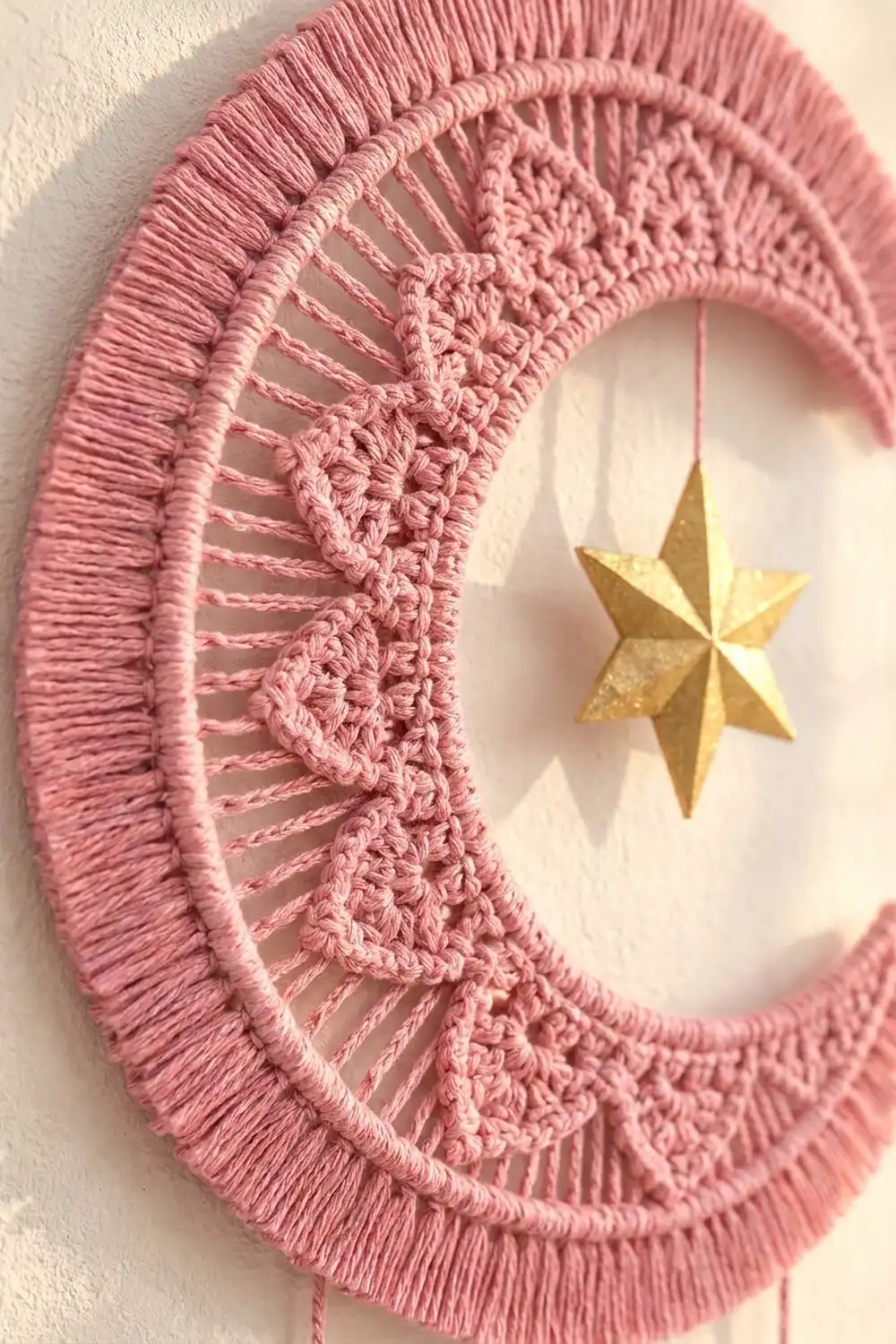
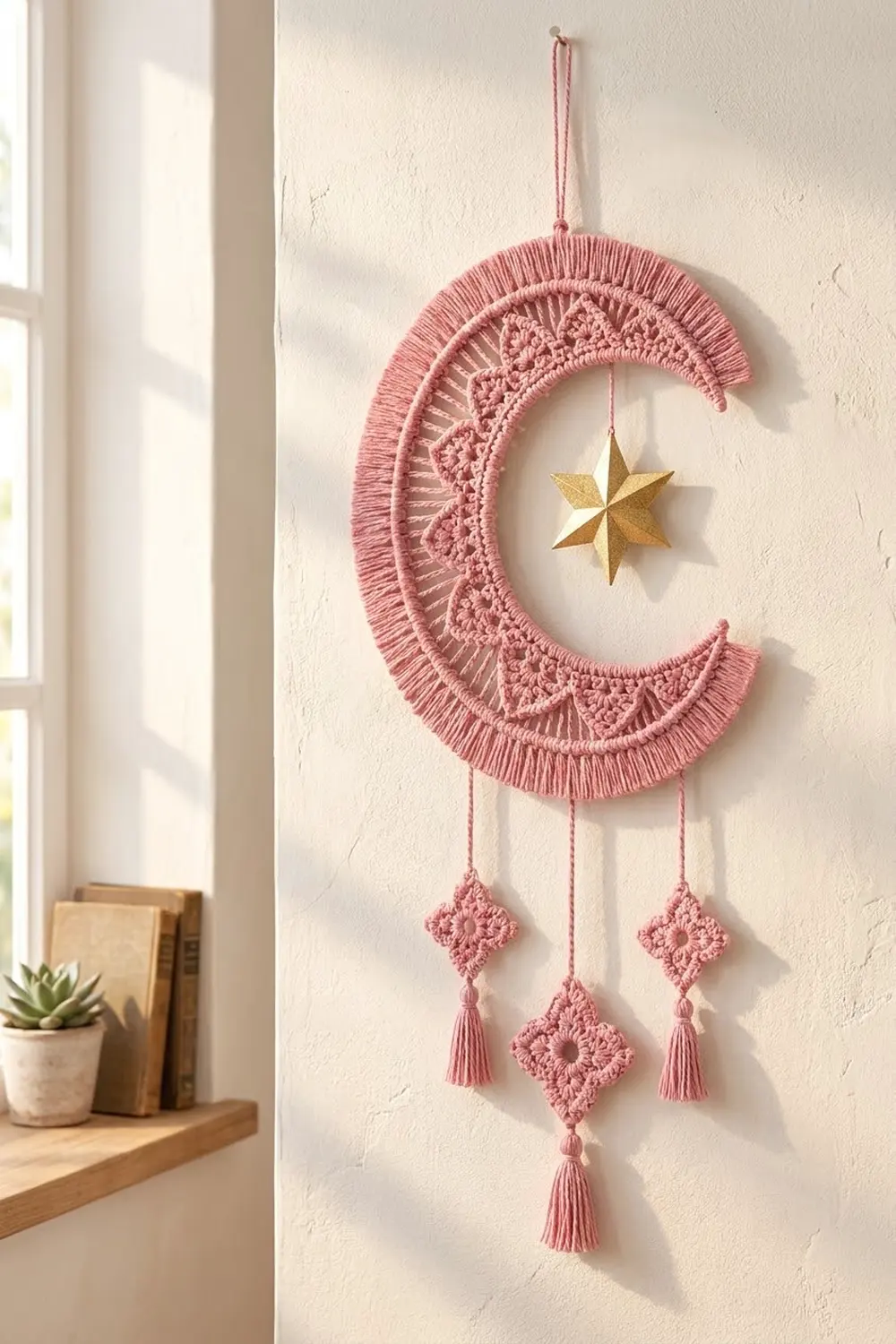
The Rosy Moonbeam is a soft, boho crescent moon wall hanging in one dusty rose shade. Seven textured petals line the inner curve, fans of long spoke stitches open out between them, and a band of tall stitches finishes the outer edge. Three small diamonds and tassels hang below, and a gold star ornament hangs inside the opening.
Everything is one color, so the texture does the work. Matte worsted-weight cotton gives the best stitch definition and lets the spokes hang straight. This pattern uses US crochet terms throughout.
The finished crescent is about 13 in (33.0 cm) tall and 7.5 in (19.1 cm) wide. From the top of the crescent to the tip of the center tassel, the hanging is about 27 in (68.6 cm) long.
The crescent is worked flat in turning rows, starting along the inner curve and working outward. Adding stitches in later rows makes the band curve naturally. After a one-round border, you make three diamond motifs and three tassels and hang them from chain cords.
Finished Size and Construction
- Finished size: crescent 13 in × 7.5 in (33.0 × 19.1 cm); total length about 27 in (68.6 cm)
- Skill level: Intermediate
- Terminology: US crochet terms
- Yarn weight: Worsted (#4) cotton
- Hook: 4.5 mm (US 7)
- Number of pieces: 1 crescent, 3 diamonds, 3 tassels, plus chain cords
- Layout: hanging loop at the top; three dangles below; center dangle longest
- Piece sizes: crescent band 3.5 in (8.9 cm) at its widest; each diamond 2.25 in (5.7 cm) per side
- Size before border: 12.5 in × 7.25 in (31.8 × 18.4 cm)
- Border depth: 0.25 in (0.6 cm)
Materials
Yarn: Use a smooth, matte worsted-weight cotton or cotton blend, about 85 m per 50 g (93 yd per 1.75 oz). Avoid fuzzy yarns, because they blur the spokes and petals.
- Dusty Rose: 120 g, about 204 m (223 yd)
- Crescent: about 70 g
- Diamonds: about 15 g
- Tassels: about 20 g
- Cords and loop: about 5 g
These quantities include roughly a 10% margin for gauge swatches and tassel trimming.
Tools:
- 4.5 mm (US 7) crochet hook
- Tapestry needle
- Scissors
- 4 stitch markers
- Stiff card 3.5 in (8.9 cm) tall, for tassels
- Rust-proof pins, blocking mat, spray bottle
- Gold star ornament, about 2 in (5.1 cm) across (purchased)
- 10 in (25.4 cm) strand of gold thread or yarn, for the star
Abbreviations (US Terms)
- ch – chain
- sl st – slip stitch
- sc – single crochet
- hdc – half double crochet
- dc – double crochet
- tr – treble crochet
- dtr – double treble: yo 3 times, insert hook, pull up a loop, [yo, draw through 2] 4 times
- trtr – triple treble: yo 4 times, insert hook, pull up a loop, [yo, draw through 2] 5 times
- dc2tog / dc3tog – double crochet 2 (or 3) together
- cl – 3-dc cluster: [yo, insert into the same st, pull up a loop, yo, draw through 2] 3 times, yo, draw through all 4 loops
- FLO – front loop only
- sp – space
- st(s) – stitch(es)
- RS / WS – right side / wrong side
- rnd – round
Standing dc: Start with a slip knot on the hook, yo, insert into the st, and complete a dc as normal.
Gauge and Checkpoints
Gauge: 16 sc × 16 rows = 4 in (10.2 cm), and 16 dc × 8 rows = 4 in (10.2 cm). Chain cords run at 5 ch = 1 in (2.5 cm).
Test one piece first: Make one diamond before you start the crescent. After Rnd 3, each side should measure 2.25 in (5.7 cm).
Crescent checkpoints:
- Row 1: 43 sc = 10.75 in (27.3 cm), unstretched
- Petals: each petal 1.25 in (3.2 cm) wide at the base and 1.5 in (3.8 cm) tall
- Row 6: 71 sc, about 17.75 in (45.1 cm) along the edge
- Row 8: 76 sc = 19 in (48.3 cm); band width 2.5 in (6.4 cm)
- Row 9: outer edge 88 sts = 22 in (55.9 cm); band width 3.25 in (8.3 cm)
If your work is too big, go down one hook size. If it is too small, go up one size. If your trtr stitches come out shorter than the petals, pull up the first loop taller rather than changing hooks.
Crescent
The crescent is worked flat in turning rows, from the inner curve outward. With RS facing, Row 1’s first sc sits at the right end, and stitch numbers count from that right end.
Foundation: Ch 44.
Row 1 (RS): Sc in 2nd ch from hook and in each ch across. Turn. (43 sc)
Place markers to plan the petals. The layout repeats as 1 gap st plus 5 petal sts. Sts 1, 7, 13, 19, 25, 31, 37 and 43 are gap sts, and the 7 petals sit on sts 2–6, 8–12, 14–18, 20–24, 26–30, 32–36 and 38–42. That gives 8 gap sts + 35 petal sts = 43.
Petals (make 7)
Work each petal separately on its 5 base sts.
Row 2 (RS): Standing dc in the first st of the petal base, dc in the next 4 sts. Turn. (5 dc)
Row 3 (WS): Ch 2 (does not count as a st), dc2tog, cl in next st, dc2tog. Turn. (3 sts)
Row 4 (RS): Ch 2, dc3tog. (1 st, the petal tip)
Fasten off, leaving a 4 in (10.2 cm) tail. Make all 7 petals the same way, always starting with RS facing at the right-hand side of each base. Each petal is a firm triangle pointing outward, and the cluster in Row 3 pops to the RS.
Spoke Row
Row 5 (RS): Join the yarn in st 1 of Row 1 and work:
- (Dc, ch 1, tr, ch 1, dtr) all in st 1. This is the right half-fan.
- Sc in the tip of petal 1.
- [(Trtr, ch 1) 4 times, trtr] in the next gap st of Row 1, then sc in the tip of the next petal. Repeat this step 5 more times.
- (Dtr, ch 1, tr, ch 1, dc) in st 43. This is the left half-fan.
Turn.
Count: 3 + 3 half-fan sts, 6 × 5 = 30 trtr, and 7 sc = 43 sts, plus 2 + 2 + 24 = 28 ch-1 sps.
Each trtr should reach the height of a petal tip, about 1.5 in (3.8 cm). The fans open into the triangles between petals to form the spoke rays. The graduated stitches at each end make the slanted horn ends.
Ridge Rows
Row 6 (WS): Ch 1, sc in each st and each ch-1 sp across. Turn. (43 + 28 = 71 sc)
Row 7 (RS): Ch 1, sc in next 11 sts, 2 sc in next st, [sc in next 23 sts, 2 sc in next st] 2 times, sc in last 11 sts. Turn. (71 + 3 increases = 74 sc)
Row 8 (WS): Working in FLO, ch 1, sc in next 24 sts, 2 sc in next st, sc in next 24 sts, 2 sc in next st, sc in last 24 sts. Turn. (74 + 2 increases = 76 sc)
Working Row 8 in FLO leaves the RS-facing loops unworked, which makes the crisp ridge line on the RS.
Outer Strand Band
Row 9 (RS):
- Sl st in first 2 sts, sc in next 2 sts, hdc in next 2 sts, dc in next 2 sts.
- [Tr in next 4 sts, 2 tr in next st] 12 times.
- Dc in next 2 sts, hdc in next 2 sts, sc in next 2 sts, sl st in last 2 sts.
Do not fasten off. Stitches used: 8 + 60 + 8 = 76. Stitches made: 8 + 72 + 8 = 88 sts.
The close-set trebles look like vertical ribbed strands. The stepped stitches at each end taper the band into the horns.
Make All Pieces
Everything is Dusty Rose:
- Crescent: 1
- Diamonds: 3
- Tassels: 3
- Chain cords: 1 hanging loop, 3 upper cords, 3 short tassel cords
Diamond (make 3)
Rnd 1: Ch 6, sl st to the first ch to form a ring. Ch 3 (counts as dc), 15 dc in the ring, join to the top of the ch-3. (16 dc; about 1.25 in / 3.2 cm across, with a 0.4 in / 1.0 cm center hole)
Rnd 2: Ch 3 (counts as dc), (dc, ch 2, 2 dc) in the same st, dc in next 3 sts, [(2 dc, ch 2, 2 dc) in next st, dc in next 3 sts] 3 times, join. (28 dc, 4 ch-2 sps; 7 dc per side between corner sps; each side 1.75 in / 4.4 cm)
Rnd 3: Ch 1, sc in the same st and in next dc, (sc, ch 3, sc) in the ch-2 sp, [sc in next 7 dc, (sc, ch 3, sc) in the ch-2 sp] 3 times, sc in last 5 dc, join. (36 sc, 4 ch-3 picots; 9 sc per side including the corner sc)
Fasten off. Each side measures 2.25 in (5.7 cm), and the diamond is 3.5 in (8.9 cm) point to point including the picots.
Tassel (make 3)
- Wrap the yarn 25 times around the 3.5 in (8.9 cm) card.
- Slide an 8 in (20.3 cm) strand under the wraps at the top and tie it tightly. Leave its ends long for attaching.
- Cut through the wraps at the bottom edge of the card.
- Wrap the neck 0.5 in (1.3 cm) below the top 6 times and knot. Bury the neck ends inside the tassel.
- Trim the tassel to 3 in (7.6 cm).
Layout
        [ hanging loop – border st 6 ]
     (  crescent, opening right  )   ★ star
      |            |           |
  st 64        st 74        st 84
  4 in cord    7 in cord    4 in cord
     ◇             |            ◇
  1 in cord        ◇         1 in cord
   tassel       1 in cord     tassel
                 tassel
Joining
Lay the bordered crescent RS up with the opening to your right. Count the outer-edge border sc from the upper horn tip, which is st 1 of the 88.
Hanging loop: Join the yarn in outer st 6, ch 50 (10 in / 25.4 cm), sl st in the same st. Fasten off.
Upper cords:
- Left cord: Join in outer st 64, ch 20 (4 in / 10.2 cm), sl st through the top picot of a diamond. Fasten off.
- Center cord: Join in outer st 74, ch 35 (7 in / 17.8 cm), sl st through the top picot of a diamond. Fasten off.
- Right cord: Join in outer st 84, ch 20 (4 in / 10.2 cm), sl st through the top picot of a diamond. Fasten off.
Each cord goes into exactly one border stitch and one picot, with no extra stitches added to the edge.
Tassel cords: Join in each diamond’s bottom picot, ch 5 (1 in / 2.5 cm), and fasten off with a long tail. Thread the tassel’s tie ends through the last chain, knot them securely, and bury the ends inside the tassel head.
Star: Tie the gold strand to the inner-edge border stitch nearest the top of the opening. Tie the star on so it hangs about 3 in (7.6 cm) below the inner edge, centered in the opening.
Tension: Work the cords at an even, medium tension. Tight chains will twist, and loose ones will sag unevenly.
Checkpoint: Hold the piece up by the loop. The side cords should match at 4 in (10.2 cm), the center diamond should hang about 3 in (7.6 cm) lower than the side diamonds, and the total length should be about 27 in (68.6 cm). If the crescent tilts, move the loop 1–3 sts toward the heavy side before weaving in the ends.
Border
Work the border before the joining steps above.
Border gauge: 4 sc per in (2.5 cm) along every edge, matching the body gauge.
Rnd 1 (RS): Do not turn after Row 9. Ch 1 and work:
- Outer edge: sc in each of the 88 sts. (88 sc)
- First horn end: work 6 sc evenly down the row ends. Use 1 sc each for the ends of Rows 1, 6, 7 and 8, and 2 sc on the half-fan dc. Row 9’s sl st end gets none. (6 sc)
- Inner edge: work into the bottom loops of the foundation chain: 3 sc in the first st, sc in next 41 sts, 3 sc in the last st. (43 + 4 extra = 47 sc)
- Second horn end: work 6 sc evenly up the row ends. (6 sc)
Join to the first sc and fasten off.
Total: (88 + 6 + 43 + 6 worked one per stitch or row end) + 4 extra horn-point sc = 147 sc.
Why the math works:
- The outer edge has 88 sts over 22 in (55.9 cm), so one sc per st keeps it at 4 per in.
- The inner edge has 43 sts over 10.75 in (27.3 cm), which is also 4 per in. The 4 extra sc just turn the two sharp horn points.
- Each horn end is 1.5 in (3.8 cm) long, so 6 sc keeps the same rate.
The border adds 0.25 in (0.6 cm) all around, which brings the crescent from 12.5 × 7.25 in (31.8 × 18.4 cm) to 13 × 7.5 in (33.0 × 19.1 cm).
Final Blocking
- Weave in all ends except the tassel tie ends. Hide the petal tails under Row 5.
- Mist the crescent until it is evenly damp.
- Pin it RS up into a smooth crescent, 13 in (33.0 cm) tall, with the band 3.5 in (8.9 cm) at its widest.
- Pin each petal tip outward so the petals stand as clean triangles.
- Run a finger along each fan to straighten the spokes into even rays.
- Pin each diamond on point at 2.25 in (5.7 cm) per side, with a pin through each picot.
- Steam the tassels lightly and smooth them straight.
- Let everything dry completely before hanging.
Final Quality-Control Checklist
- [ ] Row 1 has 43 sc, and there are 7 petals, each ending in a single tip
- [ ] 6 full fans of 5 trtr plus 2 half-fans
- [ ] Rows 6, 7, 8 and 9 have 71, 74, 76 and 88 sts
- [ ] Border count is 147 sc
- [ ] Crescent lies flat with no cupping or ruffling
- [ ] Diamonds have 36 sc and 4 picots each, and all three match in size
- [ ] Tassels are 3 in (7.6 cm) and trimmed evenly
- [ ] Side cords are 4 in (10.2 cm) and the center cord is 7 in (17.8 cm)
- [ ] Star hangs centered and the piece hangs level
Troubleshooting
- Crescent cups: The outer rows are too tight. Loosen Row 9, or work it with a hook one size larger.
- Outer edge ruffles: Row 9 is too loose. Work it with a hook one size smaller.
- Spokes sag or don’t reach the petal tips: Pull up the first loop of each trtr taller, and keep the loops even.
- Petals curl: Pin and steam them flat. Check that Row 3 has exactly 3 sts.
- Diamonds are not square: Recount Rnd 2. Each side must have 7 dc between corner sps.
- Cords twist: Chain more loosely, then hang a damp cord with a weight overnight.
- Piece tilts on the wall: Move the hanging loop toward the heavier side.
Care
Spot clean only, or hand wash cool after removing the star. Reshape while damp and dry flat.
Final Notes
Each stage builds on the one before it:
- Gauge of 16 sc = 4 in (10.2 cm) gives a Row 1 of 43 sc = 10.75 in (27.3 cm).
- The petals are 1.5 in (3.8 cm) tall, and the spoke fans match that height.
- Rows 6–8 grow the band to 76 sts and 2.5 in (6.4 cm) wide.
- Row 9 brings the outer edge to 88 sts and 22 in (55.9 cm).
- The 147-sc border finishes the crescent at 13 × 7.5 in (33.0 × 19.1 cm).
- The 4 in, 7 in and 4 in (10.2, 17.8 and 10.2 cm) cords, the 3.5 in (8.9 cm) diamonds and the 3 in (7.6 cm) tassels bring the total length to about 27 in (68.6 cm).
Check each measurement as you go, and your Rosy Moonbeam will hang soft, level and bright. Happy crocheting!