

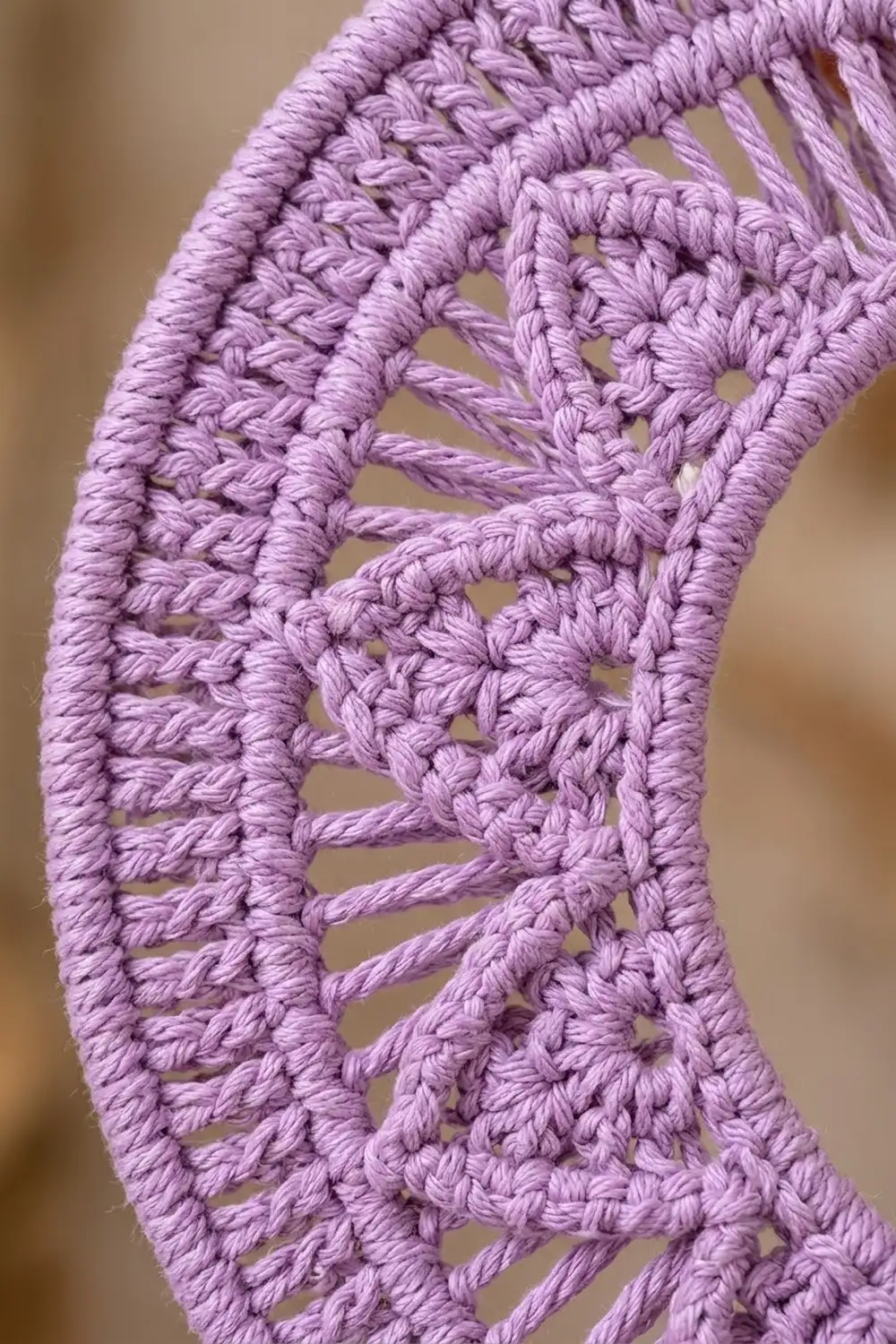
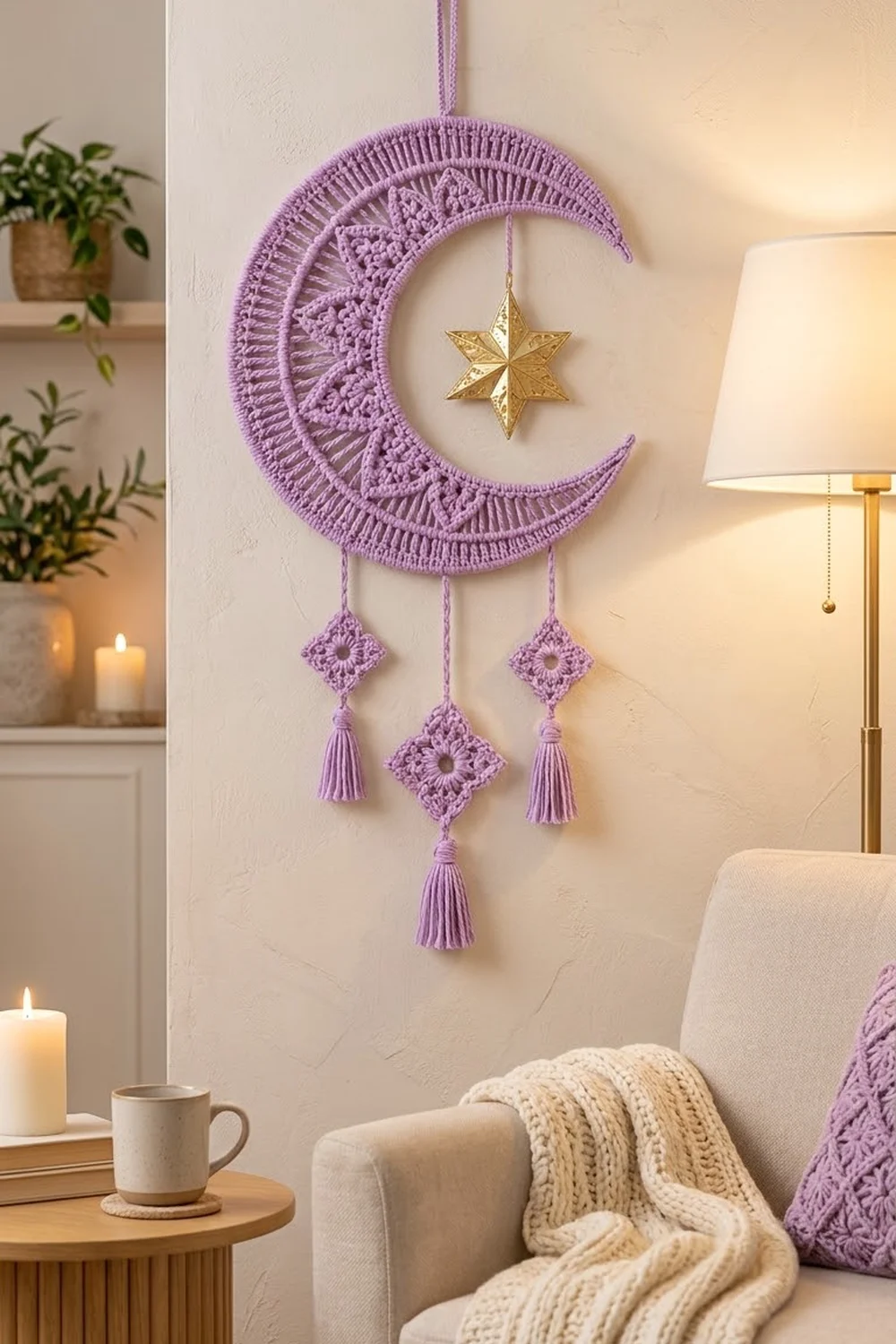
This crescent moon wall hanging uses soft lavender yarn and an open, airy texture. Long spoke stitches frame a band of solid fan-shaped petals, and a firm single-crochet edge keeps the curve crisp. Three diamond drops with tassels hang below the moon, and a small gold star hangs inside the curve.
It is crocheted in a single color, so the texture does the decorative work. The style is boho with a festive touch, and it suits a nursery, a reading nook, or a holiday mantel.
The pattern uses US crochet terms. The finished crescent is 10 in (25.4 cm) tall and 4 in (10.2 cm) across at its widest point. With the hanging loop, drops, and tassels, the whole hanging is about 24 in (61.0 cm) long.
The crescent is worked in turned rows from the inner edge outward. Graded stitch heights make the tips taper, and extra stitches in the petal band make the outer edge longer, which curves the piece. A two-round border finishes the edges. Next you make three diamond motifs and three tassels, then attach everything with chain cords.
Finished Size and Construction
- Finished crescent: 10 in (25.4 cm) tall, 8 in (20.3 cm) wide, 4 in (10.2 cm) band at its widest point
- Tip-to-tip distance: 8 in (20.3 cm)
- Total hanging length: about 24 in (61.0 cm)
- Skill level: Intermediate
- Terminology: US
- Yarn weight: Worsted (#4)
- Hook: 4.0 mm (G-6)
- Number of pieces: 1 crescent, 3 diamond motifs, 3 tassels, and 1 purchased star
- Layout: Crescent on top. Three drops hang below it and the star hangs inside the curve.
- Diamond size: 2.25 in (5.7 cm) per side, 3.2 in (8.1 cm) point to point
- Crescent band before border: 3.6 in (9.1 cm) at its widest point
- Border depth: 0.4 in (1.0 cm)
Materials
Use a smooth worsted-weight cotton or cotton blend. A twisted, multi-ply cotton shows off the spokes best and holds its shape after blocking. Avoid fuzzy yarns, because they blur the open stitch pattern.
- Lavender: 100 g / 190 m (208 yd) total
- Crescent: about 50 g / 95 m
- Diamonds: about 15 g / 28 m
- Tassels: about 20 g / 38 m
- Cords and loop: about 5 g / 10 m
These quantities include a margin of roughly 10 g for gauge swatches and tassel trimming.
Tools:
- 4.0 mm (G-6) crochet hook
- Gold metal star ornament, about 3 in (7.6 cm), with a hanging hole
- Stitch markers (at least 6)
- Tapestry needle
- Scissors
- Stiff card, 3.5 in (8.9 cm) tall, for the tassels
- Blocking board, rust-proof pins, and paper for a template
- Optional: fabric stiffener
Abbreviations (US Terms)
- ch: chain
- sl st: slip stitch
- sc: single crochet
- hdc: half double crochet
- dc: double crochet
- tr: treble crochet (yarn over twice)
- dtr: double treble crochet (yarn over 3 times)
- sk: skip
- sp: space
- st(s): stitch(es)
- RS: right side
End zone (special sequence): An end zone is 11 stitches worked as sl st in 2 sts, sc in 2 sts, hdc in 3 sts, and dc in 4 sts. At the far end of a row, work it in reverse: dc in 4, hdc in 3, sc in 2, sl st in 2. Work end-zone stitches into the matching stitches of the row below. The end zones keep the tips thin while the middle of each row gets taller.
Stitch-counting rule: In this pattern, every chain counts as one stitch, both in row totals and when you work into it on the next row.
Gauge and Checkpoints
Gauge: 18 sc and 20 rows = 4 in (10.2 cm). Each dc row is about 0.4 in (1.0 cm) tall, each tr row is about 0.55 in (1.4 cm), and each dtr row is about 0.7 in (1.8 cm).
Make one diamond motif before you start the crescent. It uses little yarn and is a quick gauge test. It should measure 2.25 in (5.7 cm) per side.
Crescent checkpoints (band depth at the widest point):
- After Row 1: 12.7 in (32.3 cm) long, measured flat
- After Row 2: 0.4 in (1.0 cm)
- After Row 3: 0.8 in (2.0 cm)
- After Row 6: 2.4 in (6.1 cm)
- After Row 7: 3.2 in (8.1 cm)
- After Row 9: 3.6 in (9.1 cm)
- After the border: 4 in (10.2 cm)
If your piece measures too big, go down a half hook size. If it measures too small, go up a half hook size. A difference of 0.2 in (0.5 cm) can be fixed in blocking. Anything more than that means you should change hooks.
Crescent Moon
Inner Band
Row 1: Ch 58. Sc in the 2nd ch from the hook and in each ch across. (57 sc)
Row 2: Ch 1, turn. Sc in each st across. (57 sc)
Short Spoke Row
Row 3: Ch 1, turn. Work an end zone (11 sts). For the middle, dc in the next st, then (ch 1, sk 1, dc in next st) 17 times. Work the reverse end zone (11 sts). (57 sts: 11 + 35 middle + 11)
The middle section has 18 dc spokes and 17 ch-1 sps. Place a marker in the first and last dc of the middle section.
Petal Band
The middle 35 sts form 6 petals and 5 gaps: (6 petals × 5 base sts) + 5 gap ch-sps = 35.
Row 4: Ch 1, turn. Work an end zone (11 sts) into the matching sts.
- Petal: Tr in the next dc, ch 1, sk the ch-sp, 5 tr in the next dc, ch 1, sk the ch-sp, tr in the next dc. (9 sts)
- Gap: Ch 1, sk the ch-sp.
Work the petal and gap sequence 5 times, then work 1 more petal. Finish with the reverse end zone. (81 sts: 11 + (6 × 9) + 5 + 11 = 81)
The 5-tr group is the narrow tip of each petal, and it points toward the inner edge. The tr on each side of a petal are its spokes, so there is a pair of spokes between neighboring petals.
Row 5: Ch 1, turn. Work an end zone (11 sts).
- Petal: Tr in the tr, ch 2, sk the ch-1 sp, tr in the next 2 tr, 2 tr in the center tr, tr in the next 2 tr, ch 2, sk the ch-1 sp, tr in the tr. (12 sts)
- Gap: Ch 1, sk the ch-1 sp.
Work the petal and gap sequence 5 times, then work 1 more petal. Finish with the reverse end zone. (99 sts: 11 + (6 × 12) + 5 + 11 = 99)
This is a growth round. The 18 extra stitches lengthen the outer edge, and that is what curves the crescent.
Row 6: Ch 1, turn. Work an end zone (11 sts).
- Petal: Tr in the tr, ch 2, sk the ch-2 sp, tr in each of the next 6 tr, ch 2, sk the ch-2 sp, tr in the tr. (12 sts)
- Gap: Ch 1, sk the ch-1 sp.
Work the petal and gap sequence 5 times, then work 1 more petal. Finish with the reverse end zone. (99 sts)
The petals are now solid fan wedges: narrow at the inner side and 6 tr wide at the outer side.
Long Spoke Row
Row 7: Ch 1, turn. Work an end zone (11 sts). For the middle, dtr in the next st, then (ch 1, sk 1 st, dtr in the next st) 38 times. Work the reverse end zone. (99 sts: 11 + 77 middle + 11)
The middle section has 39 dtr spokes and 38 ch-1 sps. The first and last dtr land on the outer tr of the first and last petals.
Outer Band
Row 8: Ch 1, turn. Sl st in the first 4 sts, sc in the next 91 sts (including each ch-1 sp stitch), and sl st in the last 4 sts. (99 sts)
Row 9: Repeat Row 8. (99 sts)
Do not fasten off.
Make All Pieces
Make the following, all in lavender:
- Crescent: 1 (above)
- Diamond motifs: 3
- Tassels: 3
Diamond Motif (make 3)
Rnd 1: Ch 4 and join with a sl st to form a ring. Ch 3 (counts as dc), then work 15 dc in the ring. Join to the top of the ch-3. (16 dc)
Keep the ring open so it forms the eyelet center.
Rnd 2: Ch 3 (counts as dc). Work (dc, ch 2, 2 dc) in the same st, then dc in the next 3 sts. Work (2 dc, ch 2, 2 dc) in the next st, then dc in the next 3 sts. Repeat from * twice. Join. (28 dc + 4 ch-2 sps; 7 dc per side)*
Rnd 3: Ch 1. Sc in each dc, and work (sc, ch 2, sc) in each ch-2 corner sp. Join and fasten off. (36 sc: 28 worked 1 per st + 8 corner sc; 9 sc per side, including both corner sc; 4 ch-2 sps)
Tassel (make 3)
- Wrap yarn 20 times around the 3.5 in (8.9 cm) card.
- Slide an 8 in (20.3 cm) strand under the top loops and tie it tightly. Leave both ends long.
- Cut the bottom loops and take the tassel off the card.
- Wrap a separate strand 6 times around the tassel, 0.5 in (1.3 cm) below the top, and knot it.
- Trim the bottom to 3 in (7.6 cm).
Layout
              [hanging loop]
         _______/‾‾‾‾\_______
        (  crescent    ) tip
        (              )  |
        (      ★ star  )  |
        (              ) tip
         ‾‾‾|‾‾‾‾‾|‾‾‾‾‾‾‾|
            ◇     |       ◇
            ‖     ◇       ‖
                  ‖
     left 3 in  center 5 in  right 3 in
Border
Border gauge: 4.5 sc per inch (18 sc = 4 in / 10.2 cm).
Rnd 1: With Row 9 facing, ch 1.
- Sc in each of the 99 sts along the outer edge.
- At the first tip, work 3 sc evenly across the tip end: 1 in the slip-stitch edge, 1 in the end of Row 2, and 1 in the end of Row 1.
- Sc in each of the 57 foundation ch loops along the inner edge.
- At the second tip, work 3 sc evenly in the same way.
- Join with a sl st to the first sc.
(162 sc: outer 99 + tip 3 + inner 57 + tip 3)
Rnd 2: Ch 1. Sc in each st along the outer and inner edges. At each tip, sc in the first tip sc, work (sc, ch 2, sc) in the center tip sc, and sc in the third tip sc. Join and fasten off. (164 sc + 2 ch-2 sps: 162 worked 1 per st + 2 extra sc)
Final counts per edge:
- Outer edge: 99 sc
- Inner edge: 57 sc
- Each tip: 4 sc plus a ch-2 point
Why the math works: At 4.5 sc per inch, 99 sc measure 22.0 in (55.9 cm). The outer arc of the template measures about 22.1 in (56.1 cm). The 57 inner sc measure 12.7 in (32.3 cm), and the template’s inner arc measures about 12.6 in (32.0 cm). Both edges are within 0.1 in (0.3 cm) of the template, so blocking only needs to coax the shape.
Joining
Attach every cord with a slip-stitch method, so each cord is a chain backed by slip stitches. Keep your chains relaxed but even. A cord that is too tight will twist and make the drops hang crooked. Chains run about 5 per inch (2.5 cm).
Count drop positions along the outer edge from the lower tip’s ch-2 point:
- Right drop: At the lower tip’s ch-2 sp.
- Center drop: At the 14th outer sc. This is the lowest point of the crescent.
- Left drop: At the 32nd outer sc.
Attach each drop:
- Join yarn in the top corner ch-2 sp of a diamond.
- Ch 15 for a 3 in (7.6 cm) cord on the left and right drops, or ch 25 for a 5 in (12.7 cm) cord on the center drop.
- Sl st into the marked crescent stitch.
- Sl st back down each ch to the diamond and fasten off.
- Use the tassel’s top ties to knot it through the bottom corner ch-2 sp, then weave in the ends.
Star cord:
- Join yarn at the 8th inner sc from the upper tip.
- Ch 18, about 3.5 in (8.9 cm).
- Pass the chain through the star’s hole and sl st into the 3rd ch.
- Sl st back up the chain and fasten off.
Hanging loop:
- Join yarn at the 14th outer sc from the upper tip.
- Ch 20 and sl st in the same st.
- Work 24 sc into the loop and fasten off. The finished loop is about 2 in (5.1 cm) tall.
Size checkpoint: Hold the piece up by the loop. It should hang about 24 in (61.0 cm) long, and the center tassel should hang lowest.
Final Blocking
- On paper, draw a 10 in (25.4 cm) circle. Draw an 8 in (20.3 cm) circle whose center is 3 in (7.6 cm) to the right of the first circle’s center. The crescent is the part of the large circle that lies outside the small one.
- Wet the crescent and diamonds, or spray them evenly, then press out the excess water in a towel.
- Pin the outer edge to the large circle line, then pin the inner edge to the small circle line.
- Pin each spoke straight, and open each ch-2 space beside the petals.
- Pin the diamonds square with their corners sharp.
- If you want a rigid hanging, brush on fabric stiffener.
- Let everything dry completely before you unpin it.
- Steam the tassels lightly and comb them straight.
Final Quality-Control Checklist
- The outer edge has 99 sc, the inner edge has 57 sc, and both tips are sharp.
- The crescent matches the template: 10 in (25.4 cm) tall and 4 in (10.2 cm) at its widest point.
- There are 6 petals with their narrow tips pointing toward the inner edge.
- Each pair of neighboring petals has a pair of tr spokes between them.
- Each diamond measures 2.25 in (5.7 cm) per side.
- The cords are untwisted, and the center drop hangs lowest.
- The tassels are 3 in (7.6 cm) long and trimmed evenly.
- All ends are woven in securely.
Troubleshooting
- The crescent won’t curve: Recount Row 5. You need 99 sts, and missing increases flatten the curve.
- The crescent curls too much: Your tall stitches are too tight. Loosen them, or go up a half hook size for Rows 4–7.
- The tips are blunt: Make sure you worked sl sts, not sc, in the end zones and in the first and last 4 sts of Rows 8–9.
- The spokes sag: Block them firmly, or use fabric stiffener.
- The diamonds cup: Your corners are too tight. Work the ch-2 corners loosely.
- The drops spin: Make the cord chains looser and block the cords straight.
Care
Spot clean with mild soap and cool water, then reshape and dry flat on the template. If you used fabric stiffener, do not soak the piece. Spot clean it only.
Final Notes
The measurement chain is simple to track. A 57-stitch foundation gives a 12.7 in (32.3 cm) inner edge. Growth in the petal band brings the outer edge to 99 stitches, or 22.0 in (55.9 cm). Nine rows plus the border make a 4 in (10.2 cm) band, and the template blocks it into a 10 in (25.4 cm) moon. Check each stage as you go, and the finished hanging will match the template.
Happy crocheting!