

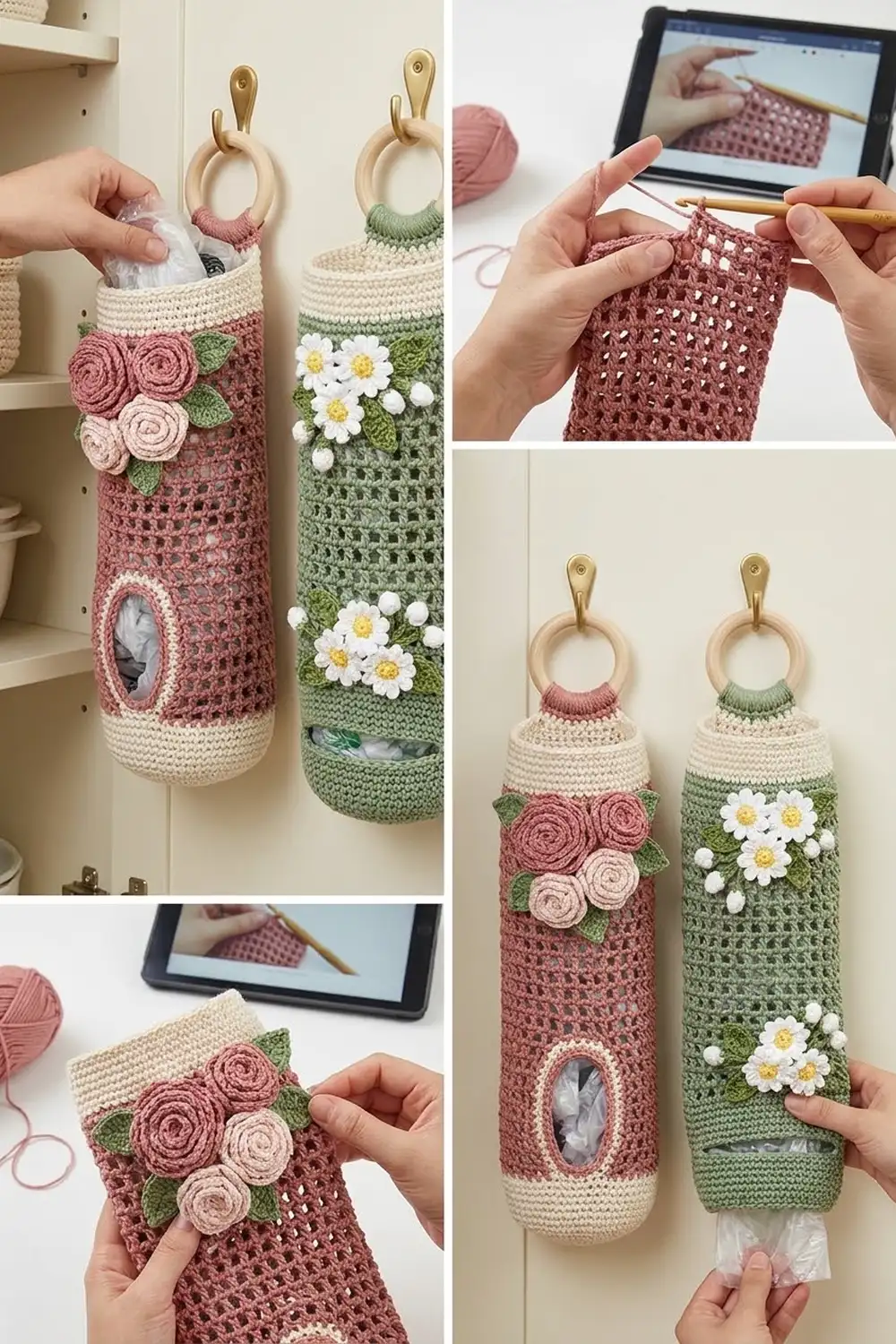
The Garden Mesh Bag Holder is a hanging tube that keeps loose plastic grocery bags in one tidy place. The body is an open filet-style mesh with solid single crochet bands at the top and bottom. It hangs from a wooden ring on a tapered strap.
The pattern gives two finishes for the same tube:
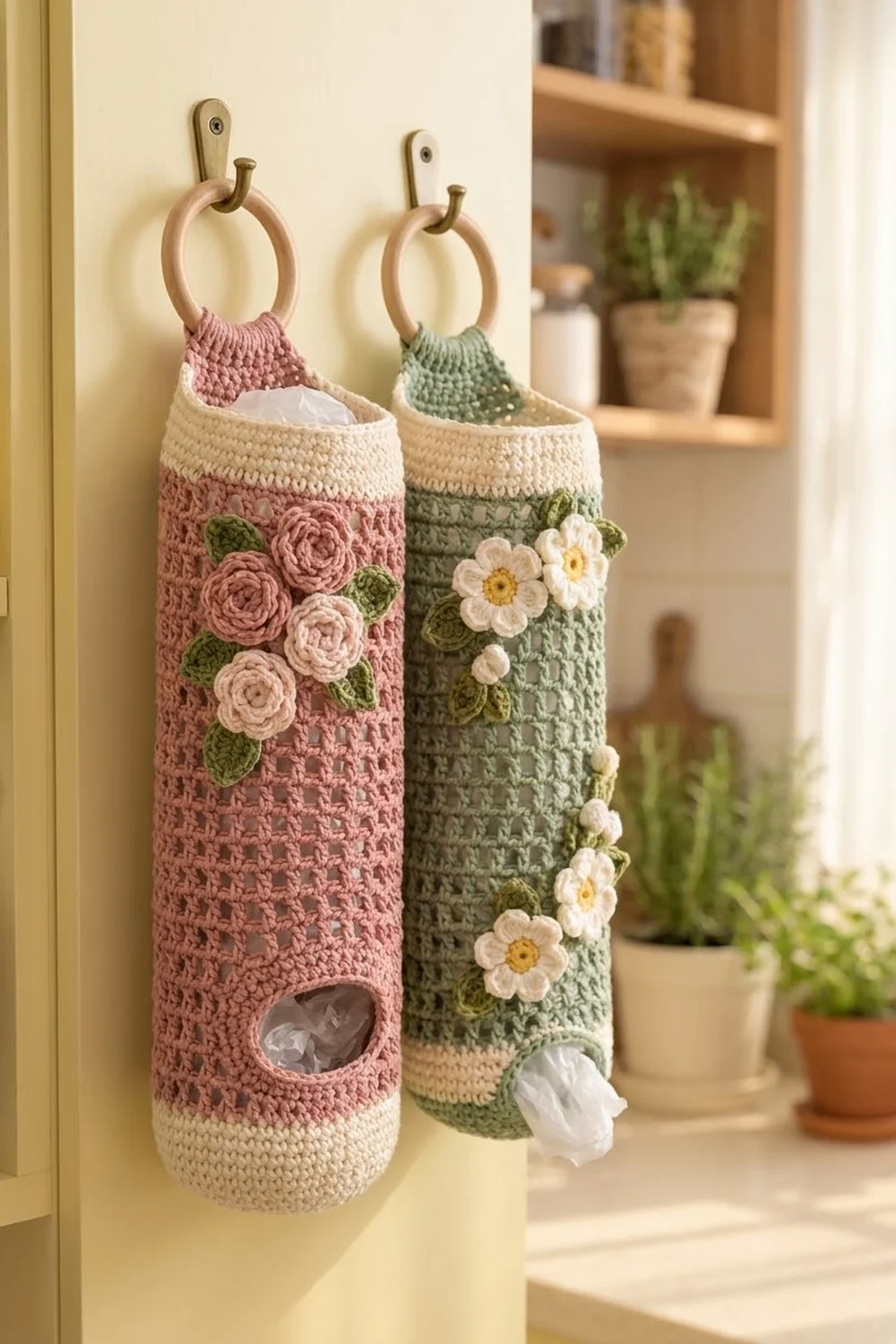
- Version A is dusty rose with cream bands, a closed round base, a side dispensing opening, and a cluster of rolled roses in dusty rose and blush pink with moss-green leaves.
- Version B is sage green with a cream top band and an open sage bottom you pull bags through. It’s decorated with white daisies that have yellow centers, small white buds, and green leaves.
All instructions use US crochet terms. Each finished tube measures 12 in (30.5 cm) around, 6 in (15.2 cm) wide laid flat, and 14 in (35.6 cm) tall, not counting the strap. Hanging from its ring, the holder is about 19.5 in (49.5 cm) long.
Both versions are worked in joined rounds from the bottom up: the bottom band first, then the mesh, then the top band. A strap is then worked in rows from the back edge. The flowers and leaves are made separately and sewn on at the end.
Finished Size and Construction
- Finished size: 12 in (30.5 cm) around, 6 in (15.2 cm) wide flat, 14 in (35.6 cm) tall
- Hanging length: about 19.5 in (49.5 cm), including strap and ring
- Skill level: Easy-intermediate
- Terminology: US
- Yarn weight: Worsted (#4) cotton
- Hook: 4.5 mm (US 7)
- Number of pieces: 1 tube body per holder, plus sewn-on appliqués (Version A: 4 roses and 4 leaves; Version B: 5 daisies, 3 buds, and 6 leaves)
- Layout: one tube with a strap at the back; no joined panels
- Height before top band: 12 in (30.5 cm)
- Top band depth: 2 in (5.1 cm), 9 rounds of sc
- Mesh section: 10 in (25.4 cm), 20 rounds
Materials
Use a smooth worsted-weight cotton or cotton blend. Cotton holds its shape and won’t stretch out under the weight of the bags. The amounts below assume a yarn with about 1.55 m per gram.
Version A (Rose)
– Dusty rose: 70 g / 109 m (body, strap, 2 roses)
– Cream: 40 g / 62 m
– Blush pink: 8 g / 12 m (2 roses)
– Moss green: 5 g / 8 m (4 leaves)
Version B (Daisy)
– Sage green: 80 g / 124 m (body, strap)
– Cream: 35 g / 54 m
– White: 8 g / 12 m (daisies and buds)
– Yellow: 3 g / 5 m
– Moss green: 6 g / 9 m (6 leaves)
Tools
– 4.5 mm (US 7) crochet hook
– One 3 in (7.6 cm) wooden ring per holder
– Stitch markers
– Tapestry needle
– Scissors
All quantities include a safety margin of about 15 percent.
Abbreviations (US Terms)
- ch – chain
- sl st – slip stitch
- sc – single crochet
- hdc – half double crochet
- dc – double crochet
- sc2tog – single crochet 2 together
- sk – skip
- sp – space
- MR – magic ring
- beg – beginning
- st(s) – stitch(es)
- RS / WS – right side / wrong side
Mesh: 1 dc + 1 ch. In this pattern each mesh counts as 2 sts, so a round of 24 mesh is 48 sts.
4-dc cluster: Yarn over, insert hook in the st, pull up a loop, yarn over, pull through 2 loops 4 times in the same st. Then yarn over and pull through all 5 loops on the hook.
Gauge and Checkpoints
- Sc in the round: 16 sts and 18 rounds = 4 in (10.2 cm)
- Mesh: 8 mesh (16 sts) and 8 rounds = 4 in (10.2 cm)
Your first 9 sc rounds act as your gauge swatch. Measure them before you go further.
Checkpoints
1. Version A base (Rnd 8): about 3.75 in (9.5 cm) across.
2. After the bottom band: the tube is 12 in (30.5 cm) around and the band is 2 in (5.1 cm) tall.
3. After 10 mesh rounds: the mesh measures 5 in (12.7 cm).
4. Before the top band: the tube is 12 in (30.5 cm) tall.
5. Finished: 14 in (35.6 cm) tall and 6 in (15.2 cm) wide flat.
If your tube is too big, go down 0.5 mm in hook size. If it’s too small, go up 0.5 mm. Don’t add or remove stitches, because the mesh repeat depends on having 48 sts.
Version A Body (Rose)
Join each round with a sl st to the first st. The ch-1 at the start of sc rounds does not count as a stitch.
Base (cream)
Rnd 1: Make a MR, ch 1, 6 sc in ring. (6 sts)
Rnd 2: 2 sc in each st. (12)
Rnd 3: Sc 1, 2 sc in next 6 times. (18)
Rnd 4: Sc 2, 2 sc in next 6 times. (24)
Rnd 5: Sc 3, 2 sc in next 6 times. (30)
Rnd 6: Sc 4, 2 sc in next 6 times. (36)
Rnd 7: Sc 5, 2 sc in next 6 times. (42)
Rnd 8: Sc 6, 2 sc in next 6 times. (48)
The flat base now measures about 3.75 in (9.5 cm) across.
Bottom band
Rnds 9–16: Sc in each st around. (48) The sides now turn upward.
Rnd 17: Change to dusty rose. Sc in each st. (48)
The band is 9 rounds and 2 in (5.1 cm) tall.
Mesh and dispensing opening
Rnd 18 (mesh set-up): Ch 4 (counts as dc + ch 1), sk next st, dc in next st, ch 1, sk next st 23 times, sl st in 3rd ch of beg ch-4. (24 mesh, 48 sts)
From here on, “dc in next dc” means skip the ch-1 sp and work into the next dc. Number the dc of Rnd 18 from 1 (the beg ch-4) to 24.
Row 19 (RS): Ch 4, dc in next dc, ch 1 17 times, dc in next dc (dc 19). Turn. (18 mesh + 1 dc = 37 sts) Leave the 6 mesh after dc 19 unworked.
Row 20 (WS): Ch 4, dc in next dc, ch 1 17 times, dc in 3rd ch of turning ch. Turn. (37 sts)
Rnd 21 (RS): Ch 4, dc in next dc, ch 1 17 times, dc in 3rd ch of turning ch, ch 11, sl st in 3rd ch of beg ch-4. (37 sts + 11 ch = 48 sts)
Rnd 22: Ch 4, dc in next dc, ch 1 18 times, sk next ch, dc in next ch, ch 1 5 times, sk last ch, sl st in 3rd ch of beg ch-4. (24 mesh, 48 sts)
This leaves an opening 6 mesh wide and 2 rows tall, about 3 in (7.6 cm) by 1 in (2.5 cm).
Rnds 23–37: Ch 4, dc in next dc, ch 1 23 times, sl st in 3rd ch of beg ch-4. (24 mesh, 48 sts each round)
You now have 20 mesh rounds, which measure 10 in (25.4 cm). The tube is 12 in (30.5 cm) tall from the base.
Opening edging: Join dusty rose at the lower right corner of the opening and sc around it as follows:
– 11 sc along the bottom edge (1 in each dc and ch-1 sp of Rnd 18)
– 4 sc up the side (2 per row end)
– 11 sc in the free loops of the ch-11
– 4 sc down the other side
Sl st to the first sc. (30 sc) Fasten off.
Continue with the Top Band and Hanger below.
Version B Body (Daisy)
Bottom band (sage, open end)
Foundation: Ch 40 and join with a sl st, taking care not to twist.
Rnds 1–4: Ch 1, sc in each st. (40)
Rnd 5: Sc 4, 2 sc in next 8 times. (48)
Rnds 6–9: Sc in each st. (48)
The open end is 10 in (25.4 cm) around, a little narrower than the body, so bags pull out one at a time instead of falling out. The band is 9 rounds and 2 in (5.1 cm) tall.
Mesh
Rnd 10: Work as Version A Rnd 18. (24 mesh, 48 sts)
Rnds 11–29: Work as Version A Rnd 23. (24 mesh, 48 sts each round)
You now have 20 mesh rounds, which measure 10 in (25.4 cm). The tube is 12 in (30.5 cm) tall. This version has no side opening.
Top Band and Hanger (Border)
The top band works as the border of this piece. It keeps the same 48-st count as the bottom band. Laid flat, it has 24 sts on the front and 24 on the back.
Conversion round (Version A Rnd 38 in dusty rose; Version B Rnd 30 in sage): Ch 1, sc in each dc and in each ch-1 sp around. That’s 24 dc + 24 ch-1 sps = 48 sts, with 0 sts added.
Cream rounds (Version A Rnds 39–46; Version B Rnds 31–38): Change to cream. Ch 1, sc in each st around. (48 sts per round; 24 per flat side)
Why the math works:
– 24 mesh × 2 sts = 48 sts.
– 48 sts ÷ 16 sts per 4 in = 12 in (30.5 cm) around, which is 6 in (15.2 cm) per flat side.
– The band has 9 rounds, and 9 ÷ 18 rounds per 4 in = 2 in (5.1 cm).
– So the tube is 2 + 10 + 2 = 14 in (35.6 cm) tall.
Hanger strap. Flatten the tube. On Version A, center the opening on the front. Mark the 16 center sts of the back edge. Join dusty rose (Version A) or sage (Version B) at the first marked st and work in rows.
Row 1: Ch 1, sc in each of the 16 marked sts. Turn. (16)
Row 2: Ch 1, sc2tog, sc to last 2 sts, sc2tog. Turn. (14)
Row 3: Ch 1, sc in each st. Turn. (14)
Rows 4–10: Repeat Rows 2–3 three more times, then work Row 2 once more. (12, 12, 10, 10, 8, 8, 6)
Rows 11–18: Ch 1, sc in each st. Turn. (6)
The strap is 4 in (10.2 cm) wide at the base and 1.5 in (3.8 cm) wide at the top. It is 18 rows, or 4 in (10.2 cm), long.
Fasten off with a long tail. Fold the last 7 rows, about 1.5 in (3.8 cm), over the wooden ring to the WS and whipstitch the edge down. About 2.5 in (6.4 cm) of strap stays visible.
Appliqués
Rolled rose (Version A: 2 dusty rose, 2 blush)
Ch 25.
Row 1: Sc in 2nd ch from hook and in each ch across. Turn. (24)
Row 2: Ch 1, (sc, hdc, dc) in next st, (dc, hdc, sc) in next st 12 times. (12 petals, 72 sts)
Fasten off, leaving a 12 in (30.5 cm) tail. Roll the strip tightly from the starting end with the RS facing out, so the petals spiral. Stitch through the layers at the base to secure. Each rose is about 1.75 in (4.4 cm) across.
Leaf (moss green; Version A: 4, Version B: 6)
Ch 8. Sc in 2nd ch from hook, hdc in next, dc in next 3 chs, hdc in next, 3 sc in last ch. Working along the other side of the chain: hdc in next, dc in next 3, hdc in next, sc in next, sl st to the first sc. (15 sts plus the sl st) Each leaf is about 1.75 in (4.4 cm) long.
Daisy (Version B: 5)
Rnd 1 (yellow): MR, ch 1, 6 sc in ring, sl st to join. (6)
Rnd 2 (yellow): Ch 1, 2 sc in each st, sl st to join. (12)
Rnd 3 (white): (Hdc, 3 dc, hdc) in next st, sl st in next st 6 times. (6 petals)
Each daisy is about 1.75 in (4.4 cm) across.
Bud (white; Version B: 3)
Ch 4, work a 4-dc cluster in the 4th ch from hook, ch 1, fasten off. Each bud is about 0.5 in (1.3 cm).
Placement
– Version A: Arrange the 4 roses in a vertical cluster on the upper left front. The top rose overlaps the lower edge of the cream band, and the colors alternate dusty rose and blush going down. Tuck the leaves behind the outer edges of the roses so they peek out.
– Version B: Sew 2 daisies, 1 bud, and 3 leaves just below the cream band, a little right of center. Sew the other 3 daisies, 2 buds, and 3 leaves about two-thirds of the way down the front.
Whipstitch around the outer edge of each piece, sewing into the dc posts of the mesh rather than the open spaces.
Final Blocking
- Weave in all ends along the sc bands or inside the dc posts.
- Lightly mist the holder with water.
- Slide it over a rolled towel about 3.75 in (9.5 cm) in diameter.
- Line up the mesh columns so they run straight up the tube.
- Pat the tube to 14 in (35.6 cm) tall and 12 in (30.5 cm) around.
- Shape the flowers with your fingertips and let everything dry completely.
Final Quality-Control Checklist
- 48 sts in every sc round and 24 mesh in every mesh round
- Mesh columns line up vertically
- Tube is 6 in (15.2 cm) wide flat and 14 in (35.6 cm) tall
- Version A opening is edged with 30 sc and lies flat
- Strap is centered on the back, and the ring is firmly whipstitched in place
- Appliqués are secure, with no stitches showing on the front
- All ends are woven in securely
Troubleshooting
- Mesh slants: Make sure each dc goes into the dc below it, not into the ch-1 sp.
- Base cups or ruffles: Cupping means your tension is too tight, and ruffling means it’s too loose. Rework Rnd 8 with a hook 0.5 mm larger (for cupping) or smaller (for ruffling).
- Opening gapes: Work the edging more snugly, or use 3 sc on each side instead of 4.
- Strap twists: Count your stitches on Rows 2–10 and check that the decreases are at both ends.
- Roses unroll: Add 3–4 more stitches through all the layers at the base.
Care
Hand wash in cool water and lay flat to dry. Try to keep the wooden ring dry, and reshape the flowers while they’re still damp.
Final Notes
Each measurement depends on the one before it:
– A gauge of 16 sts per 4 in (10.2 cm) gives a 48-st tube that is 12 in (30.5 cm) around.
– A 2 in (5.1 cm) band, 10 in (25.4 cm) of mesh, and another 2 in (5.1 cm) band give a height of 14 in (35.6 cm).
– 2.5 in (6.4 cm) of visible strap plus the 3 in (7.6 cm) ring bring the hanging length to about 19.5 in (49.5 cm).
Check your size at every checkpoint, and both versions will come out the same.
Happy crocheting!