

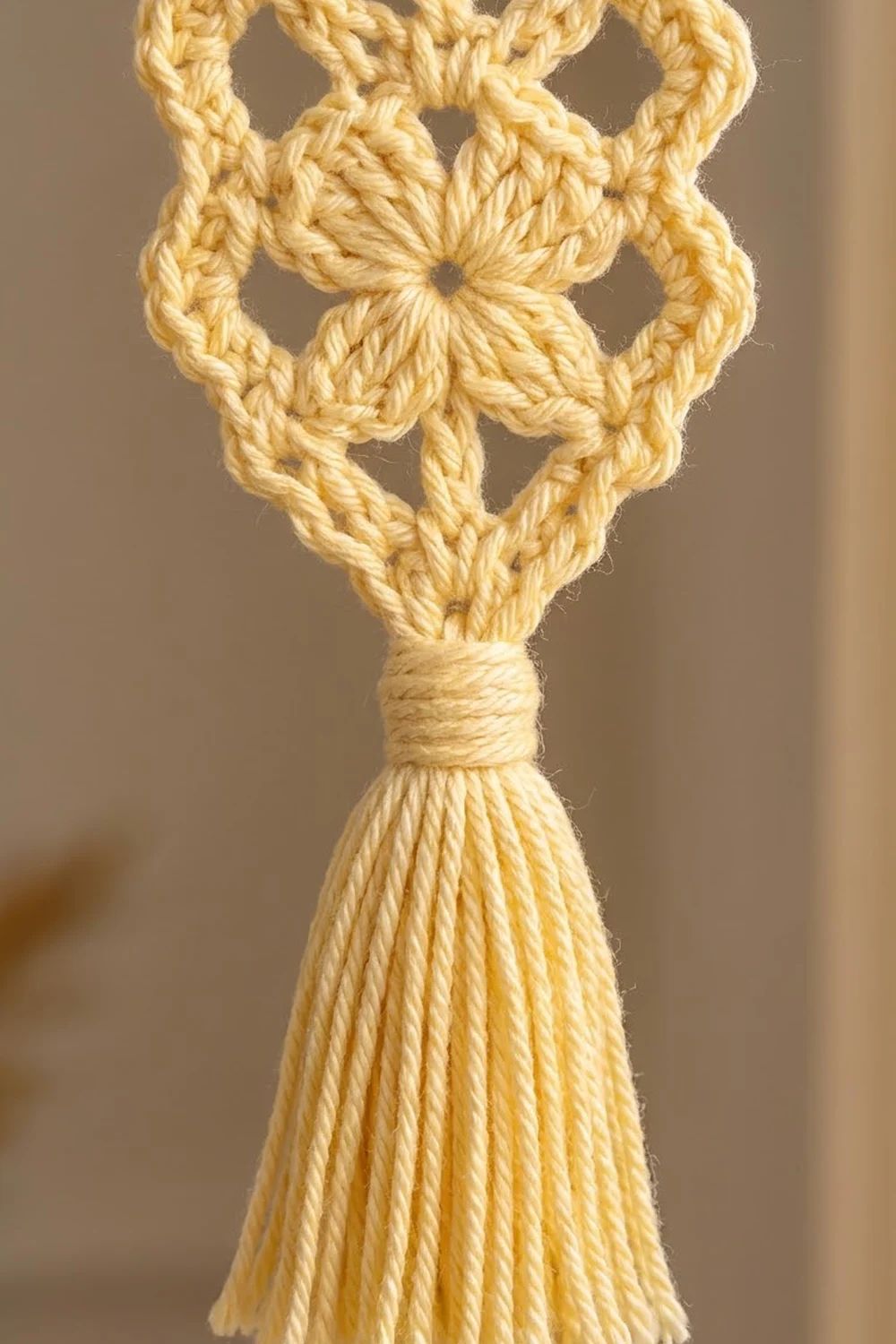
The Sunlit Lattice Strip Curtain is a set of ten narrow lace strips that hang side by side. They let light through without blocking it. Each strip has a single column of six-petal flowers inside an open diamond lattice. The strip ends in a soft V-point with a full tassel, and a small tab at the top slides onto a curtain rod.
The colors are cream, butter yellow and warm taupe, hung in a repeating cream, yellow, taupe order that starts and ends with cream. The look is light and airy, with a gentle boho feel.
This pattern uses US crochet terms. Each finished strip is 4 in (10.2 cm) wide and 48 in (121.9 cm) long, not counting the tab and tassel. On the rod with 0.5 in (1.3 cm) gaps, the full curtain is about 44.5 in (113.0 cm) wide and about 54 in (137.2 cm) from the top of the tab to the tassel tips.
You work each strip flat in rows from the top down: a solid single crochet band, thirty 3-row flower repeats and a 2-row point. Then you add a 2-round border, a hanging tab and a tassel. The strips are never sewn together.
Finished Size and Construction
- Finished strip size: 4 in x 48 in (10.2 cm x 121.9 cm), not counting tab and tassel
- Full curtain: about 44.5 in (113.0 cm) wide x 54 in (137.2 cm) long
- Skill level: Easy-Intermediate
- Terminology: US crochet terms
- Yarn weight: DK (weight 3) cotton
- Hook: 4.0 mm (G-6)
- Number of pieces: 10 separate strips
- Layout: 10 strips in one row, hung 0.5 in (1.3 cm) apart, not joined
- Strip size before border: 3 in x 47 in (7.6 cm x 119.4 cm)
- Border depth: 0.5 in (1.3 cm) on each long side; adds 0.5 in (1.3 cm) to the total length
- Tassel length: 5 in (12.7 cm)
Materials
Use a smooth, mercerized or combed DK cotton. Cotton keeps the lace open and the clusters crisp, and it sags very little. Avoid fuzzy or stretchy yarns, which blur the lattice and can make the strips grow longer.
Yarn amounts (based on DK cotton at about 110 m per 50 g):
- Cream: 160 g / 352 m (4 strips)
- Butter Yellow: 120 g / 264 m (3 strips)
- Taupe: 120 g / 264 m (3 strips)
Each strip uses about 40 g / 88 m, including the border, tab and tassel. All amounts include a margin of about 15 percent for your test piece, tassel trimming and differences in tension.
Tools:
- 4.0 mm (G-6) crochet hook, plus 3.5 mm and 4.5 mm hooks in case you need to adjust gauge
- Tapestry needle and scissors
- A stiff card 5.5 in (14.0 cm) tall, for the tassels
- Rust-proof pins and a blocking surface 50 in (127.0 cm) long
- Measuring tape
- Curtain rod up to 1 in (2.5 cm) in diameter
Abbreviations (US Terms)
- ch – chain
- sl st – slip stitch
- sc – single crochet
- dc – double crochet
- sk – skip
- sp – space
- st(s) – stitch(es)
- rep – repeat
- dc3tog – double crochet 3 together
Special stitches:
- 3-dc cluster (cl): (Yo, insert hook, pull up a loop, yo, pull through 2 loops) 3 times in the same place, then yo and pull through all 4 loops.
- 6-dc gather: (Yo, insert hook in the first location, pull up a loop, yo, pull through 2 loops) twice. Repeat the bracket twice in the second location, then twice in the third location. You now have 7 loops on the hook. Yo and pull through all 7 loops. This makes three petals that meet at one point.
- Eye: The tight ch 1 you make right after a gather. It locks the gather and becomes the flower center.
Gauge and Checkpoints
- 15 sc = 3 in (7.6 cm)
- 5 rows of sc = 1 in (2.5 cm)
- One 3-row flower repeat = 1.5 in (3.8 cm) tall after blocking
Test one piece first. Start your first strip and stop after Row 17 (the top band plus 4 flower repeats). Pin it flat without stretching, then measure.
Checkpoints:
- After Row 5: 3 in (7.6 cm) wide, 1 in (2.5 cm) tall
- After Row 17 (4 repeats): 7 in (17.8 cm) tall
- After Row 35 (10 repeats): 16 in (40.6 cm) tall
- After Row 95 (30 repeats): 46 in (116.8 cm) tall
- After Row 97 (point): 47 in (119.4 cm) tall, 3 in (7.6 cm) wide
- After the border: 4 in x 48 in (10.2 cm x 121.9 cm)
If your piece is too wide, switch to a 3.5 mm hook. If it is too narrow, switch to a 4.5 mm hook. To change the length, add or remove whole repeats of 1.5 in (3.8 cm) each. Each repeat you add or remove changes the border count by 5 sc per side.
Strip Pattern (Make 10)
You work back and forth in rows. Because the flower repeat is 3 rows long, it starts on alternating sides of the work. The clusters look the same from both sides, so this doesn’t matter.
Top Band
Foundation: Ch 16.
Row 1: Sc in 2nd ch from hook and in each ch across. Turn. (15 sc)
Rows 2–4: Ch 1 (does not count as a st, here and throughout), sc in each sc across. Turn. (15 sc)
Row 5 (lattice setup): Ch 1, sc in first sc, ch 3, sk next 3 sc, sc in next sc, ch 2, sk next 2 sc, sc in next sc, ch 2, sk next 2 sc, sc in next sc, ch 3, sk next 3 sc, sc in last sc. Turn. (5 sc, 2 ch-3 sps, 2 ch-2 sps)
The 3rd sc is the center sc. Every flower lines up above it.
Flower Repeat (Rows 6–8)
Row 6 (gather row): Ch 3 (counts as dc), ch 3, 6-dc gather with 2 legs in first ch-3 sp, 2 legs in center sc and 2 legs in last ch-3 sp, ch 1 tightly (eye), ch 3, dc in last sc. Turn. (2 dc, 1 gather, 1 eye, 2 ch-3 sps)
The three pairs of legs make the lower three petals, which meet at the eye.
Row 7 (fan row): Ch 3 (counts as dc), ch 2, sk ch-3 sp, (cl, ch 2, cl, ch 2, cl) in eye, ch 2, sk ch-3 sp, dc in 3rd ch of turning ch. Turn. (2 dc, 3 cl, 4 ch-2 sps)
The clusters make the upper three petals. The skipped ch-3 sps leave a diamond-shaped opening on each side of the flower.
Row 8 (lattice row): Ch 1, sc in first dc, ch 3, sc in top of first cl, ch 2, sc in top of center cl, ch 2, sc in top of 3rd cl, ch 3, sc in 3rd ch of turning ch. Turn. (5 sc, 2 ch-3 sps, 2 ch-2 sps)
Row 8 matches Row 5, so the flowers stack in a straight column.
Rows 9–95: Rep Rows 6–8 another 29 times, for 30 flower repeats in total. Row 95 is a lattice row. (5 sc, 2 ch-3 sps, 2 ch-2 sps)
Point
Row 96: Sl st in first sc and in each of next 3 ch, sl st in 2nd sc, ch 1, sc in same sc, ch 3, sc in center sc, ch 3, sc in 4th sc. Leave the rest of the row unworked. Turn. (3 sc, 2 ch-3 sps)
Row 97: Ch 2 (does not count), dc3tog with one leg in first ch-3 sp, one in center sc and one in last ch-3 sp, ch 1 to lock. Fasten off. (1 st at tip)
Make All Pieces
Make 10 strips:
- Cream: 4 strips
- Butter Yellow: 3 strips
- Taupe: 3 strips
Finish each strip completely, including the border, tab and tassel below. Hang them in this order, from left to right:
Position:  1   2   3   4   5   6   7   8   9   10
Color:     C   Y   T   C   Y   T   C   Y   T   C
C = Cream, Y = Butter Yellow, T = Taupe
Joining: Hanging the Strips
The strips are not stitched together. They share a rod and nothing more, so each strip can move freely. Hang them after the border, tab, tassel and blocking steps are done.
Method: Slide each folded tab onto the rod in the layout order. Each tab is 1.4 in (3.6 cm) wide and sits at the center of its strip. Nothing joins the strips stitch to stitch, so no stitches are added between them.
Spacing: Leave 0.5 in (1.3 cm) between neighboring strips. Ten strips at 4 in (10.2 cm) plus nine gaps of 0.5 in (1.3 cm) gives 44.5 in (113.0 cm).
Tension advice: Don’t tug the strips to make them even, because lace grows when it is stretched. If one strip hangs lower than the rest, block it again.
Size checkpoint: The curtain should be about 44.5 in (113.0 cm) wide, with all tassel tips within 0.5 in (1.3 cm) of the same height.
Border
Work the border on each strip separately, in that strip’s color.
Border gauge: Along the long sides, work 5 sc for each 1.5 in (3.8 cm) flower repeat. That is 1 sc in each sc-height row end and 2 sc around each dc-height row end.
Round 1: Join yarn in the first foundation ch.
- Top: 3 sc in first ch (corner), sc in each of next 13 ch, 3 sc in last ch (corner). (19 sc)
- Long side A: Sc in the end of each of Rows 1–5 (5 sc). Then, for each of the 30 repeats, work 2 sc around the gather-row dc, 2 sc around the fan-row dc and 1 sc in the end of the lattice row. (155 sc)
- Point: 4 sc down the first point edge, 3 sc in the tip st, 4 sc up the second point edge. (11 sc)
- Long side B: Work as for side A in reverse. (155 sc)
- Sl st to first sc. (340 sc in total: 19 + 155 + 11 + 155)
Round 2: Ch 1.
- Top: Sl st in each of the 19 top sts.
- Long side A: *Sc in next 2 sc, (sc, ch 4, sc) in next sc, sc in next 2 sc; rep from * 30 more times. (31 groups: 186 sc, 31 ch-4 loops)
- Point: Sl st in each of the 11 point sts.
- Long side B: Work as for side A. (186 sc, 31 ch-4 loops)
- Join with sl st to first sl st. Fasten off.
Why the math works: Each long side has 155 sc: 5 for the top band and 5 for each of the 30 repeats. 155 divided by 5 is exactly 31 groups, so there are no leftover stitches. One ch-4 loop sits beside each flower, plus one beside the top band.
Hanging tab: There are 13 sts along the top edge between the two corners. Join yarn in the 4th of these, inserting your hook under the sl st and the Round 1 sc together.
- Row 1: Ch 1, sc in same st and in each of next 6 sts. Turn. (7 sc)
- Rows 2–12: Ch 1, sc in each sc across. Turn. (7 sc)
Fasten off, leaving a 12 in (30.5 cm) tail. The tab is 2.4 in (6.1 cm) long. Fold it to the back and whipstitch Row 12 to the top band. This makes a loop about 1 in (2.5 cm) deep.
Tassel: Wrap yarn 30 times around the 5.5 in (14.0 cm) card. Tie the top of the bundle tightly with a 10 in (25.4 cm) strand, then cut the wraps at the bottom. Wrap a second strand 6 times around the bundle 0.75 in (1.9 cm) below the top and tie it off. Thread the top tie through the tip st, knot it on the back and hide the ends inside the tassel. Trim the tassel to 5 in (12.7 cm).
Final Blocking
- Weave in all ends.
- Soak the strip in cool water, then press out the extra water in a towel. Don’t wring it.
- Pin the strip flat to 4 in x 48 in (10.2 cm x 121.9 cm).
- Pin each ch-4 loop outward, and open each diamond and each flower eye.
- Check that the flowers form a straight line down the center.
- Let the strip dry completely, at least 24 hours.
- Steam the tassel lightly, comb it straight and trim it to 5 in (12.7 cm).
Final Quality-Control Checklist
- [ ] Each strip measures 4 in x 48 in (10.2 cm x 121.9 cm)
- [ ] 30 flowers per strip and 31 scallops on each long side
- [ ] Every flower has 6 petals and an open eye
- [ ] The point is centered under the column of flowers
- [ ] Tabs are centered and firmly sewn
- [ ] Tassels are 5 in (12.7 cm) long and tied securely
- [ ] 4 cream, 3 yellow and 3 taupe strips are hung in order
Troubleshooting
Flowers drift to one side: Always put the middle pair of gather legs in the center sc.
Eye closes up: Work the locking ch 1 snugly but not tightly, then work the fan into that ch.
Edges ruffle: Too many border sc. Keep to exactly 5 sc per repeat.
Edges pull in: Too few sc, or tension that is too tight. Count again (155 per side) and relax your grip.
Strips are different lengths: Count the repeats on each strip, then block all strips to 48 in (121.9 cm).
Tassel looks thin: Use 36 wraps instead of 30. This uses a little more yarn.
Care
Hand wash in cool water with a mild soap, then dry flat to the blocked measurements. Don’t hang the strips while they are wet, because the weight of the water will stretch the lace.

Final Notes
Fifteen sc give a 3 in (7.6 cm) wide strip. The top band adds 1 in (2.5 cm), and the 30 repeats bring the length to 46 in (116.8 cm). The point makes it 47 in (119.4 cm). The border brings each strip to 4 in x 48 in (10.2 cm x 121.9 cm). Ten strips with 0.5 in (1.3 cm) gaps hang about 44.5 in (113.0 cm) wide. If your gauge matches at Row 17, every later measurement will match too.
Happy crocheting!