

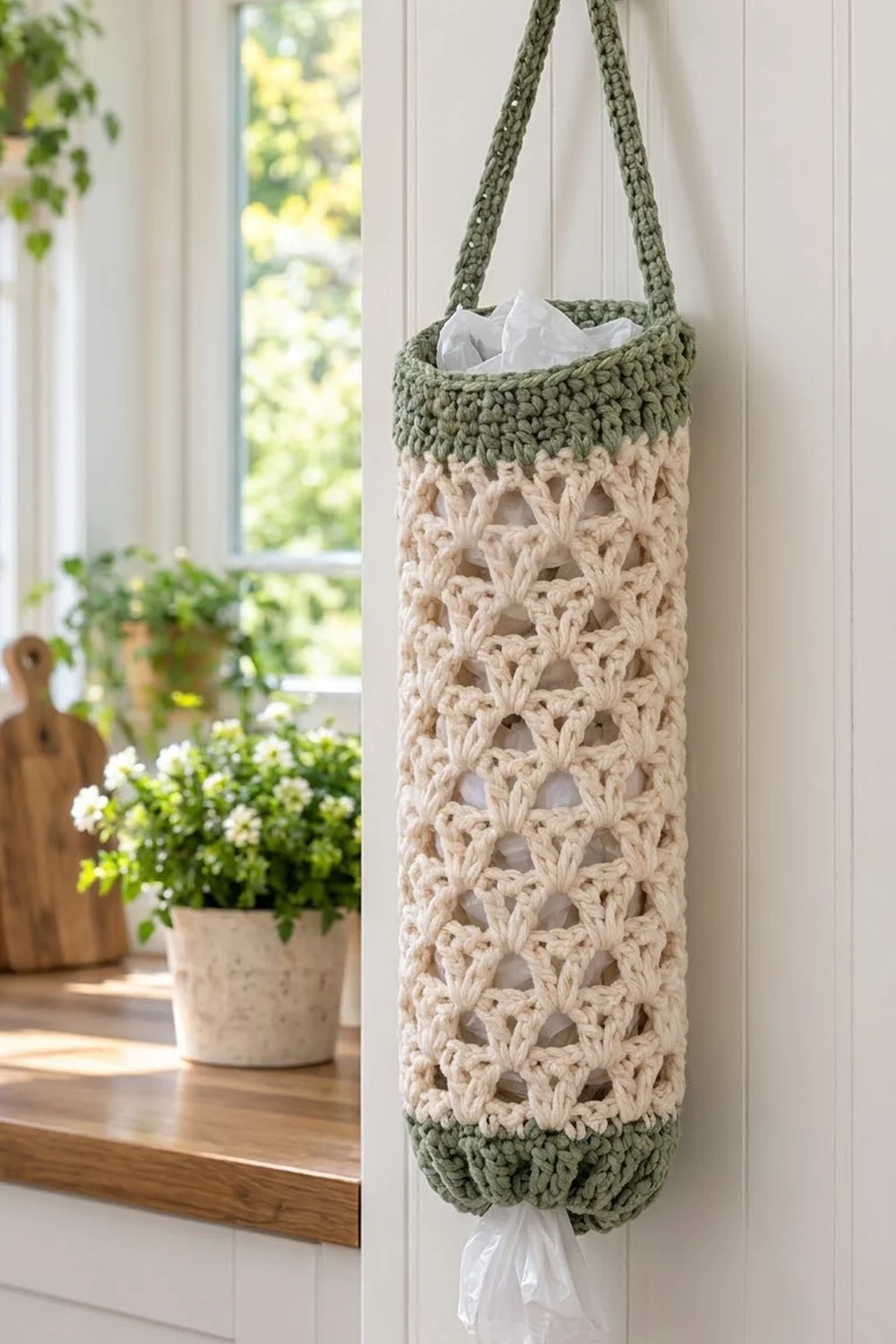
The Sage Lattice Bag Holder is a tall, airy tube that keeps loose plastic bags tidy and easy to grab. You stuff bags in at the top and pull them out, one at a time, through a cinched opening at the bottom. It hangs from a hook or door knob on a sturdy single crochet strap.
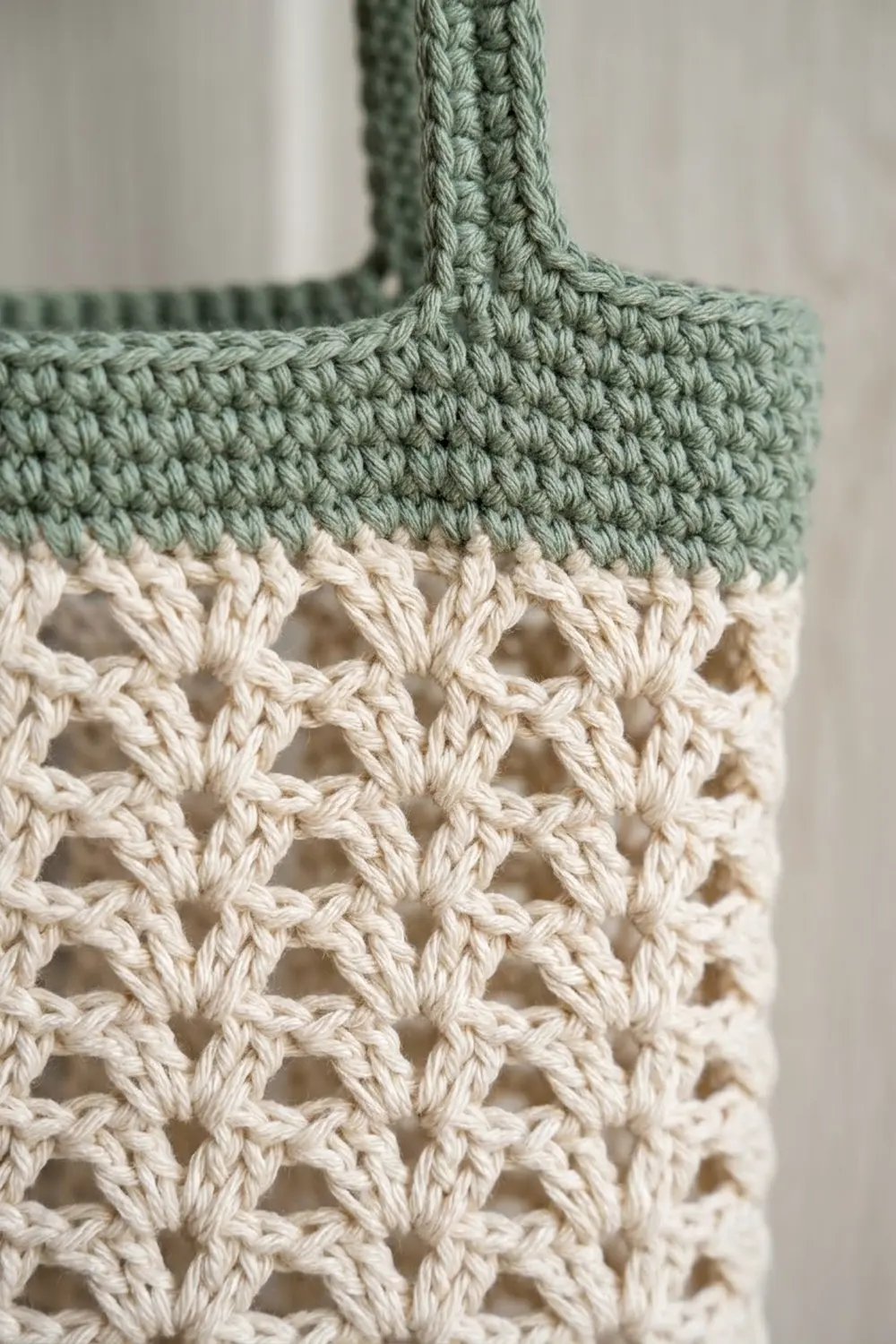
The body is worked in cream cotton in a staggered V-shell lattice. Every shell sits over a single stitch from the round below, so the openings line up in neat diagonal rows, and you can see how full the holder is at a glance. Sage-green bands frame both ends. The top band is firm and holds its shape. The bottom band is gathered with a drawstring, which gives it a soft ruffle.
This pattern uses US crochet terms. The finished holder measures 12 in (30.5 cm) around, which is 6 in (15.2 cm) wide laid flat, and 19 in (48.3 cm) tall without the strap. The strap is 10 in (25.4 cm) long.
Construction is simple. You chain a ring and work the cream body upward in joined rounds. Then you add the sage top band to the last cream round and the sage bottom band to the free loops of the foundation chain. The strap is worked straight off the top band, and a chain drawstring is threaded through the bottom eyelets.
Finished Size and Construction
- Finished size: 12 in (30.5 cm) circumference, 6 in (15.2 cm) flat width, 19 in (48.3 cm) tall
- Skill level: Easy / advanced beginner
- Terminology: US crochet terms
- Yarn weight: Worsted (#4), cotton or cotton blend
- Hook: 5.0 mm (US H-8)
- Number of pieces: 1 tube with an attached strap, plus 1 chain drawstring
- Layout: Worked in the round from the bottom up, with no seams
- Piece size (body before bands): 12 in (30.5 cm) around × 15.5 in (39.4 cm) tall
- Bands: Top band 1.5 in (3.8 cm) deep, bottom band 2 in (5.1 cm) deep before gathering
- Strap: 1 in (2.5 cm) wide × 10 in (25.4 cm) long
Materials
Use a smooth worsted-weight cotton or cotton blend. Cotton keeps the lattice crisp and doesn’t stretch much when the holder is full. Steer clear of very soft acrylic, because the tube will slowly lengthen under the weight of the bags.
- Cream (main color): 140 g, about 265 m
- Sage green (contrast color): 70 g, about 135 m
Both amounts include a margin of about 15% for your gauge swatch and small tension differences.
Tools:
- 5.0 mm (US H-8) crochet hook
- 4 locking stitch markers
- Tapestry needle
- Scissors
- Measuring tape
- Rustproof pins and a rolled towel (or a tall bottle) for blocking
Abbreviations (US Terms)
- ch – chain
- sl st – slip stitch
- sc – single crochet
- dc – double crochet
- sk – skip
- sp – space
- st(s) – stitch(es)
- rep – repeat
- rnd(s) – round(s)
- beg – beginning
Special stitch:
- Shell: (2 dc, ch 2, 2 dc) all in the same stitch or space.
- Beg shell: ch 3 (counts as dc), then (dc, ch 2, 2 dc) in the same stitch.
One shell has 4 dc and 1 ch-2 sp.
Gauge and Checkpoints
Single crochet gauge: 16 sc and 16 rnds = 4 in (10.2 cm).
Lattice gauge: 1 pattern repeat (6 foundation stitches) = 1.5 in (3.8 cm) wide; 4 pattern rnds = 2.5 in (6.4 cm) tall.
Because the holder is a single tube, the body acts as your test piece. Work up to Rnd 5, then lay the tube flat and measure it before you go any further.
Checkpoints:
- After Rnd 1: the ring of 48 sc lies flat without twisting and measures 12 in (30.5 cm) around, or 6 in (15.2 cm) flat.
- After Rnd 5: the 4 lattice rnds measure 2.5 in (6.4 cm) tall, and the flat width is still 6 in (15.2 cm).
- After Rnd 26: the cream body measures 15.5 in (39.4 cm) from the foundation chain.
- After the top band: the band adds 1.5 in (3.8 cm).
- After the bottom band: the full tube measures 19 in (48.3 cm) tall.
If your piece is too big: go down to a 4.5 mm hook. A flat width over 6.5 in (16.5 cm) makes the tube baggy, and the bags will drop out.
If your piece is too small: go up to a 5.5 mm hook. A flat width under 5.5 in (14.0 cm) makes it hard to stuff in more than a few bags.
Don’t change the stitch count to fix gauge. The lattice only works in multiples of 6.
Body (Cream)
With cream, ch 48 and sl st to the first ch to form a ring. Be careful not to twist the chain.
Rnd 1: Ch 1, sc in each ch around, sl st to first sc to join. (48 sc)
This round measures about 0.25 in (0.6 cm) tall.
Rnd 2 (Round A): Ch 3 (counts as dc), sk 2 sts, shell in next st, sk 2 sts, dc in next st, sk 2 sts, shell in next st, sk 2 sts; rep from * 6 more times. Join with sl st to top of beg ch-3. (8 shells + 8 single dc = 40 dc and 8 ch-2 sps)
Each 6-stitch section of Rnd 1 holds exactly one single dc and one shell, so 48 ÷ 6 = 8 repeats.
Rnd 3 (Round B): Beg shell in same st as join, dc in ch-2 sp of next shell, shell in next single dc; rep from * 6 more times, dc in ch-2 sp of last shell. Join with sl st to top of beg ch-3. (8 shells + 8 single dc = 40 dc and 8 ch-2 sps)
Rnd 4 (Round A): Sl st in next dc, sl st in next ch-2 sp, ch 3 (counts as the single dc in this sp), shell in next single dc, dc in ch-2 sp of next shell; rep from * 6 more times, shell in last single dc. Join with sl st to top of beg ch-3. (8 shells + 8 single dc = 40 dc and 8 ch-2 sps)
This is how the stagger works. Each new shell goes into a single dc, and each new single dc goes into a shell’s ch-2 sp. So the shells change columns every round, and the triangular openings sit offset from one another, just like a lattice.
Rnds 5–25: Alternate Round B (odd rnds) and Round A (even rnds), ending with a Round B on Rnd 25. Every round keeps 40 dc and 8 ch-2 sps.
That gives you 24 lattice rounds in total (Rnds 2–25). At 4 rnds = 2.5 in (6.4 cm), they measure 15 in (38.1 cm).
Rnd 26 (conversion round): Ch 1, sc in same st as join, sc in next dc, sc in ch-2 sp, sc in each of next 2 dc, sc in next single dc, sc in each of next 2 dc, sc in ch-2 sp, sc in each of next 2 dc; rep from * 6 more times, sc in last single dc. Join to first sc. (40 sc worked 1 per dc + 8 sc worked in ch-2 sps = 48 sc)
The body now measures 15.5 in (39.4 cm): 0.25 in (0.6 cm) for Rnd 1, plus 15 in (38.1 cm) of lattice, plus 0.25 in (0.6 cm) for Rnd 26. Fasten off cream and weave in the tail.
Border: Top Band, Strap, and Bottom Band (Sage)
Border gauge: 16 sc and 16 rnds = 4 in (10.2 cm), which works out to 4 sc rnds per 1 in (2.5 cm).
The tube has no corners, so the “side” here is the full circumference. Each band begins with the same 48 stitches as Rnd 1 and Rnd 26, which means it matches the body exactly and won’t flare or pucker.
Top Band
Rnd 1: Join sage with a sl st in any sc of Rnd 26. Ch 1, sc in same st and in each st around. Join. (48 sc)
Rnds 2–6: Ch 1, sc in each st around. Join. (48 sc)
Six rounds at 4 rnds per inch give a band 1.5 in (3.8 cm) deep. Don’t fasten off yet.
Lay the tube flat with the join at one side fold. Place markers in sts 1–4 of Rnd 6 (beginning at the join). Count 24 sts from st 1 and place markers in sts 25–28. Because 48 ÷ 2 = 24, these two groups sit directly opposite each other.
Strap
Row 1: Ch 1, sc in each of sts 1–4. (4 sc)
Rows 2–40: Ch 1, turn, sc in each st across. (4 sc)
Forty rows at 4 rows per inch give a strap 10 in (25.4 cm) long and 1 in (2.5 cm) wide.
Attach: Bring the strap over the top of the tube to the marked sts 25–28, making sure it isn’t twisted. Hold the last row against the outside of the band and sl st through both layers, 1 strap st to 1 band st. (4 sl sts) Fasten off and weave in the ends.
Bottom Band
Turn the tube upside down so the foundation chain is on top.
Rnd 1: Join sage with a sl st in any free bottom loop of the foundation chain. Ch 1, sc in same loop and in each loop around. Join. (48 sc)
Rnds 2–3: Ch 1, sc in each st around. Join. (48 sc)
Rnd 4 (eyelet round): Ch 3 (counts as dc), dc in next st, ch 1, sk 1, dc in each of next 2 sts, ch 1, sk 1; rep from * 14 more times. Join to top of beg ch-3. (32 dc + 16 ch-1 sps = 48 sts; 16 eyelets)
Rnd 5 (conversion round): Ch 1, sc in each dc and in each ch-1 sp around. Join. (32 sc worked 1 per dc + 16 sc worked in ch-1 sps = 48 sc)
Rnds 6–7: Ch 1, sc in each st around. Join. (48 sc)
Fasten off and weave in the ends. The band has 6 sc rnds at 0.25 in (0.6 cm) each plus one dc round at 0.5 in (1.3 cm), so it is 2 in (5.1 cm) deep.
Why the math works: The body, both bands, and the eyelet round all hold 48 stitches. The eyelet round splits that into 16 repeats of 3 (2 dc + 1 ch), so 16 × 3 = 48. Both conversion rounds put back exactly 1 sc for each stitch or space, so nothing creeps in or drops out.
Drawstring
With sage, ch 90, about 22 in (55.9 cm), and fasten off. Starting at the center front, weave the chain in and out through the 16 eyelets so both ends come out of neighboring eyelets. Pull until the opening is about 2 in (5.1 cm) across. That’s wide enough to pull a bag through, but snug enough to hold the rest in. Tie a bow and knot each end.
Final Blocking
- Weave in all the ends before you block, but don’t trim them yet.
- Wet the holder in cool water, then squeeze gently. Don’t wring it.
- Roll it in a towel to take out the extra water.
- Slide it over a rolled towel or a tall bottle about 3.75 in (9.5 cm) across, so the tube sits at 12 in (30.5 cm) around without stretching.
- Pat the lattice so the shells stand upright and the openings line up in straight diagonal rows.
- Check the length: 15.5 in (39.4 cm) for the cream body and 19 in (48.3 cm) overall.
- Pin the strap flat at 1 in (2.5 cm) wide and leave it to dry.
- Once it’s completely dry, trim the tails and re-tie the drawstring.
Final Quality-Control Checklist
- Every lattice round has 8 shells and 8 single dc.
- The shells alternate columns from round to round, with none stacked directly on another.
- The joins line up in a neat seam line on one side, at the back.
- Both green bands have 48 sc and lie flat with no ruffling (before you cinch).
- The strap is attached to opposite sides at sts 1–4 and 25–28, with no twist.
- All 16 eyelets are open and threaded evenly.
- The flat width is 6 in (15.2 cm) and the total length is 19 in (48.3 cm).
- All ends are secure, with no loose loops inside the tube.
Troubleshooting
Shells are stacking instead of staggering: You probably put a shell into a ch-2 sp. Shells always go into single dc, and single dc always go into ch-2 sps.
The join is drifting around the tube: That’s normal with sl st starts. Mark the first stitch of each round so you can track it, and keep the join at the back.
The top band flares: Your sc tension is looser than your lattice tension. Rework the band with a 4.5 mm hook, keeping 48 sts.
The bottom won’t close tightly: Make sure you skipped a stitch at every ch-1 in Rnd 4, and count 16 eyelets. You can also pull the drawstring tighter and add a double knot.
The strap stretches over time: Go down to a 4.5 mm hook for the strap, or work a row of sl sts along each long edge.
The tube is twisted: Your foundation chain was twisted when you joined it. Unfortunately, you’ll need to start over and check the chain carefully before joining.
Care
Hand wash in cool water with mild soap and lay flat or over a bottle to dry. Don’t tumble dry, because the cotton may shrink and the lattice can lose its shape.
Final Notes
Everything in this holder follows one measurement chain. A ring of 48 stitches gives 12 in (30.5 cm) around. Eight lattice repeats of 1.5 in (3.8 cm) fit exactly into that ring. Twenty-four lattice rounds at 0.625 in (1.6 cm) each add up to 15 in (38.1 cm), and the two sc rounds bring the body to 15.5 in (39.4 cm). The 1.5 in (3.8 cm) top band and the 2 in (5.1 cm) bottom band finish the tube at 19 in (48.3 cm), and the 10 in (25.4 cm) strap hangs it from any hook.
If your gauge checkpoints match, the rest of the holder will fall into place. Fill it up, hang it by the kitchen door, and enjoy a tidier cupboard.
Happy crocheting!