

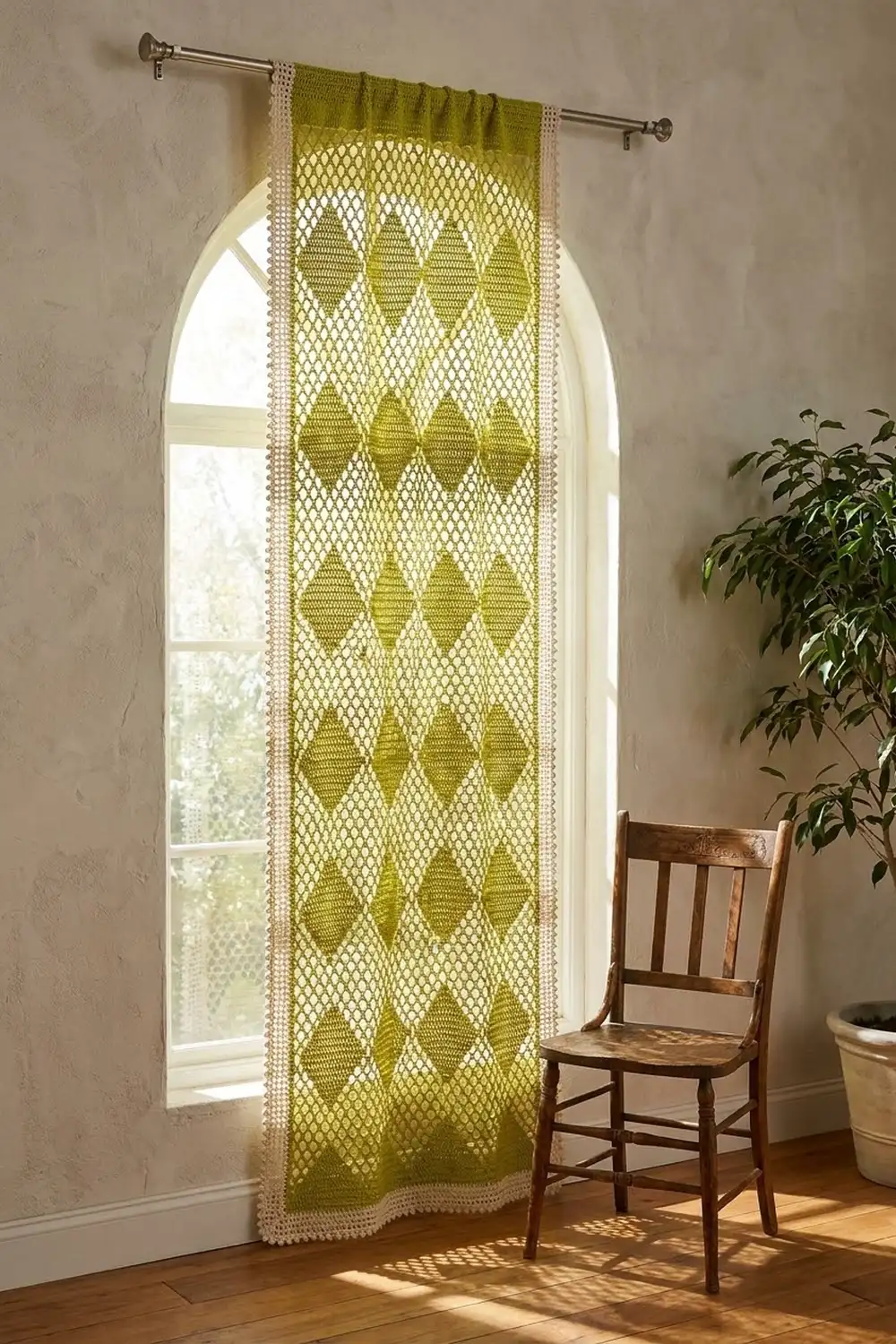
The Olive Grove Curtain Panel is a single full-length lace curtain made of tall, solid diamonds stacked point to point in vertical columns. Open diamond-shaped windows sit between the columns, so light comes through and the solid motifs seem to float on a fine lattice.
The body is a bright chartreuse olive-green cotton. A natural cream border runs down both long sides and across the bottom, finished with a beaded crab-stitch edge. The style is relaxed and Mediterranean. It suits sunlit rooms with plaster walls, linen and terracotta.
This pattern uses US crochet terms. The finished panel measures 33.25 in (84.5 cm) wide by 82.25 in (208.9 cm) long, including the border and the folded rod pocket.
You work the panel flat in one piece from the bottom up. Start with a foundation row of single crochet, then repeat a 2-row diamond pattern (a shell row and a cluster row) 45 times. A plain band at the top folds into a rod pocket. Last, you work a 5-row cream border down one side, across the bottom and up the other side.
Finished Size and Construction
- Finished size: 33.25 in (84.5 cm) wide x 82.25 in (208.9 cm) long
- Skill level: Intermediate (shells, 7-stitch clusters, crab stitch)
- Terminology: US crochet terms
- Yarn weight: Worsted (#4) cotton or cotton blend
- Hook: 5.0 mm (H-8)
- Number of pieces: 1 (a single panel, worked flat)
- Layout: 12 diamond columns across, 45 diamonds tall
- Piece size before border: 30.25 in (76.8 cm) wide x 79.25 in (201.3 cm) tall, from the foundation row to the base of the rod-pocket band
- Rod pocket: a 3 in (7.6 cm) band folded in half to 1.5 in (3.8 cm)
- Border depth: 1.5 in (3.8 cm) on both sides and the bottom
The photo shows several identical panels hung across a wall of windows. This pattern makes one panel. For a pair, make two.
Materials
Use a smooth worsted-weight cotton, either mercerized or matte. Cotton keeps the diamonds crisp and hangs straight. Fuzzy yarns blur the lattice, so avoid them. The amounts below assume about 186 yd (170 m) per 100 g.
- Chartreuse olive green (body and rod pocket): 1,100 g, about 2,045 yd (1,870 m)
- Natural cream (border): 250 g, about 465 yd (425 m)
Both amounts include about 10–15% extra for the gauge swatch and small differences in tension. If you crochet loosely, buy one extra skein of green.
Tools:
- 5.0 mm (H-8) crochet hook
- Tapestry needle
- Stitch markers (at least 6)
- Rust-proof blocking pins
- Measuring tape
- Large blocking surface or a towel-covered floor
- Spray bottle or steamer
Abbreviations (US Terms)
- ch – chain
- sc – single crochet
- hdc – half double crochet
- dc – double crochet
- tr – treble crochet (yarn over twice)
- sk – skip
- sp(s) – space(s)
- st(s) – stitch(es)
- RS / WS – right side / wrong side
- rev sc – reverse single crochet (crab stitch)
Special stitches:
- Shell: 7 tr in the same stitch.
- tr7tog (7-treble cluster): *Yarn over twice, insert hook in next st, yarn over and pull up a loop, [yarn over and draw through 2 loops] twice; repeat from * 6 more times (8 loops on hook). Yarn over and draw through all 8 loops. Counts as 1 st.
- rev sc (crab stitch): With RS facing, work from left to right (right-handed). Insert hook in the next st to the right, pull up a loop, then yarn over and draw through both loops.
Gauge and Checkpoints
Pattern gauge: 1 repeat (10 sts) = 2.5 in (6.4 cm) wide, and 2 rows (1 diamond) = 1.75 in (4.4 cm) tall. That works out to 4 sts per 1 in (2.5 cm).
Make a test swatch first. Ch 42. Work Row 1 (41 sc), then Rows 2–9 of the body pattern, using 4 repeats instead of 12. That gives 4 diamonds across and 4 diamonds tall. Block the swatch lightly, then measure it. It should be 10.25 in (26.0 cm) wide by 7.25 in (18.4 cm) tall, including the foundation row.
- Swatch too big: switch to a 4.5 mm (7) hook.
- Swatch too small: switch to a 5.5 mm (I-9) hook.
On a curtain, height matters as much as width. If the width is right but the diamonds come out short, loosen your yarn-overs on the tr stitches a little. You can also add 1–2 diamond repeats to reach the length you need.
Checkpoints:
- After Row 3: width 30.25 in (76.8 cm)
- After Row 9: height 7.25 in (18.4 cm)
- After Row 91: height 79 in (200.7 cm)
- After Row 92: height 79.25 in (201.3 cm)
- After Row 100: the band above Row 92 measures 3 in (7.6 cm)
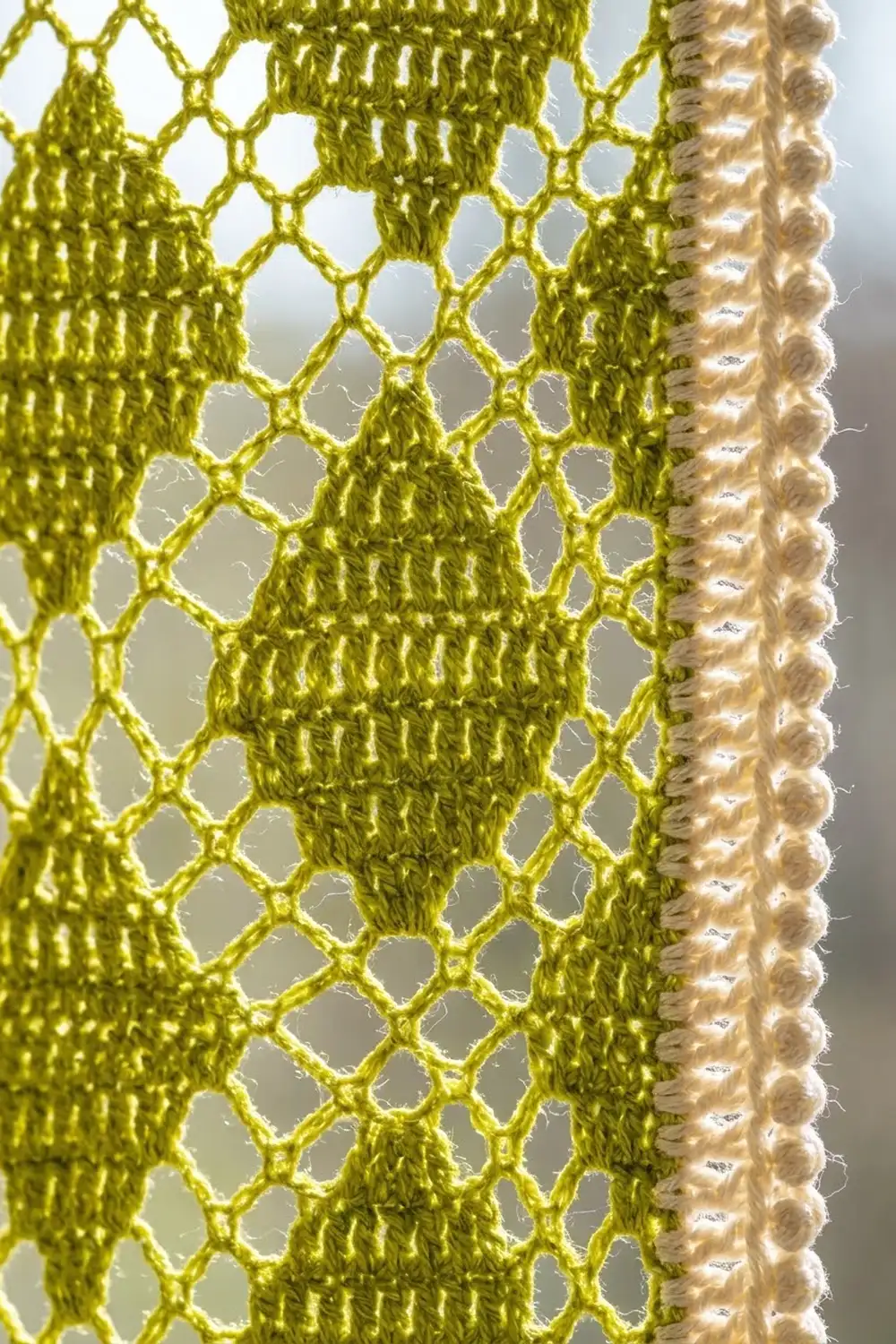
Body Pattern
Use the green yarn. Row 1 is the bottom edge of the curtain.
Foundation: Ch 122.
Row 1 (RS): Sc in 2nd ch from hook and in each ch across, turn. (121 sc)
Row 2 (shell row): Ch 4 (counts as first tr). Sk 4 sc, shell in next sc, sk 4 sc, tr in next sc; repeat from * 11 more times, turn. (12 shells + 13 tr = 97 tr)*
The ch-4 plus 12 repeats of 10 sts uses all 121 sc: 1 + (12 x 10) = 121.
Row 3 (cluster row): Ch 4 (counts as tr). Ch 3, tr7tog over the 7 tr of the next shell, ch 3, tr in next tr; repeat from * across, working the last tr in the top of the turning ch, turn. (13 tr, 12 clusters, 24 ch-3 sps)*
Rows 2 and 3 together make one diamond. The shell spreads the stitches out, and the cluster pulls the same 7 stitches back to a point. The ch-3 sps form the slanted lattice lines.
Row 4 (shell row): Ch 4 (counts as tr). Shell in the top of the next cluster, tr in next tr; repeat from * across, working the last tr in the top of the turning ch, turn. (12 shells + 13 tr = 97 tr)*
Don’t work into the ch-3 sps. They stay as the lower edges of the open windows. Each new shell grows out of the cluster below it, so the diamonds stack point to point in straight columns.
Row 5 (cluster row): Work as Row 3. (13 tr, 12 clusters, 24 ch-3 sps)
Rows 6–91: Repeat Rows 4 and 5 another 43 times. You finish on a cluster row (Row 91), with 45 diamonds in each column. Check that the piece measures 30.25 in (76.8 cm) wide and 79 in (200.7 cm) tall.
Row 92 (transition row): Ch 1. Sc in first tr, 4 sc in next ch-3 sp, sc in top of cluster, 4 sc in next ch-3 sp, sc in next tr; repeat from * across, turn. (13 + 12 + (24 x 4) = 121 sc)*
Each ch-3 sp sits over the 4 sts skipped in Row 2. Working 4 sc into each one brings the top edge back to the same 121 sts as the foundation.
Rod-Pocket Band
Row 93: Ch 2 (does not count as a st). Hdc in each st across, turn. (121 hdc)
Rows 94–100: Repeat Row 93. (121 hdc each row)
The 8 hdc rows measure 3 in (7.6 cm). Fasten off, leaving a 100 in (254.0 cm) tail.
Form the pocket: Fold the band in half to the WS so the top of Row 100 meets the WS of Row 92. Whipstitch it in place st to st (121 to 121). Leave both short ends open. The pocket is 1.5 in (3.8 cm) deep and fits a rod up to 1 in (2.5 cm) in diameter.
Border
Use the cream yarn. The border runs down one long side, across the bottom and up the other side. It stops at Row 92, so the rod pocket stays open at both ends.
Border gauge: 4 sc = 1 in (2.5 cm). All 5 border rows together measure 1.5 in (3.8 cm) deep.
Row 1 (WS): With WS facing, join cream at the end of Row 92 on one side. Ch 1. Work 1 sc in the end of Row 92. Then work 7 sc over each pair of tr rows (3 sc in one row end, 4 in the next) down to Row 2. Finish the side with 1 sc in the end of Row 1. (1 + (45 x 7) + 1 = 317 sc)
Ch 2 for the corner. Working in the free loops of the foundation chain, sc in each ch across (121 sc). Ch 2 for the corner. Work up the second side the same way (317 sc), then turn.
Count: 317 + 121 + 317 = 755 sc, plus 2 corner ch-2 sps. The corners are ch-2 sps, not stitches, so no stitch is counted twice.
Row 2 (RS): Ch 1. Sc in each sc, working (sc, ch 2, sc) in each corner sp, then turn.
Sides: 317 + 1 = 318 sc each. Bottom: 121 + 2 = 123 sc. Total: 759 sc.
Row 3 (WS): Ch 3 (counts as dc). Dc in each st, working (dc, ch 2, dc) in each corner sp, then turn.
Sides: 318 + 1 = 319 dc each. Bottom: 123 + 2 = 125 dc. Total: 763 dc.
Row 4 (RS): Ch 1. Sc in each st, working (sc, ch 2, sc) in each corner sp. Do not turn.
Sides: 319 + 1 = 320 sc each. Bottom: 125 + 2 = 127 sc. Total: 767 sc.
Row 5 (RS, crab stitch): Ch 1. Working back along Row 4, rev sc in each sc, with 2 rev sc in each corner sp.
Count: 320 + 2 + 127 + 2 + 320 = 771 rev sc.
Fasten off. Use the tails to neaten the border ends flush with the folded pocket.
Why the math works: At 4 sc per inch, 317 sc fill exactly 79.25 in (201.3 cm). That is the body height: 45 diamonds at 1.75 in (4.4 cm) each, plus two sc rows at 0.25 in (0.6 cm) each. The 121 bottom sc fill 30.25 in (76.8 cm), which matches the 121 foundation sts. Because each side’s count matches the length of its edge, the border lies flat without ruffling or pulling. Each later row adds 1 st on each side of every corner space, which gives the corners room to turn flat as the border gets deeper.
Final Blocking
- Soak the panel in cool water with a little gentle wash for 15 minutes.
- Press out the water, then roll the panel in towels. Never wring it.
- Lay it flat, RS up.
- Pin the body to 30.25 in (76.8 cm) by 79.25 in (201.3 cm), measuring inside the border.
- Pin the border straight so the total width is 33.25 in (84.5 cm).
- Open each window with your fingers so the lattice runs in clean diagonals. Each diamond should be about 2 in (5.1 cm) wide.
- Let it dry completely, which can take 24 hours or more.
- Unpin the panel, insert the rod and let it hang for a day so the length settles.
Final Quality-Control Checklist
- Every shell row has 12 shells and 13 single tr (97 tr).
- Every cluster row has 13 tr, 12 clusters and 24 ch-3 sps.
- Every column has 45 diamonds, touching point to point.
- Row 92 has 121 sc, the same as Row 1.
- The band is 8 hdc rows, folded to 1.5 in (3.8 cm), with both ends open.
- Border Row 1 has 317 sc on each side and 121 across the bottom.
- Border Row 5 totals 771 rev sc.
- The body measures 30.25 in x 79.25 in (76.8 cm x 201.3 cm).
- The finished panel measures 33.25 in x 82.25 in (84.5 cm x 208.9 cm).
- Tails are woven into the solid diamonds, not across the open lattice.
Troubleshooting
Columns drift or lean. A shell probably went into a ch-3 sp. Each shell belongs in the closing loop at the top of a cluster.
Clusters look gappy. Keep all 8 loops on the hook an even size, then close the cluster firmly.
The top is narrower than the bottom. Check Row 92. Each ch-3 sp needs 4 sc, not 3.
The border ruffles. You have too many side stitches. Recount to 7 sc per diamond.
The border pulls the sides in. You have too few stitches, or your cream tension is tighter than your green. Go up half a hook size for the border.
The curtain is too short. Add diamonds before Row 92. Each one adds 1.75 in (4.4 cm). For each extra diamond, add 7 sc to each side in Border Row 1.
The rod doesn’t fit. Add 2 hdc rows to the band for each extra 0.375 in (1.0 cm) of pocket depth you need.
Care
Hand wash in cool water, or machine wash on a delicate cycle inside a large mesh bag. Lay it flat until just damp, then rehang it so it keeps its length.
Final Notes
The measurements build on each other, so every checkpoint depends on the one before it. The gauge is 10 sts to 2.5 in (6.4 cm) and 2 rows to 1.75 in (4.4 cm). Twelve repeats give a 30.25 in (76.8 cm) body. Forty-five diamonds plus two sc rows give 79.25 in (201.3 cm).
The 3 in (7.6 cm) band folds into a 1.5 in (3.8 cm) pocket. The 1.5 in (3.8 cm) cream border then brings the panel to 33.25 in (84.5 cm) by 82.25 in (208.9 cm). If each checkpoint matches, the panel will hang straight and true.
Happy crocheting!