

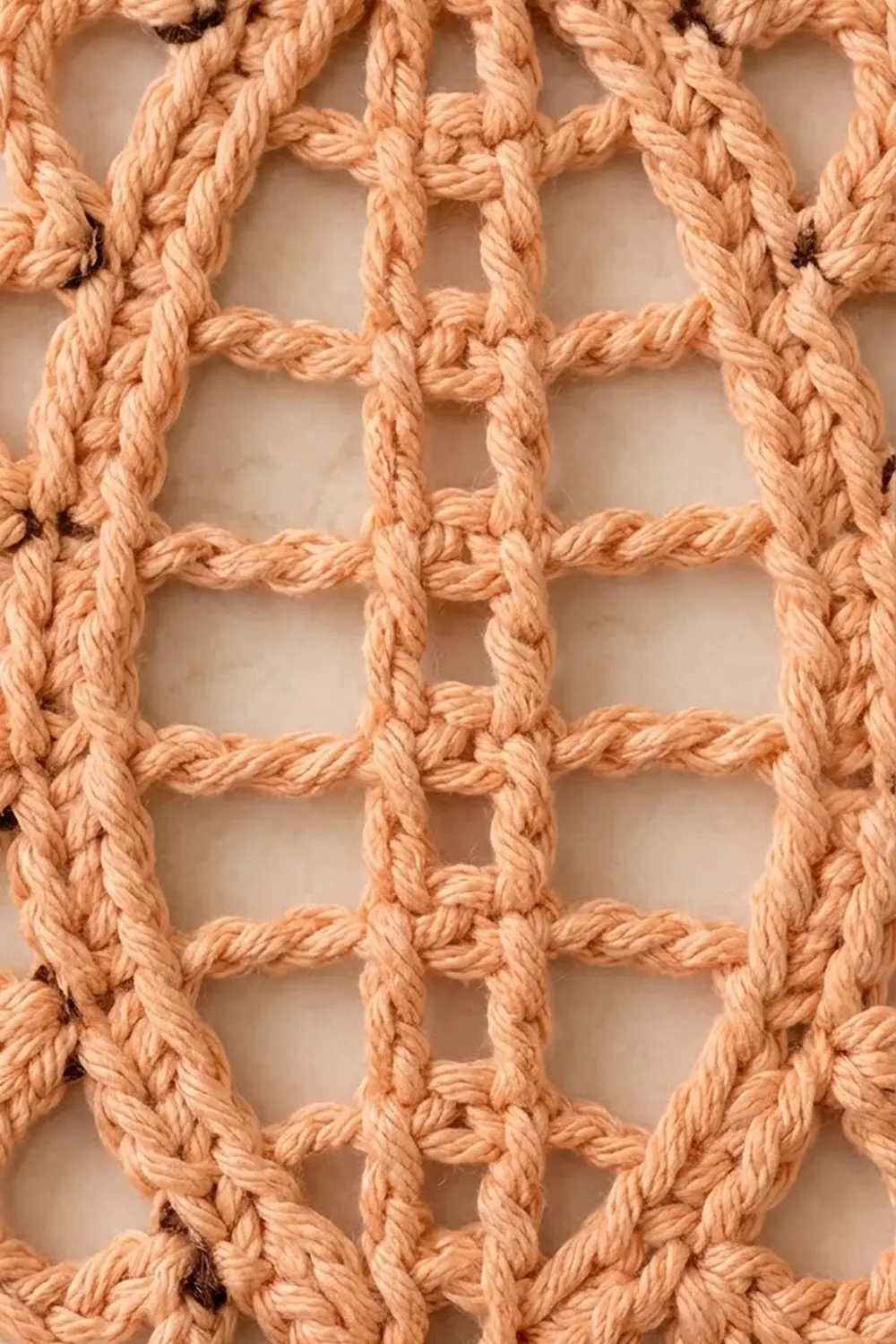
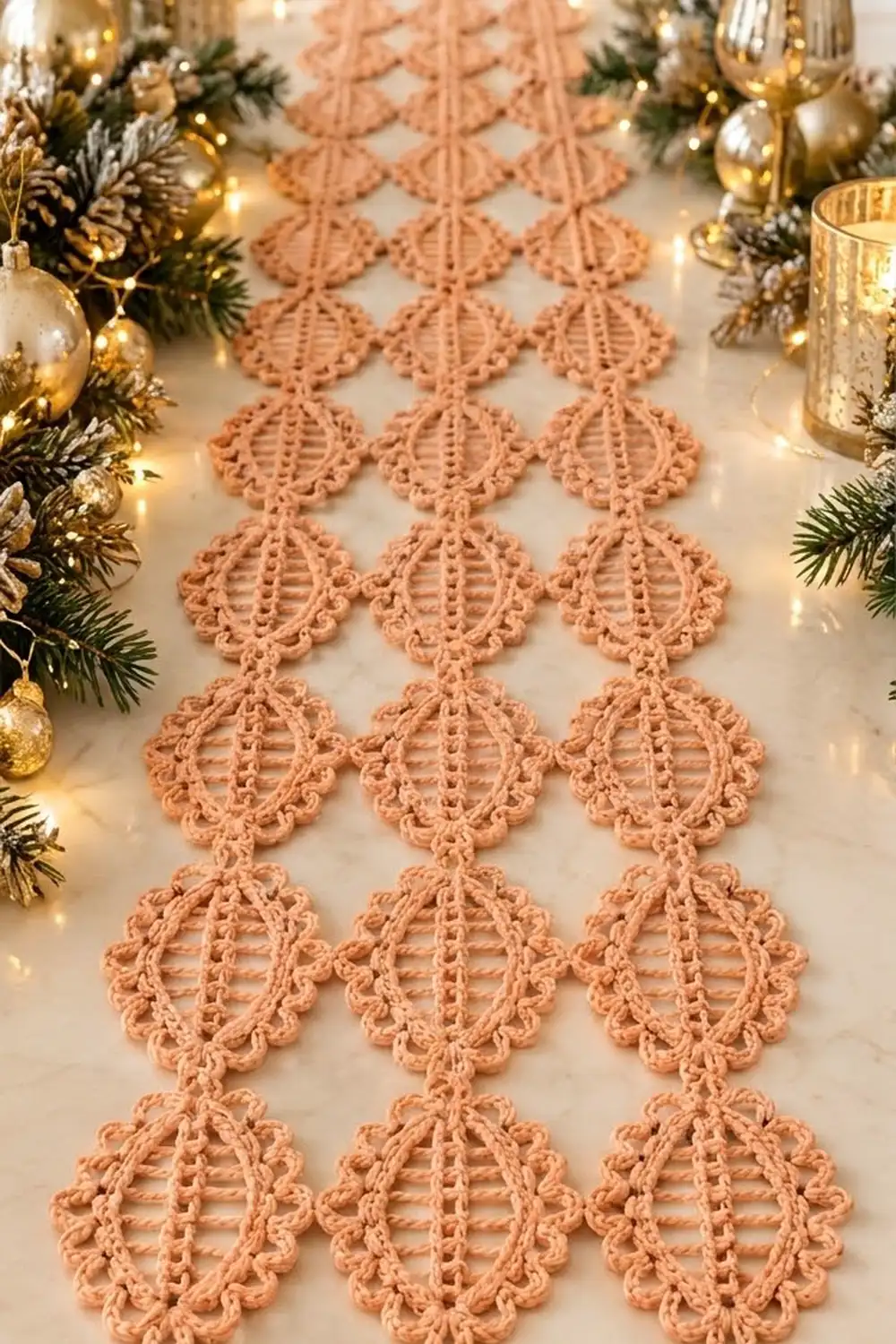
The Apricot Glow Table Runner is made of 24 oval lace motifs in one warm peach shade. Each oval has a slim ladder spine down the middle, horizontal bars that fan out to form an oval, a corded outline, and an outer ring of scallops. The motifs touch only at a few points, so the table shows through the open diamonds between them.
It looks delicate but is easy to work, because the whole motif is just single crochet, chains, and four tall stitch heights. With one color there are no ends to carry. Three tassels at each end finish the runner.
This pattern uses US crochet terms. The finished runner is 14.25 in (36.2 cm) wide and 54 in (137.2 cm) long, or 64 in (162.6 cm) including tassels.
You start each motif by working single crochet around a short foundation chain to make the spine. Tall stitches worked outward from the spine become the bars, and a single crochet round turns the chains into a solid outline. A chain-loop round followed by a covering round makes the scallops. From the second motif on, you join each motif to its neighbors as you work its last round.
Finished Size and Construction
- Finished size: 14.25 in x 54 in (36.2 cm x 137.2 cm), plus a 5 in (12.7 cm) tassel at each end
- Skill level: Intermediate
- Terminology: US
- Yarn weight: Worsted (#4) cotton
- Hook: 5 mm (H-8)
- Number of pieces: 24 motifs plus 6 tassels
- Layout: 3 motifs across, 8 motifs long
- Piece size: 4.75 in x 6.75 in (12.1 cm x 17.1 cm)
- Size before the scallop edging (after Round 3): 3.5 in x 5.5 in (8.9 cm x 14.0 cm)
- Border depth: about 0.6 in (1.5 cm). The scallop rounds of the motifs are the border, so there is no separate border round.
Materials
Yarn: Use a smooth worsted-weight cotton or cotton blend, about 190 m per 100 g. Mercerized or tightly plied cotton shows the corded outline best. Avoid fuzzy yarns, which blur the bars.
- Peach (Main Color): 250 g / 475 m
- Motifs: about 7 g / 13 m each, so 168 g / 312 m for all 24
- Tassels: about 30 g / 56 m for all 6
The quantities above include a margin of roughly 25% for swatching, joins, and ends. Buy everything from one dye lot.
Tools:
– 5 mm (H-8) crochet hook
– Tapestry needle
– Scissors
– A piece of stiff card 5.5 in (14.0 cm) tall, for the tassels
– Rustproof pins and a blocking mat
– Spray bottle
– Tape measure
Abbreviations (US Terms)
- ch – chain
- sl st – slip stitch
- sc – single crochet
- dc – double crochet
- tr – treble crochet (yarn over twice)
- dtr – double treble crochet (yarn over 3 times, then work off 2 loops at a time 4 times)
- sk – skip
- sp – space
- st(s) – stitch(es)
- rep – repeat
Special technique – Drop-loop join (DLJ): Remove your hook from the working loop. Insert the hook from front to back into the stitch you are joining to on the finished motif. Pick up the dropped loop and pull it through. Then work the next sc as written. This join adds no stitches, so the counts stay the same.
Gauge and Checkpoints
Gauge: 16 sc = 4 in (10.2 cm) with a 5 mm hook.
Make one complete motif and block it before starting the rest. It is your real gauge swatch. Check these measurements as you go:
- After Round 1: the spine is 4.25 in (10.8 cm) long and 0.5 in (1.3 cm) wide.
- After Round 2: the motif is 3.25 in (8.3 cm) wide at the widest bars and 5 in (12.7 cm) tall.
- After Round 3: 3.5 in x 5.5 in (8.9 cm x 14.0 cm).
- After Round 5, blocked: 4.75 in x 6.75 in (12.1 cm x 17.1 cm).
Allow about ±0.25 in (0.6 cm) at each stage.
If your motif is too big, go down to a 4.5 mm hook. If it is too small, go up to a 5.5 mm hook. If only the bars look wrong (floppy or pulling), fix your tall stitches. They should be about 1.2 in (3.0 cm) long for dtr.
Motif (Make 24)
The rounds are worked with the right side facing and are not turned.
Round 1 (spine): Ch 18. Work 3 sc in the 2nd ch from hook (bottom tip). Sc in each of the next 15 ch. Work 3 sc in the last ch (top tip). Rotate and work along the opposite side of the foundation chain: sc in each of the next 15 ch. Join with a sl st to the first sc.
Count: 36 sc (3 at each tip and 15 along each long side).
The two rows of sc on either side of the foundation chain make the ladder-like spine.
Round 2 (bars): Sl st into the next st, which is the center sc of the bottom tip. Ch 1 and sc in the same st.
Right side: Ch 4, sk the next tip st and side st 1. Dc in side st 2. Ch 3, sk 2, tr in st 5. Ch 3, sk 2, dtr in st 8. Ch 3, sk 2, tr in st 11. Ch 3, sk 2, dc in st 14. Ch 4, sk st 15 and the first tip st, then sc in the center sc of the top tip.
Left side: Ch 4, sk the next tip st and side st 1. Dc in st 2. Ch 3, sk 2, tr in st 5. Ch 3, sk 2, dtr in st 8. Ch 3, sk 2, tr in st 11. Ch 3, sk 2, dc in st 14. Ch 4, sk st 15 and the last tip st, then join with a sl st to the first sc.
Count: 12 sts (2 sc, 4 dc, 4 tr, 2 dtr), 8 ch-3 sps and 4 ch-4 sps.
Each tall stitch grows straight out from the side of the spine, so it lies flat as a horizontal bar. Because the bars go dc, tr, dtr, tr, dc, the line of their tops curves into an oval.
Round 3 (corded outline): Ch 1. Work 3 sc in the first sc (bottom tip).
[4 sc in the ch-4 sp, sc in the dc, 3 sc in the ch-3 sp, sc in the tr, 3 sc in the ch-3 sp, sc in the dtr, 3 sc in the ch-3 sp, sc in the tr, 3 sc in the ch-3 sp, sc in the dc, 4 sc in the ch-4 sp] (25 sc).
Work 3 sc in the top-tip sc, rep the bracket once more, then join to the first sc.
Count: 56 sc (3 at each tip and 25 along each side).
The motif should now measure 3.5 in x 5.5 in (8.9 cm x 14.0 cm).
Round 4 (scallop loops): Sl st into the next st (center sc of the bottom tip). Ch 1. Work (sc, ch 7, sc) in the same st for the bottom tip loop.
[Ch 5, sk 3, sc in the next st] 7 times. The last sc lands in the center sc of the top tip.
Ch 7, sc in the same st for the top tip loop.
[Ch 5, sk 3, sc in the next st] 6 times. Ch 5, sk 3, join to the first sc.
Count: 16 sc, 14 ch-5 loops (7 per side) and 2 ch-7 tip loops.
Why it fits: there are 28 steps from one tip center to the other (1 + 25 + 2). Seven loops of 4 steps each covers exactly 28.
Round 5 (scallop cover): Sl st into the bottom ch-7 tip loop. Ch 1.
Work 9 sc in the tip loop. [7 sc in the next ch-5 loop] 7 times. Work 9 sc in the top tip loop. [7 sc in the next ch-5 loop] 7 times. Join to the first sc and fasten off.
Count: 116 sc (49 per side and 9 per tip loop).
Leave the Round 4 sc unworked between loops so each scallop puffs into a clean arch.
Loop numbering for joining: With the bottom tip toward you, the right-side scallops are numbered 1–7 going up from the bottom. The left-side scallops are numbered 1–7 going down from the top. Scallop 4 on each side sits at the widest point of the oval.
Make All Pieces
You need 24 motifs in Peach. Make the first one completely. Make the other 23 through Round 4, then work their Round 5 as you join them.
Layout (C = column, R = row; R1 is one end of the runner):
R8: [M] [M] [M]
R7: [M] [M] [M]
R6: [M] [M] [M]
R5: [M] [M] [M]
R4: [M] [M] [M]
R3: [M] [M] [M]
R2: [M] [M] [M]
R1: [M] [M] [M]
    C1  C2  C3
Every motif points the same way, with its tips running along the length of the runner.
Joining
Method: Join as you go with the drop-loop join (DLJ) while working Round 5. Work the rows from R1 to R8, going from C1 to C3 within each row.
Side-to-side joins: When you work right-side scallop 4 of a new motif, make 3 sc. Then DLJ into the 4th sc of left-side scallop 4 on the motif to its right, and finish the remaining 4 sc. The 4th sc of a 7-sc scallop is its peak, so the two motifs meet exactly at their widest points.
End-to-end joins: When you work the bottom tip loop of a motif in R2–R8, make 4 sc. Then DLJ into the 5th sc of the top tip loop of the motif below, and finish the remaining 5 sc. Again, you are joining at the peak of the loop.
Totals: 2 side joins per row x 8 rows = 16. 7 end joins per column x 3 columns = 21. That makes 37 joins.
Tension: Pull each dropped loop snug, but don’t let it pucker the scallop. Lay the work flat after each row. If the motifs bow toward each other, your joins are too tight.
Size checkpoint: After you finish R2, the piece should be 14.25 in (36.2 cm) wide and 13.5 in (34.3 cm) long. Each motif adds 4.75 in (12.1 cm) across and 6.75 in (17.1 cm) in length, because joins add no length.
Border
The edge of this runner is the motifs’ own Round 5 scallops. That matches the open, lacy look, so no separate border round is worked.
Border gauge: one 7-sc scallop spans about 0.75 in (1.9 cm) along the curve and is about 0.6 in (1.5 cm) deep.
Long edges (C1 left side and C3 right side):
8 motifs x 7 scallops = 56 free scallops on each long edge.
Stitch count: 8 motifs x 49 sc = 392 sc on each long edge.
Short ends (R1 bottom and R8 top):
3 motifs x 9 sc = 27 sc in the free tip loops on each end. A tassel hangs from each of these loops.
Why the math works: The DLJ never adds or removes a stitch. Each long edge is exactly (motifs in the column) x (one motif’s 49 sc per side), with nothing added at the seams. All 37 joins are in interior scallops, so the outer edge stays complete.
Tassels (make 6):
1. Wrap the yarn 30 times around the 5.5 in (14.0 cm) card.
2. Thread a 10 in (25.4 cm) strand under the wraps at the top and tie it tightly.
3. Cut the wraps at the bottom.
4. Wrap another strand around the tassel 0.75 in (1.9 cm) below the top 8 times, then tie it off and bury the ends inside the tassel.
5. Trim the tassel to 5 in (12.7 cm).
6. Use the top tie to attach the tassel through the center of an outer tip loop, then knot it securely.
Final Blocking
- Weave in all ends along the outlines, where they won’t show.
- Soak the runner in cool water for 10 minutes. Press out the water in a towel without wringing.
- Lay it on blocking mats at 14.25 in x 54 in (36.2 cm x 137.2 cm).
- Pin the center spine of each motif straight.
- Pin the peak of every outer scallop to round it out.
- Pull each open diamond gently into shape so the joins sit flat.
- Let it dry completely. Comb the tassels straight and trim them evenly.
Final Quality-Control Checklist
- [ ] All 24 motifs measure 4.75 in x 6.75 in (12.1 cm x 17.1 cm)
- [ ] Every motif has 5 bars per side, with the dtr in the middle
- [ ] Every motif has 7 scallops per side and 2 tip loops
- [ ] All 37 joins are at scallop or tip-loop peaks
- [ ] The runner is 14.25 in x 54 in (36.2 cm x 137.2 cm)
- [ ] All 6 tassels are 5 in (12.7 cm) and centered on their tip loops
- [ ] No ends are visible from the right side
Troubleshooting
- Bars curl or twist: Your yarn-overs are too tight. Loosen up, and make sure the long-side stitches are skipped exactly as written.
- Outline cups: Round 3 is too tight. Go up a hook size for that round only.
- Outline ruffles: Work 2 sc instead of 3 into the ch-3 sps, or use ch 2 in Round 2.
- Scallops are uneven: Recount the Round 4 skips. There must be 7 loops per side.
- Motifs are offset in a column: Check that each tip join is on the 5th sc of 9.
- Tassels look thin: Use 36 wraps instead of 30.
Care
Hand wash in cool water with a mild detergent, then lay flat to dry and reshape it. Don’t hang it while wet, because the open lace can stretch.
Final Notes
Here is the measurement chain:
– Gauge: 16 sc = 4 in (10.2 cm)
– The spine is 4.25 in (10.8 cm) long
– The outline is 3.5 in x 5.5 in (8.9 cm x 14.0 cm)
– A finished motif is 4.75 in x 6.75 in (12.1 cm x 17.1 cm)
– Three across makes 14.25 in (36.2 cm), and eight long makes 54 in (137.2 cm)
– Adding the tassels makes 64 in (162.6 cm) overall
If the first motif matches these numbers, every later step will fit.
Happy crocheting!