

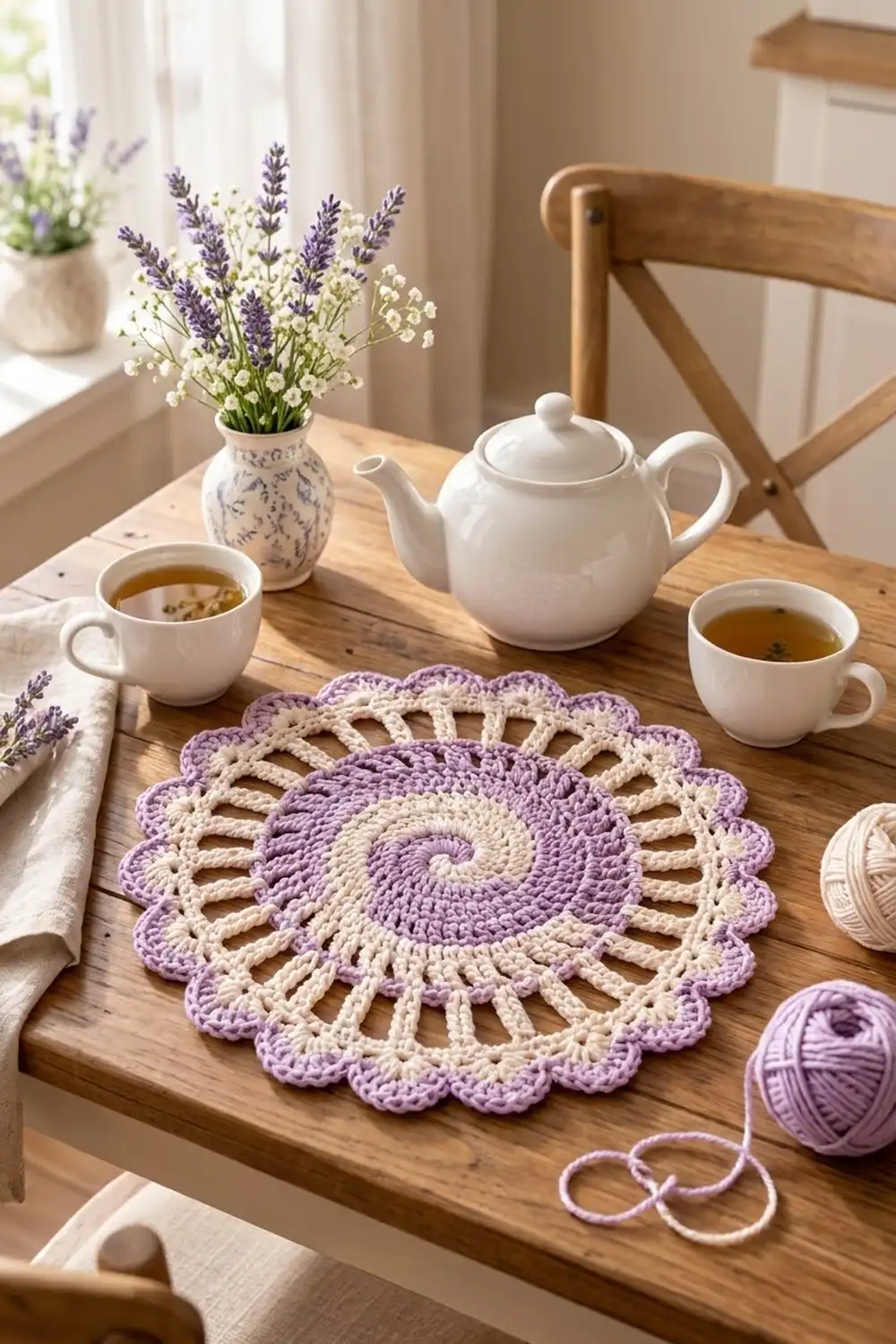
The Lilac Nautilus Doily is a round doily made as one motif and built around a two-color swirl. A lavender and cream spiral turns out from the center like a seashell. Around it, a ring of tall cream spokes opens up the middle section, and a scalloped edge finished in lavender frames the whole piece.
The palette is soft and simple: lilac lavender and warm cream, nothing else. The style sits between a classic lace doily and a modern mandala. It suits a bedside table, a dresser top, or a shelf under a vase of flowers.
This pattern uses US crochet terms. The finished doily measures about 10.5″ (26.7 cm) across after blocking.
You work the whole doily in the round from the center out:
- Crochet the two-color spiral with both yarns active at once, then level it off.
- Add a lavender outline round.
- Work two rounds of open cream spokes and close them with a solid cream round.
- Finish with a cream shell round edged in lavender.
Finished Size and Construction
- Finished size: 10.5″ (26.7 cm) diameter, blocked
- Skill level: Intermediate (two-color spiral technique)
- Terminology: US crochet terms
- Yarn weight: DK / light worsted (weight 3), cotton or cotton blend
- Hook: 4.0 mm (G-6)
- Number of pieces: 1 (single round motif)
- Layout: One circular doily, no joining
- Piece size: 10.5″ (26.7 cm) diameter
- Size before border: 9.25″ (23.5 cm) diameter after Round 10
- Border depth: about 0.625″ (1.6 cm), Rounds 11–12
Materials
Choose a smooth mercerized or combed cotton in DK weight. Cotton shows the spiral clearly, keeps the spokes straight, and blocks crisply. Avoid fuzzy or brushed yarns, because they blur the swirl.
- Color A – Lavender: 20 g, about 48 m (52 yd)
- Color B – Cream: 25 g, about 60 m (66 yd)
These quantities include about 20% extra for swatching, joins, and weaving in ends.
Tools:
- 4.0 mm (G-6) crochet hook
- 2 locking stitch markers
- Yarn needle
- Scissors
- Measuring tape
- Blocking mat and rust-proof pins
- Spray bottle with water
Abbreviations (US Terms)
- ch – chain
- sl st – slip stitch
- sc – single crochet
- hdc – half double crochet
- dc – double crochet
- tr – treble crochet (yo twice, insert, pull up a loop, [yo, pull through 2] 3 times)
- sk – skip
- st(s) – stitch(es)
- sp – space
- yo – yarn over
- rep – repeat
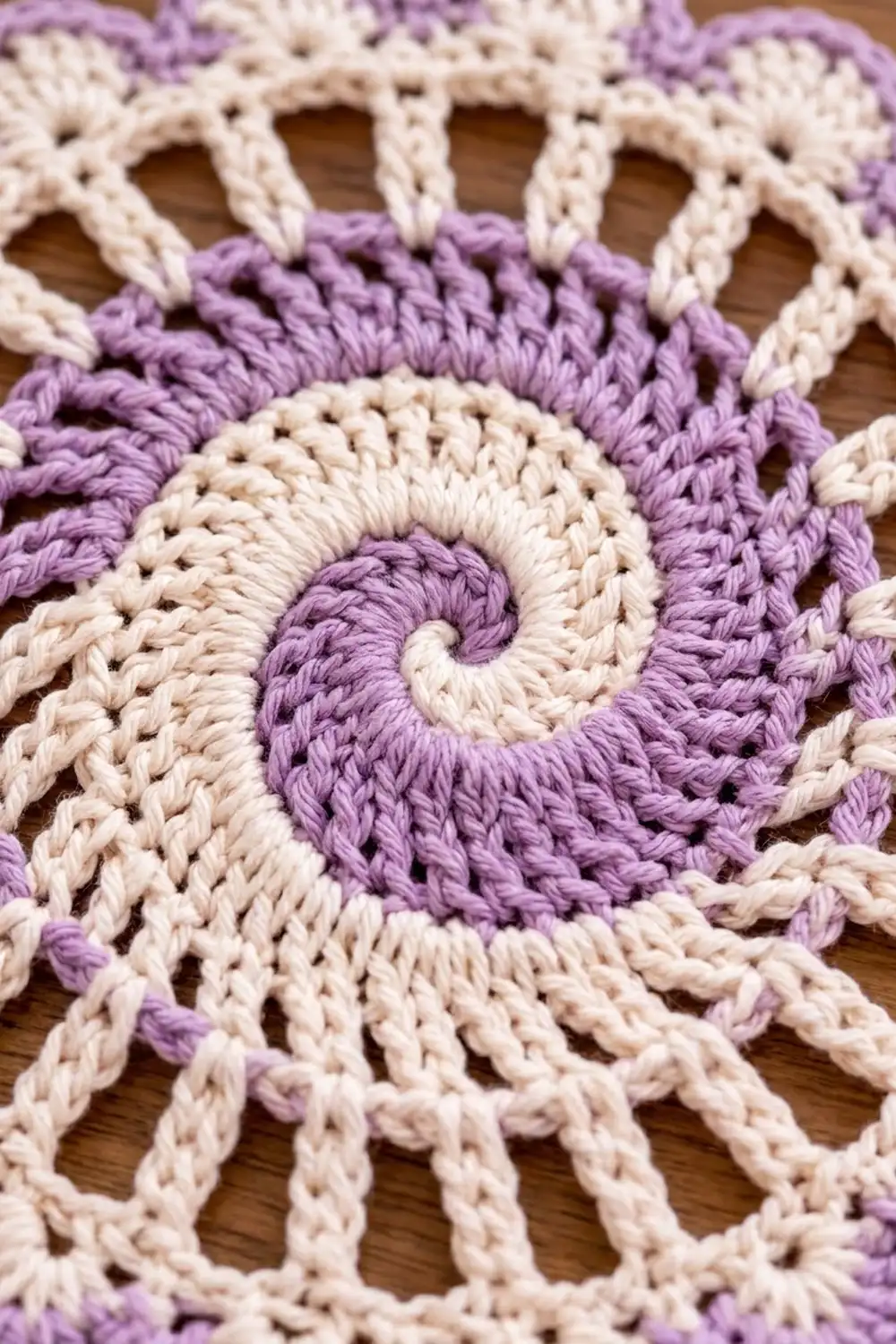
Special technique – Two-color spiral: Both colors stay attached the whole time. Work one color for a set number of stitches, remove the hook, and put a stitch marker in that live loop. Then pick up the other color’s live loop and work with it. Each color always works into the stitches the other color made in the previous round, which creates the interlocking swirl. Do not join rounds and do not turn.
Gauge and Checkpoints
The center is a spiral, so gauge for this doily is measured by diameter. Work Rounds 1–3 as a test piece and measure before going further.
- Gauge: Rounds 1–3 = 2.75″ (7.0 cm) diameter
Checkpoints (laid flat, unblocked):
- After Round 1: 1.25″ (3.2 cm)
- After Round 2: 2″ (5.1 cm)
- After Round 3: 2.75″ (7.0 cm)
- After Round 4: 3.5″ (8.9 cm)
- After Round 5: 4.25″ (10.8 cm)
- After Round 6: 5″ (12.7 cm)
- After Round 7: 5.5″ (14.0 cm)
- After Round 9: 8.5″ (21.6 cm)
- After Round 10: 9.25″ (23.5 cm)
- After Round 12: 10.5″ (26.7 cm)
If your circle is too big: Go down to a 3.5 mm hook, or make the yarn-overs on your dc tighter.
If your circle is too small: Go up to a 4.5 mm hook.
Also check that the work lies flat. If the center ruffles, your increases are too loose. If it cups, your stitches are too tight. Changing your hook by 0.5 mm usually fixes either problem.
Spiral Center (Rounds 1–7)
Round 1
With A, make a magic ring. Ch 2 (does not count as a st). In the ring work: sc, hdc, 4 dc. Remove the hook and place a marker in the live A loop. (6 A sts)
Pull a loop of B up through the ring and ch 1 (does not count as a st). In the ring work: sc, hdc, 4 dc. Remove the hook and place a marker in the live B loop. (6 B sts)
Pull the ring closed. Round total: 12 sts.
Round 2
Pick up A. Work 2 dc in each of the next 6 sts (these are B’s Round 1 sts). Drop A and mark the loop. (12 A sts)
Pick up B. Work 2 dc in each of the next 6 sts (A’s Round 1 sts). Drop B and mark the loop. (12 B sts)
Round total: 24 sts.
From here on, each color works into the other color’s stitches from the previous round. Keep the two balls on opposite sides of you so the strands do not twist.
The swirl starts to show from this round on. The two colors are interlocking correctly if you see one wide lavender arm and one wide cream arm wrapping around each other. If you see stacked rings instead, they are not.
Round 3
Each color: [dc in next st, 2 dc in next st] 6 times. (18 sts per color)
Round total: 36 sts.
Round 4
Each color: [dc in next 2 sts, 2 dc in next st] 6 times. (24 sts per color)
Round total: 48 sts.
Round 5
Each color: [dc in next 3 sts, 2 dc in next st] 6 times. (30 sts per color)
Round total: 60 sts.
Round 6 (Taper Round)
This round levels the spiral so the edge is round, while it still increases.
With A: [dc in next 4 sts, 2 dc in next st] 4 times, [hdc in next 4 sts, 2 hdc in next st] once, [sc in next 4 sts, 2 sc in next st] once. Drop A and mark the loop. (36 A sts)
With B: [dc in next 4 sts, 2 dc in next st] 4 times, [hdc in next 4 sts, 2 hdc in next st] once, [sc in next 4 sts, 2 sc in next st] once, sl st in next st. Fasten off B. (36 B sts; the sl st is not counted)
Round total: 72 sts.
Round 7 (Lavender Outline)
Pick up A. Sc in each st around: 36 sc over B’s Round 6 sts, then 36 sc over A’s Round 6 sts. Sl st to the first sc. Fasten off A.
Round total: 72 sc.
The spiral center now measures 5.5″ (14.0 cm) and has a solid lavender ring all the way around it.
Open Spoke Section (Rounds 8–10)
Round 8
Join B with a sl st in any sc. Ch 4 (counts as tr), ch 2, sk 2 sc, [tr in next sc, ch 2, sk 2 sc] 23 times. Sl st to the top of the beginning ch-4.
Round total: 24 tr and 24 ch-2 sps. Each repeat uses 3 sc of Round 7, and 24 × 3 = 72.
Round 9
Ch 4 (counts as tr), ch 3, sk the ch-2 sp, [tr in top of next tr, ch 3, sk the ch-2 sp] 23 times. Sl st to the top of the beginning ch-4.
Round total: 24 tr and 24 ch-3 sps.
Each tr sits on top of a tr from Round 8, which makes 24 long, straight cream spokes. The wider ch-3 spaces let the spokes fan out as the circle grows.
Round 10
Ch 3 (counts as dc), 4 dc in next ch-3 sp, [dc in next tr, 4 dc in next ch-3 sp] 23 times. Sl st to the top of the beginning ch-3.
Round total: 120 dc (24 dc worked 1 per tr + 96 dc worked 4 per ch-3 sp).
Checkpoint: 9.25″ (23.5 cm) diameter. This is your size before the border.
Scalloped Border (Rounds 11–12)
Border gauge: There are 20 scallops around the edge. After blocking, each is about 1.65″ (4.2 cm) wide at the outer rim. The border adds about 0.625″ (1.6 cm) on every side.
Round 11 (Cream Shells)
Continue with B. Ch 1, sc in the same st, sk 2 sts, 7 dc in next st, sk 2 sts, [sc in next st, sk 2 sts, 7 dc in next st, sk 2 sts] 19 times. Sl st to the first sc. Fasten off B.
Round total: 160 sts (20 sc + 140 dc), forming 20 shells.
Round 12 (Lavender Edge)
Join A with a sl st in any sc between shells (this counts as the first sl st). [Sc in next 3 dc, 3 sc in next dc (the 4th, center dc of the shell), sc in next 3 dc, sl st in next sc] 20 times, working the last sl st into the joining sl st. Fasten off A.
Round total: 200 sts (180 sc + 20 sl st). Each scallop has 9 sc: 3 + 3 + 3.
Why the Math Works
Each repeat in Round 11 uses exactly 6 stitches of Round 10: 1 sc, 2 skipped, 1 shell stitch, and 2 skipped. Since 120 ÷ 6 = 20, the shells divide evenly with no partial repeat.
In Round 12, the 7 dc of each shell get 3 + 3 + 3 = 9 sc, because the center dc takes 3 sc to round the tip. The 2 extra sc per scallop give the curve room to lie flat instead of pulling. The sl st anchors the dip between scallops so each one stays crisp.
The stitch count grows from 120 to 160 to 200 across the border. That matches the larger circumference as the 9.25″ (23.5 cm) circle grows to 10.5″ (26.7 cm).
Final Blocking
- Weave in all ends before blocking. Run lavender tails through lavender stitches and cream tails through cream stitches so nothing shows.
- Soak the doily in cool water for 10 minutes, then press the water out in a towel. Do not wring it.
- Lay it flat on a blocking mat. Measure from edge to edge through the center and ease it to 10.5″ (26.7 cm).
- Pin the center of the spiral flat first. Then pin each of the 24 spokes straight, working in opposite pairs.
- Pin the tip of every scallop (20 pins). Check that the diameter stays 10.5″ (26.7 cm) in several directions.
- Mist lightly and let it dry completely, usually 12–24 hours.
- For a crisper finish on cotton, spray lightly with starch before it dries.
Final Quality-Control Checklist
- [ ] The spiral shows two clean, interlocking swirls of lavender and cream.
- [ ] Round 7 has 72 sc and forms an even lavender ring.
- [ ] There are 24 spokes, each straight and evenly spaced.
- [ ] Round 10 has 120 dc with no gaps at the spoke tops.
- [ ] There are 20 cream shells, each edged with 9 lavender sc.
- [ ] The doily measures 10.5″ (26.7 cm) in every direction.
- [ ] The piece lies flat with no cupping or ruffling.
- [ ] All ends are woven in and invisible from the front.
Troubleshooting
The spiral looks like stripes, not a swirl. Each color must work into the other color’s stitches. If a color goes over its own stitches, the spiral breaks. Count back to the last marker and rework.
The yarns keep tangling. Always pick up the next color from the same direction. Untwist the balls after each round.
There is a step or bump where the spiral ends. Make sure Round 6 tapers through hdc and sc. A small step is normal, and Round 7 smooths it.
The center cups. Your dc are too tight. Try a larger hook for Rounds 1–6.
The spokes lean or twist. Work each Round 9 tr into the top of the Round 8 tr, not into the ch-2 sp. Pin the spokes straight when blocking.
The spoke count is off. Recount Round 7 first. You need exactly 72 sc for 24 spokes.
The edge ruffles. Check that you skip 2 sts on both sides of every shell. If the count is correct, block firmly, or work Rounds 11–12 with a 3.75 mm hook.
The edge pulls inward. Loosen your tension in Round 12, and check that each shell’s center dc has 3 sc.
Care
Hand wash in cool water with mild soap and dry flat, reshaping to 10.5″ (26.7 cm). Starch again after washing if you like a firm finish.
Final Notes
Here are the measurements in order:
- The two-color spiral reaches 5″ (12.7 cm) at Round 6 with 72 stitches.
- The lavender outline brings it to 5.5″ (14.0 cm).
- Two rounds of 24 spokes open the doily to 8.5″ (21.6 cm).
- Round 10 closes the spokes at 120 dc and 9.25″ (23.5 cm).
- The scalloped border adds 0.625″ (1.6 cm) on each side, for a finished doily of 10.5″ (26.7 cm).
Check your diameter at each checkpoint, keep your two colors untwisted, and block with care. You’ll end up with a smooth, seashell-like swirl.
Happy crocheting!