
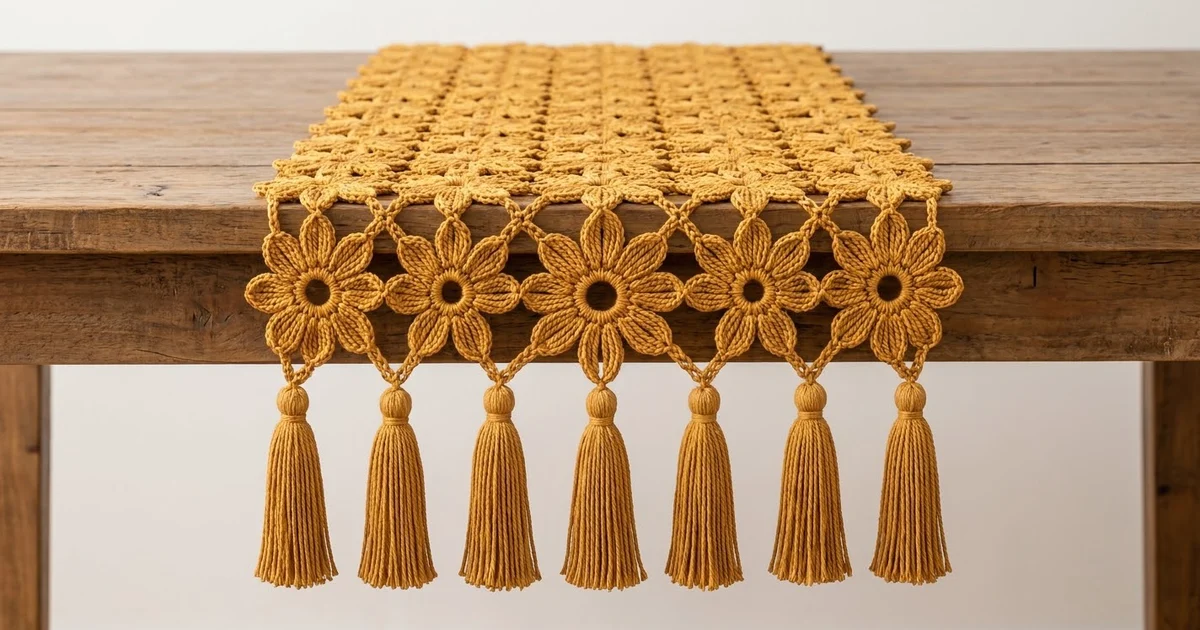
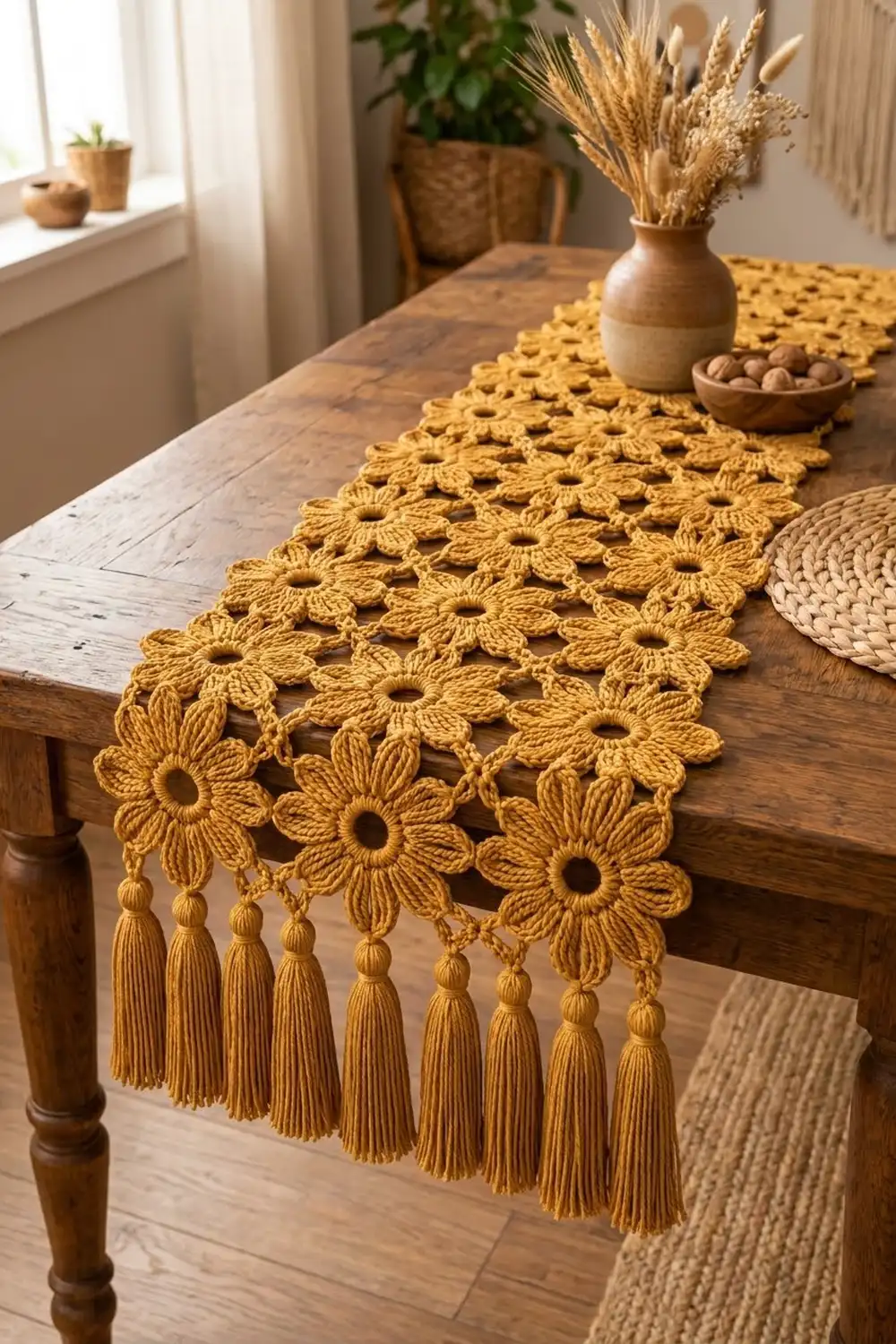
The Golden Bloom Lace Table Runner is an openwork runner made of eight-petal flowers in one warm mustard gold. Each flower has a padded open ring at its center and eight long, leaf-shaped petals. Chain connectors run from the diagonal petal tips to small rings, which makes a light lattice of diamond-shaped gaps between the flowers. Chunky tassels hang from both short ends.
The style is boho and earthy. It suits a wooden table, dried flowers and candlelight. Because the whole runner is one color, the texture of the petals does the work, so a smooth cotton with good stitch definition matters more than anything else.
This pattern uses US crochet terms. The finished runner measures 17.5 x 61.5 inches (44.5 x 156.2 cm) before tassels. The tassels add 5 inches (12.7 cm) at each end, for a total length of 71.5 inches (181.6 cm).
You make 33 flower motifs and join them as you go during each motif’s last round, in a grid 3 motifs wide and 11 motifs long. A three-round border then straightens the scalloped edge, and 14 tassels finish the short ends.
Finished Size and Construction
- Finished size: 17.5 x 61.5 in (44.5 x 156.2 cm), plus 5 in (12.7 cm) tassels at each end
- Skill level: Intermediate
- Terminology: US crochet terms
- Yarn weight: Worsted (#4) cotton or cotton blend
- Hook: 5.0 mm (H-8)
- Number of pieces: 33 flower motifs, joined as you go
- Layout: 3 motifs wide x 11 motifs long
- Motif size: 5.5 in (14.0 cm) from petal tip to opposite petal tip
- Size before border: 16.5 x 60.5 in (41.9 x 153.7 cm)
- Border depth: about 0.5 in (1.3 cm) on every side
Materials
Yarn: A smooth worsted-weight mercerized or combed cotton, about 170 m per 100 g. Cotton gives the petals crisp edges and lets the runner lie flat on a table. Avoid fuzzy or very splitty yarns, because they hide the petal shaping.
- Mustard gold: 550 g (935 m) in total
- Motifs: about 330 g (561 m)
- Border: about 45 g (77 m)
- Tassels: about 80 g (136 m)
These quantities include a margin of about 20% for gauge differences, swatching and weaving in ends. Buy all the yarn from a single dye lot.
Tools:
- 5.0 mm (H-8) crochet hook
- Tapestry needle
- Sharp scissors
- Stitch markers
- Stiff card or a tassel maker, 5.5 in (14.0 cm) tall
- Measuring tape
- Blocking mats and rust-proof pins
- Spray bottle
Abbreviations (US Terms)
- ch – chain
- sl st – slip stitch
- sc – single crochet
- hdc – half double crochet
- dc – double crochet
- tr – treble crochet
- sp – space
- st(s) – stitch(es)
- RS – right side
Special technique – Junction ring: ch 4, sl st in 4th ch from hook. This makes a small ring that up to four motifs connect to.
Special technique – Straight join: in place of a ch-3 petal tip, work ch 1, sl st in the ch-3 tip of the neighboring motif, ch 1.
Gauge and Checkpoints
Base gauge: 18 sc x 20 rows = 4 in (10.2 cm) in sc rows.
Before you start the runner, make one complete motif with no joins and check it at each stage:
- After Rnd 1: 1.5 in (3.8 cm) across, with an open center of about 0.75 in (1.9 cm)
- After Rnd 2: 2 in (5.1 cm) across
- After Rnd 4: 5.5 in (14.0 cm) from one petal tip to the opposite tip, measured lightly flattened
If your motif is too big (over 5.75 in / 14.6 cm), go down half a hook size. If it is too small (under 5.25 in / 13.3 cm), go up half a hook size. A difference of 0.25 in (0.6 cm) per motif adds up to 2.75 in (7.0 cm) over the 11-motif length, so do not skip this step.
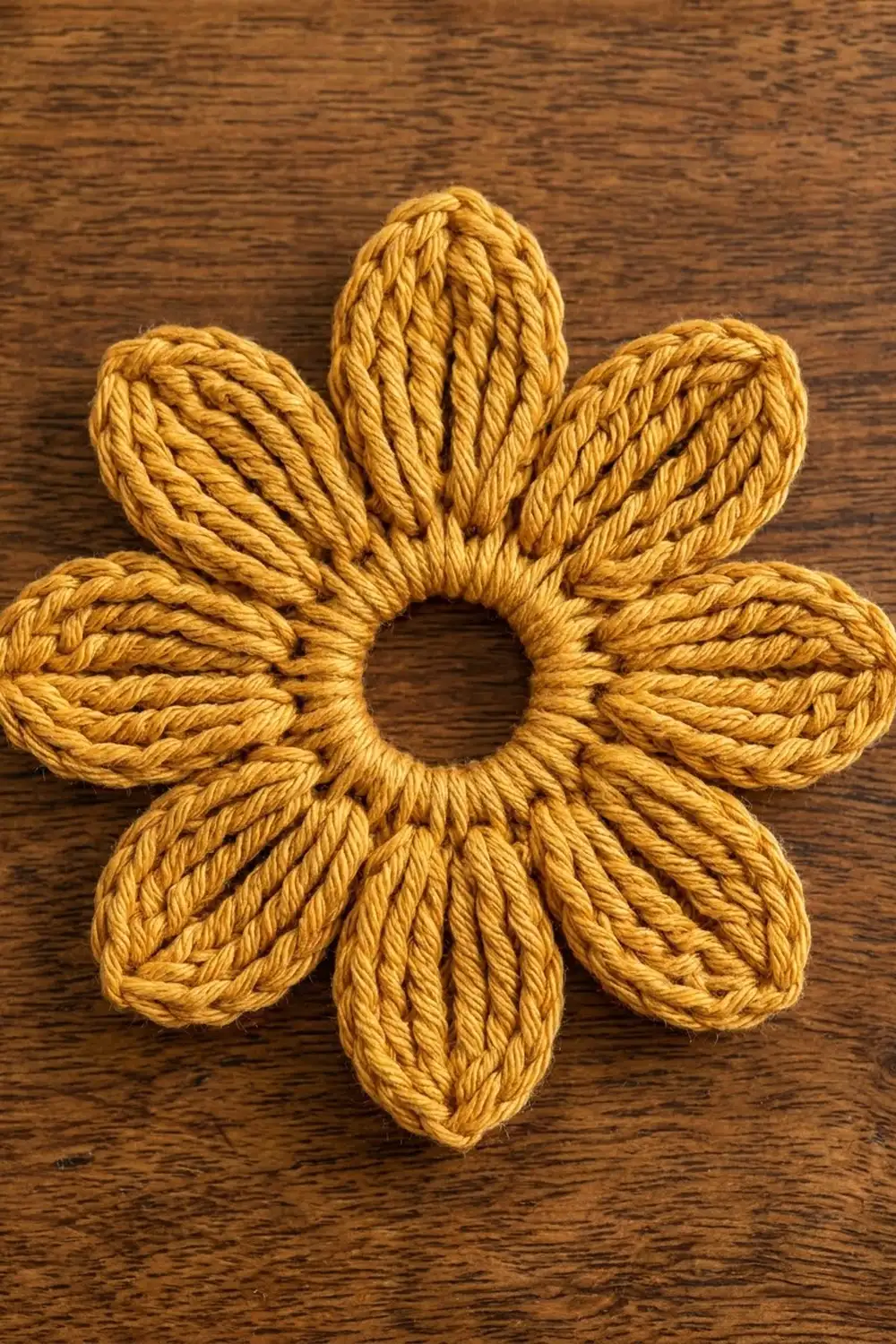
Flower Motif (Make 33)
Leave a 6 in (15.2 cm) tail at the start and end of each motif for weaving in.
Rnd 1: Ch 12, sl st in first ch to form a ring. Ch 1, work 24 sc into the ring, sl st in first sc. (24 sc)
The ring stays open. Pack the stitches tightly so the center looks padded and rounded.
Rnd 2: Ch 1, sc in next 2 sc, 2 sc in next sc; repeat from * 7 more times, sl st in first sc. (32 sc)*
Rnd 3 (petal loops): Ch 1, sc in next sc, ch 12, sc in next sc, ch 2, skip next 2 sc; repeat from * 7 more times, sl st in first sc. (16 sc, 8 ch-12 loops, 8 ch-2 sps)*
Each repeat uses exactly 4 stitches of Rnd 2: 8 repeats x 4 sts = 32 sts. Each ch-12 loop is anchored to two neighboring stitches, so it hangs as a long, narrow loop. That narrow loop becomes the center spine of the petal.
Rnd 4 (petals): Sl st into the first ch-12 loop. In the ch-12 loop work (sc, hdc, 2 dc, 4 tr, ch 3, 4 tr, 2 dc, hdc, sc); sc in next ch-2 sp; repeat from * 7 more times, sl st in first sc. Fasten off. (8 petals of 16 sts each + 8 sc between petals = 136 sts, plus 8 ch-3 tips)*
Working all the stitches into the loop, and not into individual chains, makes the stitches fan out on both sides of the chain. The result is an elongated leaf with a groove down the middle and a point at the ch-3 tip. The stitches grow from sc to tr at the widest part of the petal and taper back down, which gives the leaf its shape.
Motif checkpoint: 8 petals, 8 ch-3 tips, 5.5 in (14.0 cm) across.
Make All Pieces
You need 33 motifs in Mustard gold. Make the first motif complete with no joins. Make the other 32 up to the end of Rnd 3, then work Rnd 4 of each one as a joining round.
Layout (each F is one motif; o marks a junction ring):
o---o---o---o
| F | F | F |   Row 1
o---o---o---o
| F | F | F |   Row 2
o---o---o---o
      ...       Rows 3-10
o---o---o---o
| F | F | F |   Row 11
o---o---o---o
That is 3 columns x 11 rows = 33 motifs, and 4 x 12 = 48 junction rings.
Joining (Join-As-You-Go)
Orientation: For each motif, name the tips like a compass: N, NE, E, SE, S, SW, W and NW. N/E/S/W are the straight tips and NE/SE/SW/NW are the diagonal tips. Before you start Rnd 4, turn the motif so its petal loops sit in these 8 positions.
Straight tips (N, E, S, W): When a straight tip meets an already-finished neighbor (the new motif’s W tip to that motif’s E tip, or its N tip to that motif’s S tip), use the straight join in place of ch 3. When the tip faces the outside of the runner, or a motif you have not made yet, work a normal ch 3.
Diagonal tips (NE, SE, SW, NW): Every diagonal tip connects to a junction ring, including tips on the outer edge. In place of ch 3, work:
- ch 5;
- if the ring does not exist yet: make a junction ring (ch 4, sl st in 4th ch from hook);
- if the ring already exists: sl st into the center of that ring;
- ch 5, then finish the petal with 4 tr, 2 dc, hdc, sc as usual.
The two ch-5 strands lie side by side and form the doubled chain connector between the flowers.
Stitch-to-stitch logic: All 8 tips still count as tips, and the petals keep their 16 stitches each. Joins only change what happens at the tip, so the Rnd 4 count stays at 136 sts for every motif.
Join totals:
- Straight joins: 2 per row x 11 rows = 22 side-to-side, plus 3 per row gap x 10 gaps = 30 top-to-bottom, for 52 straight joins
- Diagonal tips: 33 x 4 = 132, which connect to 20 interior rings (4 tips each), 24 edge rings (2 tips each) and 4 corner rings (1 tip each): 80 + 48 + 4 = 132
- Outer straight tips left free: 11 + 11 + 3 + 3 = 28
Tension: Make the sl st joins snug but not tight. If you pull them tight, the petal tips pucker. If you leave them loose, the grid slips out of line. Keep each ch-5 strand the same length as the one beside it.
Joined size checkpoint: each motif takes up 5.5 in (14.0 cm), so the joined runner is 16.5 x 60.5 in (41.9 x 153.7 cm). Check this after Row 3 by measuring 16.5 in (41.9 cm) across and 16.5 in (41.9 cm) down.
Border
Border gauge: 4.5 sc = 1 in (2.5 cm), worked into the chain arcs.
Counting rule: Each motif on an edge gives that side 1 junction ring and 1 straight tip. Each side’s count begins with its starting corner ring and ends just before the next corner ring, which belongs to the next side. Each corner is therefore counted only once.
Rnd 1: With RS facing, join yarn in a corner ring. *Sc in ring, ch 11, sc in next free straight tip (ch-3 sp), ch 11; repeat from * around, sl st in first sc.
- Per motif per side: 1 + 11 + 1 + 11 = 24 sts
- Long side: 11 motifs x 24 = 264 sts
- Short side: 3 motifs x 24 = 72 sts
- Total: (2 x 264) + (2 x 72) = 672 sts (56 sc and 616 ch)
Rnd 2 (conversion round): Ch 1. Sc in each sc, and work 11 sc into each ch-11 arc, which gives 1 sc for each chain. Work 3 sc in each of the 4 corner-ring sc. Sl st in first sc.
- Long side: 264 + 2 = 266 sts
- Short side: 72 + 2 = 74 sts
- Total: 672 + 8 = 680 sts
Rnd 3: Ch 1, sc in each sc, working 3 sc in the center sc of each corner. Sl st in first sc. Fasten off.
- Long side: 266 + 2 = 268 sts
- Short side: 74 + 2 = 76 sts
- Total: 680 + 8 = 688 sts
Why the math works: Each motif gives 24 stitches per side across 5.5 in (14.0 cm), or about 4.4 stitches per inch, which matches the border gauge. The long side has 266 sc over 60.5 in (153.7 cm) and the short side has 74 sc over 16.5 in (41.9 cm), both about 4.4 to 4.5 stitches per inch, so the border lies flat without ruffling or cupping. The ch-11 arcs pull the low junction rings out to the line of the straight tips and turn the scalloped flower edge into a straight one.
Tassels (Make 14)
- Wrap yarn 30 times around the 5.5 in (14.0 cm) card.
- Slide a 12 in (30.5 cm) strand under the wraps at the top and tie it tightly. Leave the tails long; you will use them to attach the tassel.
- Cut through the wraps at the bottom edge.
- Wrap a second strand tightly 6 times around the tassel, 0.75 in (1.9 cm) below the top, to form the head. Knot it, and thread the ends down into the skirt.
- Trim the skirt evenly to 5 in (12.7 cm).
Placement: 7 tassels on each short end. Attach each one to the Rnd 3 sc that lines up with each of the 4 junction rings and each of the 3 straight tips on that end, so they sit 2.75 in (7.0 cm) apart. Use a tapestry needle to pass the top tails through the stitch, knot them securely on the wrong side, and weave them in.
Final Blocking
- Weave in all ends before blocking, but do not trim them yet.
- Lay the runner flat on blocking mats, RS up.
- Pin the four corners first, to 17.5 x 61.5 in (44.5 x 156.2 cm).
- Pin along the long edges every 2.75 in (7.0 cm), at the straight tips and the rings.
- Pin out each petal tip and each junction ring so the diamond gaps open evenly.
- Spray with water until the runner is damp all the way through.
- Let it dry completely, then unpin it and trim the ends.
- Hang the tassels over a table edge and smooth them with damp fingers.
Final Quality-Control Checklist
- 33 motifs, each with 8 petals and an open center
- Every motif measures 5.5 in (14.0 cm) tip to tip
- 52 straight joins and 48 junction rings, with no diagonal tip left free
- Border counts: 672, 680 and 688 sts
- Finished size of 17.5 x 61.5 in (44.5 x 156.2 cm)
- 7 evenly spaced tassels on each short end, all trimmed to 5 in (12.7 cm)
- All ends woven in securely
Troubleshooting
Petals look rounded, not pointed: Check that you worked the ch 3 at the tip and that Rnd 3 really has ch 12. A short loop makes short petals.
The center ring closes up: Your foundation chain is tight. Work the ch-12 ring with a larger hook, then switch back.
Motifs are wavy: Rnd 4 is tighter than Rnds 1 to 3. Relax your tension on the tr stitches.
Diamond gaps are uneven: Recount the ch-5 strands. Each connector needs exactly 5 + 5 ch.
The border ruffles: You worked more than 11 sc into an arc. The border cups: you worked fewer than 11 sc into an arc, or skipped the corner increases.
Tassels look thin: Wrap 35 times in place of 30. You will need about 12 g (20 m) more yarn for the 14 tassels.
Care
Hand wash cold or machine wash on the delicate cycle in a laundry bag, then lay flat to dry and pin back to size. Comb the tassels gently with your fingers once they are dry.
Final Notes
The measurement chain is simple. Rnd 2 measures 2 in (5.1 cm) across, and each finished motif measures 5.5 in (14.0 cm). Joined 3 x 11, the motifs make 16.5 x 60.5 in (41.9 x 153.7 cm). The 0.5 in (1.3 cm) border brings the runner to 17.5 x 61.5 in (44.5 x 156.2 cm), and the 5 in (12.7 cm) tassels add the finishing swing. If the first motif is right, the rest of the runner will be too.
Happy crocheting!