

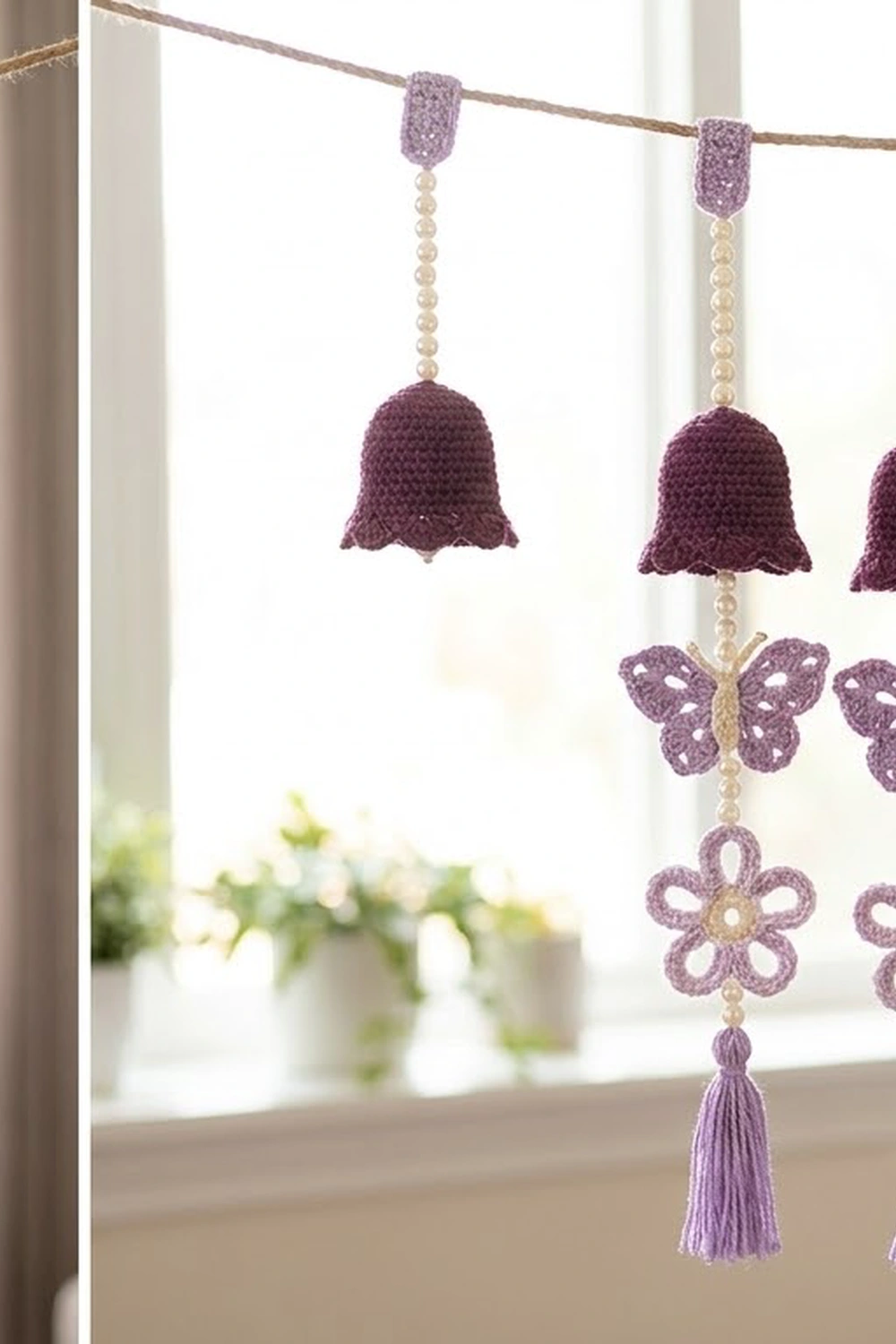
This boho wall hanging pairs plum bells, lavender butterflies, and lilac flowers on strands of ivory pearls. Each strand ends in a soft lavender tassel. Hang it from jute rope over a bed, in a nursery, or in a sunny window.
There are four colors. Deep plum is for the bells. Lavender is for the butterflies, tassels, and hanging tabs. Pale lilac is for the flowers, and cream is for the flower centers and butterfly bodies. The pearls tie the colors together and add a little shine.
The pattern uses US crochet terms. The finished hanging measures about 21 in (53.3 cm) wide and 16 in (40.6 cm) tall, from the top of the rope to the bottom of the longest tassel.
Each motif is made separately. The bells are worked top down in spiraling single crochet and finished with a scalloped ruffle. The butterflies and flowers are flat openwork motifs worked into chain loops. You then string everything onto six pearl strands and tie each strand to a crocheted tab wrapped around the rope.
Finished Size and Construction
- Finished size: 21 in (53.3 cm) wide x 16 in (40.6 cm) tall
- Skill level: Easy-intermediate
- Terminology: US
- Yarn weight: DK (#3) cotton
- Hook: 3.5 mm (E-4)
- Number of pieces: 4 bells, 3 butterflies, 5 flowers, 6 tassels, 6 hanging tabs
- Layout: 6 vertical strands, each with 2 motifs and 1 tassel, set 3 in (7.6 cm) apart on the rope
- Piece size: each motif is about 2.75 in (7.0 cm) tall; butterflies are 3 in (7.6 cm) wide
- Bell size before ruffle: 2.25 in (5.7 cm) tall, 2.3 in (5.8 cm) across the opening
- Ruffle depth: 0.5 in (1.3 cm)
Materials
Use a smooth, mercerized DK cotton. It shows the stitches clearly, holds the bell shape well, and makes neat tassels. Acrylic also works, but the bells will be softer and the tassels fluffier.
- Plum: 35 g (80 m), for the bells
- Lavender: 70 g (160 m), for the butterflies, tassels, and tabs
- Pale lilac: 30 g (70 m), for the flowers
- Cream: 10 g (25 m), for the flower centers and butterfly bodies
All quantities include a margin of about 20 percent.
Tools and notions:
- 3.5 mm (E-4) crochet hook
- Tapestry needle and stitch marker
- 130 ivory glass pearls, 8 mm, with holes large enough for your cord
- Clear nylon beading cord, 0.5 mm, or strong cream thread
- Jute rope, 0.75 in (1.9 cm) thick, 21 in (53.3 cm) long
- Cardboard 3 in (7.6 cm) tall, for the tassels
- Scissors, rustproof pins, a blocking mat, and spray starch
Abbreviations (US Terms)
- ch: chain
- sl st: slip stitch
- sc: single crochet
- hdc: half double crochet
- dc: double crochet
- tr: treble crochet
- inc: 2 sc in the same stitch
- st(s): stitch(es)
- MR: magic ring
Standing sc: Start with a slipknot on your hook. Insert the hook into the stitch, yarn over, and pull up a loop. Yarn over again and pull through both loops.
Gauge and Checkpoints
Gauge: 20 sc and 22 rounds = 4 in (10.2 cm) in sc worked in the round. Gauge controls how well the bells keep their shape and whether the strands line up.
Make one bell first and measure it before you make any other piece.
- Bell, after Round 4: a flat circle 1.5 in (3.8 cm) across
- Bell, after Round 14: 2.25 in (5.7 cm) tall, with an opening 2.3 in (5.8 cm) across
- Bell, after the ruffle: 2.75 in (7.0 cm) across the scallops
- Flower, after Round 2: 1 in (2.5 cm) across
- Butterfly, after Round 1: 0.75 in (1.9 cm) across
If your bell is too big, switch to a 3.25 mm hook. If it’s too small or too stiff, switch to a 3.75 mm hook. Use the same hook for every motif so they all match.
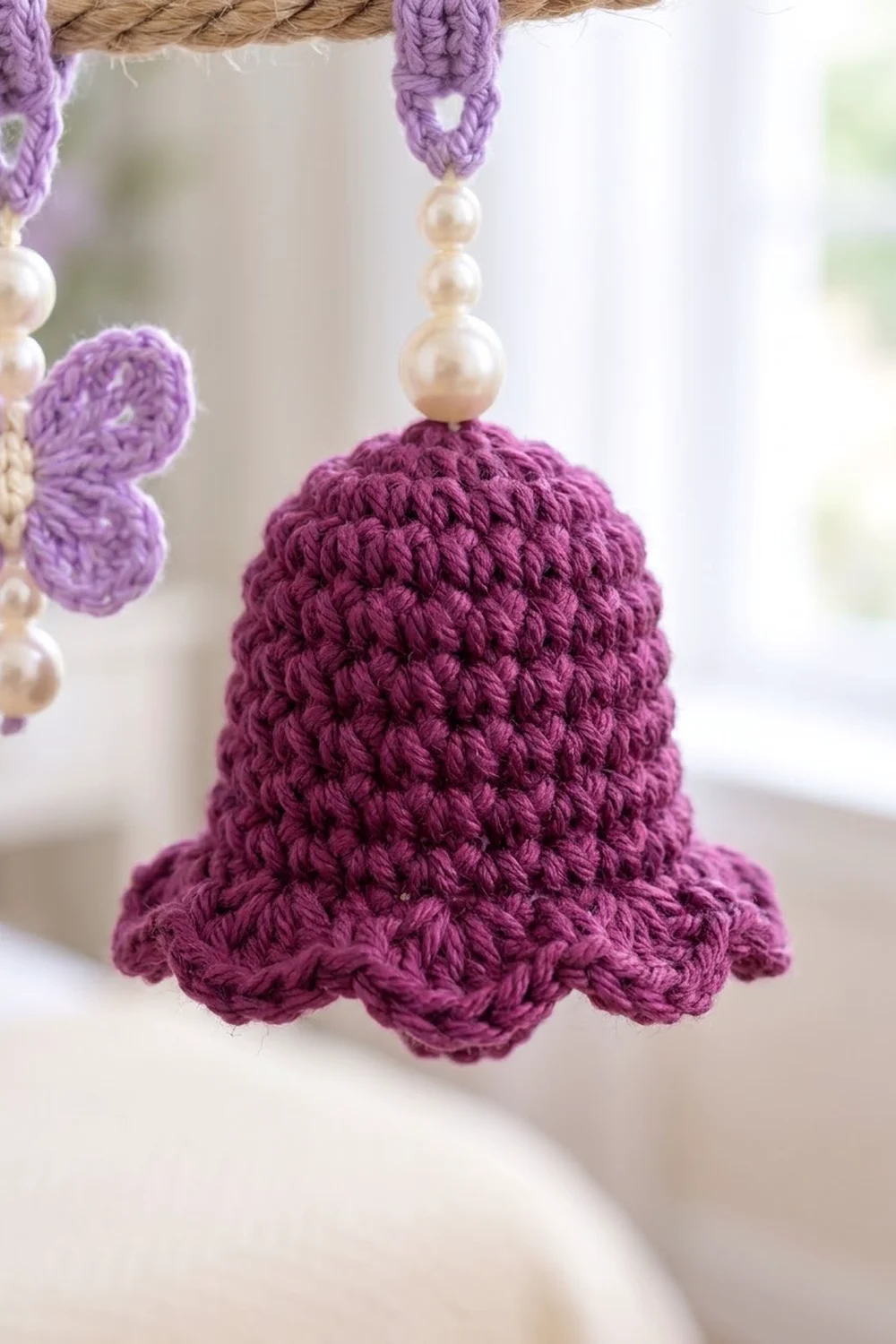
Bell (Make 4)
Work the bell from the top down in a continuous spiral with plum. Place a marker in the first stitch of each round.
Round 1: MR, 6 sc in the ring. (6)
Round 2: Inc in each st around. (12)
Round 3: (Sc in next st, inc) 6 times. (18)
Round 4: (Sc in next 2 sts, inc) 6 times. (24)
Checkpoint: the circle should measure 1.5 in (3.8 cm) across.
Rounds 5–8: Sc in each st around. (24) The sides will start to curve down into a dome.
Round 9: (Sc in next 3 sts, inc) 6 times. (30)
Rounds 10–12: Sc in each st around. (30)
Round 13: (Sc in next 4 sts, inc) 6 times. (36)
Round 14: Sc in each st around. (36) Sl st in the next st to smooth out the end of the spiral.
Checkpoint: the bell should be 2.25 in (5.7 cm) tall with a 2.3 in (5.8 cm) opening. Keep the yarn attached and go straight on to the ruffle (see Border below). Leave the magic ring open just wide enough for the beading cord to pass through.
Butterfly (Make 3)
Round 1 (lavender): MR, ch 3 (counts as dc), 11 dc in the ring, sl st to the top of the ch-3. (12 dc)
Round 2 (wing loops): Work these four loops in order:
- Ch 8, skip 2 sts, sl st in next st (upper right wing).
- Ch 6, skip 2 sts, sl st in next st (lower right wing).
- Ch 6, skip 2 sts, sl st in next st (lower left wing).
- Ch 8, skip 2 sts, sl st in the top of the beginning ch-3 (upper left wing).
You now have 4 loops: 2 ch-8 loops and 2 ch-6 loops.
Round 3 (fill the wings): Work the stitches below into each loop. Sl st in each Round 2 sl st between the wings. (48 sts and 4 sl sts)
- Each ch-8 loop: (sc, hdc, 2 dc, 5 tr, 2 dc, hdc, sc), 13 sts.
- Each ch-6 loop: (sc, hdc, 7 dc, hdc, sc), 11 sts.
The stitches arch over each loop and leave an open eyelet in the middle of each wing.
Round 4 (edging): Work the edging below on each wing. Sl st in each sl st between the wings. Fasten off. (64 sc and 4 sl sts)
- Each upper wing: sc in the first 4 sts, inc in each of the next 5 sts, sc in the last 4 sts. (18 sc)
- Each lower wing: sc in the first 4 sts, inc in each of the next 3 sts, sc in the last 4 sts. (14 sc)
Body (cream): Ch 9. Working in the back bumps, 2 sc in the 2nd ch from the hook, sc in the next 6 chs, 3 sc in the last ch. Rotate and sc in the next 6 chs along the other side, then sc again in the first ch. Sl st to the first sc. (18 sc) The body is an oval about 1.6 in (4.1 cm) long.
Sew the body down the center of the butterfly, between the two upper wings and between the two lower wings. The finished butterfly is 3 in (7.6 cm) wide and 2.75 in (7.0 cm) tall.
Flower (Make 5)
Round 1 (cream): MR, 8 sc in the ring. (8)
Round 2: Inc in each st around, sl st to the first sc. (16) Fasten off. Checkpoint: the center should be 1 in (2.5 cm) across.
Round 3 (pale lilac): Join with a standing sc in any st, ch 7, skip next st. Sc in next st, ch 7, skip next st. Repeat from * 6 more times. Sl st to the first sc. (8 sc and 8 ch-7 loops)
Round 4 (petals): In each ch-7 loop, work (sc, hdc, 2 dc, ch 2, 2 dc, hdc, sc), then sl st in the next sc. Fasten off. (8 petals of 8 sts each, 64 sts plus 8 ch-2 tips)
Each petal is an open outline around a hollow center. The finished flower is about 2.75 in (7.0 cm) across.
Hanging Tab (Make 6)
Row 1 (lavender): Ch 13, sc in the 2nd ch from the hook and in each ch across. (12)
Rows 2–4: Ch 1, turn, sc in each st across. (12)
The tab measures 2.4 in (6.1 cm) by 0.75 in (1.9 cm). Leave a 12 in (30.5 cm) tail.
Tassel (Make 6)
- Wrap lavender yarn 30 times around the 3 in (7.6 cm) cardboard.
- Slide a 10 in (25.4 cm) strand under the wraps at the top and tie it tightly.
- Cut through the wraps along the bottom edge.
- Wrap another strand 6 times around the tassel, 0.5 in (1.3 cm) below the top. Knot it and hide the ends inside.
- Trim the tassel to 3 in (7.6 cm).
Make All Pieces
- Plum: 4 bells
- Lavender: 3 butterflies, 6 tassels, 6 tabs
- Pale lilac: 5 flowers
- Cream: 5 flower centers, 3 butterfly bodies
Strand layout (S = short top segment of 5 pearls; L = long top segment of 9 pearls):
Strand:   1    2    3    4    5    6
Top:      S    L    S    L    S    L
Motif A:  Bfly Bell Bell Bfly Bell Bfly
Motif B:  Flwr Flwr Flwr Flwr Bell Flwr
End:      Tsl  Tsl  Tsl  Tsl  Tsl  Tsl
The totals should be 4 bells, 3 butterflies, and 5 flowers.
Joining
Build each strand from the bottom up.
- Cut 24 in (61.0 cm) of cord. Double-knot one end through the tie at the top of a tassel.
- Thread 6 pearls, about 1.9 in (4.8 cm).
- Add Motif B:
- Flower: On the back, pass the cord in at the top edge of the cream center and out at the bottom edge, so the flower hangs flat.
- Butterfly: Pass the cord through the back of the body.
- Bell: Tie a double overhand knot 2.25 in (5.7 cm) above the top pearl. Thread the cord up through the magic ring. The bell’s top rests on the knot, and the rim sits just above the pearls.
- Thread 6 more pearls, then add Motif A the same way.
- Thread the top segment: 5 pearls, about 1.6 in (4.1 cm), or 9 pearls, about 2.8 in (7.1 cm).
Tabs: Wrap a tab around the rope with the short ends together. Sl st through both layers across the 12 matching stitches to close it into a snug ring. Tie the top of a strand through the bottom of the fold.
Tension: Tie each knot firmly, but not so tightly that the motifs pucker. The pearls should touch without bunching.
Placement: Put the tabs at 3, 6, 9, 12, 15, and 18 in (7.6, 15.2, 22.9, 30.5, 38.1, and 45.7 cm) from the left end of the rope. This spaces the strands 3 in (7.6 cm) apart and leaves 3 in (7.6 cm) of bare rope at each end.
Size checkpoint: A short strand is 1.6 + 2.75 + 1.9 + 2.75 + 1.9 + 3 = 13.9 in (35.3 cm). A long strand is 15.1 in (38.4 cm). With the rope and tab added, the total height is 16 in (40.6 cm).
Border: Bell Ruffle
The ruffle is the border on each bell. It starts from the 36 sts of Round 14.
Border gauge: Each scallop uses 6 sts and measures about 0.95 in (2.4 cm) along the flared rim.
Round 15 (conversion round): Ch 1. (Sc in next st, 2 sc in next st) 18 times, sl st to the first sc. (36 sts worked one into each existing st, + 18 added = 54 sts)
Round 16 (scallops): Sc in next st, skip 2 sts, 5 dc in next st, skip 2 sts. Repeat from * 8 more times. Sl st to the first sc. (9 scallops: 9 sc + 45 dc = 54 sts)
Why the math works:
- Each repeat uses exactly 6 sts (1 + 2 + 1 + 2), and 54 ÷ 6 = 9, so the repeats fit with nothing left over.
- Round 15 adds 50 percent more stitches, which makes the ruffle flare.
- Nine scallops of 0.95 in (2.4 cm) each wrap a rim about 2.75 in (7.0 cm) across.
Fasten off and weave in the ends.
Final Blocking
- Lightly dampen all the motifs and tabs, but not the tassels.
- Stuff each bell with plastic wrap, or set it over a small bottle, so it keeps its dome shape.
- Pin the bell scallops so they flare evenly to 2.75 in (7.0 cm) across.
- Pin each flower flat at 2.75 in (7.0 cm) across, with a pin in every ch-2 petal tip.
- Pin each butterfly to 3 in (7.6 cm) wide, opening up each wing eyelet.
- Mist everything with spray starch and let it dry completely.
- Lightly steam the tassels, then comb them and trim to 3 in (7.6 cm).
Final Quality-Control Checklist
- [ ] 4 bells, 3 butterflies, 5 flowers, 6 tassels, and 6 tabs
- [ ] Each bell has 9 even scallops
- [ ] Each flower has 8 open petals
- [ ] Every butterfly’s upper wings are larger than its lower wings
- [ ] The strands alternate short and long
- [ ] The tabs are 3 in (7.6 cm) apart
- [ ] All knots are secure and all ends are trimmed
Troubleshooting
- The bell top is flat or flared: You may have added extra increases. Recount Rounds 1–4. Round 4 should end at 24 sts.
- The ruffle doesn’t flare: Check that Round 15 has 54 sts.
- The scallops are uneven: Recount Round 15. You need exactly 54 sts for nine 6-st repeats.
- The petals curl: The ch-7 loops are too tight. Chain more loosely, or go up a hook size for Round 3.
- The motifs twist on the cord: Pass the cord through each motif at two points, top and bottom.
Care
Dust it gently. To wash, take the motifs off the rope, hand wash in cool water, dry flat, and re-block the bells.
Final Notes
Each measurement builds on the last. A 1.5 in (3.8 cm) bell top gives a 2.25 in (5.7 cm) bell with a 2.75 in (7.0 cm) ruffle. The 2.75 in (7.0 cm) motifs on 13.9 in (35.3 cm) and 15.1 in (38.4 cm) strands, spaced 3 in (7.6 cm) apart, give a hanging 21 in (53.3 cm) wide and 16 in (40.6 cm) tall. Check your gauge on the first bell and everything else will line up.
Happy crocheting!