

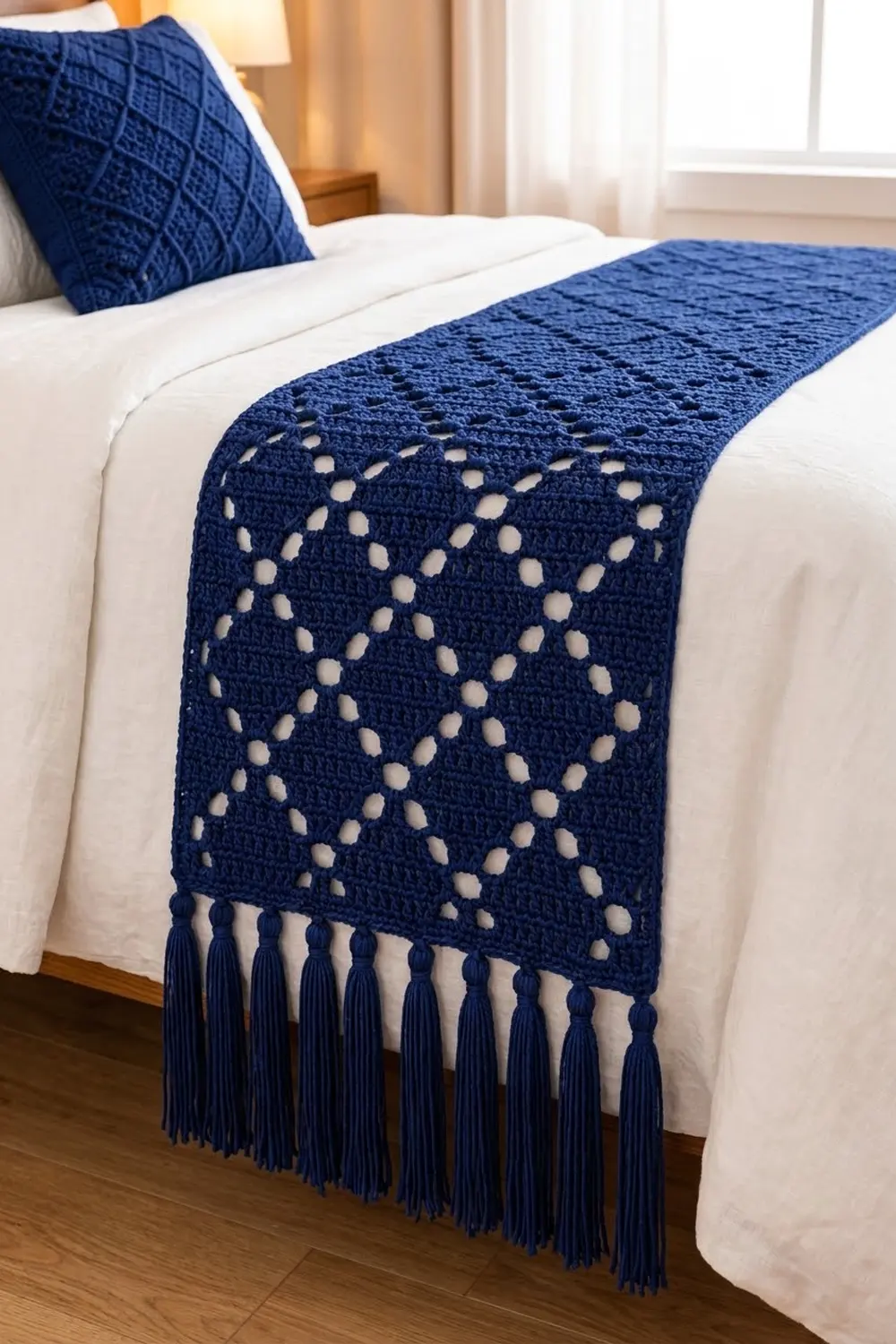
A bed runner is an easy way to change how a bedroom feels. This one is worked in a single deep navy shade. Its open diagonal lattice frames rows of solid diamonds, and a fringe of chunky tassels finishes each end.
The design uses filet crochet. Each “block” is either solid double crochet or an open mesh made with a chain-1 space. The open blocks are set out in crossing diagonal lines, and the solid areas between them become diamonds. Where two lines cross, a small cluster of four holes forms. This gives the runner its tiled look.
The pattern uses US crochet terms. The finished runner measures 17 in x 73 in (43.2 cm x 185.4 cm) without tassels. With the 6 in (15.2 cm) tassels at each end, it measures about 85 in (215.9 cm) from tip to tip.
You work the whole piece flat in rows, as one rectangle. It starts and ends with a solid band, and the lattice repeats in between. Two rounds of single crochet border the rectangle, and you add tassels to both short ends. It is a single piece, so there’s nothing to join.
Finished Size and Construction
- Finished size: 17 in x 73 in (43.2 cm x 185.4 cm), without tassels
- Skill level: Intermediate (easy for anyone who has done filet crochet)
- Terminology: US crochet terms
- Yarn weight: Worsted (#4)
- Hook: 5.0 mm (US H-8)
- Number of pieces: 1
- Layout: One rectangle worked in rows, 3 diamond repeats across, 17 lattice repeats along the length
- Body size before border: 16 in x 72 in (40.6 cm x 182.9 cm)
- Border depth: 0.5 in (1.3 cm) on every side
- Tassels: 11 per short end, 22 total, each 6 in (15.2 cm) long
Materials
Yarn: Use a smooth worsted-weight yarn so the holes look clean and round. Cotton or a cotton blend gives crisp diamonds and a nice drape. Soft acrylic is lighter and easier to wash. Avoid fuzzy or very splitty yarns, because the mesh holes will fill in.
- Navy blue: about 650 g / 1,300 m (1,422 yd), for example seven 100 g skeins of about 200 m (219 yd) each
This amount covers the body (about 920 yd / 841 m), the border (about 80 yd / 73 m), and the tassels (about 180 yd / 165 m). It also includes a safety margin of roughly 15% for swatching and for any difference in tension. Buy all skeins from the same dye lot.
Tools:
- 5.0 mm (US H-8) crochet hook
- Tapestry needle
- Sharp scissors
- A 6.5 in (16.5 cm) wide piece of stiff cardboard for the tassels
- 4 locking stitch markers
- Tape measure
- Blocking mats, rust-proof pins, and a spray bottle
Abbreviations (US Terms)
- ch – chain
- sl st – slip stitch
- sc – single crochet
- dc – double crochet
- st(s) – stitch(es)
- sp – space
- tch – turning chain
- rep – repeat
- rnd – round
- RS / WS – right side / wrong side
Special stitches (blocks):
- Solid block (S): dc in each of the next 2 sts. If the block below was open, dc in the ch-1 sp, then dc in the next dc.
- Open block (O): ch 1, skip the next st or ch-1 sp, dc in the next dc.
Every row starts with a ch-3, which counts as the first dc. After it, the row has 28 blocks of 2 sts each, so 1 + (28 x 2) = 57 sts. In every count, a ch-1 sp counts as 1 st.
Gauge and Checkpoints
Gauge: 14 sts and 8 rows = 4 in (10.2 cm) in filet pattern. This means 7 blocks = 4 in (10.2 cm), and each row is 0.5 in (1.3 cm) tall.
Test swatch: Ch 25. Dc in the 4th ch from the hook and in each ch across (23 sts). Work 9 more rows. On these rows, alternate one solid row with one row of (S, O) across. Measure the center 14 sts and 8 rows. Since the runner is one large piece, treat the first band as your test piece too. Stop after Row 4 and measure before you continue.
Checkpoints:
- After Row 1: 16 in (40.6 cm) wide
- After Row 4: 16 in x 2 in (40.6 cm x 5.1 cm)
- After Row 12 (first lattice repeat): 6 in (15.2 cm) tall. Each diamond repeat is 4.6 in (11.7 cm) wide and 4 in (10.2 cm) tall.
- After Row 76: 38 in (96.5 cm) long
- After Row 144: 16 in x 72 in (40.6 cm x 182.9 cm)
If your work is too big: Change to a 4.5 mm (US 7) hook. If it is too small: Change to a 5.5 mm (US I-9) hook. Width matters most, because it controls how the border and tassels are spaced. If your row height is a little off, add or remove full 8-row lattice repeats so the diamonds stay whole. Each repeat changes the length by 4 in (10.2 cm).
Body
The runner starts with a solid band. After that, the four lattice row types (A, B, C, and D) build the diamonds. Each row starts with 2 solid edge blocks, has 3 repeats of an 8-block lattice section, and ends with 2 solid edge blocks.
Row 1 (RS): Ch 59. Dc in the 4th ch from the hook and in each ch across. The 3 skipped ch count as the first dc. (57 sts)
Rows 2–4: Ch 3, turn. Dc in each st across, working the last dc in the top of the tch. (57 sts)
Lattice row setup: Each lattice row starts with: ch 3, turn, dc in the next 4 sts (2 edge blocks). Each one ends with: dc in the next 3 sts and in the top of the tch (2 edge blocks). Between these, work the lattice section given for that row 3 times.
- Row type A: [O, 6 S, O]
- Row type B: [S, O, 4 S, O, S]
- Row type C: [2 S, O, 2 S, O, 2 S]
- Row type D: [3 S, 2 O, 3 S]
Every lattice row has 51 dc and 6 ch-1 sps. (57 sts)
Row 5: Work Row type A.
Row 6: Work Row type B.
Row 7: Work Row type C.
Row 8: Work Row type D.
Row 9: Work Row type D.
Row 10: Work Row type C.
Row 11: Work Row type B.
Row 12: Work Row type A.
In each repeat, the open blocks sit at block positions 1 and 8 in Row 5, then 2 and 7, then 3 and 6, then 4 and 5. They then move back out. This makes two crossing diagonal lines. Rows 8–9 put 4 holes together in the middle of each repeat, and Rows 12 and 13 put 4 holes together where two repeats meet. Those are the hole clusters you can see between the diamonds.
Rows 13–140: Rep Rows 5–12 sixteen more times. That makes 17 lattice repeats in total. (57 sts on every row)
Rows 141–144: Ch 3, turn. Dc in each dc and each ch-1 sp across, working the last dc in the top of the tch. (57 sts)
Do not fasten off. The body is now 144 rows and should measure 16 in x 72 in (40.6 cm x 182.9 cm).
Border
Border gauge: On the short ends you work 1 sc per stitch. On the long sides you work 2 sc per dc row-end. Each sc round adds about 0.25 in (0.6 cm), so 2 rounds give a 0.5 in (1.3 cm) border.
Each corner is a group of 3 sc. The middle sc of that group is the corner stitch. In the side counts below, both corner stitches are included, and each corner is shared by 2 sides. Mark each corner stitch as you make it.
Rnd 1 (RS): Ch 1, turn so the RS faces you. Work 3 sc in the first st of Row 144 (corner). Sc in the next 55 sts. Work 3 sc in the last st (corner). Rotate the piece. Work 2 sc in each row-end down the long side (288 sc). Work 3 sc in the first foundation ch (corner). Sc in the next 55 ch. Work 3 sc in the last ch (corner). Work 2 sc in each row-end up the second long side (288 sc). Join with a sl st to the first sc.
Counts: short sides have 59 sc each, and long sides have 292 sc each, with corner stitches included. (698 sc in total)
Rnd 2: Ch 1. Sc in each sc around, and work 3 sc in each corner stitch. Join with a sl st to the first sc.
Counts: short sides have 61 sc each, and long sides have 294 sc each, with corner stitches included. (706 sc in total) Fasten off and weave in the ends.
Why the math works: Each short end has 57 body sts. In Rnd 1, it gets 3 + 55 + 3 = 61 sc. Counted from corner stitch to corner stitch, that is 59. Each long side has 144 dc row-ends, and 2 sc each gives 288 sc. Adding the 2 sc beside the corner stitches and the 2 corner stitches makes 292. The total is 2 x 59 + 2 x 292 − 4 shared corners = 698. In Rnd 2, the 3-sc corners add 2 sts to every side and 8 sts in total, so you get 706. Since every side count is tied to the edge it’s worked into, the border lies flat. The finished size is 16 + 1 = 17 in (43.2 cm) by 72 + 1 = 73 in (185.4 cm).
Tassels
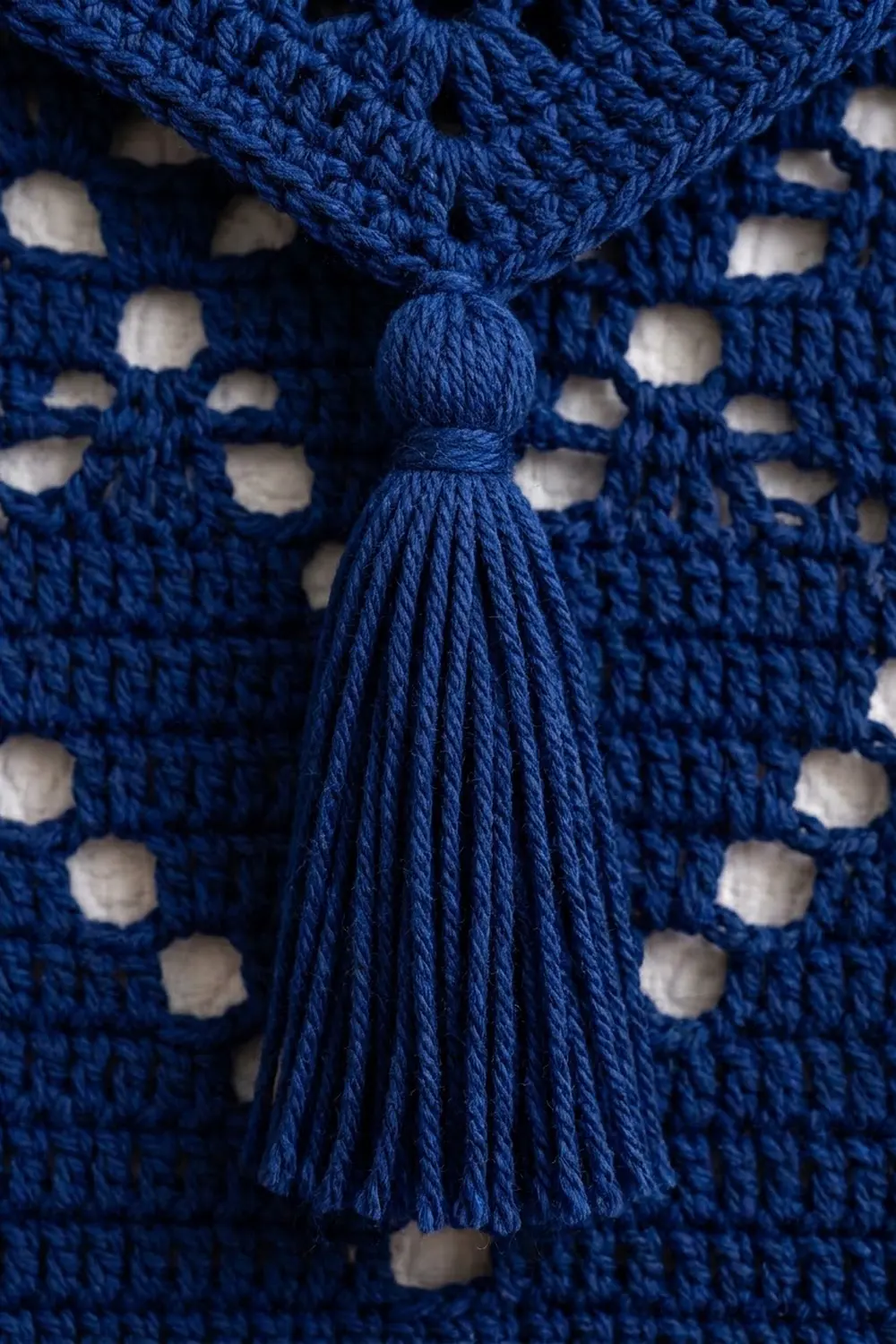
Make the tassels (make 22): Wrap the yarn 20 times around the 6.5 in (16.5 cm) cardboard. Slide a 12 in (30.5 cm) strand under the wraps at the top edge and tie it tightly. Cut through all the wraps at the bottom edge, which gives 20 strands of 13 in (33.0 cm) folded in half. Wrap an 18 in (45.7 cm) strand tightly around the bundle 0.75 in (1.9 cm) below the fold, knot it, and hide its tails inside the tassel. Trim the ends evenly to 6 in (15.2 cm).
Placement: On each short end of Rnd 2, number the 61 sts from corner stitch to corner stitch. Attach a tassel to sts 1, 7, 13, 19, 25, 31, 37, 43, 49, 55, and 61. That makes 11 tassels spaced every 6 sts, about 1.7 in (4.3 cm) apart, with one centered on st 31. To attach a tassel, pull both tails of its top tie through the st with your hook. Knot them firmly on the WS and weave them into the border.
Final Blocking
- Weave in all the remaining ends along solid dc areas, not through the holes.
- Wet the runner in cool water, or spray it until it’s evenly damp. Press out the water in a towel without wringing.
- Lay it flat on blocking mats with the RS up.
- Pin the long sides straight to 73 in (185.4 cm), then pin the short ends to 17 in (43.2 cm). Check that the corners are square.
- Line up the diamonds. Each repeat should be about 4.6 in (11.7 cm) wide and 4 in (10.2 cm) tall. Gently open each hole with a fingertip.
- Leave the tassels unpinned. Comb them straight and let them hang over the edge of the mat.
- Let everything dry completely before you unpin it, then trim any uneven tassel ends to 6 in (15.2 cm).
Final Quality-Control Checklist
- Every body row has 57 sts.
- There are 144 rows: a 4-row solid band, 17 lattice repeats, and a 4-row solid band.
- The diagonal lines are straight, with no open block shifted by one.
- Each row has 3 complete diamond repeats across the width.
- Border Rnd 2 has 706 sc, with 3-sc corners.
- The finished size is 17 in x 73 in (43.2 cm x 185.4 cm).
- There are 11 tassels on each end, evenly spaced, all 6 in (15.2 cm) long.
- All ends are hidden in solid areas.
Troubleshooting
The runner gets wider or narrower. You’ve probably missed or added a dc at the tch. Count to 57 at the end of every row.
A diagonal line has a jog. One open block is in the wrong place. Check the row type against the order A, B, C, D, D, C, B, A, then pull back to the error.
The holes look small or closed. Your ch-1 sps are too tight. Work the chain a bit looser, or block more firmly.
The border ruffles. Your sc are too loose or you added extra stitches. Recount (288 per long side in Rnd 1), or go down half a hook size for the border only.
The border cups or pulls in. You missed row-ends. Make sure every dc row-end gets 2 sc.
The tassels look uneven. Wrap the cardboard with even tension, and trim all the tassels together after blocking.
Care
Hand wash or machine wash on a cool, gentle cycle in a mesh laundry bag, then reshape and dry flat. Comb the tassels straight while they’re damp.
Final Notes
Every measurement here links back to the gauge. 14 sts = 4 in (10.2 cm), so 57 sts make a 16 in (40.6 cm) width. 8 rows = 4 in (10.2 cm), so 144 rows make a 72 in (182.9 cm) length. The border adds 0.5 in (1.3 cm) on each side, which brings the runner to 17 in x 73 in (43.2 cm x 185.4 cm). The tassels are spaced every 6 sts along the 61-st short ends, so they line up with the lattice and the runner hangs evenly. If you check your width after Row 1 and count your sts on every row, the rest of the runner will come out right.
Happy crocheting!