

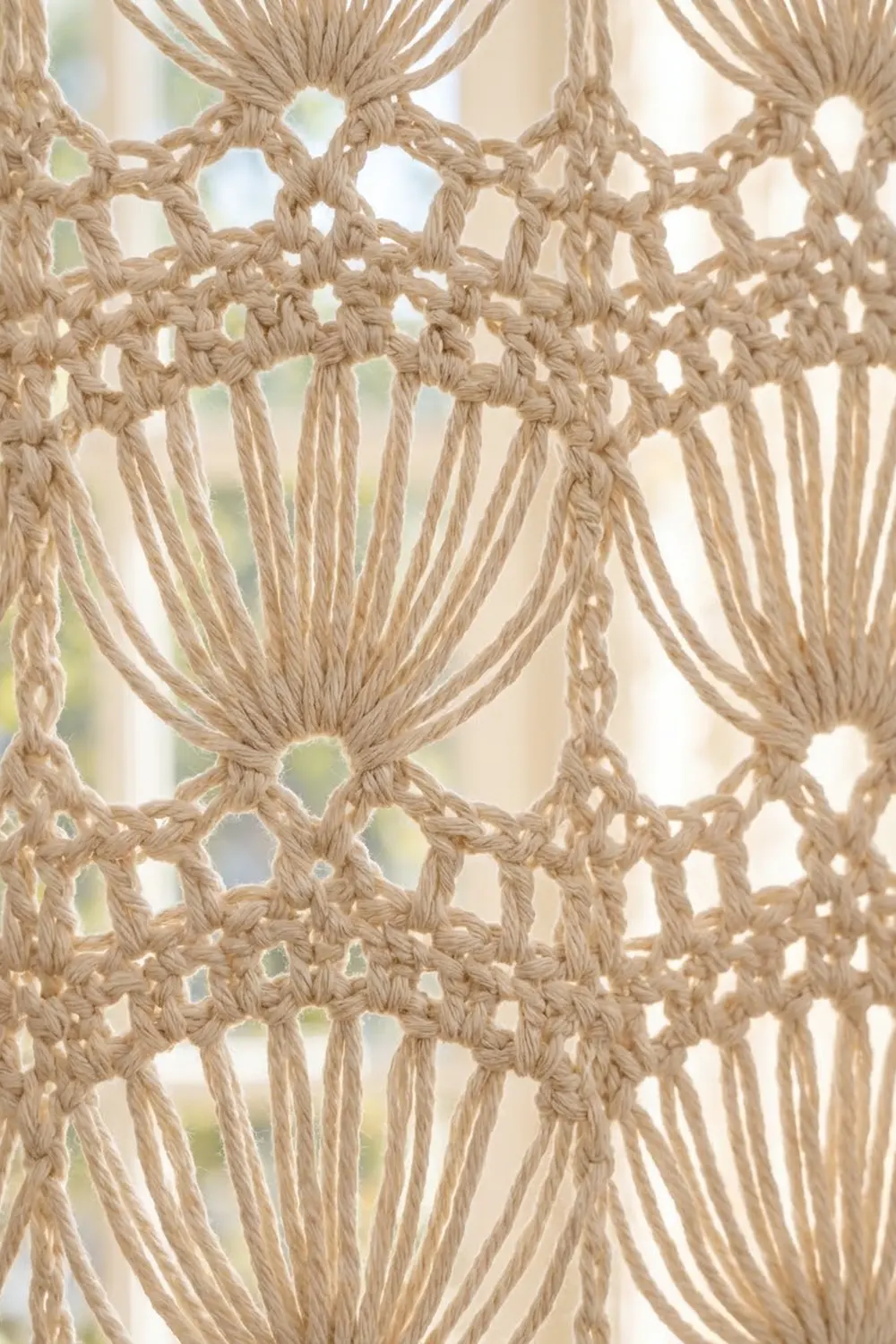
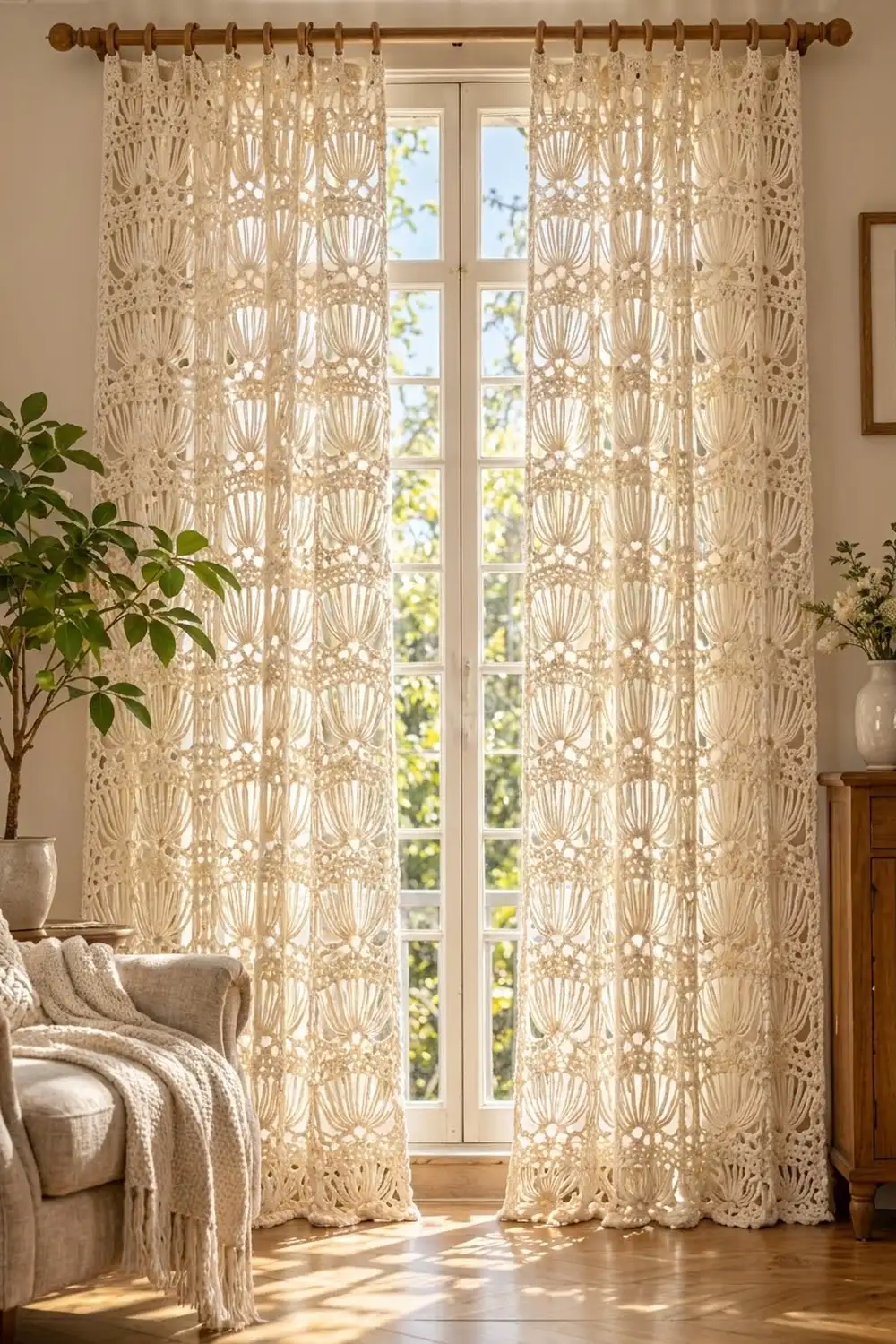
This floor-length curtain panel is made of airy broomstick lace fans. Each fan has ten long loops that start at one small hole and open out into a wide shell. Every band is shifted half a fan from the band below, so the shells line up in a soft diamond grid.
The panel uses one color, a warm cream cotton, for a calm, sunlit boho look. Narrow single crochet strips frame each band of fans. All instructions use US crochet terms.
The finished panel measures 40 in (101.6 cm) wide and 79.75 in (202.6 cm) long including the border. The tabs add 3 in (7.6 cm) on top, for a total drop of 82.75 in (210.2 cm).
The panel is one piece, worked flat from the bottom up. After the lace body, you work two rounds of single crochet border, then add eleven tabs to the top edge. For a pair like the one in the photo, make a second identical panel. The two panels hang side by side and are never joined.
Finished Size and Construction
- Finished size: 40 in x 79.75 in (101.6 cm x 202.6 cm); 82.75 in (210.2 cm) including tabs
- Skill level: Intermediate
- Terminology: US
- Yarn weight: #4 worsted cotton
- Hook: 5.5 mm (US I-9), plus a 1.5 in (3.8 cm) dowel
- Number of pieces: 1 panel (tabs worked on)
- Layout: 13 fans across, 26 staggered fan bands from bottom to top
- Piece size before border: 39 in x 78.75 in (99.1 cm x 200.0 cm)
- Border depth: 0.5 in (1.3 cm) per side
- Tabs: 11 tabs, each 1.2 in (3.0 cm) wide, forming 3 in (7.6 cm) loops
Materials
Choose a smooth, mercerized or combed worsted cotton, about 170 m per 100 g. Cotton shows each loop clearly and hangs straight. Avoid fuzzy or stretchy yarns: they blur the fans, and the panel will keep growing longer as it hangs.
- Cream (one panel): 1,300 g (2,210 m), about 13 balls of 100 g
- Cream (pair of panels): 2,600 g (4,420 m)
These amounts include about a 15% margin for your swatch, tension differences, and the tabs.
Tools:
– 5.5 mm (US I-9) hook
– Smooth dowel, 1.5 in (3.8 cm) across and at least 30 in (76.2 cm) long
– Stitch markers and a tapestry needle
– Scissors and a tape measure
– Rust-proof pins and a spray bottle
– 11 curtain rings per panel (optional)
Abbreviations (US Terms)
- ch – chain
- sc – single crochet
- sk – skip
- sl st – slip stitch
- sp(s) – space(s)
- st(s) – stitch(es)
- yo – yarn over
- RS / WS – right side / wrong side
Special stitch – Fan (broomstick lace group):
– Loop row: Insert the hook into the given space, yo, and pull up a loop. Stretch the loop up and slip it onto the dowel. Repeat into the same space until you have the stated number of loops from that space.
– Work-off row: For the first group of the row, insert the hook through all loops of the group together and slide them off the dowel. Yo, pull up a loop, ch 1, then work the stated number of sc into the center of the group, going through all of its loops each time. For every later group, insert the hook through the group, slide it off, and work the sc in the same way.
Gauge and Checkpoints
Gauge (blocked): 10 sc = 3 in (7.6 cm); 4 sc rows = 1 in (2.5 cm). One band (sc row, anchor row, loop row, and work-off row) = 3 in (7.6 cm) tall and 10 sts = 3 in (7.6 cm) wide.
Test swatch: Ch 31 and work Rows 1–9 over 30 sts:
– Anchor Row A: sc in first 3 sts, (ch 4, sk 4, sc in next 6) twice, ch 4, sk 4, sc in last 3.
– Anchor Row B: sc in first st, ch 1, sk 1, sc in next 6, (ch 4, sk 4, sc in next 6) twice, ch 1, sk 1, sc in last st.
After blocking, the swatch should measure 9 in (22.9 cm) wide and 6.25 in (15.9 cm) tall.
- Too big: Use a 5 mm (H-8) hook. If only the fans are too tall, use a thinner dowel.
- Too small: Use a 6 mm (J-10) hook. If only the fans are too short, use a thicker dowel.
- An error of just 0.1 in (0.3 cm) per 3 in (7.6 cm) adds 1.3 in (3.3 cm) across the full width, so get the gauge right before you start.
Panel checkpoints:
– Width after Row 1: 39 in (99.1 cm)
– After Row 25: 18.25 in (46.4 cm) long
– After Row 57: 42.25 in (107.3 cm) long
– After Row 105: 78.25 in (198.8 cm) long
– After Row 107: 78.75 in (200.0 cm) long
Panel Body
Row direction: Anchor rows and work-off rows are RS rows. Work each loop row with the RS facing, without turning, going back along the row in the opposite direction. The work-off row then returns you to the edge where you started. The plain sc rows are WS rows.
Starting loop: At the start of each loop row, stretch the loop on your hook up and slip it onto the dowel. This loop is not counted. Work it off together with the group next to it, which is the last group of the work-off row.
Foundation: Ch 131.
Row 1 (RS): Sc in 2nd ch from hook and in each ch across. (130 sc)
Row 2 (WS): Ch 1, turn, sc in each st across. (130 sc)
Row 3 (RS, Anchor Row A): Ch 1, turn, sc in first 3 sts, ch 4, sk 4 sts, sc in next 6 sts; repeat from * to * 11 more times, then ch 4, sk 4 sts, sc in last 3 sts. (78 sc + 13 ch-4 sps = 130 sts)
Each ch-4 space sits at the center of a 10-st section. These spaces become the holes at the base of the fans.
Row 4 (Loop Row A): Do not turn. Place the starting loop on the dowel. Working back across the row, pull up 10 loops in each ch-4 sp and skip all the sc. (130 loops + starting loop)
Row 5 (RS, Work-off Row A): Starting with the group nearest the working yarn, work each group of 10 loops off as a Fan with 10 sc. (13 Fans x 10 sc = 130 sc)
Each fan starts from one space and opens to 10 sc, exactly the width of its section. The 6 skipped sc between fan bases leave small triangular openings.
Row 6 (WS): Ch 1, turn, sc in each st across. (130 sc)
Row 7 (RS, Anchor Row B): Ch 1, turn, sc in first st, ch 1, sk 1 st, sc in next 6 sts, ch 4, sk 4 sts, sc in next 6 sts; repeat from * to * 11 more times, then ch 1, sk 1 st, sc in last st. (80 sc + 12 ch-4 sps + 2 ch-1 sps = 130 sts)
This row moves the spaces 5 sts sideways, which creates the stagger.
Row 8 (Loop Row B): Do not turn. Place the starting loop on the dowel. Working back across, pull up 5 loops in the first ch-1 sp, 10 loops in each ch-4 sp, and 5 loops in the last ch-1 sp. (5 + 120 + 5 = 130 loops + starting loop)
Row 9 (RS, Work-off Row B): Work off the first group of 5 as a half Fan with 5 sc. Work off each group of 10 as a full Fan with 10 sc. Work off the last group of 5 as a half Fan with 5 sc. (5 + 120 + 5 = 130 sc)
The half fans fill the ends of the row, so both side edges stay straight.
Rows 10–105: Repeat Rows 2–9 twelve more times, for 13 repeats in all. (26 fan bands; 130 sc)
Rows 106–107: Ch 1, turn, sc in each st across. (130 sc each row) Fasten off.
The body should measure 39 in x 78.75 in (99.1 cm x 200.0 cm).
Border
Border gauge: Each round adds 0.25 in (0.6 cm). Along the sides, place sc at 10 sc per 3 in (7.6 cm).
Side distribution: Work 1 sc in the end of Row 1. Then, for each band, work 1 sc in the end of the sc row, 1 sc in the end of the anchor row, and 8 sc spaced evenly along the loop and work-off rows, worked around the outer loops. Finish with 1 sc each in the ends of Rows 106 and 107. That gives 1 + (26 x 10) + 2 = 263 sc. Place a marker every 10 sc.
Round 1 (RS): Join yarn in the first st of Row 107. Ch 1, 3 sc in same st, sc in next 128 sts, 3 sc in last st. Work 263 sc down the side. Working into the free loops of the foundation ch, 3 sc in the first ch, sc in next 128 ch, 3 sc in the last ch. Work 263 sc up the other side. Sl st to the first sc.
– The corner st is the center sc of each 3-sc group.
– Top and bottom: 130 sts between corners (132 including corners)
– Sides: 265 sts between corners (267 including corners)
– Total: 4 + (2 x 130) + (2 x 265) = 794 sts
Round 2: Ch 1, sc in each st around, with 3 sc in each corner st. Sl st to the first sc.
– Top and bottom: 132 sts between corners (134 including corners)
– Sides: 267 sts between corners (269 including corners)
– Total: 4 + (2 x 132) + (2 x 267) = 802 sts
Why the math works: The top and bottom start with the body’s exact 130 sts. On the sides, 263 sts over 78.75 in (200.0 cm) is 3.34 sc per inch, which matches the body’s 3.33 sc per inch, so the edges stay flat. Two rounds add 0.5 in (1.3 cm) per side, giving 40 in x 79.75 in (101.6 cm x 202.6 cm).
Tabs: The top edge of Round 2 has 134 sts including the corners. Divide it into 11 tabs of 4 sts and 10 gaps of 9 sts: (11 x 4) + (10 x 9) = 134. The tabs sit 13 sts apart, or 3.9 in (9.9 cm) center to center.
For each tab: with RS facing, join yarn in the first tab st. Ch 1, sc in same st and in next 3 sts. (4 sc) Next row: ch 1, turn, sc in each st across. (4 sc) Repeat this row until the tab is 6 in (15.2 cm) long, about 24 rows. Fasten off and leave a 12 in (30.5 cm) tail. Thread on a ring if you are using one. Fold the tab to the WS and whipstitch the last row to the back of the same 4 border sts. This makes a 3 in (7.6 cm) loop.
Final Blocking
- Weave in the ends along the sc rows, not through the fans.
- Soak the panel in cool water for 15 minutes, then press the water out gently without wringing.
- Roll the panel in towels to remove extra water.
- Lay it flat with RS up, on a bed or on a towel-covered floor.
- Pin it to 39 in (99.1 cm) wide and 79.75 in (202.6 cm) long.
- Shape each fan into an even shell and open up the base holes.
- Let it dry completely, or hang the damp panel on its rod and check the length as it dries.
Final Quality-Control Checklist
- 130 sts in every sc row and every work-off row
- 26 bands, alternating full-fan bands and bands with half fans at the edges
- Each full fan has 10 loops from one space and 10 sc on top
- Body measures 39 in x 78.75 in (99.1 cm x 200.0 cm)
- Border Round 2 has 802 sts
- 11 evenly spaced tabs, each forming a 3 in (7.6 cm) loop
- Finished size is 40 in x 79.75 in (101.6 cm x 202.6 cm)
- For a pair, the two panels match within 0.5 in (1.3 cm)
Troubleshooting
- Fans twist or lean: Your loops are different heights. Pull every loop fully up to the dowel before slipping it on.
- Edges curve: Recount Rows 3 and 7. A missing edge sc throws off the half fans.
- Panel narrows toward the top: Your work-off sc are getting tighter. Relax your tension and measure the width every few bands.
- Loops slide off the dowel: Put a rubber band or cork on the free end of the dowel.
- Panel too short: Add one band (Rows 2–5 or Rows 6–9) before Row 106. This adds 3 in (7.6 cm), and you will need 10 more border sc on each side.
- Border ruffles: You have more than 263 sc on a side. Recount using your markers.
Care
Hand wash, or machine wash cool on a gentle cycle in a mesh bag. Dry flat or on the rod, and re-block lightly if the fans lose their shape.
Final Notes
Here is the measurement chain. A gauge of 10 sc = 3 in (7.6 cm) makes 130 sts = 39 in (99.1 cm). Thirteen repeats of two bands each, plus three sc rows, make a body 78.75 in (200.0 cm) long. With 263 border sts per side, the edges stay flat, and the two border rounds bring the panel to 40 in x 79.75 in (101.6 cm x 202.6 cm). The 3 in (7.6 cm) tabs complete the 82.75 in (210.2 cm) drop. Check each checkpoint as you go and your panel will hang straight and even.
Happy crocheting!