

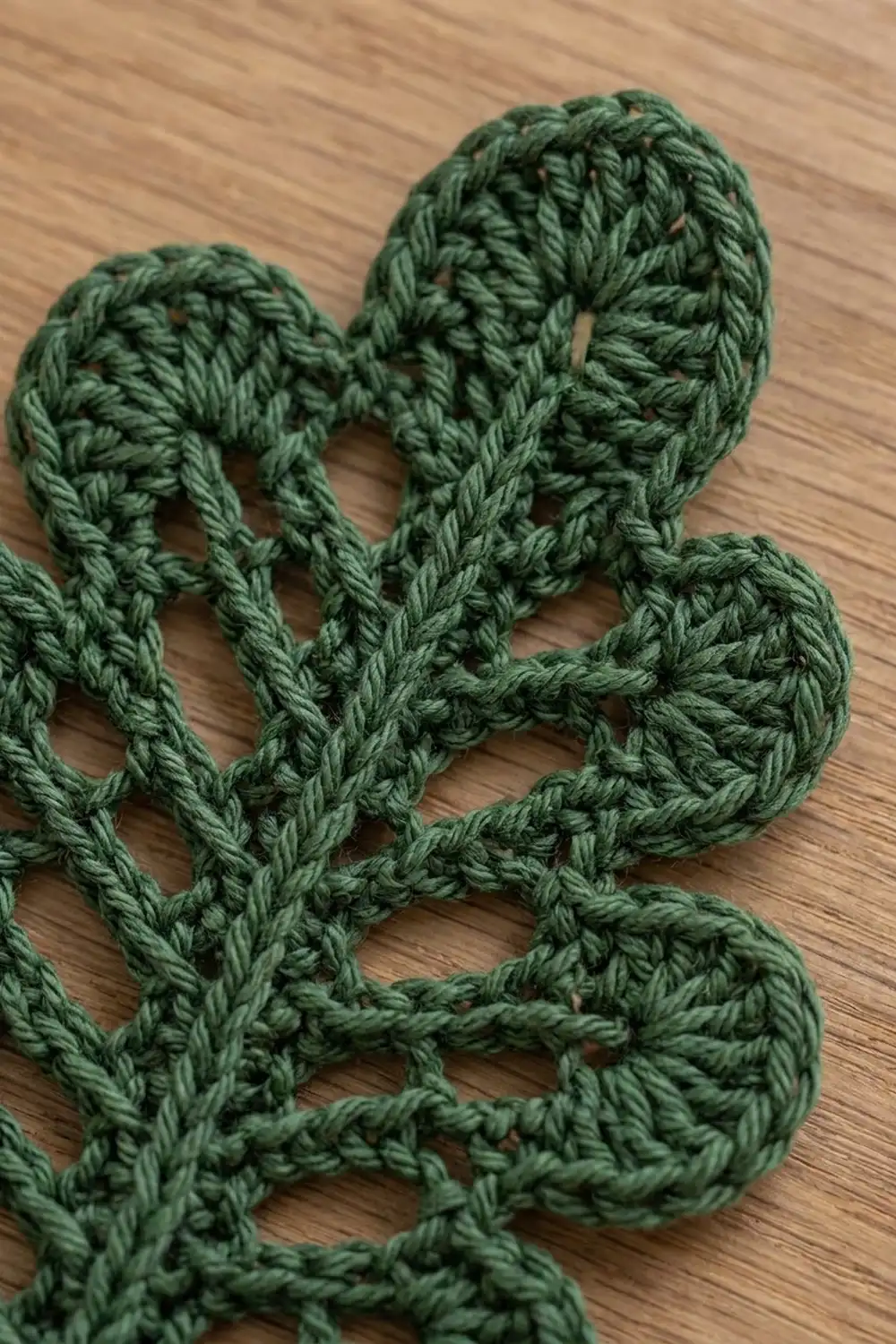
This oak leaf motif has a rounded top lobe, four scalloped lobes down each side, and long open slots that look like the veins of a real leaf. A raised slip-stitch midrib runs from the base to the tip, and a neat single-crochet edge outlines the whole shape.
It is worked in one deep forest green, which shows off the texture well. The look is woodland and slightly vintage, close to Irish crochet lace, but in a sturdier worsted weight that stays flat and holds its shape.
The finished leaf measures 8.25 in long × 4.25 in wide (21.0 cm × 10.8 cm) after blocking. The pattern uses US crochet terms throughout.
The leaf is one piece worked in four rounds around a foundation chain. Round 1 outlines the chain, Round 2 builds the open vein spokes, Round 3 shapes the lobes, and Round 4 is the border. A surface slip-stitch midrib finishes the piece.
Finished Size and Construction
- Finished size: 8.25 in × 4.25 in (21.0 cm × 10.8 cm)
- Skill level: Intermediate
- Terminology: US
- Yarn weight: Worsted (#4)
- Hook: 4.5 mm (US 7)
- Number of pieces: 1
- Layout: Single leaf; the long axis runs base to tip
- Piece size before border (after Round 3): 7.75 in × 3.75 in (19.7 cm × 9.5 cm)
- Border depth: 0.25 in (0.6 cm) on every edge
Materials
Yarn: Use a smooth worsted-weight cotton or cotton blend with good stitch definition. Fuzzy or very splitty yarns blur the open vein slots. Mercerized cotton gives the crispest lobes.
- Forest Green: 20 g, about 40 m (44 yd)
These quantities include a margin of roughly 30% for your gauge swatch and yarn tails.
Tools:
- 4.5 mm (US 7) crochet hook
- Tapestry needle
- Scissors
- Rust-proof pins
- Blocking mat or folded towel
- Spray bottle
- Ruler or tape measure
Abbreviations (US Terms)
- ch – chain
- sl st – slip stitch
- sc – single crochet
- hdc – half double crochet
- dc – double crochet
- tr – treble crochet (yarn over 2 times)
- dtr – double treble crochet (yarn over 3 times, insert hook, pull up a loop, [yarn over, pull through 2 loops] 4 times)
- sp(s) – space(s)
- st(s) – stitch(es)
- sk – skip
- RS – right side
Special stitches:
- Small Lobe (worked over the next ch-1 sp, the next dtr, and the next ch-1 sp): (hdc, 2 dc) in sp, 2 dc in dtr, (2 dc, hdc) in sp. 8 sts.
- Large Lobe (worked over the same 3 sts): (hdc, dc, 2 tr) in sp, 2 tr in dtr, (2 tr, dc, hdc) in sp. 10 sts.
- Surface sl st: Hold the yarn behind the work. Insert the hook from front to back, pull up a loop, and draw it through the loop on the hook.
You do not turn at any point. The side facing you in Round 1 is the RS.
Gauge and Checkpoints
Gauge: 16 sc and 18 sc rows = 4 in (10.2 cm).
Before you make the leaf, work a small sc swatch. If your gauge matches, make one full leaf as your test piece and measure it at each checkpoint below. Measure flat, without stretching.
- After Round 1: 5.75 in × 0.5 in (14.6 cm × 1.3 cm)
- After Round 2: 7 in × 2.25 in (17.8 cm × 5.7 cm)
- After Round 3: 7.75 in × 3.75 in (19.7 cm × 9.5 cm)
- After Round 4 (blocked): 8.25 in × 4.25 in (21.0 cm × 10.8 cm)
Too big? Go down 0.5 mm in hook size. Too small? Go up 0.5 mm. The Round 1 length matters most because the foundation chain sets the length of the whole leaf. If Round 1 is off by more than 0.25 in (0.6 cm), change your hook before going on.
Pattern
Round 1 – Foundation Outline
Ch 23.
Sc in 2nd ch from hook, sc in next 20 ch, 5 sc in last ch (this is the tip). Working along the unused loops on the other side of the foundation, sc in next 20 ch, then 2 sc in the same ch as the first sc (this is the base). Join with a sl st to the first sc.
(48 sc: base 3, Side A 20, tip 5, Side B 20)
Side A is the first long edge you worked. The base group is the 3 sc in the first ch, and the tip group is the 5 sc in the last ch.
Checkpoint: 5.75 in × 0.5 in (14.6 cm × 1.3 cm).
Round 2 – Vein Spokes
Ch 3 (counts as dc), ch 1 in the same st (this is the first base sc).
Side A: Tr in next sc, ch 1, sk next sc. [Dtr in next sc, ch 1, sk next sc] 9 times.
Tip: (Dtr, ch 1) in next sc. (Dtr, ch 1, dtr, ch 1) in each of next 3 sc. (Dtr, ch 1) in next sc.
Side B: [Dtr in next sc, ch 1, sk next sc] 9 times. Tr in next sc, ch 1, sk next sc.
Base: (Dc, ch 1) in next sc. (Dc, ch 1, dc, ch 1) in last sc. Join with a sl st to the top of the beginning ch-3.
(32 sts and 32 ch-1 sps: 4 dc, 2 tr, 26 dtr)
Per section: Side A has 10 sts (1 tr + 9 dtr) and 10 sps. The tip has 8 dtr and 8 sps. Side B has 10 sts and 10 sps. The base has 4 dc and 4 sps.
The tall dtr spokes make the long open vein slots. The shorter dc at the base keeps the base narrow.
Checkpoint: 7 in × 2.25 in (17.8 cm × 5.7 cm).
Round 3 – Lobes
Ch 1, sc in the same st as the join.
Side A: Sc in next ch-1 sp, sc in next tr. Then work, in order:
- Small Lobe, sc in next dtr
- Large Lobe, sc in next dtr
- Large Lobe, sc in next dtr
- Small Lobe, sc in next dtr
(42 sts on Side A)
Each sc in a dtr pulls in to form one of the deep notches between the lobes.
Top Lobe: Work into ch-1 sps only, skipping every dtr between them:
- (Hdc, dc) in next sp
- 2 dc in each of next 2 sps
- (Dc, tr) in next sp
- 2 tr in next sp
- 3 tr in next sp
- 2 tr in next sp
- (Tr, dc) in next sp
- 2 dc in each of next 2 sps
- (Dc, hdc) in next sp
(23 sts in the Top Lobe, worked over 11 sps)
Side B: Sc in next dtr. Then work, in order:
- Small Lobe, sc in next dtr
- Large Lobe, sc in next dtr
- Large Lobe, sc in next dtr
- Small Lobe
Then sc in next tr and sc in next ch-1 sp.
(42 sts on Side B)
Base: Sc in next dc, sc in next sp, sk next dc, (sc, ch 2, sc) in next sp, sk next dc, sc in next sp. Join with a sl st to the first sc.
(113 sts plus 1 ch-2 sp)
Count check: 1 starting sc + 42 + 23 + 42 + 5 base sc = 113.
The Small–Large–Large–Small order makes the leaf widest across the lower middle and tapers it toward the top lobe and the base, like a real oak leaf.
Checkpoint: 7.75 in × 3.75 in (19.7 cm × 9.5 cm).
Border
Border gauge: 4 sc = 1 in (2.5 cm) along a straight edge. The border adds 0.25 in (0.6 cm) all the way around, so the leaf grows from 7.75 × 3.75 in to 8.25 × 4.25 in (19.7 × 9.5 cm to 21.0 × 10.8 cm).
Lobe edgings used in Round 4:
- Small Lobe edging (over 8 sts): sc in next 2 sts, 2 sc in next st, sc in next 2 sts, 2 sc in next st, sc in next 2 sts. 10 sc.
- Large Lobe edging (over 10 sts): sc in next 2 sts, 2 sc in next st, sc in next st, 2 sc in each of next 2 sts, sc in next st, 2 sc in next st, sc in next 2 sts. 14 sc.
Round 4 – Edging
Ch 1, sc in same st as the join. This is the first base st.
Side A: Sc in next 2 sc, Small Lobe edging, sl st in next sc, Large Lobe edging, sl st in next sc, Large Lobe edging, sl st in next sc, Small Lobe edging, sl st in next sc.
(54 sts: 50 sc + 4 sl st)
Top Lobe: Sc in next 5 sts, [2 sc in next st, sc in next 2 sts] 4 times, 2 sc in next st, sc in next 5 sts.
(28 sc)
Side B: Sl st in next sc, Small Lobe edging, sl st in next sc, Large Lobe edging, sl st in next sc, Large Lobe edging, sl st in next sc, Small Lobe edging, sc in next 2 sc.
(54 sts: 50 sc + 4 sl st)
Base: Sc in next 3 sc, 3 sc in ch-2 sp, sc in next 2 sc. Join with a sl st to the first sc.
(9 sc in the base, counting the first sc)
Round 4 total: 145 sts (54 + 28 + 54 + 9).
Fasten off and leave a 6 in (15.2 cm) tail.
Why the math works: Each lobe is a convex curve, so its outer edge must be longer than the round below it.
- Each Small Lobe gains 2 sc (8 to 10).
- Each Large Lobe gains 4 sc (10 to 14), because its taller tr give it a wider arc.
- The Top Lobe gains 5 sc (23 to 28), placed symmetrically around its center 3-tr group.
- The notches use sl sts instead of sc, which keeps them tight and deep instead of filling them in.
- The base ch-2 sp takes 3 sc to give the base its small point.
Total check: 113 + 8 (four Small Lobes) + 16 (four Large Lobes) + 5 (Top Lobe) + 3 (base ch-2 sp) = 145.
Midrib
With RS facing, join the yarn at the base, at the center of the foundation chain between the two rows of Round 1 sc. Work 1 surface sl st into the center of each foundation ch, all the way to the tip (22 sl sts). Fasten off and pull the tail to the back.
Keep these sl sts slightly loose so the leaf does not pucker along its length. The midrib should sit up as a clear raised line.
Final Blocking
- Weave in all tails on the wrong side, following the stitch direction.
- Spray the leaf until it is damp all the way through, but not dripping.
- Lay it RS up on the blocking mat.
- Pin the base point and the tip so the leaf is 8.25 in (21.0 cm) long, with the midrib straight.
- Pin the outermost point of each Large Lobe so the leaf is 4.25 in (10.8 cm) across at its widest.
- Pin each notch toward the midrib to deepen it, and pin each Small Lobe into a rounded shape.
- Gently open each vein slot with your fingertip so the spokes run straight out from the midrib.
- Let it dry completely before you unpin it.
Final Quality-Control Checklist
- Round 1: 48 sc; Round 2: 32 sts and 32 sps; Round 3: 113 sts; Round 4: 145 sts.
- There are four lobes on each side, ordered Small, Large, Large, Small from the base, and they mirror each other.
- The Top Lobe is centered over the midrib.
- All 8 notches are clean and tight.
- The midrib runs straight from the base to the tip.
- The leaf measures 8.25 in × 4.25 in (21.0 cm × 10.8 cm) after blocking.
- No tails show on the RS.
Troubleshooting
The leaf curls lengthwise. Your Round 1 sc are probably too tight against a loose chain. Remake the chain with a hook 0.5 mm larger, then switch back to your main hook for Round 1.
The lobes ruffle. Your tension is loose on the tr groups. Go down 0.5 mm in hook size for Rounds 3–4, or block firmly.
The notches look shallow. Make sure each notch is a sc in a dtr in Round 3 and a sl st in Round 4, and pin the notches inward while blocking.
The two sides don’t match. Count each side of Round 3 (42 sts each) before starting the border.
The midrib puckers. Pull out the midrib and redo it with looser sl sts.
The tip is lopsided. In Round 2, check that the tip has exactly 8 dtr, with the doubled groups in the middle 3 sc.
Care
Hand wash in cool water with a mild soap, press out the water in a towel, and dry flat, re-pinning if needed. Do not tumble dry, because it softens the lobe edges.

Final Notes
Each stage of the leaf builds on the one before it:
- The 22-ch foundation sets the length at 5.75 in (14.6 cm).
- The dtr spokes widen the leaf to 2.25 in (5.7 cm).
- The Small–Large–Large–Small lobes bring it to 7.75 × 3.75 in (19.7 × 9.5 cm).
- The 0.25 in (0.6 cm) border and blocking finish it at 8.25 × 4.25 in (21.0 × 10.8 cm).
If you check your size at each stage, the finished leaf will come out at the right size. It works on its own as an appliqué, a coaster, or a decoration.
Happy crocheting!