

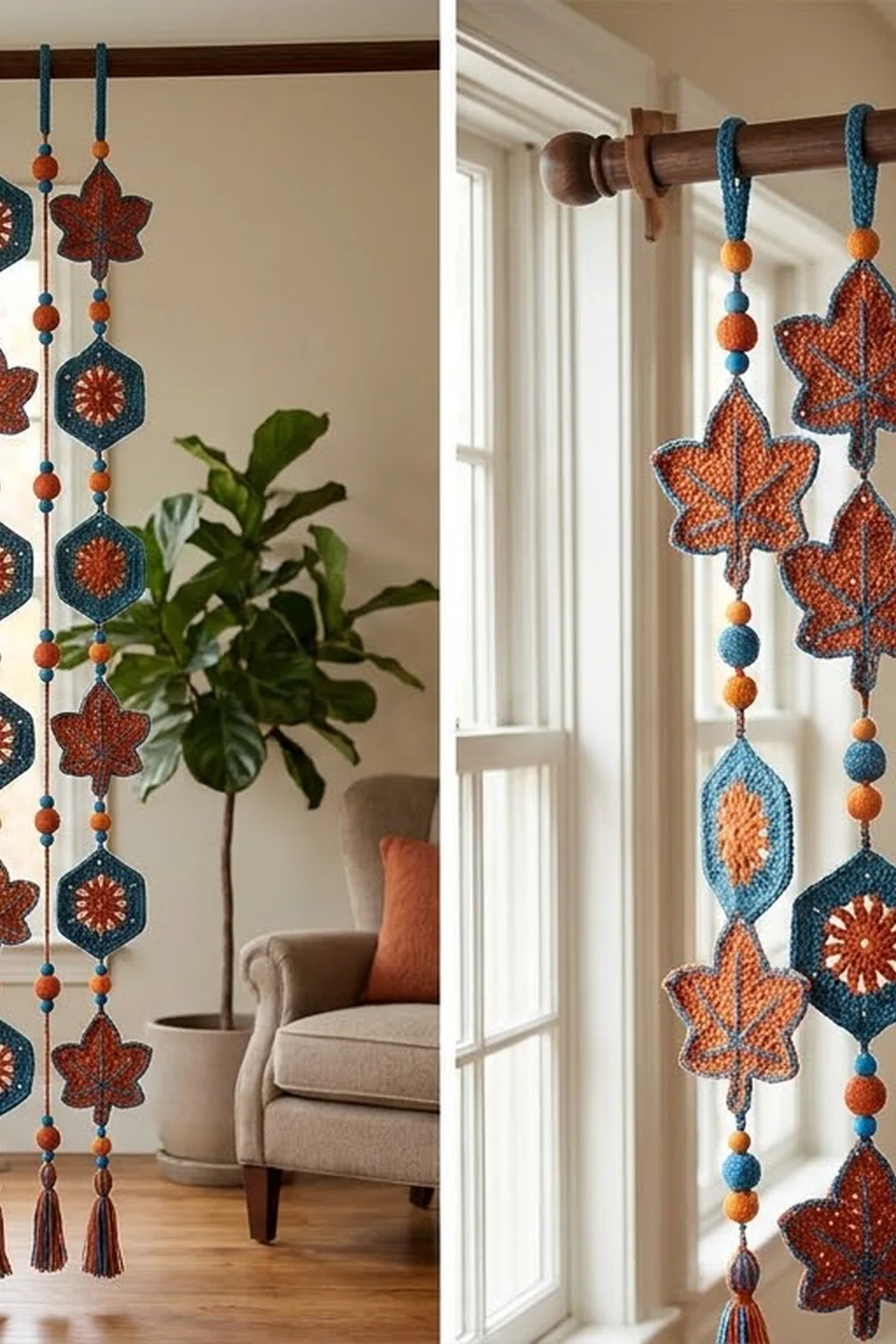
The Ember Maple Strand Curtain is made of hanging strands. Each strand stacks maple leaves and hexagon motifs, with small round crochet beads between them. Every strand loops over a rod at the top and ends in a two-color tassel.
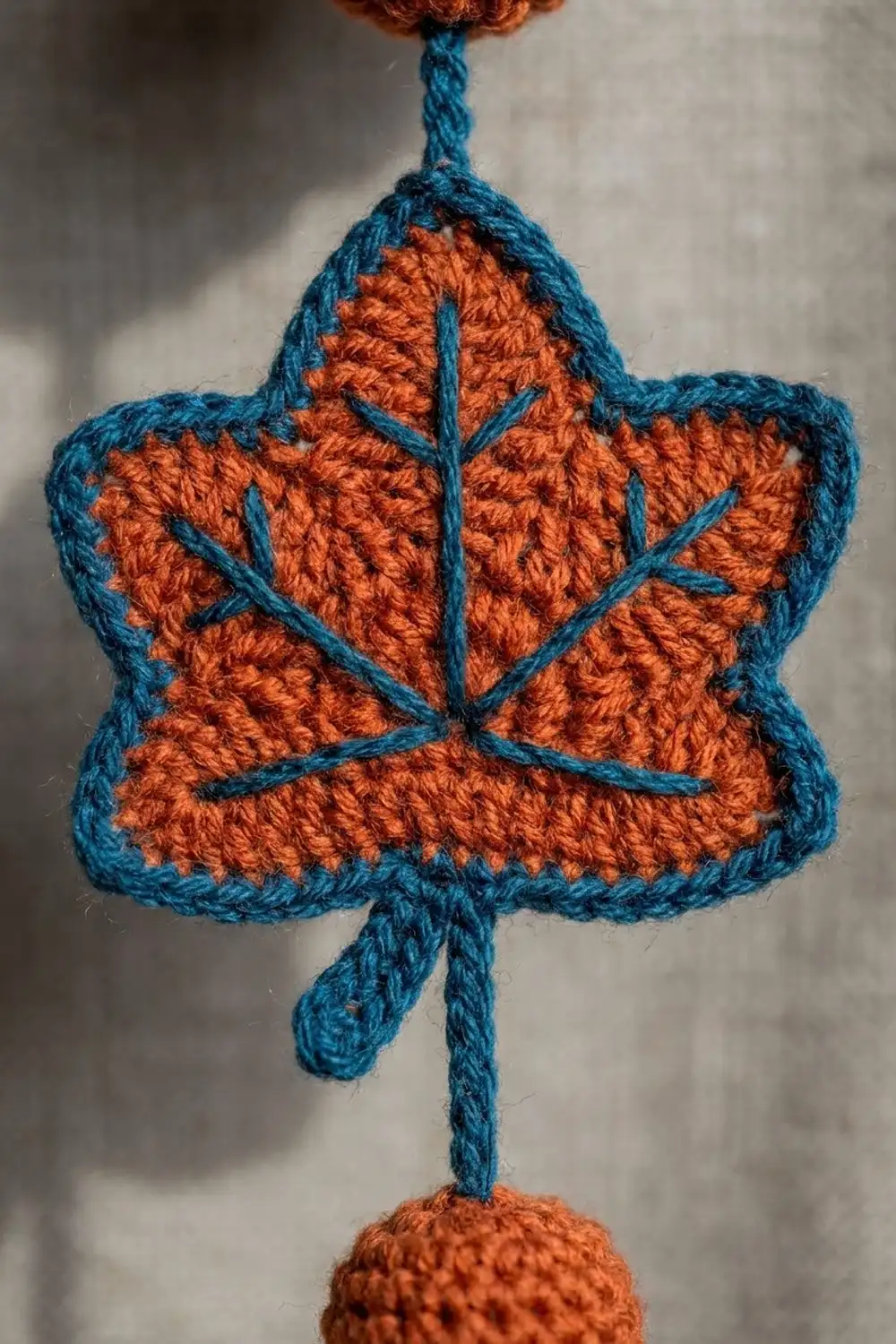
The palette is rust orange and deep petrol blue. The leaves are orange with a blue outline, blue surface-stitched veins, and a blue stem. The hexagons have an orange spoked-flower center framed by two rounds of solid blue. The beads run orange, blue, orange between motifs.
This pattern uses US terms. One panel measures 39.5 in (100.3 cm) wide and 84 in (213.4 cm) long, including tassels. The photo shows two matching panels, so make two for a full doorway.
You make every piece separately and add a blue border to each motif. Then you anchor everything onto a blue spine yarn, one strand at a time.
Finished Size and Construction
- Finished size (one panel): 39.5 in (100.3 cm) wide x 84 in (213.4 cm) long
- Skill level: Intermediate
- Terminology: US
- Yarn weight: DK (#3) cotton
- Hook: 3.5 mm (E-4)
- Number of pieces per panel: 60 hexagons, 60 leaves, 250 orange beads, 130 blue beads, 10 tassels
- Layout: 10 strands, each with 6 hexagons and 6 leaves, in a checkerboard pattern
- Hexagon size: 3 in (7.6 cm) flat to flat, 3.5 in (8.9 cm) point to point
- Leaf size: 3.5 in (8.9 cm) wide x 3.5 in (8.9 cm) tall, plus a 1 in (2.5 cm) stem
- Hexagon size before border: 2.25 in (5.7 cm) across
- Border depth: hexagons 0.5 in (1.3 cm), 2 sc rounds; leaves 0.25 in (0.6 cm), 1 sc round
Materials
Use a smooth mercerized or combed DK cotton. It keeps leaf points crisp and beads round, and it hangs without stretching. Avoid fuzzy or stretchy yarns, because long strands will grow.
Quantities are for one panel, using 50 g balls of about 120 m (131 yd). Double them for the pair shown.
- Rust orange: 500 g (about 1,200 m), 10 balls
- Petrol blue: 450 g (about 1,080 m), 9 balls
These quantities include a margin of at least 10% for tails, gauge differences, and test pieces.
Tools:
- 3.5 mm (E-4) crochet hook
- About 100 g polyester fiberfill
- Tapestry needle and a 3 in (7.6 cm) or longer doll needle
- Stitch markers, scissors, measuring tape
- Stiff card, 6.5 in (16.5 cm) tall
- Blocking mat, rust-proof pins, spray bottle
- Curtain rod up to 1.25 in (3.2 cm) in diameter
Abbreviations (US Terms)
- ch – chain
- sl st – slip stitch
- sc – single crochet
- hdc – half double crochet
- dc – double crochet
- tr – treble crochet
- sc2tog – single crochet 2 together
- sp – space
- st(s) – stitch(es)
Surface slip stitch: Hold the yarn behind the work. Insert the hook from front to back through a gap between stitches, pull up a loop, and draw it through the loop on your hook. Repeat to draw a chain line across the front.
Gauge and Checkpoints
Before you start, make one hexagon, one leaf, and one bead to test your gauge.
- Sc gauge: 11 sc = 2 in (5.1 cm)
- Hexagon after Rnd 3: 2.25 in (5.7 cm) across
- Hexagon after Rnd 5: 3.5 in (8.9 cm) point to point, sides 1.75 in (4.4 cm)
- Leaf after Rnd 2: 1.5 in (3.8 cm) across
- Leaf after Rnd 4: 3.5 in (8.9 cm) wide
- Bead: 0.75 in (1.9 cm)
If your pieces are too big, go down 0.25 mm. If they are too small, go up 0.25 mm. The hexagon matters most: being off by 0.25 in (0.6 cm) per motif adds up to 3 in (7.6 cm) per strand.
Hexagon Center (Orange)
Rnd 1: Make a magic ring. Ch 3 (counts as dc), work 11 dc in the ring, then sl st to the top of the ch-3. (12 dc)
Rnd 2: Ch 4 (counts as dc + ch 1), *dc in next dc, ch 1; repeat from * 10 more times, then sl st to the 3rd ch of the ch-4. (12 dc, 12 ch-1 sps)
Rnd 3: Sl st into the first ch-1 sp. Ch 3 (counts as dc), work 2 dc in the same sp, then 3 dc in each remaining ch-1 sp. Sl st to the top of the ch-3. (36 dc in 12 groups)
Fasten off. The Rnd 2 posts form spokes with small openings between the petal groups. The center measures 2.25 in (5.7 cm).
Leaf Center (Orange)
Rnd 1: Make a magic ring. Ch 2 (does not count as a st), work 10 hdc in the ring, then sl st to the first hdc. (10 hdc)
Rnd 2: Ch 2, work 2 hdc in each st, then sl st to the first hdc. (20 hdc)
Rnd 3 (lobes): Do not chain. Each lobe uses 4 sts. Work the first lobe’s sl st into the joining st, then work in this order: Small Lobe, Big Lobe, Big Lobe, Big Lobe, Small Lobe.
- Small Lobe: Sl st in next st, sc in next st, (hdc, dc, ch 2, dc, hdc) in next st, sc in next st.
- Big Lobe: Sl st in next st, hdc in next st, (dc, tr, ch 2, tr, dc) in next st, hdc in next st.
Sl st into the first sl st and fasten off. (35 sts including 5 valley sl sts, plus 5 ch-2 tip sps)
This gives you three large upper lobes and two smaller lower lobes. The valley between the two small lobes is where the stem goes.
Beads (Orange and Blue)
Rnd 1: Make a magic ring and work 6 sc in it. (6 sc)
Rnd 2: Work 2 sc in each st. (12 sc)
Rnd 3: Sc in each st. (12 sc)
Rnd 4: Stuff the bead firmly, then work sc2tog 6 times. (6 sc)
Fasten off with an 8 in (20.3 cm) tail. Weave it through the front loops, cinch the opening closed, and hide the end. Each bead is a firm 0.75 in (1.9 cm) ball.
Tassels
Hold one strand each of orange and blue together and wrap them 12 times around the 6.5 in (16.5 cm) card. Tie the top loops with a 12 in (30.5 cm) blue strand and leave its tails long for attaching. Cut the bottom loops.
Wrap blue 6 times around the bundle, 0.5 in (1.3 cm) below the top. Knot it and bury the ends. Trim the tassel to 6 in (15.2 cm).
Make All Pieces
Finish the Border rounds and leaf veins on every motif before joining.
Per panel:
- Hexagons: 60
- Leaves: 60
- Orange beads: 250 (25 per strand)
- Blue beads: 130 (13 per strand)
- Tassels: 10
Strand A (odd strands): Loop, then [orange bead, blue bead, orange bead, hexagon, orange bead, blue bead, orange bead, leaf] 6 times. End with an orange bead, a blue bead, and a tassel.
Strand B (even strands): Work the same as Strand A, but put the leaf before the hexagon in each repeat.
Layout grid (H = hexagon, L = leaf):
Strand:  1  2  3  4  5  6  7  8  9  10
Row 1:   H  L  H  L  H  L  H  L  H  L
Row 2:   L  H  L  H  L  H  L  H  L  H
Rows 3–12: repeat Rows 1–2 five more times
Joining
Method: Each strand is anchored onto one blue spine yarn.
Top loop: With blue, leave a 36 in (91.4 cm) tail and ch 24. Sl st into the first ch to form a ring. The loop fits a rod up to 1.25 in (3.2 cm) across and hangs 1.5 in (3.8 cm) below it. Thread the tail onto the doll needle; this is your spine.
Stitch-to-stitch logic:
- Beads: Pass the needle straight through the center, from the magic ring end to the cinched end.
- Hexagons: Hang point up. Bring the spine through the top corner ch-2 sp and whipstitch twice around it. Run the spine down the back, behind the center ring, and whipstitch twice through the bottom corner ch-2 sp.
- Leaves: Whipstitch twice through the top-lobe tip ch-2 sp. Run the spine down the back along the center vein, then whipstitch twice through the last stem sl st.
Adding yarn: Work in 36 in (91.4 cm) lengths. To change lengths, finish the old tail and start the new one inside the same bead.
Tension: Snug each piece against the one above it so no spine yarn shows, without puckering. Hang the strand every few motifs to check that it falls straight.
Bottom: Tie the tassel tails to the spine and bury all ends inside the tassel.
Size checkpoint: One repeat is 2.25 in (5.7 cm) of beads + a 3.5 in (8.9 cm) hexagon + 2.25 in (5.7 cm) of beads + a 4.5 in (11.4 cm) leaf with stem = 12.5 in (31.8 cm). Six repeats make 75 in (190.5 cm).
To that, add the 1.5 in (3.8 cm) loop drop, 1.5 in (3.8 cm) of end beads, and the 6 in (15.2 cm) tassel, for a total strand length of 84 in (213.4 cm). Space the strands 4 in (10.2 cm) apart, center to center: 9 gaps x 4 in + 3.5 in = 39.5 in (100.3 cm).
Border
Work the blue border on each motif before you join anything.
Border gauge: 11 sc = 2 in (5.1 cm), which is 5.5 sc per inch.
Hexagon Border
Rnd 4 (blue, conversion round): Join blue in any dc. Ch 1, then sc in the same st and the next 4 sts. Work (sc, ch 2, sc) in the next st. *Sc in next 5 sts, (sc, ch 2, sc) in next st; repeat from * 4 more times. Sl st to the first sc.
Count: 36 sts worked 1-per-st + 6 extra corner sc = 42 sc, plus 6 ch-2 sps. That is 7 sc per side.
Rnd 5 (blue, trim round): Ch 1, then sc in the same st and the next 5 sc. Work (sc, ch 2, sc) in the ch-2 sp. *Sc in next 7 sc, (sc, ch 2, sc) in next ch-2 sp; repeat from * 4 more times. Sc in the last sc and sl st to the first sc. Fasten off.
Count: 42 sts worked 1-per-st + 12 extra corner sc = 54 sc, plus 6 ch-2 sps. That is 9 sc per side, and those 9 already include the sc worked into the corner sp at each end.
Why the math works: Rnd 3 has 36 dc, exactly 6 per side. The border adds stitches only at the 6 corners, so the sides stay straight and the hexagon lies flat. At 5.5 sc per inch, 9 sc plus the corner chain come to 1.75 in (4.4 cm) per side, which gives a 3.5 in (8.9 cm) point-to-point hexagon.
Leaf Border
Rnd 4 (blue, conversion round): Join blue with a sl st in the valley between the two small lobes.
- Stem: Ch 7. Sl st in the 2nd ch from the hook and the next 5 ch (6 sl sts), then sl st in the valley again.
- Lobes: *Sc in next 3 sts, (sc, ch 2, sc) in the tip ch-2 sp, sc in next 3 sts, skip the next valley sl st; repeat from * 4 more times. End the last repeat with a sl st at the stem base instead of skipping.
Count: 30 non-valley sts worked 1-per-st + 10 extra tip sc = 40 sc (8 per lobe), plus 5 ch-2 sps and the 6-sl-st stem.
Why the math works: All the extra stitches go into the tips, so the points stay sharp. Skipping the valley sl sts pulls the valleys inward.
Veins: With blue, surface slip stitch about 5 sts per inch (2.5 cm). Work from the stem base through the center to the top tip. Then work from the center out to each of the other 4 tips. Weave in the ends on the back.
Final Blocking
- Mist each finished motif lightly.
- Pin each hexagon to 3 in (7.6 cm) flat to flat, with a pin in every corner sp.
- Pin each leaf to 3.5 in (8.9 cm) wide. Pin every tip and valley, and pin the stem straight.
- Let the pieces dry completely, at least 12 hours.
- After joining, hang each strand. Mist any twisted sections and let gravity straighten them.
- Trim the tassels evenly while the strands hang.
Final Quality-Control Checklist
- Every hexagon has 54 sc and 6 corner sps, and measures 3.5 in (8.9 cm) point to point.
- Every leaf has 40 sc, 5 sharp tips, a stem, and 5 veins.
- Beads are firm and 0.75 in (1.9 cm).
- Each strand is 84 in (213.4 cm) long, with 6 hexagons, 6 leaves, 25 orange beads, and 13 blue beads.
- Strands alternate A, B across the panel.
- No spine yarn shows, and every tail is buried.
Troubleshooting
- Hexagon cups: The border is too tight. Go up 0.25 mm for Rnds 4–5.
- Hexagon ruffles: The center is too large. Go down 0.25 mm for Rnds 1–3.
- Leaf tips curl: Re-block with a pin in every tip.
- Beads are lumpy: Stuff with smaller wisps of fiberfill.
- Strand twists: Anchor every motif at both its top and bottom.
- Strands are uneven lengths: Measure after each repeat and adjust how snugly the beads sit.
Care
Dust gently, or hand wash in cool water with mild soap. Lay the strands flat to dry and reshape the motifs while they are damp.
Final Notes
Here is the measurement chain: a 2.25 in (5.7 cm) center becomes a 3.5 in (8.9 cm) hexagon. Two bead groups, one hexagon, and one leaf make a 12.5 in (31.8 cm) repeat. Six repeats plus the loop, end beads, and tassel make an 84 in (213.4 cm) strand, and ten strands make a 39.5 in (100.3 cm) panel.
Happy crocheting!