

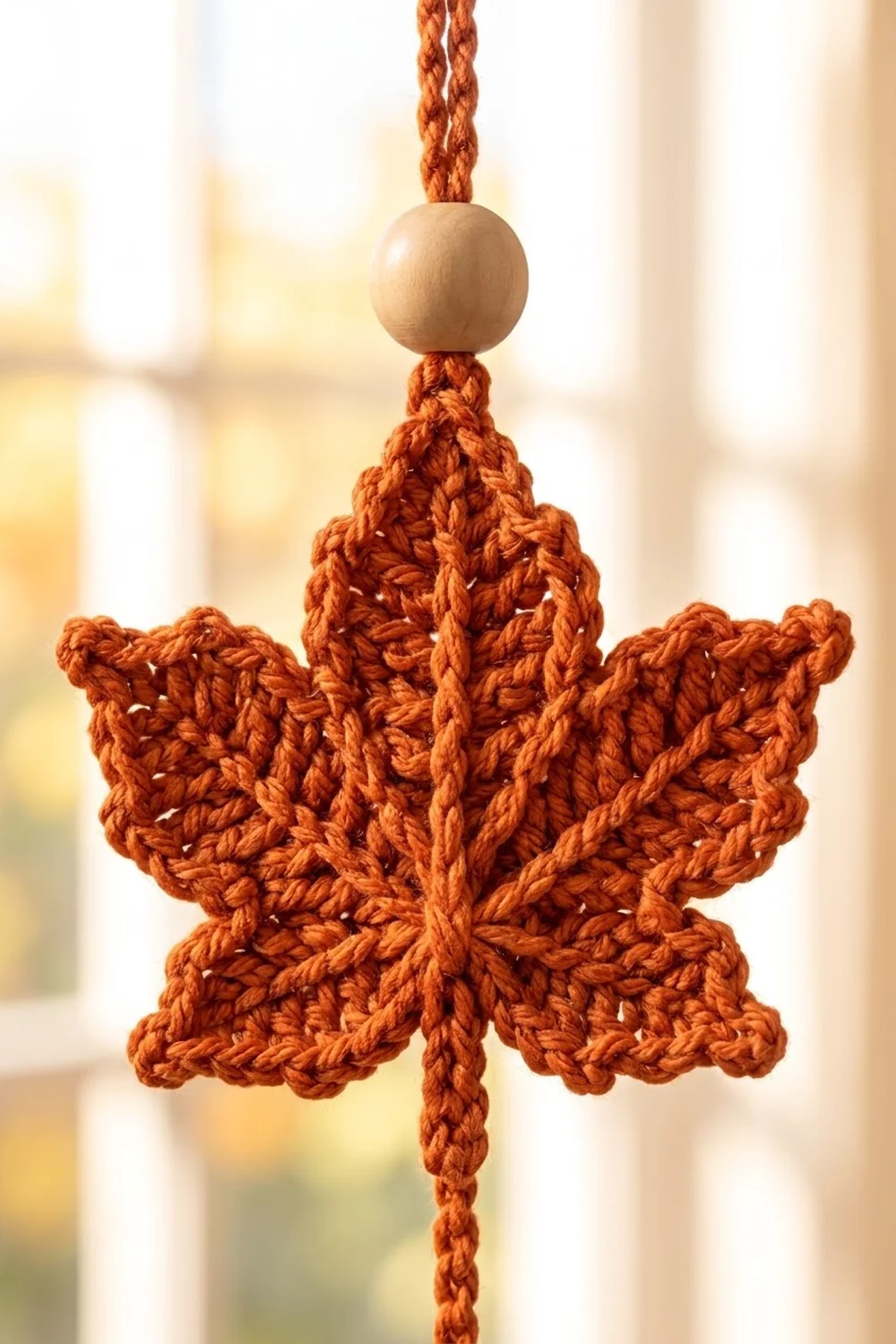
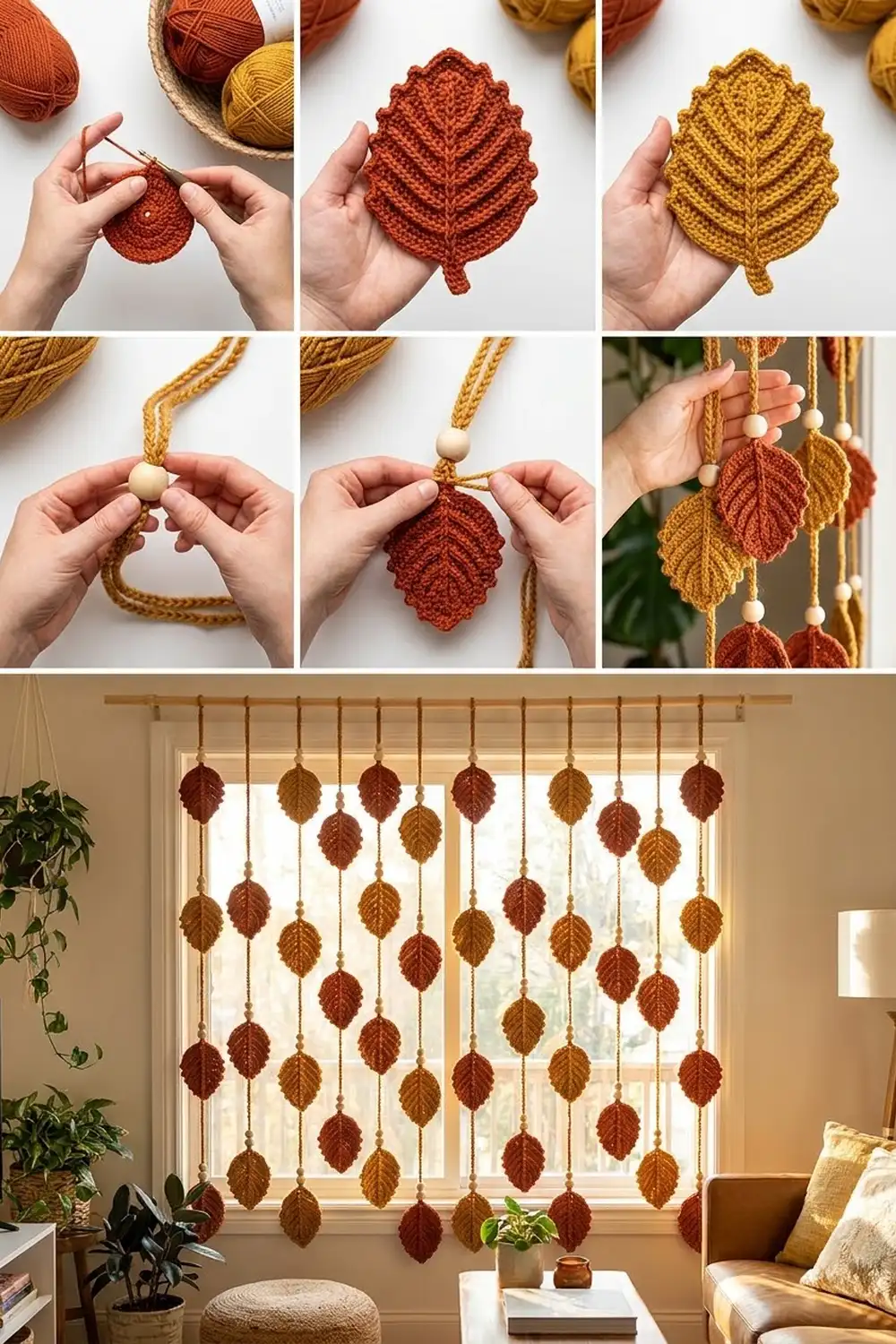
This beaded curtain is made of fifty small maple leaves strung on chunky chain cords. A wooden bead sits above each leaf. Hang it in a sunny window and it glows with warm autumn color.
The leaves alternate between rust orange and golden mustard. Each leaf has five pointed lobes, raised veins, a serrated edge and a short stem. Every other strand hangs lower, so the leaves interlock in a staggered pattern.
This pattern uses US crochet terms. Each leaf is 5 in (12.7 cm) wide and 4.5 in (11.4 cm) tall, plus a 1 in (2.5 cm) stem. The curtain is 41 in (104.1 cm) wide. Odd strands hang 49.5 in (125.7 cm) and even strands hang 54.5 in (138.4 cm).
Each leaf starts as a circle of double crochet. You grow five lobes over two rounds, then finish with a serrated edging. Each strand is one continuous chain cord made with doubled yarn, with the beads threaded on before you start. The cord runs down the back of each leaf as a hidden slip-stitch spine.
Finished Size and Construction
- Finished curtain: 41 in (104.1 cm) wide × 54.5 in (138.4 cm) at the longest strand
- Skill level: Intermediate
- Terminology: US terms
- Yarn weight: DK (#3) cotton
- Hooks: 3.5 mm (E-4) for the leaves, 5.0 mm (H-8) for the cords
- Number of pieces: 50 leaves on 10 strands
- Layout: 10 strands with 5 leaves each, spaced 4 in (10.2 cm) apart
- Leaf size: 5 in (12.7 cm) wide × 4.5 in (11.4 cm) tall, plus a 1 in (2.5 cm) stem
- Leaf size before border: 4.75 in (12.1 cm) × 4.25 in (10.8 cm)
- Border depth: 1/8 in (0.3 cm)
Materials
Choose a smooth matte or mercerized DK cotton. Cotton holds sharp points and doesn’t stretch when it hangs. Fuzzy yarns blur the veins.
- Rust orange: 150 g / 330 m (three 50 g / 110 m balls)
- Golden mustard: 150 g / 330 m (three 50 g / 110 m balls)
Each color covers 25 leaves (about 100 g / 220 m) and 5 cords (about 28 g / 62 m). These amounts include a margin of about 15%.
Tools:
- 3.5 mm (E-4) and 5.0 mm (H-8) hooks
- 50 wooden beads, 20 mm (0.8 in / 2.0 cm) wide, with holes of at least 5 mm, plus spares
- A rod or dowel, 44 in (111.8 cm) long and up to 1.5 in (3.8 cm) in diameter
- Tapestry needle, stitch markers, rust-proof pins, blocking mat, tape measure and scissors
Abbreviations (US Terms)
- ch – chain
- sl st – slip stitch
- sc – single crochet
- hdc – half double crochet
- dc – double crochet
- tr – treble crochet
- st(s) – stitch(es)
- sp – space
- rnd – round
- RS / WS – right side / wrong side
Special stitches:
- Large spike: Ch 5. Sl st in the 2nd ch from the hook, then work sc, hdc and dc in the next 3 ch. This makes 4 spike sts, and you end at the base of the spike.
- Small spike: Ch 3. Sl st in the 2nd ch from the hook, then sc in the next ch. This makes 2 spike sts.
- Ch-2 picot: Ch 2, then sl st in the top of the last sc you made.
- Surface sl st: Hold the yarn on the back of the fabric. Insert the hook through the fabric, pull up a loop, and draw it through the loop on the hook.
Gauge and Checkpoints
Make, block and measure one complete leaf before you make the rest.
Gauge:
- Leaf: Rnds 1–2 measure 2 in (5.1 cm) across with the 3.5 mm hook.
- Cord: 3 ch measure 1 in (2.5 cm) with doubled yarn and the 5.0 mm hook.
Checkpoints:
- Rnd 1: 1.25 in (3.2 cm)
- Rnd 2: 2 in (5.1 cm)
- Rnd 3: 2.5 in (6.4 cm)
- Rnd 4: 3.5 in (8.9 cm) at the widest point
- Rnd 5: 4.75 in (12.1 cm), measured from the Lobe 2 tip to the Lobe 4 tip
- After the border and blocking: 5 in (12.7 cm)
If your leaf is the wrong size: If Rnd 2 is bigger than 2 in (5.1 cm), switch to a 3.25 mm hook. If it’s smaller than 1.75 in (4.4 cm), switch to a 3.75 mm hook. A 1/4 in (0.6 cm) error at Rnd 2 grows to about 1/2 in (1.3 cm) at the tips.
Leaf Pattern (Make 50)
Use the 3.5 mm hook and keep the RS facing you throughout. The beginning ch-3 counts as a dc. The beginning ch-1 does not count as a stitch.
Rnd 1: Make a magic ring. Ch 3, then work 11 dc into the ring. Close the ring and sl st to the top of the ch-3. (12 dc)
Rnd 2: Ch 3, then dc in the same st. Work 2 dc in each st around. Sl st to the top of the ch-3. (24 dc)
Rnd 3: Ch 1. [Sc in the next 3 sts, 2 sc in the next st] 6 times. Sl st to the first sc. (30 sc)
The round now has six sections of 5 sts each. Sections 1–5 become Lobes 1–5, and Section 6 is the stem section. Lobe 3 sits opposite the stem and becomes the top lobe.
Rnd 4 (lobe bases): Ch 1.
For each of Lobes 1–5, working over 5 sts:
- Sc in the 1st st.
- (Hdc, dc) in the 2nd st.
- (Tr, ch 2, tr) in the 3rd st.
- (Dc, hdc) in the 4th st.
- Sc in the 5th st.
Each lobe has 8 sts and one ch-2 sp.
Stem section, working over 5 sts:
- Sc in the next 3 sts.
- Ch 9. Sl st in the 2nd ch from the hook and in the next 7 ch. This makes a stem of 8 sl sts.
- Sc again in the same (3rd) st, then sc in the last 2 sts.
Sl st to the first sc. (46 sts: 40 lobe sts and 6 stem-section sc, plus 5 ch-2 sps and the stem)
Rnd 5 (points): Ch 1.
Lobe 1 (small):
- Sl st in the sc, sc in the hdc, hdc in the dc, dc in the tr.
- In the ch-2 sp, work (dc, tr, small spike, tr, dc).
- Dc in the tr, hdc in the dc, sc in the hdc, sl st in the sc.
Lobes 2, 3 and 4 (large): Work as for Lobe 1, but make a large spike instead of a small spike.
Lobe 5 (small): Work as for Lobe 1.
Stem section: Sl st in each of the 6 sc, leaving the stem free. Join with a sl st.
(66 sts: 12 per lobe × 5 lobes = 60, plus 6 sl sts. The spikes add 3 × 4 + 2 × 2 = 16 spike sts.)
The three long upper lobes and two short lower lobes give the leaf its maple shape. Work the border (see the Border section) on each leaf before you start the next one.
Make All Pieces
- Leaves: 25 in rust orange and 25 in golden mustard
- Cords: 5 in rust orange (Strands 1, 3, 5, 7 and 9) and 5 in golden mustard (Strands 2, 4, 6, 8 and 10)
Strand:  1  2  3  4  5  6  7  8  9  10
Start:   T  L  T  L  T  L  T  L  T  L
Leaf 1   R  G  R  G  R  G  R  G  R  G
Leaf 2   G  R  G  R  G  R  G  R  G  R
Leaf 3   R  G  R  G  R  G  R  G  R  G
Leaf 4   G  R  G  R  G  R  G  R  G  R
Leaf 5   R  G  R  G  R  G  R  G  R  G
R = rust  G = gold  T = top start  L = starts 5 in (12.7 cm) lower
Each odd strand has 3 rust leaves and 2 gold leaves. Each even strand has 2 rust and 3 gold. That gives 25 of each color in total.
Joining: Stringing the Strands
Setup: Hold two strands of the cord color together. Use the tapestry needle to thread 5 beads onto the doubled yarn.
Hanging loop: With the 5.0 mm hook, ch 18 and sl st in the first ch to make a ring. The ring is 6 in (15.2 cm) around and hangs 3 in (7.6 cm) below the rod. For even strands only, ch 15 more to add 5 in (12.7 cm).
Leaf repeat (work 5 times):
- Ch 6 to make 2 in (5.1 cm) of cord.
- Slide a bead up to the hook. Ch 3 to make 1 in (2.5 cm) more. The first of these ch locks the bead in place.
- Hold the leaf RS facing you. Insert the hook through the ch-2 tip sp of Lobe 3 and sl st.
- Turn the leaf to the WS. Work surface sl sts straight down the center, one about every 1/4 in (0.6 cm):
- 10 sl sts from the tip to the center ring
- 8 sl sts from the ring to the base of the stem
- 1 sl st into the back of each of the 8 stem sts
(26 sl sts per leaf)
After the 5th leaf, fasten off at the stem tip.
How the joins work: The cord enters each leaf at the top tip, runs down the back as a spine, and comes out at the stem tip. Each leaf hangs from its own tip, so its weight doesn’t pull on the lobes.
Tension: Work the spine sl sts loosely, about as tall as a chain. After stringing, each leaf should still measure 4.5 in (11.4 cm) tall. If it’s shorter, the spine is too tight and the leaf will curl. Pull out the spine and work it again more loosely.
Repeat length: 2 in of cord + 0.8 in bead + 1 in of cord + 4.5 in leaf + 1 in stem = 9.3 in (23.6 cm) per repeat.
- Five repeats measure 46.5 in (118.1 cm).
- With the 3 in (7.6 cm) loop, odd strands hang 49.5 in (125.7 cm).
- With the extra 5 in (12.7 cm), even strands hang 54.5 in (138.4 cm).
Size checkpoint: Hang the strands 4 in (10.2 cm) apart, center to center. Ten strands span 36 in (91.4 cm). Add half a leaf width at each side, and the curtain is 41 in (104.1 cm) wide.
Border (Leaf Edging)
The curtain has no outer fabric border because the strands hang free. Instead, each leaf gets a serrated edging round, worked right after Rnd 5. The counts below are given per lobe side.
Border gauge: About 5 sc per 1 in (2.5 cm) along the lobe edges. The border adds 1/8 in (0.3 cm) all around.
Border Rnd: Ch 1.
Large lobes (2, 3 and 4):
- Left side: Sc in each of the 6 sts (sl st, sc, hdc, dc, dc, tr). Work a ch-2 picot after the 3rd sc.
- Spike, first side: Work 4 sc up the free chain loops.
- Tip: In the tip ch, work (sc, ch 2, sc).
- Spike, second side: Work 4 sc down the spike sts.
- Right side: Sc in each of the 6 sts (tr, dc, dc, hdc, sc, sl st). Work a ch-2 picot after the 3rd sc.
Each large lobe has 22 sc, 1 ch-2 tip and 2 picots.
Small lobes (1 and 5): Work the same way, but make only 2 sc along each side of the spike. Each small lobe has 18 sc, 1 ch-2 tip and 2 picots.
Stem section: Sl st in each of the 6 sl sts, skipping the stem. Join with a sl st and fasten off.
(108 sts: 66 sc on the large lobes, 36 sc on the small lobes and 6 sl sts, plus 5 ch-2 tips and 10 picots)
Why the math works: This is a conversion round.
- Large lobe: 1 sc in each of the 12 lobe sts, plus 1 sc in each of the 8 sts and chain loops along the spike, makes 20. The 2 extra sc at the tip bring it to 22.
- Small lobe: 12 + 4 = 16, plus 2 extra at the tip, makes 18.
- Stem section: 6 sl sts, one in each st.
The picots add no stitches to the round, so the sides stay flat while still getting their serrated points. The extra stitches go only at the tip, which keeps each point crisp.
Veins: With the RS facing you, use matching yarn to work surface sl sts from the center ring out to each tip, one about every 1/4 in (0.6 cm). Use 9 sl sts for each large lobe and 6 for each small lobe. Weave in the ends on the WS.
Final Blocking
- Soak the leaves for 10 minutes. Press out the water in a towel without wringing.
- Pin each leaf RS up. Pin the five tips first, with the Lobe 2 and Lobe 4 tips 5 in (12.7 cm) apart.
- Pin the top tip 4.5 in (11.4 cm) above the stem base. Straighten the stem to 1 in (2.5 cm).
- Pin each picot so it points outward.
- Let the leaves dry completely, which takes 12–24 hours. String them only after they’re dry.
- Hang the curtain overnight so the cords straighten. Steam any twists lightly, holding the iron above the yarn.
Final Quality-Control Checklist
- All 50 leaves are 5 in (12.7 cm) × 4.5 in (11.4 cm).
- Each leaf has three large spikes and two small spikes, plus 5 tips and 10 picots.
- The veins are raised and even.
- Every bead is locked in place.
- The spines lie flat and no leaf curls.
- The strands hang 49.5 in (125.7 cm) and 54.5 in (138.4 cm).
- The colors match the layout grid.
- All ends are woven in.
Troubleshooting
- Leaf cups or ruffles: Check that Rnd 3 has 30 sts, then block firmly.
- Rounded points: Make sure you worked (sc, ch 2, sc) at each tip, and chain the spikes more tightly.
- Leaf too wide: Use a smaller hook for Rnds 1–2.
- Bead slides along the cord: Lock it with a tight ch right after the bead.
- Cord twists: Let the doubled yarn hang and untwist itself as you work.
- Leaves overlap: Space the strands slightly more than 4 in (10.2 cm) apart.
Care
Shake the curtain gently to remove dust. If it needs washing, hand wash it in cool water and reshape the leaves flat while they’re damp.
Final Notes
Every measurement builds on the one before it:
- Rnds 1–2 measure 2 in (5.1 cm).
- After Rnd 5, the leaf is 4.75 in (12.1 cm) wide.
- After the border, the leaf is 5 in (12.7 cm) wide.
- Each strand repeat is 9.3 in (23.6 cm).
- The strands hang 49.5 in (125.7 cm) and 54.5 in (138.4 cm).
- The curtain is 41 in (104.1 cm) wide.
Check your first leaf against these numbers, and the rest of the curtain will come out right.
Happy crocheting!