
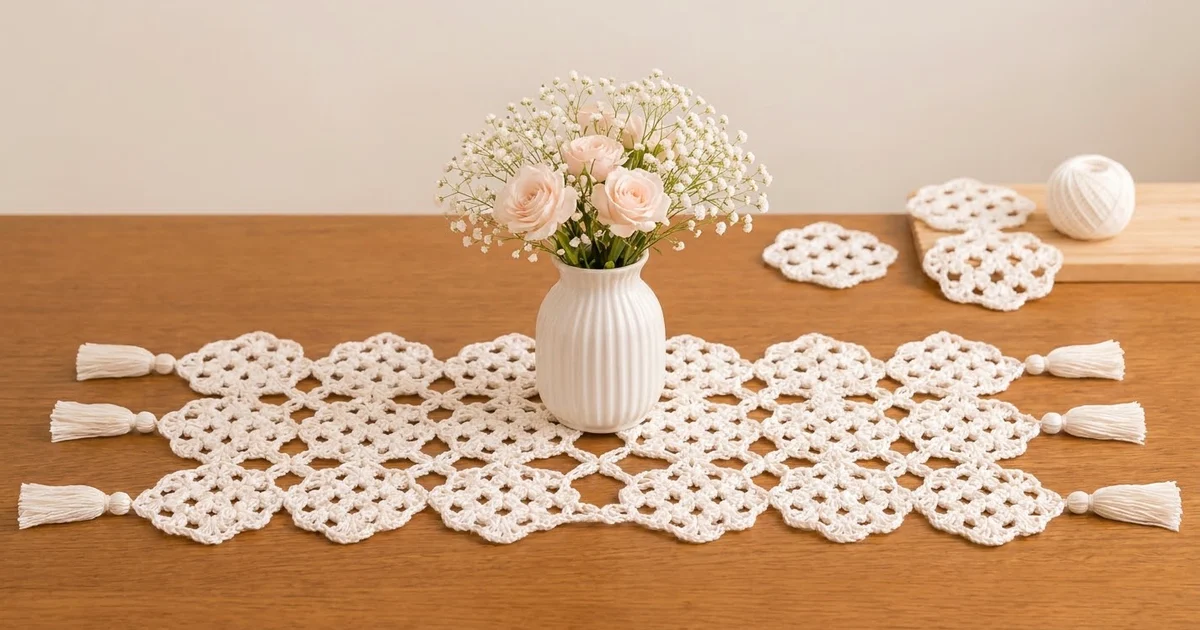
This runner is made of lacy white squares. Each one has a center flower, four corner flowers, and soft fan shells on its edges. The squares join only at the middle of each side, so the rounded corners leave small diamond windows where four squares meet. The result looks light and vintage, like heirloom lace on a wooden table.
Everything is worked in one color: a crisp white or ivory cotton. A simple picot border finishes the edges, and three full tassels hang from each short end. The pattern uses US crochet terms throughout.
The finished runner measures 12 in (30.5 cm) wide by 39.5 in (100.3 cm) long, not counting tassels. Each tassel adds 4 in (10.2 cm) at both ends.
You’ll make 14 identical motifs in six rounds each and lay them out 2 across by 7 long. Then you slip-stitch them together through the center 10 stitches of each shared side. Two border rounds and six tassels finish the runner.
Finished Size and Construction
- Finished size: 12 x 39.5 in (30.5 x 100.3 cm), plus 4 in (10.2 cm) tassels at each end
- Skill level: Intermediate
- Terminology: US crochet terms
- Yarn weight: DK / light (3), mercerized or matte cotton
- Hook: 3.5 mm (US E-4)
- Number of pieces: 14 motifs
- Layout: 2 motifs wide x 7 motifs long
- Motif size: 5.5 x 5.5 in (14.0 x 14.0 cm), blocked
- Size before border: 11 x 38.5 in (27.9 x 97.8 cm)
- Border depth: 0.5 in (1.3 cm) on every side
Materials
Yarn: Use a smooth DK-weight cotton or cotton blend so the clusters and picots look crisp. Pure cotton blocks flat and keeps its shape on a table. Avoid fuzzy or brushed yarns, because they blur the lace.
- White (or ivory): 200 g / approx. 460 m (503 yd)
All quantities include a margin of about 20%. The motifs use about 7 g each, the border about 12 g, and the tassels about 4 g each.
Tools:
- 3.5 mm (US E-4) crochet hook
- Tapestry needle
- Scissors
- Stitch markers
- Rigid card, 4.5 in (11.4 cm) tall, for winding tassels
- Blocking mats, rustproof pins, and a spray bottle
Abbreviations (US Terms)
- ch – chain
- sl st – slip stitch
- sc – single crochet
- hdc – half double crochet
- dc – double crochet
- sp – space
- st(s) – stitch(es)
- RS / WS – right side / wrong side
Special stitches
- Beginning cluster (beg-cl): Ch 2, then yarn over, insert hook in the stitch, pull up a loop, yarn over, pull through 2 loops; repeat from * once more (3 loops on hook). Yarn over and pull through all 3 loops.
- Cluster (cl): Yarn over, insert hook in the stitch, pull up a loop, yarn over, pull through 2 loops; repeat from * 2 more times (4 loops on hook). Yarn over and pull through all 4 loops.
- Picot: Ch 3, sl st in the 3rd ch from the hook.
Gauge and Checkpoints
Gauge matters because the runner’s size depends on 14 motifs and a border. Make one motif first, block it, and measure it before you start the rest.
- After Rnd 2: The flower measures 1.75 in (4.4 cm) across.
- After Rnd 4: The motif measures 4 in (10.2 cm) across, tip to tip.
- After Rnd 6: The motif measures 5.5 x 5.5 in (14.0 x 14.0 cm) side to side after blocking.
- Border gauge: About 4.7 sts per inch (1.9 sts per cm) along a motif edge (26 sts across 5.5 in / 14.0 cm).
Too big? Go down to a 3.25 mm hook. Too small? Go up to a 3.75 mm hook. Each 0.25 in (0.6 cm) of difference in a motif adds up to 1.75 in (4.4 cm) along the length of the runner, so fix it now.
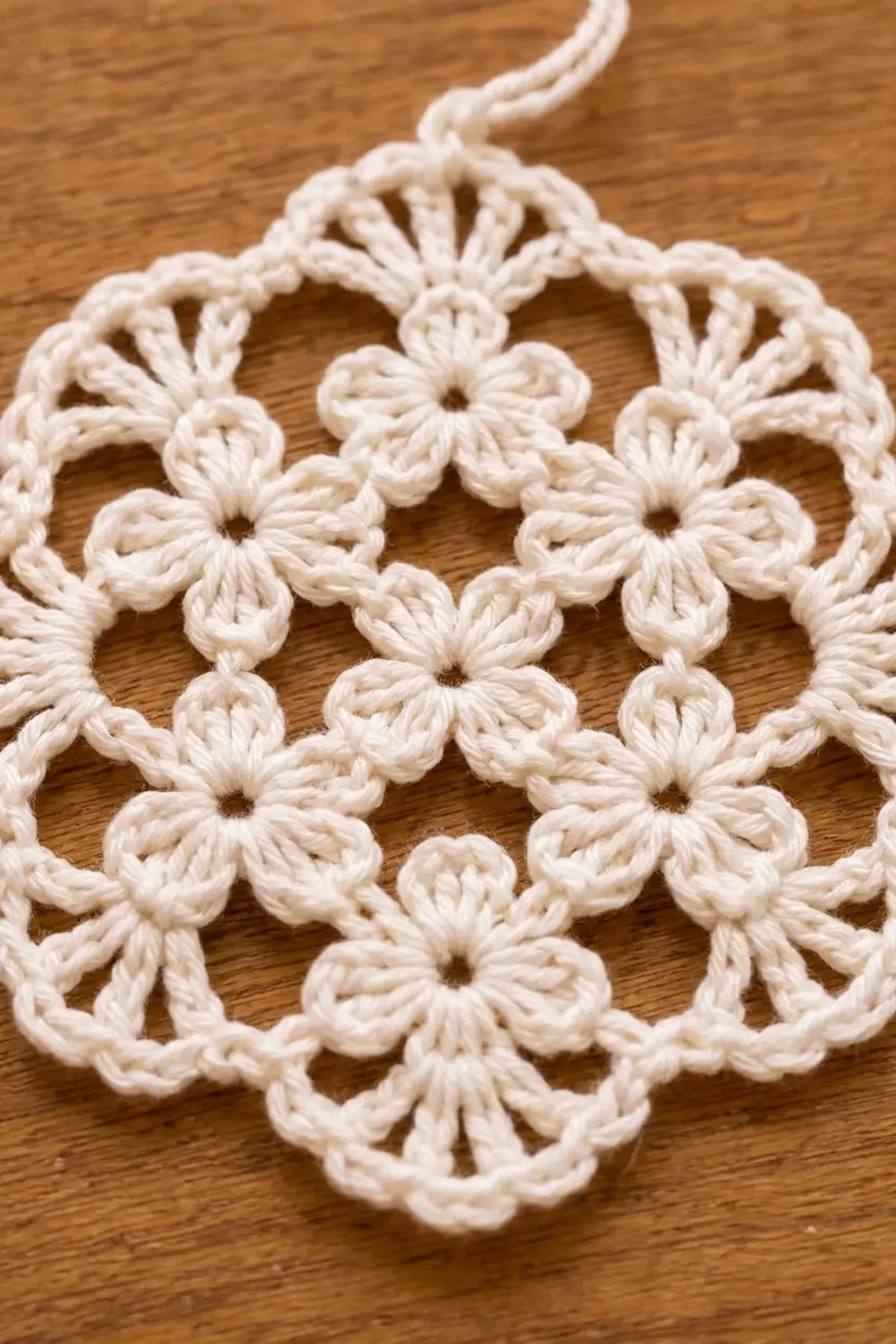
Motif (Make 14)
Work in joined rounds with the RS facing. Don’t turn.
Rnd 1: Make a magic ring. Ch 1, then work 8 sc in the ring. Join with a sl st to the first sc and pull the ring closed. (8 sc)
Rnd 2 (center flower): Work a beg-cl in the same st as the join, then ch 3. Cl in the next sc, ch 3; repeat from * 6 more times. Join with a sl st to the top of the beg-cl. (8 clusters, 8 ch-3 sps)
Rnd 3: Sl st into the first ch-3 sp. Ch 1, sc in the same sp. Ch 5, sc in the next ch-3 sp; repeat from * 6 more times. To finish, ch 2 and dc in the first sc; this forms the last loop and leaves your hook at its center. (8 sc, 8 ch-5 loops)
From here, the loops alternate between corner loops and side loops. The loop you’re sitting in is a corner loop.
Rnd 4 (corner flowers and side fans): Ch 1. In the corner loop, work (sc, ch 3, cl, ch 3, cl, ch 3, cl, ch 3, sc). Ch 2. Then work 7 dc in the next loop (a side loop) and ch 2. Repeat from * 3 more times. Join with a sl st to the first sc.
(8 sc, 12 clusters, 16 ch-3 sps, 28 dc, 8 ch-2 sps)
The three clusters fan out as a little flower at each corner. The 7-dc shells sit at the middle of each side.
Rnd 5 (lattice): Sl st into the first ch-3 sp, then ch 1 and sc in the same sp. [Ch 4, sc in the next ch-3 sp] 3 times. Ch 4, skip the ch-2 sp and the next 3 dc, and sc in the 4th (center) dc of the shell. Ch 4, skip the remaining 3 dc and the ch-2 sp, and sc in the first ch-3 sp of the next corner. Repeat from * 3 more times, but on the last repeat end with ch 4 and join to the first sc instead of working the final sc.
(20 sc, 20 ch-4 loops)
In each repeat, the second ch-4 loop sits right above the middle cluster. That loop is the corner loop. Each side has 4 side loops between corners: 4 x 4 + 4 corners = 20 loops.
Rnd 6 (scalloped edge): Sl st into the first ch-4 loop, which is a side loop. Ch 1. Work 5 sc in this loop. In the next loop (a corner loop), work (hdc, 2 dc, ch 2, 2 dc, hdc). Then work 5 sc in each of the next 3 loops. Repeat from * 3 more times. Join with a sl st to the first sc and fasten off. Weave in the ends.
Count: (16 side loops x 5 sc) + (4 corners x 6 sts) = 80 + 24 = 104 sts, plus 4 ch-2 corner sps.
Per side: Count the stitches between two corner ch-2 sps. Each side has 2 dc + 1 hdc + 20 sc + 1 hdc + 2 dc = 26 sts. In this pattern, a side’s 26 sts do NOT include the ch-2 corner sps; those are counted separately. Check: 4 x 26 = 104.
To find the joining stitches, number each side’s sts 1–26, starting after a corner ch-2 sp. Sts 1–3 are the corner tail (2 dc, hdc), sts 4–23 are the 20 sc, and sts 24–26 are the next corner tail (hdc, 2 dc). The joining stitches are sts 9–18, which are the 5 sc in each of the two middle side loops.
Make All Pieces
Make 14 motifs in White. Block each one to 5.5 x 5.5 in (14.0 x 14.0 cm) before joining. It’s much easier to line up joining stitches on flat motifs.
Layout grid (2 columns x 7 rows):
[M1 ] [M2 ]
[M3 ] [M4 ]
[M5 ] [M6 ]
[M7 ] [M8 ]
[M9 ] [M10]
[M11] [M12]
[M13] [M14]
Joining
Method: Sl st seam, worked on the RS so the ridge makes a narrow line.
Place two motifs side by side with the RS facing up and the shared sides touching. Line up st 9 of one motif with st 18 of the other. The sides face each other, so the numbering runs in opposite directions.
Join the yarn in st 9 of the first motif. Insert the hook through the outer loop of st 9 on the first motif, then through the outer loop of the matching st on the second motif, and sl st. Continue 1 sl st per matching pair until all 10 pairs are joined (10 sl sts). Fasten off.
The 8 unjoined sts at each end of the side (sts 1–8 and 19–26) curve away and open into the diamond windows.
Order:
- Join the 7 horizontal pairs (M1–M2, M3–M4, and so on): 7 seams.
- Join down each column (M1–M3, M3–M5, … M11–M13, and the same for the right column): 12 seams.
That’s 19 seams with 10 sl sts each, or 190 sl sts total.
Tension: Keep your sl sts as loose as the sc beneath them. A tight seam puckers the motifs and shortens the runner.
Checkpoint: Lay the runner flat. Before the border, it should measure 11 x 38.5 in (27.9 x 97.8 cm).
Border
Border gauge: About 4.7 sts per inch (1.9 sts per cm) along motif edges, matching Rnd 6.
Bridges: Where two motifs meet on the outer edge, there’s a small notch between their corner ch-2 sps. The border crosses each notch with a ch-3 bridge. The runner has 6 outer seam points on each long side and 1 on each short end, for 14 bridges in total.
Round 1: With the RS facing, join the yarn in any outer corner ch-2 sp of the runner. Ch 1 and work (sc, ch 2, sc) in that sp.
Work 1 sc in each of the 26 sts along the motif’s outer side. When you reach an outer seam point, sc in the corner ch-2 sp of the motif you’re on, ch 3, and sc in the corner ch-2 sp of the next motif. Then sc across that motif’s 26 sts.
At each of the other three runner corners, work (sc, ch 2, sc) in the corner ch-2 sp. Join with a sl st to the first sc.
Counts per side, between the outer corner ch-2 sps:
- Long side: (7 motifs x 26) + (6 bridges x 2 seam sc) + 2 corner sc = 182 + 12 + 2 = 196 sc, plus 6 ch-3 bridges
- Short side: (2 motifs x 26) + (1 bridge x 2 seam sc) + 2 corner sc = 52 + 2 + 2 = 56 sc, plus 1 ch-3 bridge
- Total: (2 x 196) + (2 x 56) = 504 sc
The 2 seam sc at each bridge are stitches added by this round. They aren’t part of any motif’s 26.
Round 2 (picot edge): Sl st into the corner ch-2 sp. Ch 1 and work (sc, picot, sc) in the sp. Then work sc in the next sc, picot, sc in the next sc across the side. Work 2 sc in each ch-3 bridge and treat them as 2 normal sts in the repeat.
At each corner, work (sc, picot, sc) in the ch-2 sp. Join to the first sc and fasten off.
- Total sc: 504 (1 per existing sc) + 28 (2 per bridge x 14) + 8 (2 per corner x 4) = 540 sc
- Long side: 196 + 12 = 208 sc = 104 picots
- Short side: 56 + 2 = 58 sc = 29 picots
- Picots total: (2 x 10⁴) + (2 x 29) + 4 corner picots = 270
Why the math works: Each motif side is 26 sts, an even number. Each bridge adds 2 seam sc in Round 1 and 2 more in Round 2, both even, and each corner adds 2. So every side’s count stays even, and the 2-st picot repeat fits with no leftover stitches. The two rounds add 0.5 in (1.3 cm) on each side, so the runner grows from 11 x 38.5 in (27.9 x 97.8 cm) to 12 x 39.5 in (30.5 x 100.3 cm).
Tassels (Make 6)
Wind yarn 30 times around a 4.5 in (11.4 cm) card. Tie the loops at the top with a 10 in (25.4 cm) strand. Cut the bottom loops.
Wrap another strand tightly 0.5 in (1.3 cm) below the top to form the head, then trim the tassel to 4 in (10.2 cm).
Tie 3 tassels to each short end: one at each outer corner picot and one at the center bridge.
Final Blocking
- Weave in all remaining ends along seam lines or Rnd 6 stitches.
- Soak the runner in cool water for 15 minutes, then press out the water in a towel. Don’t wring it.
- Lay the runner flat on mats. Pin the outer edges straight at 12 x 39.5 in (30.5 x 100.3 cm).
- Pin each diamond window open and each corner fan into a smooth curve.
- Pull each picot out with a pin.
- Let it dry completely. Comb the tassels straight and steam them lightly.
Final Quality-Control Checklist
- [ ] All 14 motifs measure 5.5 in (14.0 cm) and have 26 sts per side.
- [ ] Every seam has exactly 10 sl sts through sts 9–18.
- [ ] All 12 diamond windows are open and even.
- [ ] Border Round 1 has 504 sc and Round 2 has 270 picots.
- [ ] The runner measures 12 x 39.5 in (30.5 x 100.3 cm).
- [ ] All 6 tassels are 4 in (10.2 cm) long and tied securely.
- [ ] No loose ends are visible on the RS.
Troubleshooting
- Motif cups: Your Rnd 5 chains are too tight. Loosen them, or work ch 5 instead of ch 4.
- Motif ruffles: Rnd 6 is too loose. Go down a hook size for that round only.
- Seams don’t line up: Recount your sts from the corner ch-2 sp. Sts 9 and 18 are always the 6th and 15th sc.
- Border flares at bridges: Pull the ch-3 bridge snug, or work it as ch 2.
- Picot count is off: You skipped a bridge sc. Each bridge needs 2 sc in Round 2.
- Runner is too short: Your motifs are under size. Block harder, or remake with a larger hook.
Care
Hand wash in cool water with mild soap and dry flat, pinning the runner back into shape if needed. Avoid tumble drying, which can tangle the tassels and distort the lace.

Final Notes
The measurements build in a clear chain:
- One motif is 5.5 in (14.0 cm) with 26 sts per side.
- Two motifs across give 11 in (27.9 cm), and seven down give 38.5 in (97.8 cm).
- A 0.5 in (1.3 cm) border brings the runner to 12 x 39.5 in (30.5 x 100.3 cm).
- Six 4 in (10.2 cm) tassels finish the ends.
Check your gauge on the first motif, keep your seams relaxed, and the rest will fall into place.
Happy crocheting!