
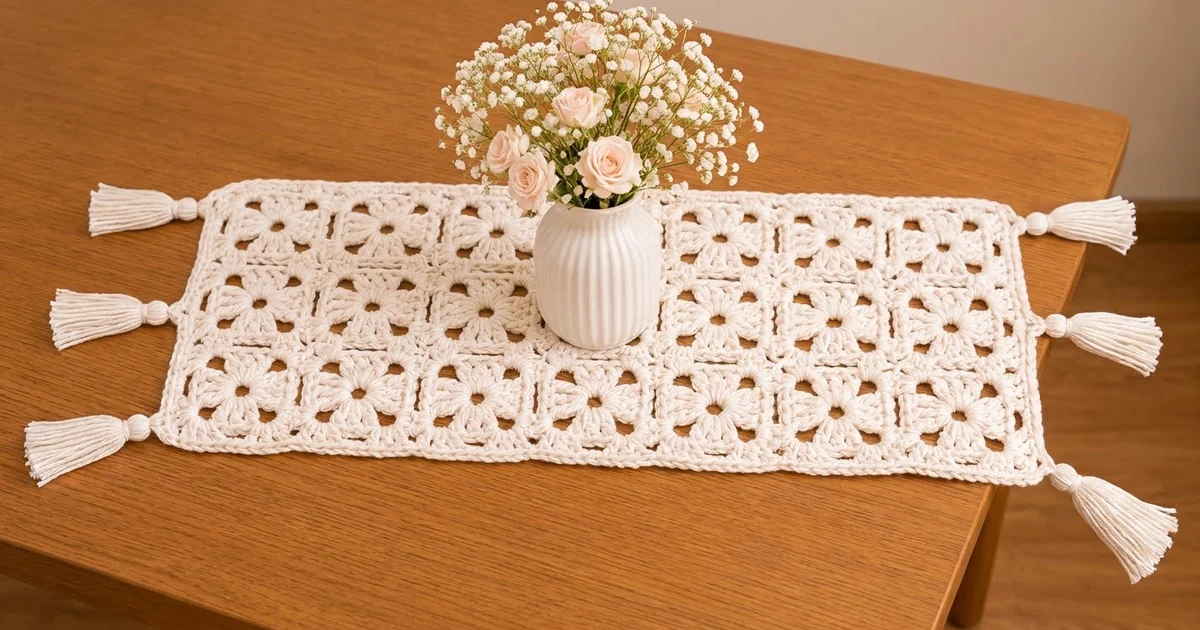
The Ivory Window Flower Table Runner is a classic granny-style runner in one soft, natural ivory cotton. Each square has a small open center, four solid petals of double crochet that point toward the middle of each side, and four open windows set on the diagonals. A firm single crochet frame squares the motif off neatly.
Twenty-seven squares are joined in a grid 3 squares wide and 9 squares long. The single crochet seams make a slightly raised, rope-like ridge on the right side. A three-round border tidies the edge, and three chunky tassels hang from each short end.
This pattern uses US crochet terms. The finished runner measures 13.5 x 37.5 in (34.3 x 95.3 cm) without the tassels. Each tassel adds 4 in (10.2 cm) of drop at either end.
Construction is simple and repetitive. You make 27 identical four-round squares, join them with single crochet seams, work a sc and reverse sc border all the way around, and then attach six wrapped tassels. Every stage has a measurement checkpoint, so you’ll know early if something is off.
Finished Size and Construction
- Finished size: 13.5 x 37.5 in (34.3 x 95.3 cm), tassels not included
- Skill level: Easy to intermediate
- Terminology: US crochet terms
- Yarn weight: Aran / heavy worsted (#4) cotton
- Hook: 5.5 mm (US I-9)
- Number of pieces: 27 squares, plus 6 tassels
- Layout: 3 squares wide x 9 squares long
- Single square size: 4 x 4 in (10.2 x 10.2 cm)
- Size before border: 12 x 36 in (30.5 x 91.4 cm)
- Border depth: 0.75 in (1.9 cm) on each side
Materials
Yarn: Use a smooth, plied aran-weight cotton or a cotton blend in ivory or natural white. Cotton shows stitch definition well, lies flat on a table, and holds up to washing. Steer clear of very splitty yarn, because the reverse sc edge and the tassels look best in a round, firm yarn.
- Ivory: about 350 g, roughly 595 m (651 yd). That’s about seven 50 g / 85 m balls.
Breakdown: squares about 216 g (8 g each), joining about 15 g, border about 30 g, and tassels about 36 g (6 g each). The total quantity already includes a safety margin of roughly 15%.
Tools:
- 5.5 mm (US I-9) crochet hook
- Tapestry needle
- Stitch markers
- Scissors
- Stiff card 4.5 in (11.4 cm) tall, for tassels
- Tape measure
- Rust-proof pins and a blocking mat or folded towels
- Spray bottle
Abbreviations (US Terms)
- ch – chain
- sl st – slip stitch
- sc – single crochet
- dc – double crochet
- rev sc – reverse single crochet (crab stitch)
- sp(s) – space(s)
- st(s) – stitch(es)
- MR – magic ring
- RS / WS – right side / wrong side
- [ ] – repeat the instructions inside the brackets as directed
Special stitch – reverse single crochet (rev sc): With the RS facing, work from left to right (right-handed). Insert the hook into the next stitch to the right, yarn over, pull up a loop, then yarn over and draw through both loops on the hook. This makes a twisted, corded edge.
Note: At the start of a round, ch 3 counts as the first dc. The ch 1 at the start of sc rounds does not count as a stitch.
Gauge and Checkpoints
Always make one full test square before you start the rest. Block it lightly and measure it flat.
- After Round 1: circle about 1.25 in (3.2 cm) across
- After Round 2: about 2.75 in (7.0 cm) across, petal tip to petal tip
- After Round 3: about 3.5 x 3.5 in (8.9 x 8.9 cm)
- After Round 4: 4 x 4 in (10.2 x 10.2 cm)
Edge gauge: 12 sc along one finished square side = 4 in (10.2 cm), or 3 sts per 1 in (2.5 cm).
If your square comes out too big (over 4.25 in / 10.8 cm), go down to a 5 mm (H-8) hook. If it’s too small (under 3.75 in / 9.5 cm), go up to a 6 mm (J-10) hook. Small errors add up fast, because 9 squares that are each 0.25 in (0.6 cm) too long make the runner 2.25 in (5.7 cm) too long.
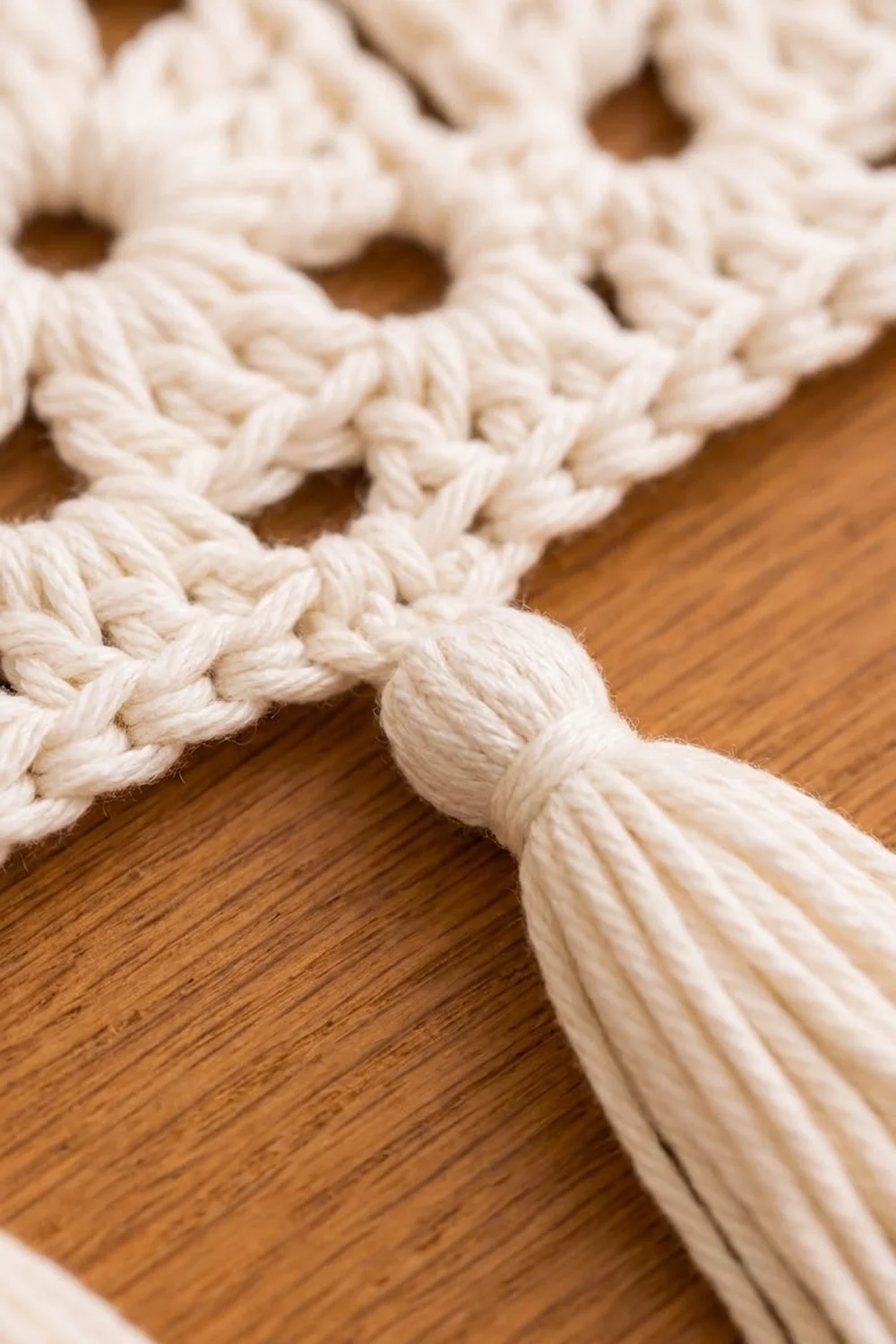
Square Pattern (Make 27)
Round 1: Make a MR. Ch 3 (counts as dc), work 11 dc into ring. Pull the ring closed, leaving a small center hole. Join with sl st to top of ch-3. (12 dc)
Round 2 (petals and windows): Ch 3 (counts as dc), dc in same st, 2 dc in each of next 2 sts, ch 5, [2 dc in each of next 3 sts, ch 5] 3 times. Join with sl st to top of ch-3. (24 dc in 4 petals of 6 dc each, 4 ch-5 sps)
The ch-5 arches skip over nothing. They bridge from one petal to the next and form the four diagonal windows between Round 1 and Round 3.
Round 3 (squaring round): Ch 3 (counts as dc), dc in each of next 5 dc, (2 dc, ch 3, 2 dc) in next ch-5 sp, [dc in each of next 6 dc, (2 dc, ch 3, 2 dc) in next ch-5 sp] 3 times. Join with sl st to top of ch-3. (40 dc, 4 ch-3 corner sps)
This is a conversion round. Each side = 6 dc worked 1 per petal stitch + 2 dc added from each adjacent corner group (4 added) = 10 dc per side. The corners sit on top of the windows, so the windows stay open beneath them. The petals now point to the middle of each side.
Round 4 (solid frame): Ch 1, sc in same st and in each of next 9 dc, (sc, ch 2, sc) in corner ch-3 sp, [sc in each of next 10 dc, (sc, ch 2, sc) in corner ch-3 sp] 3 times. Join with sl st to first sc. (48 sc, 4 ch-2 corner sps)
This is a trim round. Each side = 10 sc worked 1 per dc + 2 corner sc added = 12 sc per side, including that side’s 2 corner sc. 4 sides x 12 = 48 sc.
Fasten off and weave in the ends. Check that the square is 4 x 4 in (10.2 x 10.2 cm).
Make All Pieces
Make 27 ivory squares. Since there’s only one color, every square is identical.
Layout (S = square, columns across the width, rows along the length):
Row 1:  S  S  S
Row 2:  S  S  S
Row 3:  S  S  S
Row 4:  S  S  S
Row 5:  S  S  S
Row 6:  S  S  S
Row 7:  S  S  S
Row 8:  S  S  S
Row 9:  S  S  S
Before joining, lightly steam or spray-block all squares to the same 4 x 4 in (10.2 x 10.2 cm) size. Matching squares make the seams much easier.
Joining
Method: Single crochet seam with WS together, so the seam forms a neat raised ridge on the RS, as shown in the finished runner.
Stitch-to-stitch logic: Each square side has 12 sc between its corner ch-2 sps, so the two squares line up stitch for stitch.
Step 1 – Join rows of 3: Hold two squares WS together, RS facing you. Working through both loops of both squares, sc in matching corner ch-2 sps, sc in each of next 12 st pairs, sc in next matching corner ch-2 sps. (14 sc per seam) Add the third square the same way. Make 9 strips, each with 2 seams (18 short seams total).
Step 2 – Join the strips: Hold two strips WS together. Work 1 sc through the matching corner sps at the start, sc in each of 12 st pairs across each square, and 1 sc through the matching corner sps at each junction. Finish with 1 sc in the final corner sps. (3 x 12 + 4 = 40 sc per seam) Work 8 of these long cross seams.
Tension advice: Keep seam stitches the same height as your Round 4 sc. If a seam puckers, it’s too tight, so go up half a hook size for joining only. If it ripples, it’s too loose.
Size checkpoint: The joined runner should measure 12 x 36 in (30.5 x 91.4 cm). A range of 11.75–12.25 in (29.8–31.1 cm) by 35.5–36.5 in (90.2–92.7 cm) is fine.
Border
Border gauge: 3 sc per 1 in (2.5 cm) along the edges, matching the squares. 4 rounds of sc = 1 in (2.5 cm) in depth.
The border is worked into the outer stitches of the squares only. Don’t work into the junction corner sps along the edges, because the seams already fill them. No stitches are added at the seams.
Starting counts: Short side = 3 squares x 12 sc = 36 sts. Long side = 9 squares x 12 sc = 108 sts.
Border Round 1: With RS facing, join yarn in any outer corner ch-2 sp of the runner. Ch 1, (sc, ch 2, sc) in that corner sp, then sc in each st to the next outer corner. Work (sc, ch 2, sc) in each outer corner sp and continue around. Join to first sc.
- Short sides: 36 + 2 corner sc = 38 sc each
- Long sides: 108 + 2 corner sc = 110 sc each
- Total: 296 sc, 4 corner ch-2 sps
Border Round 2: Sl st into corner ch-2 sp. Ch 1, (sc, ch 2, sc) in same sp, sc in each sc to next corner, [(sc, ch 2, sc) in corner sp, sc in each sc to next corner] around. Join.
- Short sides: 38 + 2 = 40 sc each
- Long sides: 110 + 2 = 112 sc each
- Total: 304 sc, 4 corner ch-2 sps
Border Round 3 (rope edge): Do not turn. Ch 1, then work rev sc in each sc around, with 3 rev sc in each corner ch-2 sp. Join and fasten off.
- Short sides: 40 rev sc + corner groups
- Long sides: 112 rev sc + corner groups
- Total: 2 x 40 + 2 x 112 + 4 x 3 = 316 rev sc
Why the math works: Each square edge has 12 sts in 4 in (10.2 cm), so 3 sts per inch. The border’s first round works exactly 1 sc per edge stitch, which keeps that same 3 sts per inch. Its length matches the joined edge exactly, so it can’t ruffle or pull in. The only stitches added sit at the 4 outer corners (2 per round). Those let the border turn the corner without cupping. Three rounds at 4 rounds per inch give 0.75 in (1.9 cm) of depth: 12 + 0.75 + 0.75 = 13.5 in (34.3 cm) wide, and 36 + 0.75 + 0.75 = 37.5 in (95.3 cm) long.
Tassels (Make 6)
- Wrap yarn 30 times around the 4.5 in (11.4 cm) card.
- Slide a 12 in (30.5 cm) strand under the wraps at the top and tie it tightly. Leave the ends long for attaching.
- Cut through the wraps at the bottom edge.
- Wrap a separate strand firmly around the bundle 0.75 in (1.9 cm) below the top tie, 6–8 times. Knot it, then bury the ends inside the tassel.
- Trim the bottom so the tassel hangs 4 in (10.2 cm) below the border.
Attach 3 tassels to each short end: one in the center rev sc of each corner group, and one in the middle of the 40 rev sc short edge (between sts 20 and 21). Tie securely on the WS and weave the ends into the tassel.
Final Blocking
- Weave in all remaining ends along the seams, where they hide best.
- Lay the runner RS up on a blocking mat or on towels.
- Spray it evenly with water until it’s damp but not dripping.
- Pin out to 13.5 x 37.5 in (34.3 x 95.3 cm). Pin the 4 corners first, then the middle of each side, then fill in every 2 in (5.1 cm).
- Check that the seams run straight. Use a long ruler along each seam line.
- Gently open each diagonal window with a fingertip, and make sure the petals lie flat.
- Leave it until it’s completely dry, then unpin.
- Comb out the tassels with damp fingers and trim them evenly if needed.
Final Quality-Control Checklist
- All 27 squares are 4 x 4 in (10.2 x 10.2 cm)
- Every square has 12 sc per side and 48 sc total in Round 4
- The 4 windows on every square are open and sit on the diagonals
- 18 short seams have 14 sc each, and 8 long seams have 40 sc each
- The joined runner is 12 x 36 in (30.5 x 91.4 cm) before the border
- Border Round 1 has 296 sc, Round 2 has 304 sc, and Round 3 has 316 rev sc
- Finished size is 13.5 x 37.5 in (34.3 x 95.3 cm)
- 6 tassels, each 4 in (10.2 cm) long, sit evenly at the corners and centers of the short ends
- No loose ends are visible on the RS
Troubleshooting
Center hole too big: Pull the magic ring tighter before joining Round 1, and weave the tail around the ring once more.
Windows look closed: Your ch-5 arches may be too tight. Make the chains slightly looser, or use ch 6.
Square cups: Round 3 tension is too tight. Relax your dc, or go up a hook size for Rounds 3–4.
Square ruffles: Check your corner groups. There should be exactly 2 dc, ch 3, 2 dc per corner.
Seams pucker: Join with a hook one size larger, and double-check that you’re working 1 sc per st pair.
Border waves: You may have added stitches at seam junctions. Recount to 38 sc on the short sides and 110 sc on the long sides in Round 1.
Border pulls in: You skipped stitches, or your tension tightened. Recount and redo the round.
Tassels uneven: Wrap the same card every time, and trim all six together while they’re hanging.
Care
Hand wash or machine wash on a gentle cool cycle in a laundry bag, then reshape and dry flat. Smooth the tassels while they’re damp so they hang straight.

Final Notes
The whole runner depends on one measurement chain. The squares grow 12 dc → 24 dc → 40 dc → 48 sc, which gives 12 sc per side and a 4 in (10.2 cm) square. Twenty-seven squares in a 3 x 9 layout make 12 x 36 in (30.5 x 91.4 cm). The border starts with exactly 36 and 108 stitches per side and adds 0.75 in (1.9 cm) all around, for a finished runner of 13.5 x 37.5 in (34.3 x 95.3 cm). Get the first square right, and everything after it falls into place.
Happy crocheting!