
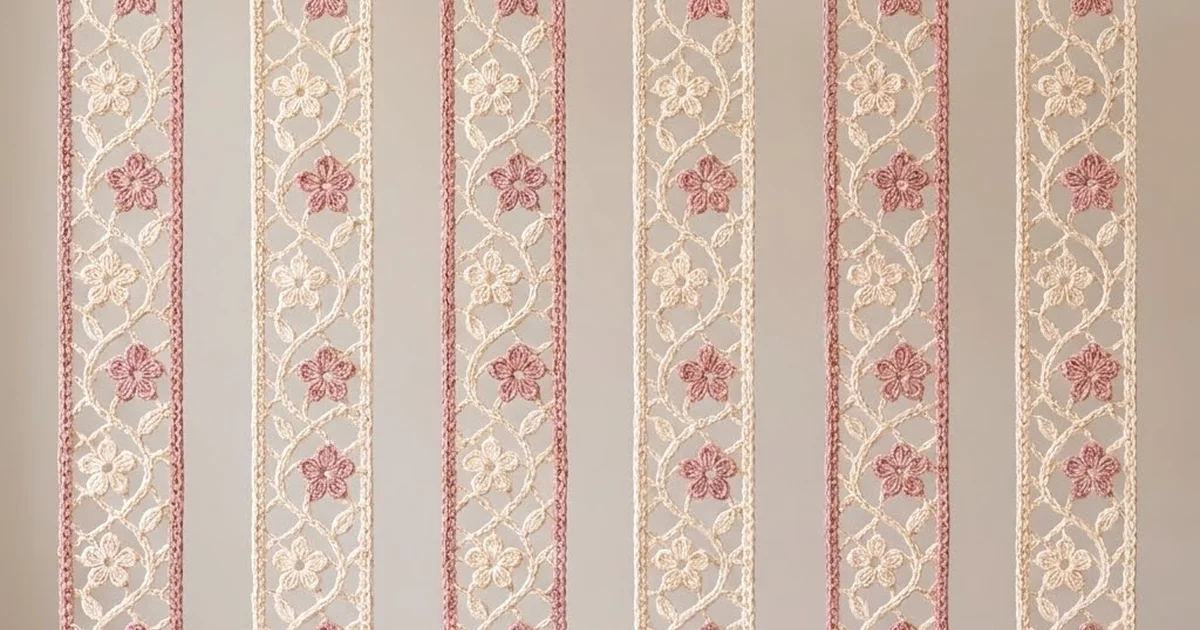
This door curtain is made of six separate lace strips. Each strip has a cream diamond-mesh body with a winding cream vine, pointed leaves, and a column of five-petal flowers that alternate dusty pink and cream. The strips hang on their own from a rod, so you can walk through the curtain and part it like a beaded curtain.
The palette is just two colors. Three strips have a dusty-pink border and hanging loop, and three have a cream border and loop. When the strips hang side by side, the pink and cream edges alternate. The style is light, romantic, and cottage-inspired.
The pattern uses US crochet terms. Each finished strip measures 6.8 in × 78.8 in (17.3 cm × 200.2 cm), not counting the hanging loop. Six strips hung edge to edge cover about 40.8 in (103.6 cm).
For each strip, you work the cream mesh body in rows. Then you make the flowers, leaves, and vine separately and sew them on. Next, you work a three-round border in the border color and add the hanging loop. The strips are never sewn to each other.
Finished Size and Construction
- Finished strip size: 6.8 in × 78.8 in (17.3 cm × 200.2 cm), plus a 2.75 in (7.0 cm) loop
- Skill level: Intermediate
- Terminology: US crochet terms
- Yarn weight: DK (#3) cotton
- Hook: 3.5 mm (E-4)
- Number of pieces: 6 bordered strips, each with 13 flowers, 24 leaves, and 1 vine
- Layout: 6 strips hanging side by side, not joined
- Body size before border: 5.8 in × 77.8 in (14.7 cm × 197.6 cm)
- Border depth: 0.5 in (1.3 cm) per side
- Flower size: 2 in (5.1 cm) across
- Leaf length: 1.25 in (3.2 cm)
Materials
Use a smooth mercerized or combed DK cotton, about 110 m (120 yd) per 50 g. Cotton gives crisp stitch definition and hangs straight without stretching too much.
- Cream: 500 g (about 1,100 m) for six bodies, all vines and leaves, 39 cream flowers, and 3 borders with loops
- Dusty pink: 100 g (about 220 m) for 39 pink flowers and 3 borders with loops
These quantities include a margin of about 20% for swatching and dye-lot safety.
Tools:
- 3.5 mm (E-4) crochet hook
- Tapestry needle
- Stitch markers
- Rust-proof pins
- Blocking mats or a long towel-covered floor area
- Measuring tape
- Spray bottle
- Curtain rod up to 1.25 in (3.2 cm) in diameter
Abbreviations (US Terms)
- ch – chain
- sl st – slip stitch
- sc – single crochet
- hdc – half double crochet
- dc – double crochet
- sk – skip
- sp – space
- RS – right side
- rev sc – reverse single crochet
Reverse single crochet (crab stitch): Work from left to right (left-handers work right to left). Insert the hook in the next stitch to the right, yarn over, and pull up a loop. Then yarn over and pull through both loops. This makes the corded edge you see on the border.
Gauge and Checkpoints
- Sc gauge: 20 sc = 4 in (10.2 cm)
- Mesh gauge: 29 sts = 5.8 in (14.7 cm) wide, and one 2-row repeat (Rows 3–4) = 1 in (2.5 cm) tall
Test piece: Ch 30 and work Rows 1–2. Repeat Rows 3–4 five times, then work the top row (Row 157 in the pattern). Your swatch should measure 5.8 in × 5.8 in (14.7 cm × 14.7 cm), pinned flat but not stretched.
After the swatch, make one complete strip before you start the others.
Checkpoints:
- After Row 2: 5.8 in wide × 0.6 in tall (14.7 cm × 1.5 cm)
- After Row 22: 10.8 in (27.4 cm) tall
- After Row 78: 38.8 in (98.6 cm) tall
- Finished body: 5.8 in × 77.8 in (14.7 cm × 197.6 cm)
If the piece is too big, go down 0.25–0.5 mm in hook size. If it is too small, go up. Mesh loops that come out too long can also be fixed by keeping each ch-5 snug and even.

Strip Body (Make 6, Cream)
Ch 30.
Row 1 (RS): Sc in 2nd ch from hook and in each ch across. Turn. (29 sc)
Row 2: Ch 1, sc in first sc, ch 5, sk 3 sc, sc in next sc; repeat from * 6 more times. Turn. (7 ch-5 loops, 8 sc)
Row 3: Ch 5 (counts as dc + ch 2), sc in first ch-5 loop, ch 5, sc in next loop; repeat from * 5 more times. Ch 2, dc in last sc. Turn. (6 full loops + 2 half loops)
Row 4: Ch 1, sc in dc, ch 5, sc in next ch-5 loop; repeat from * 5 more times. Ch 5, sc in 3rd ch of turning ch. Turn. (7 full loops)
Rows 5–156: Repeat Rows 3–4 seventy-six more times, for 77 repeats in all. The diagonal loops stack into a diamond lattice.
Row 157 (top row): Ch 1, sc in first sc, 3 sc in next ch-5 loop, sc in next sc; repeat from * 6 more times. (1 + 7 × 4 = 29 sc.) Fasten off.
The top row matches the 29 sts of Row 1, so both short edges are equal and straight.
Body checkpoint: 5.8 in × 77.8 in (14.7 cm × 197.6 cm). The height works out as Row 1 (0.2 in / 0.5 cm), plus Row 2 (0.4 in / 1.0 cm), plus 77 repeats at 1 in (2.5 cm) each, plus Row 157 (0.2 in / 0.5 cm).
Flowers (Make 78: 39 Pink, 39 Cream)
Ch 5, sl st in first ch to form a ring.
Rnd 1: Ch 1, 10 sc in ring, sl st to first sc. (10 sc)
Rnd 2: In next sc, work (sc, hdc, 2 dc). In next sc, work (2 dc, hdc, sc). Repeat from * 4 more times, then sl st to first sc. (5 petals, 8 sts each = 40 sts)
Fasten off and leave a 12 in (30.5 cm) tail. The flower measures 2 in (5.1 cm) across, and the ring leaves an open center.
Leaves (Make 144, Cream)
Ch 8.
Working in the back bumps, start in the 2nd ch from hook and work: sc, hdc, dc, dc, hdc, sc (6 sts). Work 3 sc in the last ch. Rotate the leaf and work along the other side of the chain: sc, hdc, dc, dc, hdc, sc (6 sts). Sl st in the skipped tip ch. (15 sts)
Fasten off and leave a 10 in (25.4 cm) tail. Each leaf is 1.25 in (3.2 cm) long and pointed at both ends.
Vine (Make 6, Cream)
Chain loosely until the chain measures 90 in (228.6 cm) unstretched. Sl st in the back bump of the 2nd ch from hook and in each ch back to the start. Fasten off.
The slip stitches firm up the chain into a cord that holds a curve.
Appliqué Placement (Each Strip)
Lay the body RS up and measure from the bottom edge.
- Flowers: Center the 13 flowers across the width. Place their centers at 3 in (7.6 cm) and then every 6 in (15.2 cm) up the strip, with the last at 75 in (190.5 cm). That leaves 2.8 in (7.1 cm) of plain mesh above the top flower, and 1.9 in (4.8 cm) of mesh on each side of every flower.
- Vine: Pin the vine from the bottom flower to the top flower. Swing it in S-curves, alternating left and right of each flower, and keep it at least 1 in (2.5 cm) from the side edges.
- Leaves: Pin 2 leaves in each of the 12 gaps between flowers, one on each side of the vine. Angle them upward.
- Sew: Whipstitch each piece to the mesh with its own tail. Catch only the mesh behind it and keep the stitches small. Tuck the vine ends under the first and last flowers.
Make All Pieces
| Strip | Border/loop | Pink flowers | Cream flowers | Leaves | Vine |
|---|---|---|---|---|---|
| 1 | Pink | 7 (positions 1, 3, 5…13) | 6 | 24 | 1 |
| 2 | Cream | 6 | 7 (positions 1, 3, 5…13) | 24 | 1 |
| 3 | Pink | 7 | 6 | 24 | 1 |
| 4 | Cream | 6 | 7 | 24 | 1 |
| 5 | Pink | 7 | 6 | 24 | 1 |
| 6 | Cream | 6 | 7 | 24 | 1 |
| Total | 3 pink, 3 cream | 39 | 39 | 144 | 6 |
Flower positions are counted from the bottom of the strip.
Layout (front view, left to right):
[ 1 P ][ 2 C ][ 3 P ][ 4 C ][ 5 P ][ 6 C ]
  P = pink border    C = cream border
Joining (Hanging Arrangement, No Sewing)
The strips are deliberately left unjoined. Each strip hangs only from its own loop, which lets the curtain part when you walk through.
Spacing: Slide the loops onto the rod in the order 1–6, so the border colors alternate. Space the loop centers 6.8 in (17.3 cm) apart, so neighboring borders just touch.
Tension: Each strip hangs freely under its own weight. Don’t tie the strips together at the bottom.
Size checkpoint: Six strips edge to edge measure 40.8 in (103.6 cm). For a wider doorway, add the gap you want between loops (for example, 0.5 in / 1.3 cm per gap), or make extra strips in the same color order.
Border (Each Strip)
Border gauge: 5 sc per inch (2.5 cm), the same as the body sc gauge. The short edges have 29 sts over 5.8 in (5 × 5.8 = 29). The long edges need 5 × 77.8 = 389 sc.
Side edge rate (row ends):
- Row 1 end: 1 sc
- Row 2 end: 2 sc
- Each dc-height row end (odd rows 3–155): 3 sc
- Each sc-height row end (even rows 4–156): 2 sc
- Row 157 end: 1 sc
That gives 1 + 2 + (77 × 5) + 1 = 389 sc per long side. Each 1 in (2.5 cm) repeat gets exactly 5 sc, so the border matches the body length.
Rnd 1: With RS facing, join the border color in the first st of Row 157.
- Ch 1, sc in the same st and in each st across the top. (29 sc)
- Ch 2 for the corner.
- Work 389 sc down the side, at the rate above.
- Ch 2, then sc in the bottom loop of each foundation ch. (29 sc)
- Ch 2, then work 389 sc up the second side.
- Ch 2 and sl st to the first sc.
(836 sc + 4 ch-2 corner sps.) Checkpoint: 6.2 in × 78.2 in (15.7 cm × 198.6 cm).
Rnd 2: Ch 1, sc in each sc. Work (sc, ch 2, sc) in each corner sp, and sl st to the first sc. Each short side now has 29 + 2 = 31 sc, and each long side has 389 + 2 = 391 sc. The 2 new stitches on each side are the corner sc on either end of that side. (Total 844 sc + 4 ch-2 sps.) Checkpoint: 6.6 in × 78.6 in (16.8 cm × 199.6 cm).
Rnd 3: Ch 1. Rev sc in each sc (1 per existing stitch = 844), and work 3 rev sc in each corner sp (+12). (844 + 12 = 856 rev sc.) Sl st to the first st and fasten off.
Final border checkpoint: 6.8 in × 78.8 in (17.3 cm × 200.2 cm).
Why the math works: Each border round adds stitches only at the corners. The side stitch counts stay at exactly 5 per inch, so the edges don’t ripple or pull in. Rnd 1 adds 0.2 in (0.5 cm), Rnd 2 adds 0.2 in (0.5 cm), and Rnd 3 adds 0.1 in (0.3 cm) per side. That totals 0.5 in (1.3 cm) per side, or 1 in (2.5 cm) added to each overall dimension.
Hanging loop: Count the 31 rev sc along the top edge, between the corner groups. With the border color, join in the 16th (center) rev sc. Ch 24, sl st in the same st, then work 34 sc into the ch-24 loop and sl st to the base. Fasten off.
The loop stands 2.75 in (7.0 cm) tall when laid flat and fits a rod up to 1.25 in (3.2 cm) in diameter.
Final Blocking
- Weave in all ends along the border or behind the flowers.
- Soak each strip in cool water for 10 minutes. Press out the water in a towel; don’t wring.
- Lay the strip RS up on mats or a towel and pin the corners to 6.8 in × 78.8 in (17.3 cm × 200.2 cm).
- Pin the long edges every 3 in (7.6 cm) and keep them straight.
- Open the mesh diamonds evenly. Shape the petals and leaf points with your fingers.
- Let it dry fully, then hang it for 24 hours before measuring again.
Final Quality-Control Checklist
- Each body has 29 sts at both short edges and 157 rows.
- Each strip has 13 flowers, alternating colors, with the right color at position 1.
- There are 24 leaves and a smooth S-curve vine on every strip.
- The border counts are 31 and 391 per side on Rnd 2, and 856 rev sc in Rnd 3.
- Every finished strip measures 6.8 in × 78.8 in (17.3 cm × 200.2 cm).
- The loop is centered and its color matches the border.
- No loose ends show on the front.
Troubleshooting
- Strip slants: Check that you worked the half loop at the start and end of every Row 3.
- Mesh is too long: Tighten your ch-5 tension, or go down a hook size.
- Border ruffles: You have extra sc on the sides. Recount against the 389 total.
- Border pulls in: You skipped row ends. Recheck the 3-and-2 rate.
- Flowers cup: Rnd 2 is too tight. Go up 0.5 mm for the flowers only.
- Strips hang at different lengths: Re-block them together, and match your row counts.
Care
Hand wash in cool water with mild soap, press out the water in a towel, and dry flat before rehanging. Avoid hot dryers, which can shrink cotton unevenly.

Final Notes
Every measurement comes from one chain of checks. Your swatch gives 5.8 in (14.7 cm) square. The body grows 1 in (2.5 cm) per repeat to reach 5.8 in × 77.8 in (14.7 cm × 197.6 cm). Three border rounds bring each strip to 6.8 in × 78.8 in (17.3 cm × 200.2 cm), and six strips cover 40.8 in (103.6 cm).
Check your gauge at each stage and your strips will hang straight and even.
Happy crocheting!