

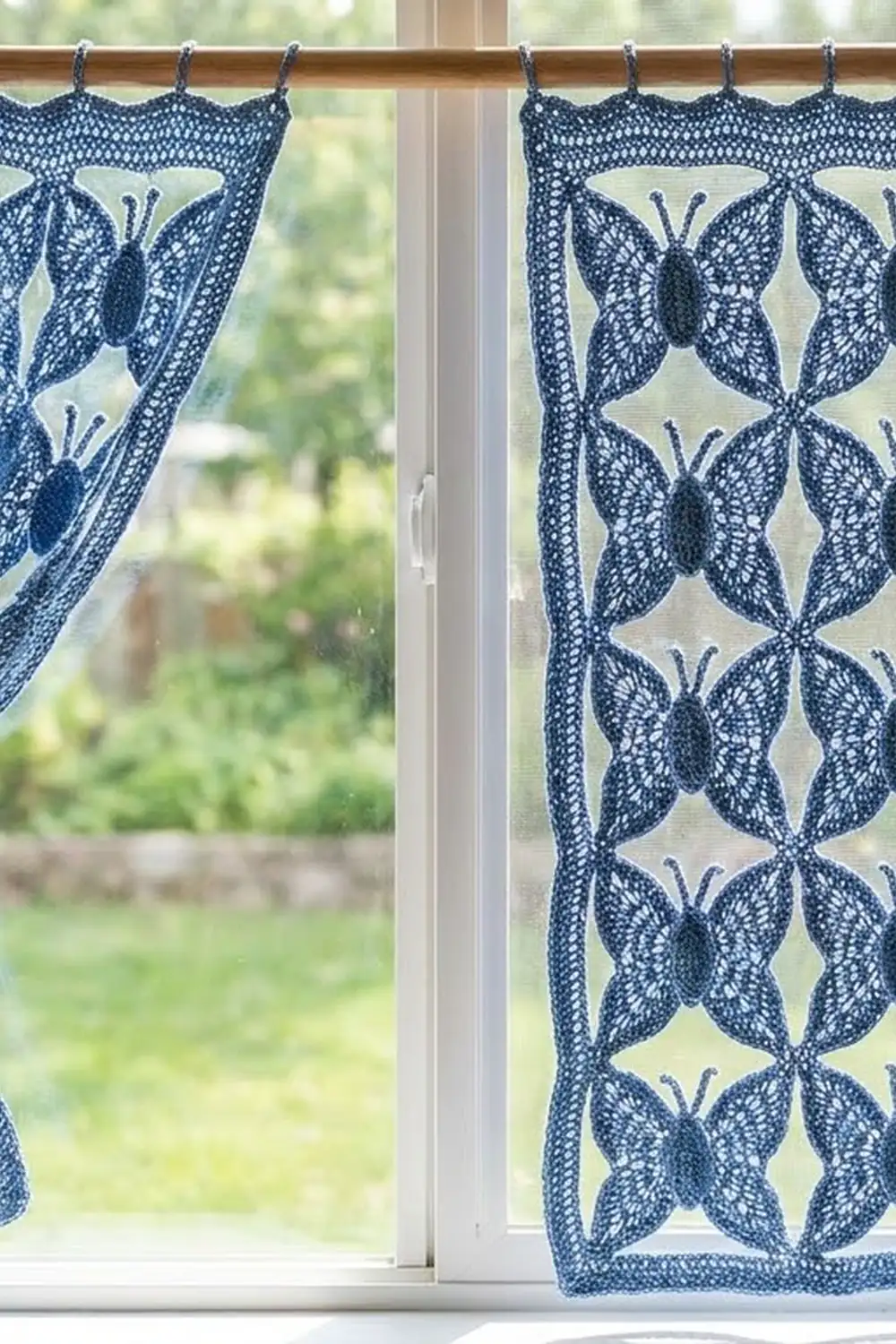
This pair of lace curtain panels is made entirely from joined butterflies. Each butterfly has a raised body, two knobbed antennae and four open wings ringed with double crochet. Light passes through the wing openings and the gaps between motifs, so the panels filter sunlight without blocking the view.
The sample uses a single denim blue cotton, which shows off the stitch texture and keeps the look calm and cottage-style. The pattern uses US crochet terms.
Each finished panel measures 13 in (33.0 cm) wide by 53.25 in (135.3 cm) long, including the header. Each panel is 2 butterflies wide and 9 butterflies tall, and the pattern makes two panels.
You make each butterfly from the center outward: first the body, then chain loops that frame the wings, then 3 rounds that fill and edge the wings. Butterflies are joined as you go on their last round. A chain frame and a scalloped header finish each panel.
Finished Size and Construction
- Finished panel: 13 in (33.0 cm) wide x 53.25 in (135.3 cm) long
- Skill level: Intermediate
- Terminology: US
- Yarn weight: Worsted (#4) cotton or cotton blend
- Hook: 5 mm (H-8)
- Number of pieces: 36 butterflies (18 per panel), 2 panels
- Layout: 2 across x 9 down per panel
- Butterfly size: 6 in (15.2 cm) wide x 4.75 in (12.1 cm) tall, not counting the antennae
- Gaps between motifs: 0.5 in (1.3 cm) side to side, 1 in (2.5 cm) top to bottom
- Joined grid before border: 12.5 in (31.8 cm) x 50.75 in (128.9 cm)
- Border depth: 0.25 in (0.6 cm) on the sides and bottom; the header adds 2 in (5.1 cm) plus 0.25 in (0.6 cm) of frame
Materials
Choose a smooth, tightly plied cotton so the wing edges look crisp. Avoid fuzzy yarn, because it blurs the openings in the wings.
- Denim Blue: 450 g, about 855 m (935 yd), based on 100 g = 190 m
- 5 mm (H-8) hook
- Tapestry needle
- 8 locking stitch markers
- Rustproof pins and a blocking surface
- Spray bottle; spray starch is optional
- 14 to 16 curtain clip rings and a rod
All quantities include a margin of about 15%.
Abbreviations (US Terms)
- ch: chain
- sl st: slip stitch
- sc: single crochet
- hdc: half double crochet
- dc: double crochet
- tr: treble crochet
- dc2tog: double crochet 2 together
- sk: skip
- sp: space
- st(s): stitch(es)
- RS: right side
Knob (special stitch): In the chain indicated, work this 3 times: yo, insert hook, yo and pull up a loop, yo and draw through 2 loops. Then yo and draw through all 4 loops on the hook, and ch 1 to close.
Antenna: Ch 6, work a knob in the 2nd ch from the hook, then sl st in each of the next 4 ch back toward the body.
Gauge and Checkpoints
- Base gauge: 16 sc = 4 in (10.2 cm), or 4 sc per inch (2.5 cm).
- Chain gauge: 4 relaxed ch = 1 in (2.5 cm).
Make and block one butterfly before starting the rest. Check it at each stage:
- After Rnd 1: The body oval is 2.75 in (7.0 cm) long x 0.75 in (1.9 cm) wide.
- After Rnd 3: About 4.75 in (12.1 cm) wide x 3.75 in (9.5 cm) tall.
- After Rnd 4: About 5.5 in (14.0 cm) wide x 4.25 in (10.8 cm) tall.
- After Rnd 5, blocked: 6 in (15.2 cm) x 4.75 in (12.1 cm).
If the butterfly is more than 0.25 in (0.6 cm) too large, go down half a hook size. If it is too small, go up half a size. Keep the chain loops in Rnd 2 relaxed, because tight loops close up the wing openings.
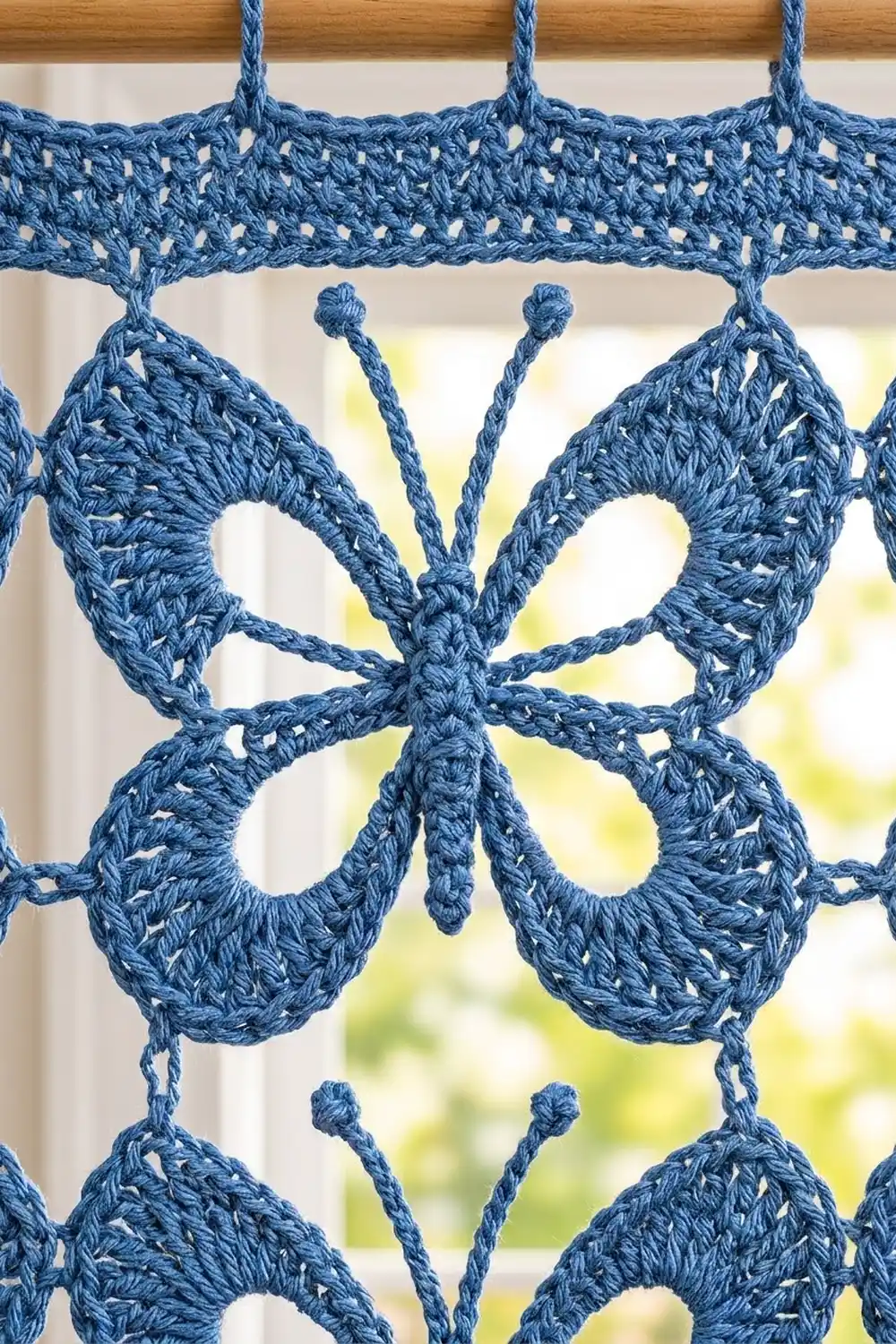
Butterfly Motif (Make 36)
Orientation: Work with the RS facing. Once Rnd 2 is done, hold the butterfly with the antennae pointing up. Wing A is on your right and wing B is on your left. If you crochet left-handed, the result is a mirror image, which works just as well.
Rnd 1 (body): Ch 11. Sc in the 2nd ch from the hook and in the next 8 ch, then work 3 sc in the last ch. Rotate and work along the other side of the chain: sc in the next 8 ch, then 2 sc in the last ch (the same ch as the first sc). Sl st to the first sc. (22 sc)
The stitches are numbered 1 to 22 from the first sc. Sts 1, 21 and 22 form the tail end, sts 10 to 12 form the head, sts 2 to 9 are side A and sts 13 to 20 are side B.
Rnd 2 (wing frames and antennae): Ch 1 and work the round in this order:
- Sc in st 1 and sc in st 2.
- Lower frame A: Ch 14, sk st 3, sc in st 4.
- Sc in st 5.
- Upper frame A: Ch 20, sk sts 6 and 7, sc in st 8.
- Sc in st 9 and sc in st 10.
- Work an antenna.
- Sc in st 11 and sc in st 12.
- Work an antenna.
- Sc in st 13 and sc in st 14.
- Upper frame B: Ch 20, sk sts 15 and 16, sc in st 17.
- Sc in st 18.
- Lower frame B: Ch 14, sk st 19, sc in st 20.
- Sc in st 21 and sc in st 22, then sl st to the first sc.
Count: 16 sc, two ch-20 loops, two ch-14 loops and 2 antennae.
Rnd 3 (wing fill): Do not ch. Work the round in this order:
- Sl st in the next sc.
- Lower wing A: In the ch-14 sp, work 2 sc, 2 hdc, 14 dc, 2 hdc, 2 sc. (22 sts)
- Sl st in each of the next 2 sc.
- Upper wing A: In the ch-20 sp, work 2 sc, 3 hdc, 20 dc, 3 hdc, 2 sc. (30 sts)
- Sl st in each of the next 7 sc. Keep the antennae to the front as you work.
- Upper wing B: In the ch-20 sp, work the same 30 sts as upper wing A.
- Sl st in each of the next 2 sc.
- Lower wing B: In the ch-14 sp, work the same 22 sts as lower wing A.
- Sl st in each of the last 3 sc, then sl st in the first sl st to join.
Count: 104 wing sts. The sl sts are not counted.
The chain loops become the open teardrop in each wing, and the dc fans around them. In Rnds 4 and 5, sl st in every sl st between the wings: 2 between each pair of wings, 7 at the head, and all the tail sl sts back to the start.
Rnd 4 (wing shaping):
- Lower wing A: Sc 2, hdc 2, then (dc in next, 2 dc in next) 7 times, then hdc 2, sc 2. (29 sts)
- Upper wing A: Sc 2, hdc 3, (dc in next, 2 dc in next) 5 times, (2 tr in next) 4 times, (2 dc in next, dc in next) 3 times, hdc 3, sc 2. (42 sts)
- Upper wing B: Sc 2, hdc 3, (dc in next, 2 dc in next) 3 times, (2 tr in next) 4 times, (2 dc in next, dc in next) 5 times, hdc 3, sc 2. (42 sts)
- Lower wing B: Sc 2, hdc 2, then (2 dc in next, dc in next) 7 times, then hdc 2, sc 2. (29 sts)
Count: 142 wing sts. The 8 tr in each upper wing form its pointed outer tip.
Rnd 5 (edging with join loops):
- Lower wing A: Sc 11, ch 9 (bottom loop), sc 9, ch 5 (side loop), sc 9.
- Upper wing A: Sc 13, ch 5 (side loop), sc 11, ch 9 (top loop), sc 18.
- Upper wing B: Sc 18, ch 9 (top loop), sc 11, ch 5 (side loop), sc 13.
- Lower wing B: Sc 9, ch 5 (side loop), sc 9, ch 9 (bottom loop), sc 11.
Count: 142 sc, 4 ch-5 side loops and 4 ch-9 loops (2 top, 2 bottom). Fasten off and weave in the ends.
Make All Pieces
Make 36 butterflies in Denim Blue, 18 per panel. Make the first one as a complete motif, and join every other motif on Rnd 5.
Layout for one panel (numbers show the order you make and join the motifs):
[ 2] [ 1]
[ 4] [ 3]
[ 6] [ 5]
[ 8] [ 7]
[10] [ 9]
[12] [11]
[14] [13]
[16] [15]
[18] [17]
Joining
Join each new motif to its finished neighbors as you work its Rnd 5. Each time you reach a loop that meets a finished neighbor, replace that loop as follows:
- Side loop: Ch 2, sl st into the neighbor’s ch-5 loop, ch 2.
- Top loop: Ch 4, sl st into the ch-9 bottom loop of the motif above, ch 4.
The joined chain has the same length as the loop it replaces, so the sc counts do not change.
How the stitches line up:
- Horizontal joins: The left motif’s upper B and lower B side loops join the right motif’s upper A and lower A side loops. That gives 2 joins per vertical seam.
- Vertical joins: The lower motif’s upper A top loop joins the upper motif’s lower A bottom loop, and the same for B. That gives 2 joins per horizontal seam.
- Example: Motif 3 joins motif 1 at the top. Motif 4 joins motif 2 at the top and motif 3 at the side.
Tension: Work the sl st loosely and do not pull the joining chains snug. The gaps should lie flat: 0.5 in (1.3 cm) between motifs side to side and 1 in (2.5 cm) top to bottom. The antennae sit inside the 1 in (2.5 cm) gap.
Size checkpoint: After 2 rows, the strip should be 12.5 in (31.8 cm) wide. After all 9 rows, the grid should be 50.75 in (128.9 cm) long. Each row adds 5.75 in (14.6 cm): one motif height plus one gap.
Border
Border gauge: 4 sts per inch (2.5 cm), counting each ch and sc as 1 st.
Rnd 1 (chain frame): Hold the panel with the RS facing. Join with sc in the right-hand top loop of the top-right motif.
- Top edge: Ch 13, sc in the next top loop. Ch 12, sc in the next top loop. Ch 13, sc in the last top loop.
- Top-left corner: Ch 11 and mark the 5th ch as the corner.
- Left side: Sc in the upper side loop of motif 2, ch 7, sc in its lower side loop. Then repeat this 8 times: ch 14, sc in the upper side loop of the next motif, ch 7, sc in its lower side loop.
- Bottom-left corner: Ch 9 and mark the 5th ch.
- Bottom edge: Sc in the first bottom loop, ch 13, sc in the next, ch 12, sc in the next, ch 13, sc in the last.
- Bottom-right corner: Ch 9 and mark the 5th ch.
- Right side: Sc in the lower side loop of motif 17, ch 7, sc in its upper side loop. Then repeat this 8 times: ch 14, sc in the lower side loop of the next motif up, ch 7, sc in its upper side loop.
- Top-right corner: Ch 11, mark the 7th ch, then sl st to the first sc.
Rnd 2: Ch 1. Sc in every sc and every ch, and work 3 sc in each marked corner ch. Sl st to the first sc.
Count per side, not including the corner sts:
- Top and bottom: 50 sts each. That is 4 sc in loops plus 46 ch (4 + 13 + 12 + 13 + 4).
- Each long side: 203 sts. That is 18 sc in loops plus 185 ch (6 + 9 x 7 + 8 x 14 + 4).
- Corners: 3 sc each, 12 in total.
- Round total: 518 sts.
Why the math works:
- At 4 sts per inch, 50 sts = 12.5 in (31.8 cm) and 203 sts = 50.75 in (128.9 cm). Both match the joined grid exactly, so the frame neither pulls in nor ruffles.
- The side spacing repeats every 23 sts, which is 5.75 in (14.6 cm) and matches the 5.75 in motif pitch.
- The 8-st spans (7 ch + 1 sc) are 2 in (5.1 cm), the distance between a motif’s two side loops.
- The 15-st spans (14 ch + 1 sc) are 3.75 in (9.5 cm), the distance from one motif’s lower side loop to the next motif’s upper side loop.
Header (worked across the top):
- Row 1: With the RS facing, join in the center sc of the top-right corner. Ch 3 (counts as a dc). Work 1 dc in each st across the top, ending in the center sc of the top-left corner. Turn. (54 dc: 1 + 1 + 50 + 1 + 1)
- Row 2: Ch 3 (counts as a dc). Dc in each st across to the last 2 sts, then dc2tog over the last 2 sts. Turn. (53 sts: 52 worked 1-per-st, plus 1 dc2tog)
- Row 3: Sc in the first st, then (sk 1, 5 dc in next, sk 1, sc in next) 13 times. (13 shells and 14 sc, using all 53 sts)
Fasten off. Rows 1 and 2 measure 1.25 in (3.2 cm), and Row 3 adds 0.75 in (1.9 cm), for a 2 in (5.1 cm) header.
Final Blocking
- Weave in all ends along stitch posts. Do not run them across the open wing spaces.
- Soak the panel in cool water for 15 minutes, then press out the water in a towel.
- Pin the frame to 13 in (33.0 cm) x 53.25 in (135.3 cm).
- Open each wing teardrop with a pin, and pin each upper wing tip into its point.
- Straighten the antennae and set each knob in place.
- Pin each shell in the header into a round scallop.
- Mist with starch if you like, and leave to dry completely.
Final Quality-Control Checklist
- 18 motifs per panel, each with 4 open wings and 2 antennae
- Every inner loop joined once; no outer loop left out of the frame
- Gaps of 0.5 in (1.3 cm) side to side and 1 in (2.5 cm) top to bottom
- Rnd 2 border counts of 50 / 203 / 50 / 203, plus 3 sc at each corner
- 13 shells in the header
- Both panels match within 0.5 in (1.3 cm)
Troubleshooting
- Wing openings closed up: The Rnd 2 chains were too tight. Use a larger hook for those chains only.
- Wings cup or ripple: Check your Rnd 4 counts. If they are correct, block the wings flatter.
- Panel narrows at the seams: The joining chains are too tight. Rework them more loosely.
- Frame wavy: Your chain gauge doesn’t match 4 per inch. Change hooks for Rnd 1.
- Antennae droop: Starch them, or work the sl sts more firmly.
Care
Hand wash cold, press out the water in a towel and dry flat, re-pinning the shape. Re-starch after washing if you used starch.
Final Notes
Here is the full measurement chain:
- Each butterfly is 6 in (15.2 cm) x 4.75 in (12.1 cm).
- Two motifs plus a 0.5 in (1.3 cm) gap give the 12.5 in (31.8 cm) width.
- Nine rows at 5.75 in (14.6 cm) each, minus the last gap, give 50.75 in (128.9 cm).
- The frame matches those numbers exactly at 4 sts per inch.
- The frame and header bring each panel to 13 in (33.0 cm) x 53.25 in (135.3 cm).
If every stage passes its checkpoint, the finished panels will hang straight and match each other.
Happy crocheting!