
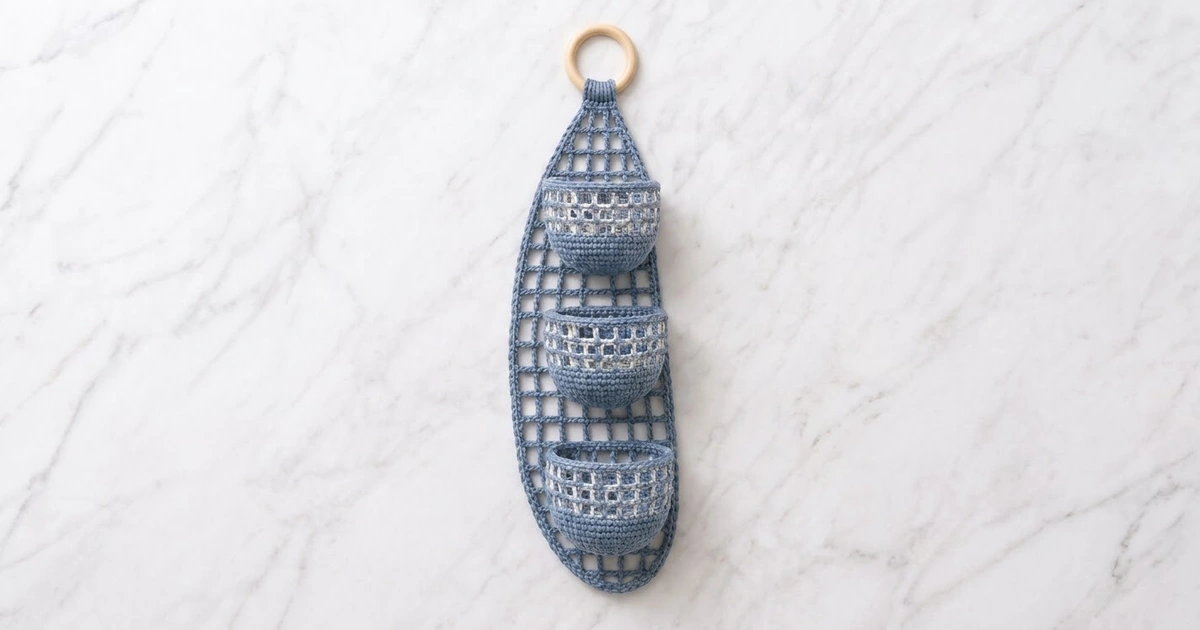
The Bluebell Lattice holder is a hanging organizer for spare toilet rolls. A long teardrop of open square mesh hangs from a wooden ring. Three round-bottomed pockets are stacked down its front, and each one holds a standard roll.
The whole piece uses one dusty denim-blue cotton. The look is calm and a little Scandinavian. The open grid keeps it light on the wall, and solid single-crochet edges give it a clean frame. The pockets are solid at the bottom for strength and open mesh near the top, so you can see the rolls.
This pattern uses US crochet terms. The finished panel is 7.6 in (19.3 cm) wide and 21 in (53.3 cm) long. With the hanging strap it measures about 22.75 in (57.8 cm), not counting the ring.
You’ll crochet the mesh panel in rows from the rounded bottom up. Then you’ll add a two-round border and work a strap off the top. Last, you’ll make three pockets in the round and sew them to the panel.
Finished Size and Construction
- Finished panel size: 7.6 in (19.3 cm) x 21 in (53.3 cm)
- Hanging length: about 22.75 in (57.8 cm), not counting the ring
- Skill level: Intermediate
- Terminology: US
- Yarn weight: Worsted (#4) cotton
- Hook: 5.0 mm (H-8)
- Number of pieces: 4 (1 backing panel, 3 pockets)
- Layout: 3 pockets stacked in one vertical column
- Pocket size: 4 in (10.2 cm) deep, rim 4.9 in (12.4 cm) across
- Panel size before border: 6.6 in (16.8 cm) x 20 in (50.8 cm)
- Border depth: 0.5 in (1.3 cm), 2 rounds of sc
Materials
Yarn: Choose a smooth, firm worsted-weight cotton or cotton blend. Cotton keeps its shape when the pockets are full and handles bathroom humidity well. Avoid acrylic, because it stretches under weight. A slightly twisted, cord-like cotton gives the crispest grid.
- Denim Blue: 250 g, about 425 m (465 yd), based on 170 m per 100 g
The panel uses about 60 g and each pocket about 42 g, for a total of about 186 g. The amount listed includes a margin of roughly 25% for your gauge swatch and dye-lot differences.
Tools:
– 5.0 mm (H-8) crochet hook
– 1 wooden ring, 2.75 in (7.0 cm) outside diameter
– 1 wall hook or knob
– Tapestry needle
– 6 locking stitch markers
– Rust-proof pins, blocking mat and spray bottle
– Scissors and tape measure
Abbreviations (US Terms)
- ch: chain
- sl st: slip stitch
- sc: single crochet
- dc: double crochet
- sk: skip
- sp: space
- st(s): stitch(es)
- rnd: round
Mesh space: One mesh space is (ch 1, sk 1 st or sp, dc in next dc). Every dc and every ch counts as 1 st. A row with n spaces has (n + 1) dc + n ch = 2n + 1 sts.
Beg inc: Ch 4 (counts as dc + ch 1), then dc in the first dc (the st at the base of the chain). This adds 1 space.
End inc: Work (dc, ch 1, dc) in the top of the turning chain. This adds 1 space.
Beg dec: Sl st in the first ch-1 sp and the next dc, then ch 3 (counts as dc). This removes 1 space.
End dec: Stop after the dc in the second-to-last dc, leaving the last ch-1 sp and the turning chain unworked. This removes 1 space.
Top of the turning chain: The 3rd ch of a ch-3 or ch-4. On Row 2, it is the 4th of the 5 skipped foundation chains, counted from the base.
Gauge and Checkpoints
- Sc gauge: 14 sc and 16 rnds = 4 in (10.2 cm)
- Mesh gauge: 7 spaces (14 sts) and 8 rows = 4 in (10.2 cm), so each mesh row is 0.5 in (1.3 cm) tall
Make one pocket first. It is your gauge test, and you’ll use it in the finished piece. Check these measurements as you go:
- Pocket Rnd 7 (42 sts): a flat circle 3.5 in (8.9 cm) across
- Pocket Rnd 20 (54 sts): rim 15.4 in (39.1 cm) around and 4.9 in (12.4 cm) across, depth 4 in (10.2 cm)
- Panel Row 5 (23 sts): 6.6 in (16.8 cm) wide
- Panel Row 28: 14 in (35.6 cm) long
- Panel Row 40: 20 in (50.8 cm) long, top 2 in (5.1 cm) wide
If your pieces are too big, go down half a millimeter in hook size. If they are too small, go up half a millimeter. If your mesh rows are too tall, pull up a shorter loop on the first yarn over of each dc.
Pocket (Make 3)
Work the base in a continuous spiral. Mark the first st of each rnd and move the marker up as you go.
Rnd 1: Magic ring, 6 sc in ring. (6 sts)
Rnd 2: 2 sc in each st around. (12 sts)
Rnd 3: (Sc 1, 2 sc in next st) 6 times. (18 sts)
Rnd 4: (Sc 2, 2 sc in next st) 6 times. (24 sts)
Rnd 5: (Sc 3, 2 sc in next st) 6 times. (30 sts)
Rnd 6: (Sc 4, 2 sc in next st) 6 times. (36 sts)
Rnd 7: (Sc 5, 2 sc in next st) 6 times. (42 sts)
Checkpoint: The flat base measures 3.5 in (8.9 cm) across.
Rnd 8: (Sc 6, 2 sc in next st) 6 times. (48 sts)
Rnd 9: (Sc 7, 2 sc in next st) 6 times. (54 sts)
Rnds 8 and 9 start to cup the base, which rounds the bottom of the pocket.
Rnds 10–15: Sc in each st around. (54 sts) At the end of Rnd 15, sl st in the next st to smooth out the spiral.
Rnd 16 (mesh): Ch 4 (counts as dc + ch 1), sk next st, dc in next st, ch 1, sk next st 26 times. Sl st to the 3rd ch of the beginning ch-4. (27 dc + 27 ch = 54 sts)
Rnds 17–18: Ch 4 (counts as dc + ch 1), sk ch-1 sp, dc in next dc, ch 1, sk ch-1 sp 26 times. Sl st to the 3rd ch of the beginning ch-4. (54 sts)
You now have 27 square openings around the cup, stacked 3 high.
Rnd 19 (conversion): Ch 1, sc in each dc and each ch-1 sp around. Sl st to the first sc. (27 sc in dc + 27 sc in sps = 54 sts)
Rnd 20: Ch 1, sc in each st around. Sl st to the first sc. (54 sts)
Fasten off and leave a 30 in (76.2 cm) tail for sewing. Weave in the starting tail.
Mark the back: On Rnd 20, place markers in st 46 and st 10. The 19 sts from st 46 to st 54 plus st 1 to st 10 form the pocket back. This keeps the round join hidden against the panel. The flattened back measures 19 sts, or 5.4 in (13.7 cm).
Backing Panel
Work in turned rows from the bottom up. Unless a row says otherwise, start with ch 3 (counts as dc) and end with a dc in the top of the turning chain.
Row 1: Ch 10. Dc in 6th ch from hook (the skipped 5 ch count as dc + ch 1 + 1 skipped ch), ch 1, sk 1 ch, dc in next ch twice. Turn. (3 spaces; 4 dc + 3 ch = 7 sts)
Row 2: Beg inc, ch 1, sk sp, dc in next dc 2 times, ch 1, sk sp, End inc. Turn. (5 spaces; 11 sts)
Row 3: Beg inc, ch 1, sk sp, dc in next dc 4 times, ch 1, sk sp, End inc. Turn. (7 spaces; 15 sts)
Row 4: Beg inc, ch 1, sk sp, dc in next dc 6 times, ch 1, sk sp, End inc. Turn. (9 spaces; 19 sts)
Row 5: Beg inc, ch 1, sk sp, dc in next dc 8 times, ch 1, sk sp, End inc. Turn. (11 spaces; 23 sts)
Checkpoint: 6.6 in (16.8 cm) wide. These four increase rows make the rounded bottom.
Rows 6–28: Ch 3, ch 1, sk sp, dc in next dc 11 times, working the last dc in the top of the turning chain. Turn. (11 spaces; 23 sts)
Checkpoint: 14 in (35.6 cm) long.
Row 29: Beg dec, work mesh across, End dec. Turn. (9 spaces; 19 sts)
Rows 30–31: Work even. (9 spaces; 19 sts)
Row 32: Beg dec, mesh across, End dec. Turn. (7 spaces; 15 sts)
Rows 33–34: Work even. (7 spaces; 15 sts)
Row 35: Beg dec, mesh across, End dec. Turn. (5 spaces; 11 sts)
Rows 36–37: Work even. (5 spaces; 11 sts)
Row 38: Beg dec, mesh across, End dec. Turn. (3 spaces; 7 sts)
Rows 39–40: Work even. (3 spaces; 7 sts) Do not fasten off.
Checkpoint: 20 in (50.8 cm) long and 2 in (5.1 cm) wide at the top. The gradual decreases form the long, tapered neck of the teardrop.
Make All Pieces
All pieces use Denim Blue.
- Backing panel: 1 (about 60 g)
- Pockets: 3 (about 42 g each, 126 g total)
Layout (front view, top to bottom):
[ ring ]
[ strap, 5 sts wide ]
Rows 29–40   open mesh taper
Row 28       == Pocket A rim (panel sts 3–21) ==
Rows 21–27      Pocket A body
Row 20       open mesh gap
Row 19       == Pocket B rim (panel sts 3–21) ==
Rows 12–18      Pocket B body
Row 11       open mesh gap
Row 10       == Pocket C rim (panel sts 3–21) ==
Rows 3–9        Pocket C body
Rows 1–2     rounded tip
Add the border and strap before you sew on the pockets.
Border
The border goes around the panel only. The pockets sit inside the frame and add no stitches to it.
Border gauge: 3.5 sc per inch, the same as the sc gauge.
How the counts work: In this border, the corner stitches belong to the top and bottom edges. The side counts are row ends only, so no stitch is counted twice.
Rnd 1: Turn, ch 1. Along the top of Row 40: 2 sc in the first st, sc in the next 5 sts, 2 sc in the last st. (Top edge: 9 sc)
Work down the first side, placing each sc around the post of the edge dc or turning chain:
– Rows 40 down to 6: 2 sc per row end, except 1 sc on Rows 40, 36, 32, 28, 24, 20, 16, 12 and 8. (26 rows x 2 + 9 rows x 1 = 61 sc)
– Rows 5 down to 2: 3 sc per row end. (12 sc)
– Row 1: 2 sc. (Side: 61 + 12 + 2 = 75 sc)
Along the foundation chain: 2 sc in the first ch, sc in the next 5 ch, 2 sc in the last ch. (Bottom edge: 9 sc)
Work up the second side as a mirror of the first, from Row 1 to Row 40. (Side: 75 sc)
Sl st to the first sc. (Total: 9 + 75 + 9 + 75 = 168 sc)
Rnd 2: Ch 1, sc in each sc around, working 2 sc in the first and last sc of the top edge and of the bottom edge. Sl st to the first sc. (Top 11 + side 75 + bottom 11 + side 75 = 172 sc) Fasten off.
Why the math works: Each of the four increase rows slants outward, so its row end measures about 0.75 in (1.9 cm) on the diagonal. At 3.5 sc per inch, that needs 3 sc. The straight and tapered rows are 0.5 in (1.3 cm) tall and need 1.75 sc each on average, which is exactly what the 2, 2, 2, 1 rhythm gives. At 3.5 sc per inch, 75 sc covers a side edge of about 21.4 in (54.4 cm), so the edge lies flat without ruffling or pulling in. The top and bottom edges are each 7 sts, or 2 in (5.1 cm), so they take 7 sc. The extra sc at each end turns the corner.
Strap: Join the yarn in the 4th sc of the 11-sc top edge.
Row 1: Ch 1, sc in the same st and the next 4 sts. Turn. (5 sc, leaving 3 sts free on each side)
Rows 2–16: Ch 1, sc in each st. Turn. (5 sc)
The strap is 1.4 in (3.6 cm) wide and 4 in (10.2 cm) long. Fasten off and leave a 12 in (30.5 cm) tail.
Joining
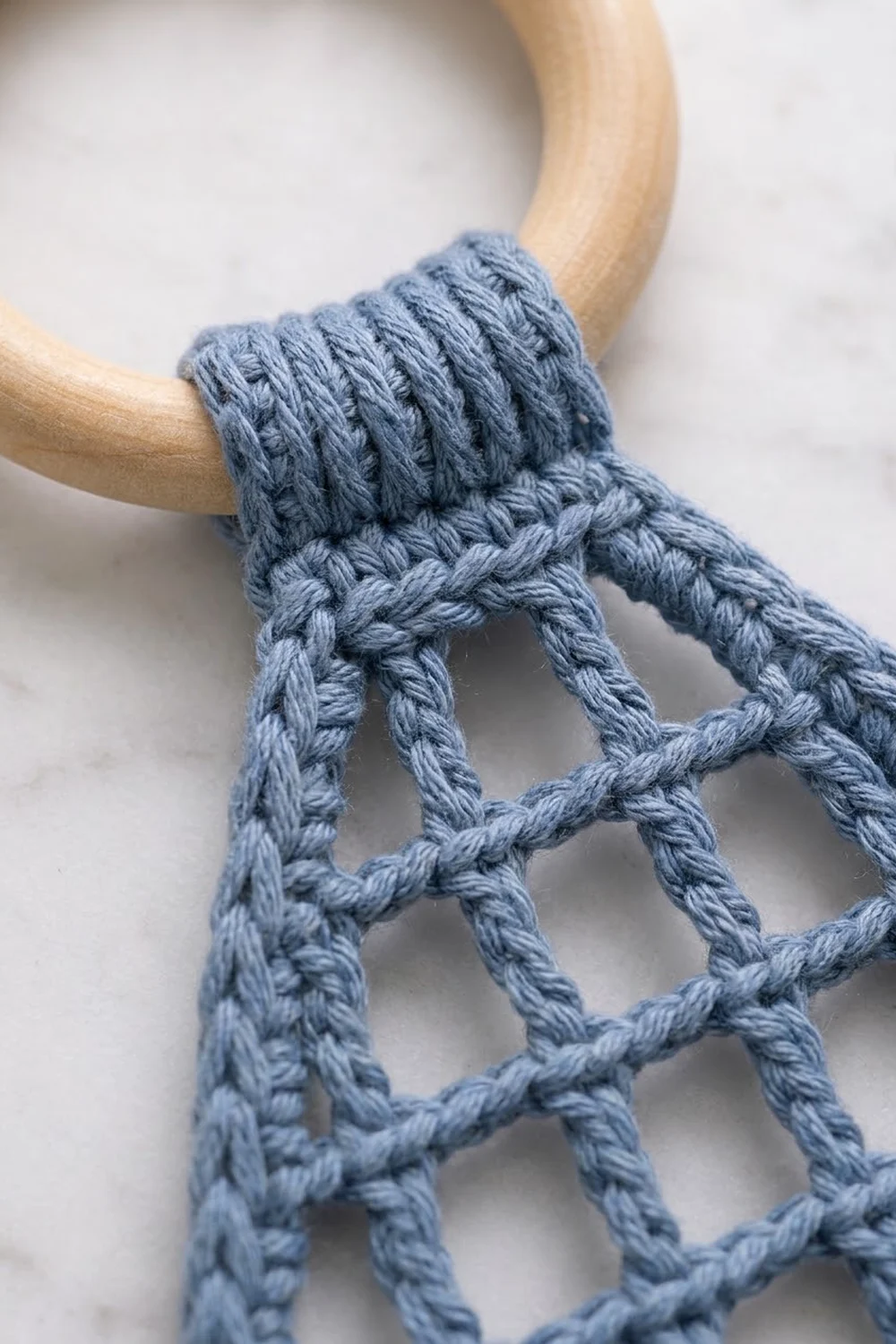
Ring: Pass the strap through the ring from front to back. Fold it down behind the panel and whipstitch the 5 sts of Row 16 to the 5 strap base sts, one to one. The visible loop above the panel is about 1.75 in (4.4 cm).
Pockets: Pin each pocket’s 19 marked back sts to its panel row: Pocket A on Row 28, Pocket B on Row 19 and Pocket C on Row 10.
Stitch-to-stitch logic: Each body row of the panel has 23 sts at 3.5 sts per inch, the same gauge as the pocket rim. So the 19 rim sts match panel sts 3 to 21 exactly, one to one, counting every dc and ch as 1 st. That leaves 2 panel sts free on each side.
Use the pocket tail to whipstitch through both loops of each rim st and into the matching panel st. Then flatten the back wall and tack it, at the level of pocket Rnd 9, to the center st of the panel 7 rows below the rim. That is st 12 of Row 21 for Pocket A, st 12 of Row 12 for Pocket B and st 8 of Row 3 for Pocket C.
Tension: Sew snugly but not tightly. Under each rim, the panel should still measure 19 sts = 5.4 in (13.7 cm). If it gathers, take out the seam and sew it again more loosely.
Size checkpoint: The panel still measures 7.6 in (19.3 cm) x 21 in (53.3 cm). There is a 0.5 in (1.3 cm) mesh gap between pockets at Rows 20 and 11. Each pocket fits a roll up to 4.5 in (11.4 cm) across.
Final Blocking
- Weave in all ends inside solid sc sections, not across the mesh.
- Spray the piece until it is damp but not dripping.
- Lay it flat with the front facing up.
- Pin the border to 7.6 in (19.3 cm) x 21 in (53.3 cm), working outward from the center line.
- Use a long ruler to straighten the mesh columns so the squares line up.
- Fill each pocket with a toilet roll or a rolled towel so it dries in shape.
- Let it dry completely, for at least 24 hours.
Final Quality-Control Checklist
- [ ] Each pocket has 54 sts on Rnd 20 and 27 even mesh openings
- [ ] The panel has 40 rows, with 11 spaces on Rows 5–28 and 3 spaces on Rows 38–40
- [ ] Border Rnd 1 has 168 sc and Rnd 2 has 172 sc
- [ ] Both long sides have 75 sc and lie flat
- [ ] The strap is centered, with 3 sts free on each side
- [ ] The pocket rims sit on Rows 28, 19 and 10, across sts 3–21
- [ ] The panel measures 7.6 in (19.3 cm) x 21 in (53.3 cm)
Troubleshooting
The mesh squares look tall: Shorten the first loop of each dc, or use ch 2 for the turning chains.
The panel edges wander: Make sure you skip each ch-1 sp and work into the dc.
The border ruffles: Change a few 2-sc row ends to 1 sc, the same number on both sides.
The border pulls in: Add 1 sc to a few of the 1-sc row ends, the same number on both sides.
The pockets are too shallow: Add 1 or 2 sc rnds after Rnd 15. Each rnd adds 0.25 in (0.6 cm). Move the lower pockets down to make room.
A pocket sags forward: Add a second tack halfway between the rim and the base tack.
Care
Hand wash in cool water with mild soap, then press out the water in a towel. Reshape and dry flat; hanging it while wet will stretch the strap.

Final Notes
At 3.5 sts per inch, each 54-st pocket rim measures 15.4 in (39.1 cm) around, and its 19 back sts lie flat across 5.4 in (13.7 cm) of the panel. The panel body is 23 sts = 6.6 in (16.8 cm) wide and 40 rows = 20 in (50.8 cm) long. The border adds 0.5 in (1.3 cm) on each edge, for a finished size of 7.6 in (19.3 cm) x 21 in (53.3 cm). The strap and ring bring the hanging length to about 22.75 in (57.8 cm). If each checkpoint matches, the pockets line up and the frame lies flat.
Happy crocheting!