

This curtain panel is a soft lattice of blush-pink butterflies held in an open ivory frame. Each butterfly has scalloped, fan-shaped wings with a row of tiny eyelets, a slim ivory body down the center, and ivory chains that rise into small points above the upper wings. Once the frames are joined, they merge into an airy mesh that lets light through.
The palette is just two colors: blush pink for the wings and warm ivory for the bodies, frames, joins, and border. The look is romantic and vintage, and it works year-round, though it is especially pretty next to soft holiday lights.
This pattern uses US crochet terms. One finished panel measures 19.5 in (49.5 cm) wide and 91.5 in (232.4 cm) long. The photo shows a matching pair, so make two panels for the same look.
You crochet 45 identical framed butterfly blocks and join them as you go on the last round. The grid is 3 blocks wide and 15 blocks long. A two-round border finishes the edges, and the curtain rod slides through the loops of the top border.
Finished Size and Construction
- Finished size (one panel): 19.5 in x 91.5 in (49.5 cm x 232.4 cm)
- Skill level: Intermediate
- Terminology: US crochet terms
- Yarn weight: Worsted (weight 4) cotton or cotton blend
- Hook: US H-8 (5 mm)
- Number of pieces: 45 butterfly blocks per panel (90 for a pair)
- Layout: 3 blocks wide x 15 blocks long
- Block size: 6 in x 6 in (15.2 cm x 15.2 cm) after Frame Round 3
- Size before border: 18 in x 90 in (45.7 cm x 228.6 cm)
- Border depth: 0.75 in (1.9 cm) on each side
Materials
Choose a smooth mercerized or combed cotton. It shows the stitch texture clearly, keeps the scallops crisp, and hangs without stretching. Avoid fuzzy yarns, which blur the mesh.
Quantities are for one panel and assume about 180 m per 100 g. Double them for a pair.
- Blush pink (wings): 250 g, about 450 m
- Ivory (bodies, frames, mesh, border): 300 g, about 540 m
These quantities include a margin of about 10-15% for swatching and weaving in ends.
Tools:
- US H-8 (5 mm) crochet hook
- Tapestry needle
- Stitch markers
- Measuring tape
- Blocking mats and rust-proof pins
- Spray bottle with water
- Scissors
Abbreviations (US Terms)
- ch – chain
- sl st – slip stitch
- sc – single crochet
- dc – double crochet
- tr – treble crochet
- sc2tog – single crochet 2 together
- sp(s) – space(s)
- sk – skip
- st(s) – stitch(es)
- R – row
- [ ] – repeat the instructions inside as directed
Special stitch – mesh join: Wherever you would normally make a ch-3 loop, work ch 1, sl st into the matching loop of the neighboring block, ch 1. This takes the place of the ch-3 loop and links the two blocks.
Gauge and Checkpoints
Gauge: 9 sc = 2 in (5.1 cm) with a 5 mm hook. Work a small sc swatch first. Then make one complete test block before you start the panel.
Checkpoints for the test block:
- Body strip (14 sc): about 3 in (7.6 cm) long.
- Butterfly with all four wings: about 4.5 in x 4.5 in (11.4 cm x 11.4 cm).
- After Frame Round 2: 5.5 in (14.0 cm) square, with 25 sc per side.
- After Frame Round 3: 6 in (15.2 cm) square.
If your block is too big, go down one hook size (4.5 mm). If it is too small, go up one hook size (5.5 mm). Remake the test block until Round 3 measures 6 in (15.2 cm). Every later measurement depends on this number.
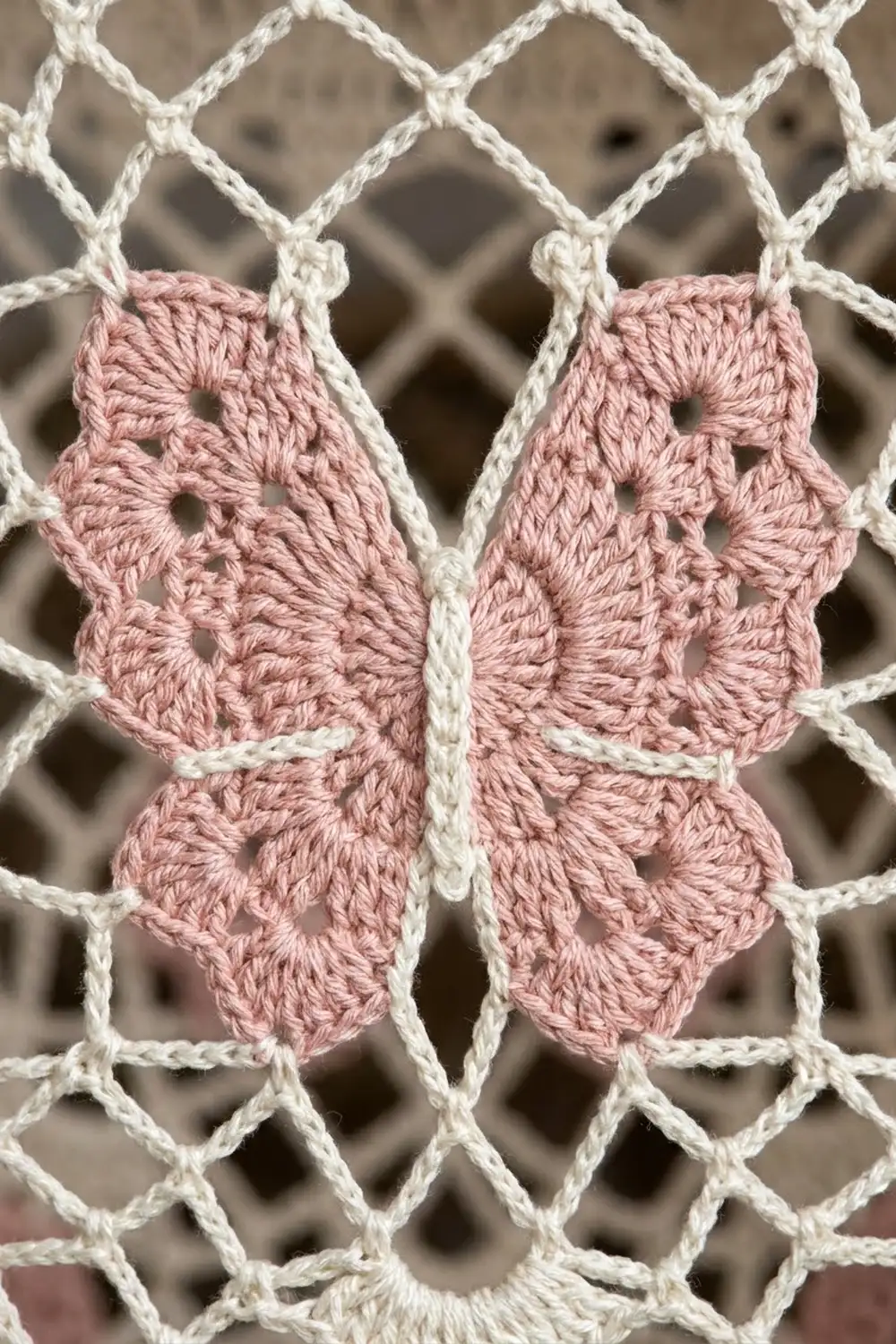
Butterfly Block
Make 45 per panel. The pink wings are worked directly onto an ivory body strip, and the ivory frame is worked around the finished butterfly.
Body (Ivory)
Row 1: Ch 15, sc in 2nd ch from hook and in each ch across. (14 sc)
Fasten off. Hold the strip vertically with the last sc made at the top. That end is the head and the other end is the tail.
Number the sts starting at the head: st 1 is at the head and st 14 is at the tail. Sts 1-8 carry the upper wing and sts 9-14 carry the lower wing.
Right Upper Wing (Pink)
Work into the tops of the sc along the right edge of the body.
Row 1: Join pink in st 1, ch 3 (counts as dc), dc in same st, dc in each of next 6 sts, 2 dc in st 8. Turn. (10 dc)
Row 2: Ch 4 (counts as dc + ch 1), dc in same st, [ch 1, dc in next st] 8 times, ch 1, (dc, ch 1, dc) in top of turning ch. Turn. (12 dc, 11 ch-1 sps)
Row 3: Ch 1, sc in first dc, [sk next ch-1 sp, 7 tr in next ch-1 sp, sk next ch-1 sp, sc in next ch-1 sp] twice, sk next ch-1 sp, 7 tr in next ch-1 sp, sk next ch-1 sp, sc in last dc. (3 shells: 21 tr + 4 sc = 25 sts)
Fasten off. The three tr shells make the scalloped outer edge, and the Row 2 eyelets sit just inside them.
Right Lower Wing (Pink)
Row 1: Join pink in st 9, ch 3 (counts as dc), dc in same st, dc in each of next 4 sts, 2 dc in st 14. Turn. (8 dc)
Row 2: Ch 4 (counts as dc + ch 1), [dc in next st, ch 1] 6 times, dc in top of turning ch. Turn. (8 dc, 7 ch-1 sps)
Row 3: Ch 1, sc in first dc, sk next ch-1 sp, 7 dc in next ch-1 sp, sk next ch-1 sp, sc in next ch-1 sp, sk next ch-1 sp, 7 dc in next ch-1 sp, sk next ch-1 sp, sc in last dc. (2 shells: 14 dc + 3 sc = 17 sts)
Fasten off. Dc shells are shorter than tr shells, so the lower wing comes out smaller and rounder.
Left Wings (Pink)
Turn the body so the free loops of the foundation chain face you, with the head still at the top. Work the Right Upper Wing again into the loops under sts 1-8, then the Right Lower Wing into the loops under sts 9-14. Start Row 1 of each wing at the head end, as before.
Checkpoint: you should have two matching pairs of wings. The upper wings have 3 scallops, the lower wings have 2, and the butterfly is about 4.5 in (11.4 cm) across.
Frame (Ivory)
Round 1: Join ivory with sc in the head end of the body. Ch 11, sc in first sc of right upper wing R3 (top-right corner). Ch 3, sc in 4th tr of first shell, ch 2, sc in 4th tr of next shell, ch 2, sc in 4th tr of last shell, ch 3, sc2tog over last sc of upper wing R3 and first sc of lower wing R3, ch 2, sc in 4th dc of first lower shell, ch 2, sc in 4th dc of next lower shell, ch 3, sc in last sc of lower wing R3 (bottom-right corner). Ch 11, sc in tail end of body. Ch 11, sc in last sc of left lower wing R3 (bottom-left corner). Work up the left side in mirror image: ch 3, sc in 4th dc of shell, ch 2, sc in 4th dc of next shell, ch 2, sc2tog over the two sc between the wings, ch 3, sc in 4th tr of shell, ch 2, sc in 4th tr of next shell, ch 2, sc in 4th tr of last shell, ch 3, sc in first sc of left upper wing R3 (top-left corner). Ch 11, sl st to first sc. (18 sc and 78 ch)
The ch-11 spans arch slightly above the upper wings. This makes the small ivory points at the top of each butterfly.
Round 2: Ch 1, sc in first sc, 11 sc in ch-11 sp, (sc, ch 2, sc) in corner sc, [3 sc in ch-3 sp, sc in next sc, 2 sc in ch-2 sp, sc in next sc, 2 sc in ch-2 sp, sc in next sc] twice, 3 sc in ch-3 sp, (sc, ch 2, sc) in corner sc, 11 sc in ch-11 sp, sc in tail sc, repeat from * to * once, sl st to first sc.
This is a conversion round: 14 non-corner sc worked 1 per st + 4 corners worked 2 per st (8 sc) + 78 sc worked into chain spaces = 100 sc, plus 4 ch-2 corner sps.
Per side:
- Top and bottom: 1 corner sc + 11 + 1 + 11 + 1 corner sc = 25 sc
- Right and left: 1 corner sc + 17 sc in spaces + 6 sc in anchors + 1 corner sc = 25 sc
Round 3 (mesh round): Sl st in each sc up to the next corner ch-2 sp, sl st in sp. Ch 1, (sc, ch 3, sc) in corner sp, ch 3, sk 3 sc, sc in next sc, [ch 3, sk 2 sc, sc in next sc] 6 times, ch 3, sk 3 sc, repeat from * to * 3 more times, sl st to first sc. Fasten off.
Each side has 2 corner sc, 7 side sc, and 8 ch-3 side loops. The round totals 36 sc, 32 side loops, and 4 corner ch-3 loops.
Finish the first block completely. For every later block, work through Round 2, then work Round 3 with the joins described below.
Make All Pieces
Each block uses both colors. Make 45 identical blocks per panel (90 for a pair):
- Pink: 4 wings per block (180 wings per panel)
- Ivory: 1 body and 1 frame per block (45 of each per panel)
Layout grid (one panel, B = butterfly block, head pointing up):
ROW 1:  B B B
ROW 2:  B B B
ROW 3:  B B B
...
ROW 15: B B B
All 15 rows are the same. Keep every butterfly head pointing toward the top of the curtain.
Joining
Method: join-as-you-go on Frame Round 3, using the mesh join.
Work Round 3 of each new block as usual until you reach a side that touches a finished block. Along that side, replace each of the 8 ch-3 side loops with a mesh join into the matching loop of the neighbor, loop 1 to loop 1 through loop 8 to loop 8. At a shared corner, work (sc, ch 1, sl st in neighbor’s corner loop, ch 1, sc).
Where four blocks meet, sl st into the same corner point used by the earlier joins, so all four corners lock together at one spot.
Join Row 1 from left to right. In each later row, join every new block to the block above it and the block to its left.
Tension: keep the ch 1 on each side of the sl st the same size as your normal chains. Tight joins make the lattice pucker, and loose joins make it sag.
Size checkpoint: 3 joined blocks should measure 18 in (45.7 cm) across. After 5 rows, the panel should be 30 in (76.2 cm) long. The finished grid should measure 18 in x 90 in (45.7 cm x 228.6 cm).
Border
Border gauge: 26 sc across each 6 in (15.2 cm) block edge, or 13 sc per 3 in (7.6 cm).
Round 1 (ivory): Join ivory in any outer corner loop of the panel. Work (sc, ch 2, sc) in each of the 4 outer corner loops. Along each block edge, work 3 sc in each of the 8 side loops. At each seam, work 1 sc into the corner loop of each of the two blocks. Each block edge gives 1 + 24 + 1 = 26 sc, counting its two corner loops. Sl st to first sc.
- Short sides: 3 blocks x 26 = 78 sc each
- Long sides: 15 blocks x 26 = 390 sc each
- Total: 936 sc, plus 4 ch-2 corner sps
No extra stitches are added at the seams. The two sc there are already counted in each block’s 26.
Round 2 (ivory mesh): Sl st in next corner ch-2 sp. Ch 1, (sc, ch 3, sc) in corner sp, ch 2, sk 1 sc, sc in next sc, [ch 3, sk 2 sc, sc in next sc] until 1 sc remains before the corner, ch 2, sk 1 sc, repeat from * to * around, sl st to first sc. Fasten off.
- Short sides: 2 corner sc + 26 sc, 25 ch-3 loops, 2 ch-2 end loops
- Long sides: 2 corner sc + 130 sc, 129 ch-3 loops, 2 ch-2 end loops
- Corners: 4 ch-3 loops
Why the math works: each side count is a multiple of 3 (78 = 3 x 26 and 390 = 3 x 130). The mesh stitches land in sc 2, 5, 8 and so on, with the last one in the second-to-last sc. That leaves one skipped sc at each end of every side, so all four corners match.
With the border, the panel is 18 in + 2 x 0.75 in = 19.5 in (49.5 cm) wide and 90 in + 2 x 0.75 in = 91.5 in (232.4 cm) long. Slide the curtain rod through the ch-3 loops of the top border.
Final Blocking
- Weave in all ends along the ivory frame stitches so no tails show through the lattice.
- Lay the panel flat on blocking mats. Work in sections if you are short on space.
- Pin the outer edges to 19.5 in x 91.5 in (49.5 cm x 232.4 cm).
- Pin the corners of each block so the grid stays square, with corners 6 in (15.2 cm) apart.
- Ease each wing scallop open with your fingers and pin the points of the upper wings.
- Spray until damp but not soaked.
- Let the panel dry completely before you unpin it, usually about 24 hours.
Final Quality-Control Checklist
- Every block measures 6 in (15.2 cm) square.
- Every upper wing has 3 tr scallops and every lower wing has 2 dc scallops.
- Every butterfly head points toward the top of the curtain.
- Every joined side has 8 mesh joins and no skipped loops.
- Every four-block corner meets at a single point.
- Border Round 1 has 78 sc on each short side and 390 sc on each long side.
- All border corners in Round 2 match.
- All ends are hidden and trimmed.
Troubleshooting
Wings ruffle: the tr shells are too loose. Use a hook one size smaller for the pink only, or work 6 tr per shell.
Frame pulls the wings flat: the Round 1 chain spans are too tight. Chain more loosely, or use a hook one size larger for that round.
Block is rectangular: count the 25 sc on each side of Round 2 and fix any side that is off.
Lattice sags between blocks: the mesh joins are too loose. Keep the ch 1 on each side of every sl st snug.
Border ripples: recount Round 1 against 26 sc per block edge.
Panel leans: the four-block corners were joined at different points. Undo them and rejoin each at a single spot.
Care
Hand wash in cool water with a mild detergent, roll in a towel to press out the water, and dry flat. Re-pin the edges if the lattice needs straightening.
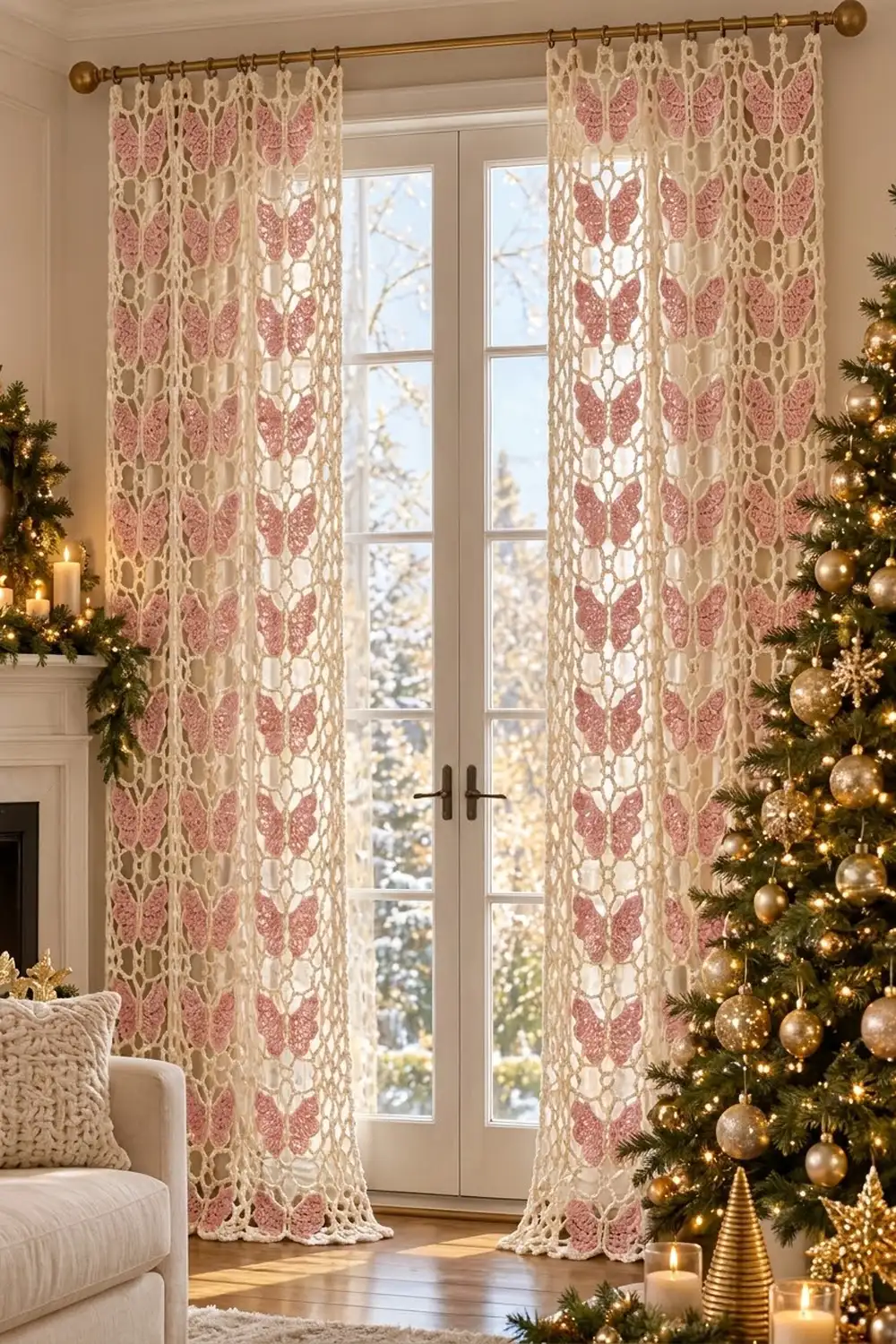
Final Notes
The measurement chain starts with a gauge of 9 sc = 2 in (5.1 cm). Frame Round 2 gives 5.5 in (14.0 cm) with 25 sc per side, and Round 3 brings each block to 6 in (15.2 cm). Three blocks across make 18 in (45.7 cm), and fifteen blocks down make 90 in (228.6 cm). The 0.75 in (1.9 cm) border brings the panel to 19.5 in x 91.5 in (49.5 cm x 232.4 cm).
Check your test block first and keep your joins even, and the butterflies will line up neatly from top to bottom.
Happy crocheting!