

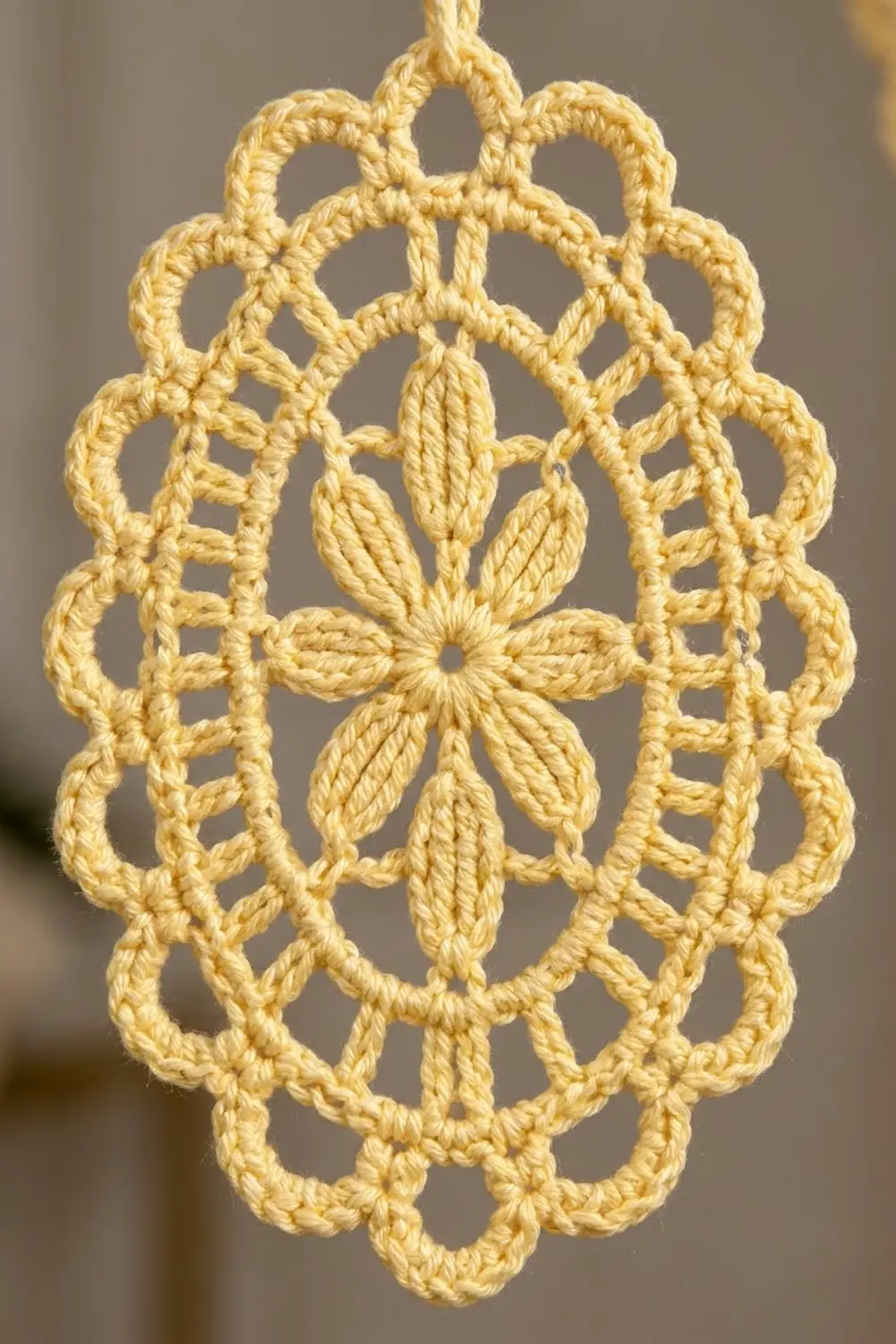
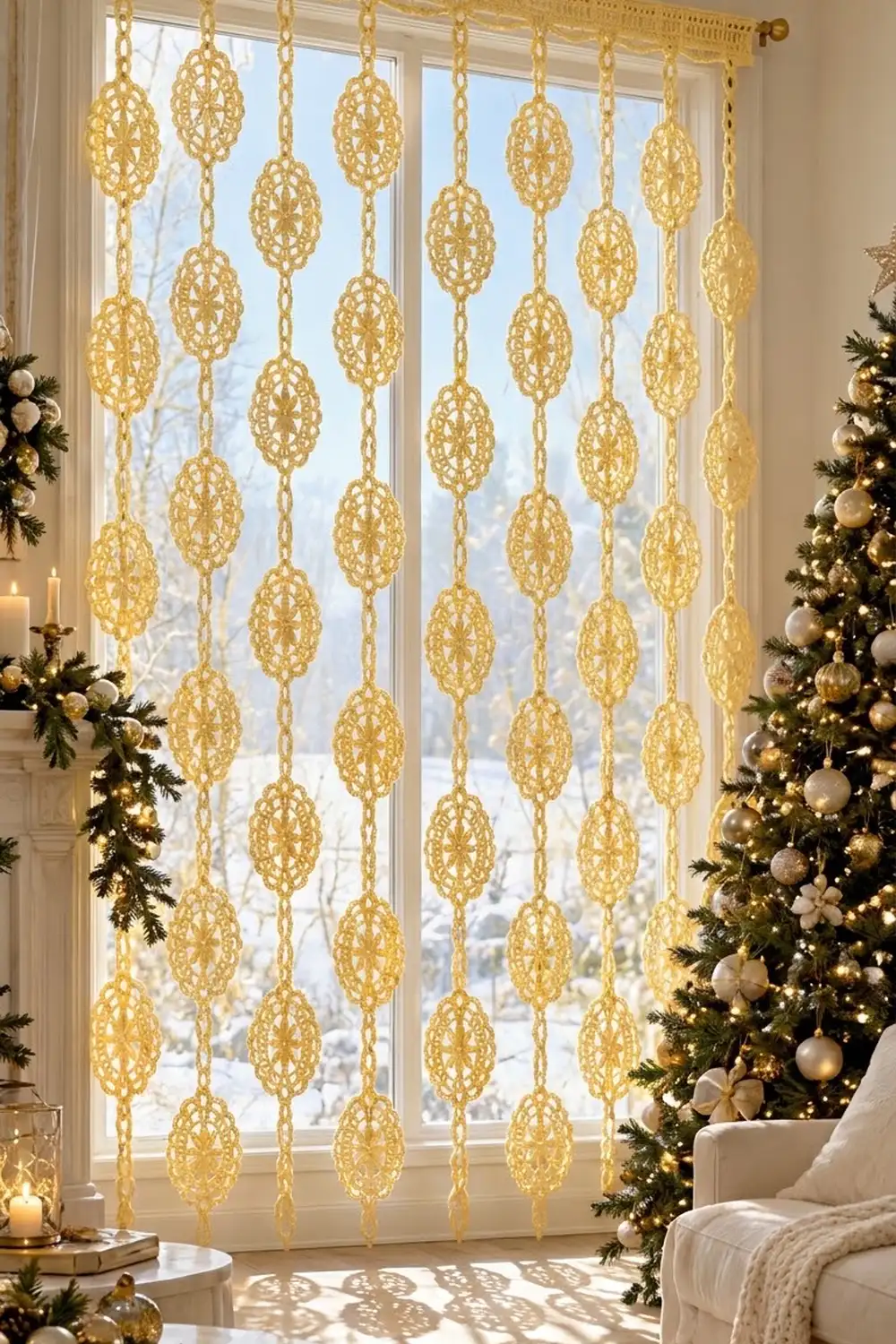
The Butter Blossom Lace Curtain is a hanging screen of oval lace medallions in one soft butter-yellow cotton. Each medallion has an eight-petal flower in the center, a solid oval frame, a ring of open spokes and a scalloped edge.
The medallions hang in eight vertical strands linked by short reinforced chain cords. Every other strand starts lower, so the motifs are staggered and light passes between them. A narrow lace header band holds all eight strands and slides onto a curtain rod with chain tabs.
This pattern uses US crochet terms. The finished curtain is 56 in (142.2 cm) wide. Measured from the top of the header to the end of the tail, the odd strands are 66.5 in (168.9 cm) long and the even strands are 70.5 in (179.1 cm).
Construction is simple. You make 56 identical motifs in the round and crochet the header band in rows. Then you build each strand with chain cords that link one motif to the next.
Finished Size and Construction
- Finished size: 56 in (142.2 cm) wide × 66.5–70.5 in (168.9–179.1 cm) long
- Skill level: Intermediate
- Terminology: US crochet terms
- Yarn weight: DK (#3 light), cotton
- Hook: 3.5 mm (E-4)
- Number of pieces: 56 motifs + 1 header band, linked with chain cords
- Layout: 8 strands × 7 motifs; even strands sit 4 in (10.2 cm) lower
- Motif size: 6 in (15.2 cm) wide × 7 in (17.8 cm) tall
- Size before header: strands hang 65 in (165.1 cm) and 69 in (175.3 cm) below the header
- Header (border) depth: 1.5 in (3.8 cm), plus rod tabs
Materials
Choose a smooth DK cotton or cotton blend with good stitch definition. Mercerized cotton shows the petal clusters crisply and hangs without stretching. Avoid fuzzy or very stretchy yarns, because the strands carry real weight.
- Butter Yellow: 450 g / 1,035 m (9 balls of 50 g / 115 m)
That total covers 56 motifs at about 6 g / 14 m each (336 g), plus about 15 g for the header and about 10 g for the cords. Quantities include a margin of roughly 25% for gauge differences and a test motif.
Tools:
- 3.5 mm (E-4) crochet hook
- Tapestry needle
- Stitch markers (at least 8)
- Measuring tape
- Blocking mats, rustproof pins and a spray bottle
- Curtain rod up to 1 in (2.5 cm) in diameter
Abbreviations (US Terms)
- ch – chain
- sl st – slip stitch
- sc – single crochet
- dc – double crochet
- tr – treble crochet
- dtr – double treble crochet
- yo – yarn over
- sp(s) – space(s)
- st(s) – stitch(es)
Special stitches:
- tr4cl (4-treble cluster): [yo twice, insert hook in st, pull up a loop, (yo, pull through 2 loops) twice] 4 times in the same st, yo, pull through all 5 loops.
- dtr4cl (4-double-treble cluster): [yo 3 times, insert hook in st, pull up a loop, (yo, pull through 2 loops) 3 times] 4 times in the same st, yo, pull through all 5 loops.
- Beginning dtr cluster: ch 5 (counts as first dtr), then work 3 partial dtr in the same st, yo, pull through all 4 loops.
Gauge and Checkpoints
Gauge: 20 sc = 4 in (10.2 cm), and 10 ch = 2 in (5.1 cm), unstretched.
Make one test motif and block it before you make all 56. Check it at each stage:
- After Rnd 1: 0.75 in (1.9 cm) across
- After Rnd 4 (solid frame): 3.25 in (8.3 cm) × 4 in (10.2 cm)
- After Rnd 6 (outer frame): 4.75 in (12.1 cm) × 5.75 in (14.6 cm)
- After Rnd 8, blocked: 6 in (15.2 cm) × 7 in (17.8 cm)
A difference of up to 0.25 in (0.6 cm) either way is fine.
If your motif is too big, switch to a 3.25 mm hook. If it’s too small, switch to a 3.75 mm hook. If only the frame cups or ruffles, change your chain tension in Rnds 3 and 5 rather than the hook.
Motif (make 56)
Every round starts at the top long petal. This keeps the top and bottom attachment points on the long axis of the oval.
Rnd 1: Make a magic ring, ch 1, 16 sc in ring, join with sl st to first sc. Pull the ring tight. (16 sc)
Rnd 2 (petals): Beginning dtr cluster in same st (top long petal), ch 4, skip next st, [tr4cl in next st, ch 4, skip next st] 3 times, dtr4cl in next st (bottom long petal), ch 4, skip next st, [tr4cl in next st, ch 4, skip next st] 3 times, join with sl st to top of beginning cluster. (8 petals: 2 long, 6 short; 8 ch-4 sps)
The two dtr petals sit in sts 1 and 9 and are taller than the six tr petals. This is what makes the round flower an oval.
Rnd 3: Ch 1, (sc, ch 2, sc) in top of same petal, [ch 5, sc in top of next petal] 3 times, ch 5, (sc, ch 2, sc) in top of bottom long petal, [ch 5, sc in top of next petal] 3 times, ch 5, join with sl st to first sc. (10 sc, 2 ch-2 sps, 8 ch-5 sps)
Rnd 4 (solid frame): Ch 1, sc in same st, 3 sc in ch-2 sp, sc in next sc, [5 sc in next ch-5 sp, sc in next sc] 3 times, 5 sc in next ch-5 sp, sc in next sc, 3 sc in ch-2 sp, sc in next sc, [5 sc in next ch-5 sp, sc in next sc] 3 times, 5 sc in last ch-5 sp, join to first sc. (56 sc)
Each half has 1 + 3 + 1 + (5 + 1) × 3 + 5 = 28 sc, and 28 × 2 = 56. The top center is st 3 and the bottom center is st 31.
Rnd 5 (spokes): Ch 5 (counts as dc + ch 2), skip next st, [dc in next st, ch 2, skip next st] 27 times, join with sl st to 3rd ch of beginning ch-5. (28 dc, 28 ch-2 sps)
Each repeat uses 2 sts, and 28 × 2 = 56. The 2nd dc sits at the top center.
Rnd 6 (outer frame): Ch 1, sc in same st, 2 sc in next ch-2 sp, [sc in next dc, 2 sc in next ch-2 sp] 27 times, join to first sc. (84 sc)
This round has 28 sc worked into the dc tops plus 56 sc worked into the spaces, for 84 sc. The top center is now st 4 and the bottom center is st 46.
Rnd 7 (scallop loops): Ch 1, sc in same st, ch 7, skip next 5 sts, [sc in next st, ch 7, skip next 5 sts] 13 times, join to first sc. (14 sc, 14 ch-7 loops)
Each repeat uses 6 sts, and 14 × 6 = 84. Loop 1 is centered over the top petal and loop 8 over the bottom petal.
Rnd 8 (covered scallops): [9 sc in next ch-7 loop, sl st in next sc] 14 times, working the last sl st into the joining st. Fasten off. (126 sc in 14 scallops)
The 5th sc of loop 1 is the top attachment point, and the 5th sc of loop 8 is the bottom attachment point. Mark both on every motif.
Weave in the ends securely and split the yarn as you weave. A lace curtain moves every time a window opens, so loose ends will work free.
Make All Pieces
- Butter Yellow motifs: 56 (8 strands × 7 motifs)
- Header band: 1
Block every motif to 6 in (15.2 cm) × 7 in (17.8 cm) before joining. Sort them into 8 stacks of 7.
Layout grid seen from the front. M = motif, – = cord or gap. Each line gives the drop from the header to the top of that tier.
HEADER:        S1 S2 S3 S4 S5 S6 S7 S8
ROW 1 (2 in):  M  -  M  -  M  -  M  -
ROW 2 (6 in):  -  M  -  M  -  M  -  M
ROW 3 (11 in): M  -  M  -  M  -  M  -
ROW 4 (15 in): -  M  -  M  -  M  -  M
...continue alternating every 4.5–5 in...
ROW 13 (56 in): M  -  M  -  M  -  M  -
ROW 14 (60 in): -  M  -  M  -  M  -  M
Odd strands start 2 in (5.1 cm) below the header and even strands start 6 in (15.2 cm) below it. That puts every even motif 4 in (10.2 cm) lower than its odd neighbors.
Header Band (Border)
The header is the curtain’s only border. Work it first so the strands have something to hang from.
Border gauge: 20 sc = 4 in (10.2 cm), so 5 sc = 1 in (2.5 cm).
Each strand gets a 35-st section of the header, which is 7 in (17.8 cm) wide. The strand hangs from the center st of its section (st 18), with 17 sts on each side.
Foundation: Ch 281.
Row 1: Sc in 2nd ch from hook and in each ch across, turn. (280 sc)
Row 2: Ch 3 (counts as first dc), dc in each remaining st across, turn. (280 dc)
Row 3 (mesh): Ch 3 (counts as dc), dc in next st, ch 1, skip next st, [dc in next 2 sts, ch 1, skip next st] 91 times, dc in last 4 sts, turn. (188 dc, 92 ch-1 sps)
That is 92 repeats × 3 sts = 276 sts, plus 4 = 280 sts.
Row 4: Ch 1, sc in each dc and each ch-1 sp across, turn. (280 sc: 188 + 92)
Row 5 (rod tabs): Ch 1, [sc in next 17 sts, (sc, ch 20, sl st) in next st, sc in next 17 sts] 8 times. Fasten off. (280 sc, 8 ch-20 tabs)
Each tab is 4 in (10.2 cm) of chain and fits a rod up to 1 in (2.5 cm) thick.
Why the math works: 8 strands × 35 sts = 280 sts, and 280 ÷ 5 sts per inch = 56 in (142.2 cm). Each tab sits directly above its strand. The header is 1.5 in (3.8 cm) deep: three sc rows at 0.2 in (0.5 cm) each plus two dc rows at 0.45 in (1.1 cm) each.
Joining: Building the Strands
Each cord is a chain worked between two fixed points and then slip-stitched back along itself. This doubles the cord so it doesn’t stretch under the weight of the motifs.
Header anchor points: On the underside of Row 1 (the foundation chain), mark st 18 of each section: sts 18, 53, 88, 123, 158, 193, 228 and 263. That leaves 17 sts outside the first and last anchors, so the layout is symmetric.
Top cord, odd strands (S1, S3, S5, S7): Join yarn with sl st at the header anchor, ch 10, sl st in the top attachment point of motif 1, then sl st in the back bump of each ch back to the header. Fasten off. (10 ch = 2 in / 5.1 cm)
Top cord, even strands (S2, S4, S6, S8): Work the same way, but ch 30. (30 ch = 6 in / 15.2 cm)
Connector cords: Join yarn with sl st in the bottom attachment point of the upper motif, ch 10, sl st in the top attachment point of the next motif, then sl st in the back bump of each ch back up. Fasten off. Repeat until all 7 motifs hang in the strand. (6 connectors per strand)
Tail: Join yarn at the bottom attachment point of motif 7, ch 10, sl st in 2nd ch from hook and in each ch back up. Fasten off. (2 in / 5.1 cm)
Always join stitch to stitch: the 5th sc of a bottom scallop to the 5th sc of the next motif’s top scallop. This keeps every motif on the same center line.
Tension: Keep the chain at gauge (10 ch = 2 in, or 5.1 cm). Loose cords sag and throw off the stagger. Tight cords pucker the scallops at the joins.
Size checkpoint: The motif pitch (one motif plus one connector) is 7 in + 2 in = 9 in (22.9 cm). Odd strands measure 2 + (7 × 7) + (6 × 2) + 2 = 65 in (165.1 cm) below the header. Even strands measure 6 + 49 + 12 + 2 = 69 in (175.3 cm). Measure each strand before you start the next.
Final Blocking
- Lay the curtain flat on blocking mats, one strand at a time.
- Mist each motif with water until damp, not dripping.
- Shape each motif to 6 in (15.2 cm) × 7 in (17.8 cm). Open every scallop and straighten the spokes.
- Pin the header flat to 56 in (142.2 cm) × 1.5 in (3.8 cm).
- Straighten each cord so it lies on the strand’s center line.
- Let everything dry completely, at least 12 hours, before hanging.
Final Quality-Control Checklist
- All 56 motifs measure 6 in (15.2 cm) × 7 in (17.8 cm), within 0.25 in (0.6 cm).
- Each motif has 2 long petals on the vertical axis and 6 short petals.
- Rnd 5 has 28 spokes and Rnd 7 has 14 loops.
- The header has 280 sts and 8 tabs centered over the strands.
- Each strand has 1 top cord, 7 motifs, 6 connectors and 1 tail.
- Even strands sit 4 in (10.2 cm) lower than odd strands.
- All cords are doubled with sl sts, and no ends are loose.
Troubleshooting
Motif is round, not oval: Check that the top and bottom petals are dtr4cl, not tr4cl, and that they sit opposite each other in sts 1 and 9.
Frame ruffles after Rnd 6: The ch-2 sps in Rnd 5 are too loose. Chain more tightly, or work that round one hook size smaller.
Frame cups: Your sc tension is too tight. Go up half a hook size for Rnds 4 and 6.
Motifs hang crooked: A cord was joined off-center. Rejoin it at the 5th sc of the correct scallop.
Header curves or waves: Recount Row 3. It must be 92 repeats plus 4 dc, for 280 sts.
Strands stretch over time: Check that every cord is slip-stitched back along itself.
Care
Hand wash in cool water with mild soap, roll in a towel to press out the water, and dry flat. Don’t wring it, and don’t hang it while it’s soaking wet.
Final Notes
Here is the full measurement chain. A gauge of 20 sc = 4 in (10.2 cm) gives a motif of 6 in (15.2 cm) × 7 in (17.8 cm). Seven motifs, six 2 in (5.1 cm) connectors, a top cord and a tail make each strand 65 in (165.1 cm) or 69 in (175.3 cm) long. Eight 35-st sections make a 280-st header that is 56 in (142.2 cm) wide and 1.5 in (3.8 cm) deep.
Check your test motif and keep your chain tension steady, and the staggered layout will come out right.
Happy crocheting!