

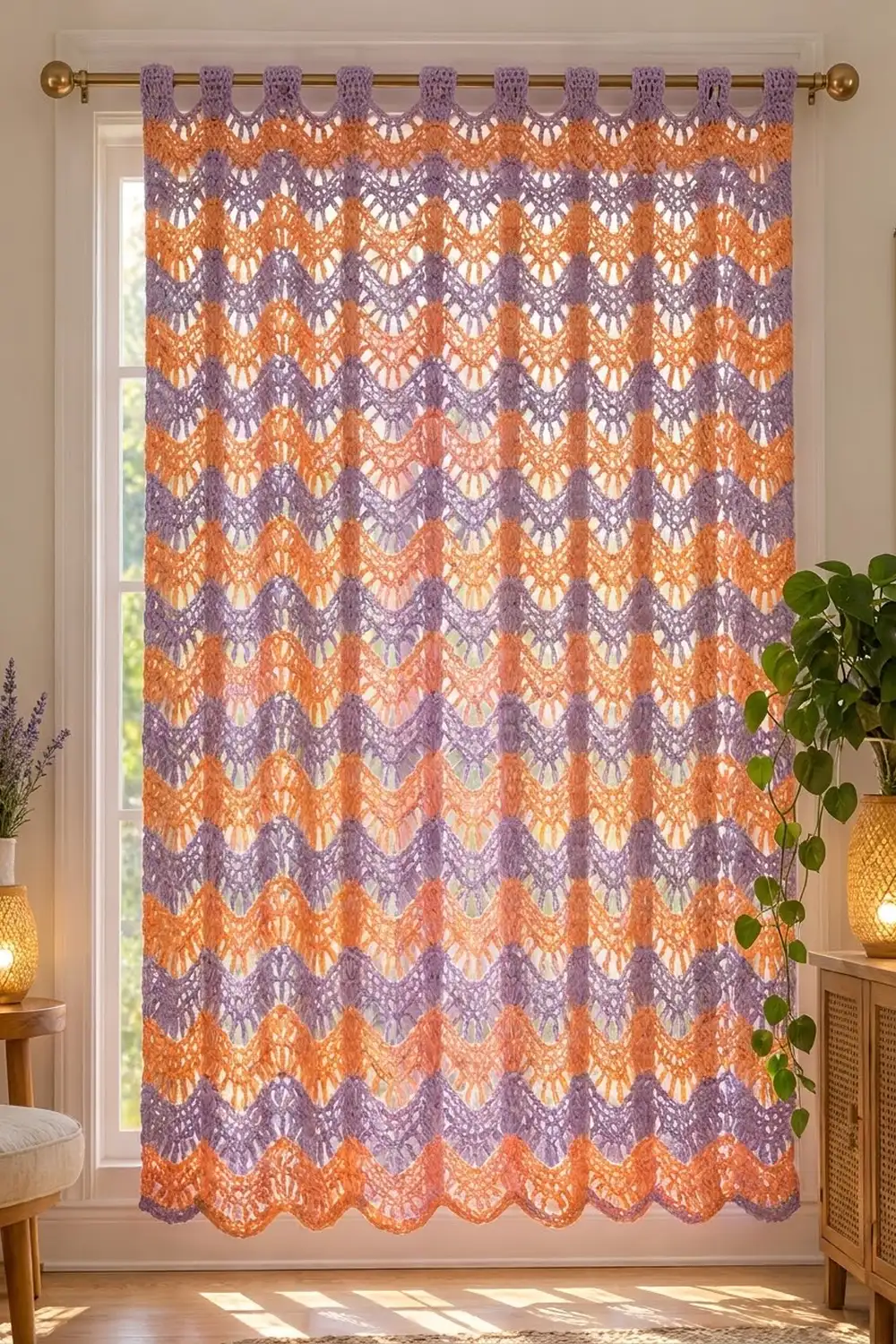
This curtain panel is built from soft rows of open fans that stack into gentle waves. Two-row stripes of warm orange and pale lavender alternate from hem to rod, and daylight shows through every fan.
The style is airy and a little retro, but the construction is simple. Each stripe is one row of fans plus a row of offset fans, so the waves interlock without any extra shaping. A scalloped orange hem softens the bottom edge, and lavender tab loops slide straight onto a curtain rod.
The pattern uses US crochet terms. The finished panel measures 41 in wide x 62 in long (104.1 cm x 157.5 cm), not counting the tab loops. The tabs add about 3 in (7.6 cm) above the top edge.
You’ll crochet one rectangular piece in rows, add a short leveling band at the top, and work a two-round border all the way around. Then you’ll finish with 11 tabs worked directly onto the top edge. The only sewing is folding down the tabs.
Finished Size and Construction
- Finished size: 41 in x 62 in (104.1 cm x 157.5 cm), plus tab loops of about 3 in (7.6 cm)
- Skill level: Intermediate
- Terminology: US crochet terms
- Yarn weight: Worsted (#4) cotton or cotton blend
- Hook: 5.0 mm (H-8)
- Number of pieces: 1 panel, with 11 tabs worked onto it
- Layout: 10 pattern repeats wide, 40 two-row stripes tall
- Piece size (body only, Rows 1–80): 40 in x 60 in (101.6 cm x 152.4 cm)
- Size before border (with top band): 40 in x 60.5 in (101.6 cm x 153.7 cm)
- Border depth: 0.5 in (1.3 cm) on the sides and top, 1 in (2.5 cm) on the scalloped bottom
Materials
Choose a smooth combed or mercerized cotton in worsted weight. Cotton holds the fan shapes crisply and doesn’t fuzz in sunlight. A cotton-acrylic blend is lighter if your rod is thin. Avoid splitty or very fuzzy yarn, because the open fans show every stitch.
- Orange: 700 g, about 1,120 m (1,225 yd)
- Lavender: 650 g, about 1,040 m (1,137 yd)
These amounts assume roughly 160 m per 100 g. They include a margin of about 10 percent for gauge differences and swatching.
Tools:
- 5.0 mm (H-8) crochet hook
- Tapestry needle
- Locking stitch markers (at least 4)
- Measuring tape
- Blocking mats or a large towel-covered surface, plus rust-proof pins
- Spray bottle
- Scissors
Abbreviations (US Terms)
- ch – chain
- sl st – slip stitch
- sc – single crochet
- hdc – half double crochet
- dc – double crochet
- tr – treble crochet
- sk – skip
- st(s) – stitch(es)
- sp – space
- RS / WS – right side / wrong side
- rep – repeat
Special stitches:
- Fan: (dc, ch 1) 5 times, then dc, all in the same st. One Fan = 6 dc + 5 ch-1 sps = 11 sts. The center of a Fan is its 3rd ch-1 sp.
- Beginning Half Fan: ch 3 (counts as dc), dc in same st, ch 1, dc in same st, ch 1, dc in same st = 6 sts.
- Ending Half Fan: (dc, ch 1) 2 times, then 2 dc, all in the last st = 6 sts.
- Scallop: 5 dc in the same st.
Counting rule: In every pattern row, each ch-1 sp counts as one stitch. Every pattern row has 121 sts.
Gauge and Checkpoints
Pattern gauge after blocking:
– Width: 1 repeat (12 sts) = 4 in (10.2 cm).
– Height: 4 rows (one orange stripe plus one lavender stripe) = 3 in (7.6 cm).
Test a swatch first. Ch 38. Work Rows 1–8 exactly as written below, using 37 sts instead of 121:
– Row 1: 4 sc + 3 Fans = 37 sts.
– Row 2: 2 Half Fans + 3 sc + 2 Fans = 37 sts.
Block the swatch. It should measure 12 in x 6 in (30.5 cm x 15.2 cm).
Checkpoints for the panel:
- After Row 4: width 40 in (101.6 cm), height 3 in (7.6 cm)
- After Row 20: height 15 in (38.1 cm)
- After Row 40: height 30 in (76.2 cm)
- After Row 80: height 60 in (152.4 cm)
- After Row 82: height 60.5 in (153.7 cm)
Measure flat and lightly stretched, the way the panel will be blocked.
If your swatch is too big, go down 0.5 mm in hook size. If it’s too small, go up 0.5 mm. Don’t change stitch counts. The 12-st repeat sets the width, and the border and tab math depend on 121 sts per row.
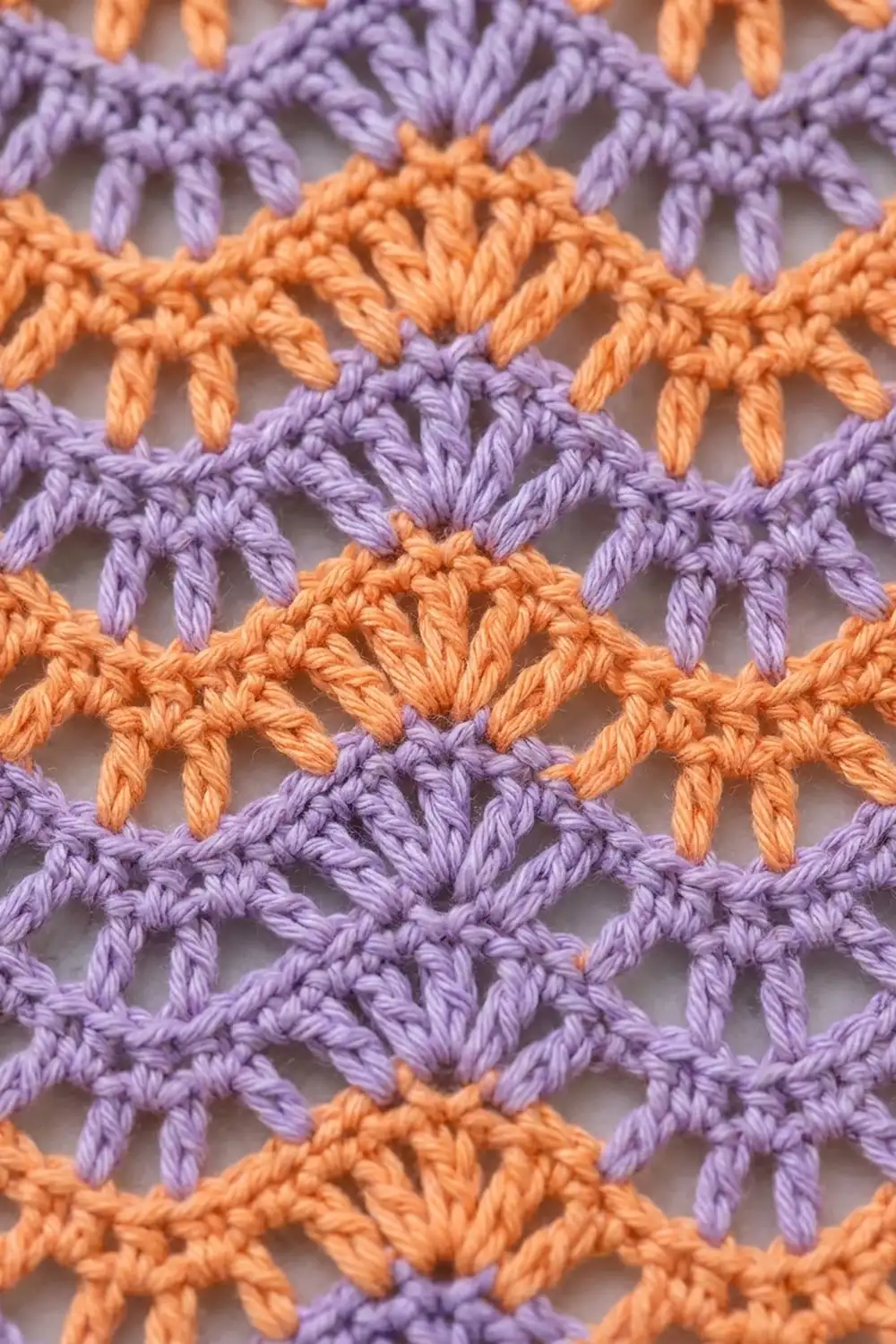
Main Pattern: Curtain Body
The body is a 2-row lace pattern. Odd rows put the Fans in one position. Even rows put each Fan on the sc between two Fans from the row below. That offset creates the wave.
Color sequence: Work 2 rows in orange, then 2 rows in lavender, and repeat. All color changes happen at the right edge (as seen from the RS). Change color on the last yarn-over of each stripe’s second row, and carry the unused yarn loosely up the side. The border will cover it.
Foundation: With orange, ch 122.
Row 1 (RS, orange): Sc in 2nd ch from hook, sk 5 ch, Fan in next ch, sk 5 ch, sc in next ch; rep from * across. Turn.
Count: 11 sc + 10 Fans = 121 sts.*
Row 2 (WS, orange): Beginning Half Fan in first sc, sk 5 sts, sc in next st (center ch-1 sp of Fan), sk 5 sts, Fan in next sc, sk 5 sts, sc in next st (center of Fan); rep from * 8 more times, sk 5 sts, Ending Half Fan in last sc. Turn. Change to lavender on the last yarn-over.
Count: 2 Half Fans (12 sts) + 10 sc + 9 Fans (99 sts) = 121 sts.*
Row 3 (RS, lavender): Ch 1, sc in first st, sk 5 sts, Fan in next sc, sk 5 sts, sc in next st (center of Fan); rep from * across, placing the last sc in the top of the beginning ch-3. Turn.
Count: 11 sc + 10 Fans = 121 sts.*
Row 4 (WS, lavender): Work as Row 2. Change to orange on the last yarn-over.
Count: 121 sts.
Rows 5–80: Rep Rows 3–4, keeping the 2-row stripe sequence:
– Rows 5–6: orange
– Rows 7–8: lavender
– Continue alternating. Rows 77–78 are orange, and Rows 79–80 are lavender.
Every row has 121 sts. That gives 40 stripes and 20 full color repeats: 20 x 3 in = 60 in (152.4 cm).
Top Leveling Band (Lavender)
Row 80 ends in Fan tops. They’re high in the middle of each Fan and low at each sc. This band fills the dips so the tabs sit on a straight edge. Work into every st and every ch-1 sp.
Row 81 (RS, lavender): Ch 1, sc in first 2 sts, hdc in next 2 sts, dc in next 2 sts, tr in next sc, dc in next 2 sts, hdc in next 2 sts, sc in next 3 sts, hdc in next 2 sts, dc in next 2 sts, tr in next sc; rep from * 8 more times, dc in next 2 sts, hdc in next 2 sts, sc in last 2 sts. Turn.
Count: 7 + (12 x 9) + 6 = 121 sts.*
Each tr lands on a low sc, and each group of 3 sc lands on a Fan center. That levels the top.
Row 82 (WS, lavender): Ch 1, sc in each st across. Fasten off.
Count: 121 sc.
The panel now measures 40 in x 60.5 in (101.6 cm x 153.7 cm).
Border
Border gauge: 3 sc per inch (per 2.54 cm) along the top and bottom, which matches the body’s 12 sts per 4 in. Along the sides, work 9 sc per 4-row color repeat (3 in / 7.6 cm). That’s also 3 sc per inch. Add 2 sc for the leveling band.
The corner ch-2 sps are not counted in the side totals below.
Round 1 (RS, orange): With RS facing, join orange in the top right corner st (the last st of Row 82).
- Top: Ch 1, sc in each st across = 121 sc. Ch 2 (corner).
- Left side: Work 1 sc in the end of Row 82 and 1 sc in the end of Row 81. Then work 9 sc evenly across every 4 rows (2 sc in each row end, plus 1 extra in every 4th row end) down to the foundation = 2 + (9 x 20) = 182 sc. Ch 2 (corner).
- Bottom: Working in the free loops of the foundation ch, sc in each ch across = 121 sc. Ch 2 (corner).
- Right side: Work as the left side, going upward = 182 sc. Ch 2 (corner). Sl st to the first sc.
Count: 121 + 182 + 121 + 182 = 606 sc, plus 4 corner ch-2 sps.
Round 2 (RS, orange): Don’t turn. Ch 1, then sc in the same st and in each sc around, working (sc, ch 2, sc) in each corner ch-2 sp. Work the bottom edge as scallops instead of plain sc. The finished side counts are:
- Top: 121 sc + 1 sc from each top corner = 123 sc
- Each side: 1 corner sc + 182 sc + 1 corner sc = 184 sc
- Bottom: Work 1 corner sc. Then sc in the first sc, *sk 2 sc, Scallop in next sc, sk 2 sc, sc in next sc; rep from * 19 more times. Finish with 1 corner sc. That’s 20 Scallops (100 dc) + 21 sc + 2 corner sc = 123 sts.
Sl st to the first sc. Fasten off.
Why the math works: The bottom edge has 121 sts, and 121 = 1 + (20 x 6). The 6-st scallop repeat fits exactly, with a sc at both ends. Twenty scallops across 40 in (101.6 cm) give one scallop every 2 in (5.1 cm), which echoes the waves above. The sides use the same 3-sc-per-inch rate as the top, so the edges won’t ruffle or pull in.
Hanging Tabs (Lavender)
The top edge now has 123 sc. The tabs use 11 x 7 sts = 77 sts. There are 10 gaps of 4 sts = 40 sts, plus 3 free sts at each end: 3 + 77 + 40 + 3 = 123.
Tab 1: With RS facing and the top edge up, sk the first 3 sc from the right corner. Join lavender in the 4th sc.
- Row 1: Ch 1, sc in same st and in next 6 sts = 7 sc. Turn.
- Rows 2–24: Ch 1, sc in each sc = 7 sc. Turn.
Fasten off, leaving a 12 in (30.5 cm) tail. The tab should measure 6 in (15.2 cm) long and about 2.3 in (5.8 cm) wide.
Tabs 2–11: Sk 4 sc after the previous tab and work the next tab over the following 7 sc. After Tab 11, exactly 3 sc remain free.
Finishing tabs: Fold each tab to the WS. Whipstitch its last row to the WS of Border Round 1, just behind the tab’s base. Each loop stands about 3 in (7.6 cm) tall and fits rods up to about 1.5 in (3.8 cm) across. The 4-st gaps are about 1.3 in (3.3 cm) wide.
Final Blocking
- Weave in all ends along stitch paths. Hide the carried-yarn ends inside the side border.
- Soak the panel in cool water for 15 minutes, then press out the water. Don’t wring it.
- Roll it in towels to remove more moisture.
- Lay it flat on mats or a towel-covered floor, RS up.
- Pin the top edge straight to 41 in (104.1 cm).
- Pin the sides to 62 in (157.5 cm), keeping them parallel.
- Pin each bottom scallop into a smooth curve.
- Gently open each Fan with your fingers so the ch-1 sps are even.
- Let it dry completely before hanging.
Final Quality-Control Checklist
- Every pattern row has 121 sts.
- Stripes alternate 2 orange rows and 2 lavender rows, starting with orange and ending with lavender.
- Each Fan sits on a sc, and each sc sits in a Fan center.
- The top band is level, with no dips above the sc points.
- Border Round 2 has 123 sts on the top and bottom and 184 sc on each side.
- There are 20 scallops and 11 tabs.
- The blocked panel measures 41 in x 62 in (104.1 cm x 157.5 cm).
- All ends are woven in securely, especially at the tabs, since they carry the weight.
Troubleshooting
The Fans look crooked. You probably put the sc in the wrong ch-1 sp. The center is always the 3rd ch-1 sp, 5 sts in from either edge of the Fan.
A row has the wrong count. Check the Half Fans. Each must have 6 sts, with 2 dc together at the outer edge.
The sides are wavy. You worked too many sc along the row ends. Stick to 9 sc per 4 rows.
The sides pull in. Either you worked too few sc or the carried yarn is too tight. Loosen the carries and recheck the count.
The panel grows longer after hanging. Cotton relaxes under its own weight. Re-block it and let it dry flat before rehanging.
The tabs flip forward. Sew the folded end firmly to the WS of Round 1, not to the top loops.
Care
Hand wash in cool water with a mild detergent and dry flat. Don’t hang the panel while it’s wet, because the weight will stretch the lace.
Final Notes
The whole panel follows one measurement chain:
– One 12-st repeat equals 4 in (10.2 cm), so 10 repeats give 121 sts and 40 in (101.6 cm).
– Four rows equal 3 in (7.6 cm), so 80 rows give 60 in (152.4 cm).
– The leveling band adds 0.5 in (1.3 cm).
– The border adds 0.5 in (1.3 cm) on the top and sides and 1 in (2.5 cm) on the bottom.
That gives a final size of 41 in x 62 in (104.1 cm x 157.5 cm). If your swatch matches and every row holds 121 sts, every later step will fit.
Happy crocheting!