

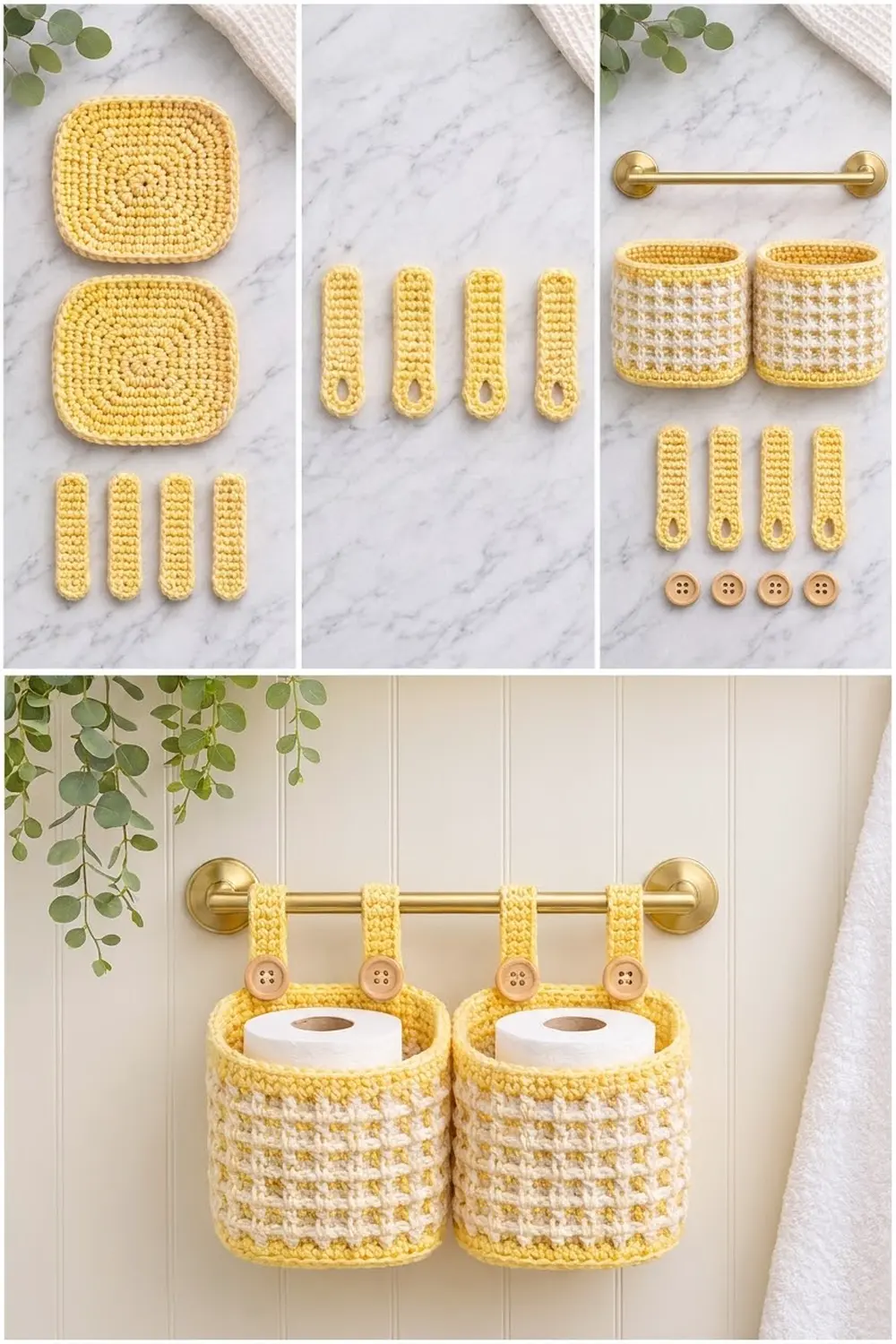
This pair of small hanging baskets brings a soft, sunny look to a bathroom wall. Each basket has a sturdy yellow base, a textured cream-and-yellow check around the walls, and two button tabs that loop over a towel rod. Each one holds a toilet paper roll, washcloths, or small bottles.
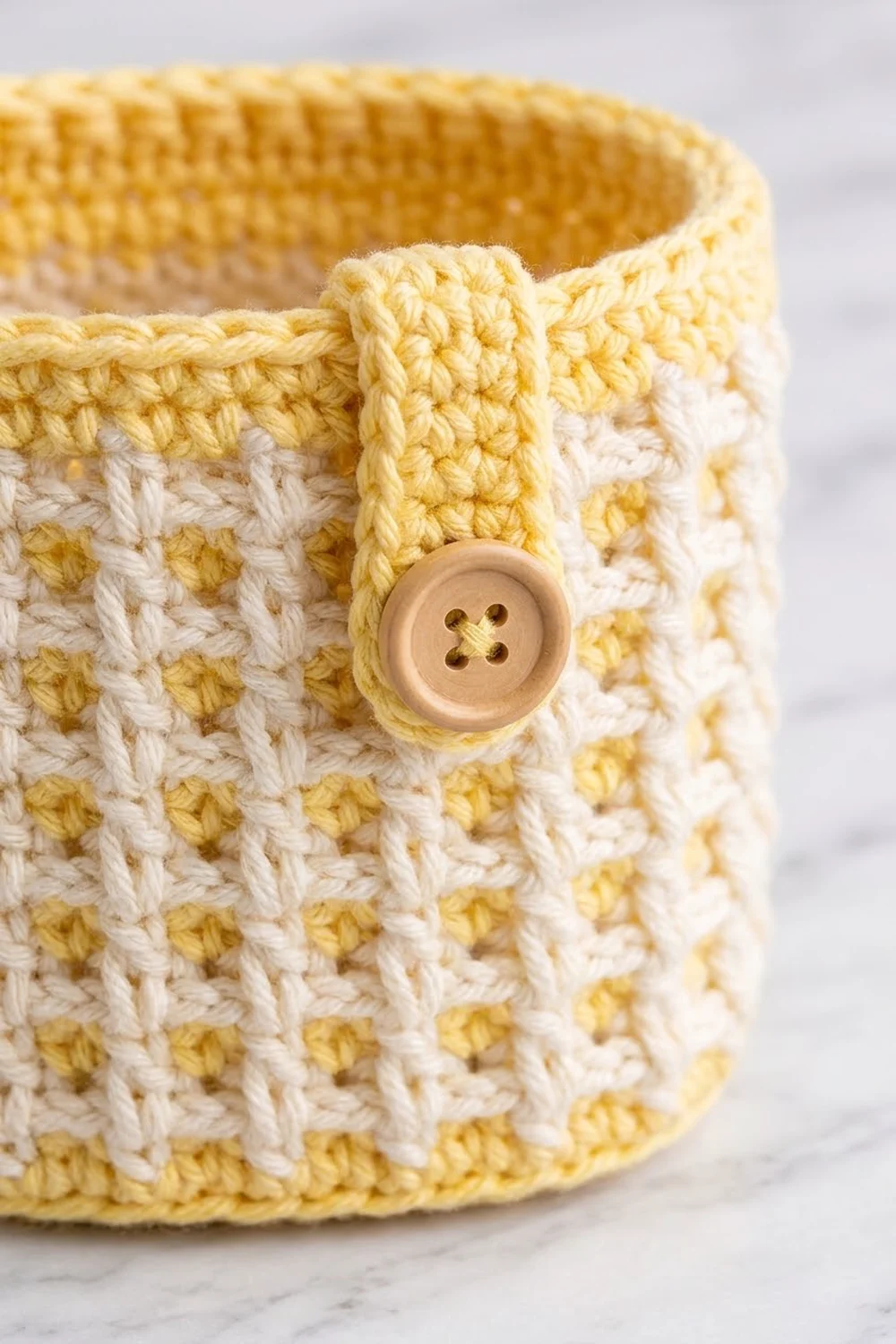
The colors are butter yellow and cream. The yellow frames everything: the base, the bottom band, the thin raised grid lines, the top band, and the corded rim. Natural wooden buttons finish the cottage-style look.
This pattern uses US crochet terms. Each finished basket measures about 6.75 in (17.1 cm) wide, 4 in (10.2 cm) deep, and 5 in (12.7 cm) tall. Each tab measures 1.5 in (3.8 cm) wide and 6.2 in (15.7 cm) long.
You work the base in joined oval rounds. Then you turn up the walls through the back loops and work the check in rounds, using spike stitches that drop yellow lines over the cream. A crab stitch rim finishes the top. You work the tabs flat, edge them, sew them inside the back of each basket, and button them to the front.
Finished Size and Construction
- Finished basket size: 6.75 x 4 x 5 in (17.1 x 10.2 x 12.7 cm)
- Skill level: Intermediate (spike stitches, color changes)
- Terminology: US crochet terms
- Yarn weight: Worsted (#4) cotton
- Hook: 4.5 mm (US 7)
- Number of pieces: 2 baskets, 4 tabs, 4 buttons
- Layout: 2 baskets side by side on one rod, with 2 tabs each
- Base size (per basket): 6.75 x 4 in (17.1 x 10.2 cm), 72 stitches around
- Wall height before rim: 4.7 in (11.9 cm)
- Rim (border) depth: about 0.25 in (0.6 cm), 1 round of crab stitch
Materials
Use a smooth, firm worsted-weight cotton or cotton blend. Cotton holds the basket’s shape and handles bathroom humidity well. Avoid splitty yarns, because the spike stitches need clean loops.
- Color Y (butter yellow): 100 g, about 160 m (175 yd)
- Color C (cream): 50 g, about 80 m (87 yd)
- 4.5 mm (US 7) crochet hook
- 4 wooden buttons with 4 holes, 0.75 in (1.9 cm)
- At least 4 stitch markers
- Tapestry needle
- Towel rod at least 16 in (40.6 cm) long, with a bar no thicker than 0.75 in (1.9 cm)
All quantities include a margin of about 25 percent for swatching and differences between brands.
Abbreviations (US Terms)
- ch – chain
- sc – single crochet
- inc – 2 sc in the same stitch
- sl st – slip stitch
- BLO – back loop only
- st(s) – stitch(es)
- rnd(s) – round(s)
- rev sc – reverse single crochet (crab stitch)
- Y / C – yellow / cream
Spike single crochet (spike): Insert the hook into the top of the matching stitch 3 rounds below (the last yellow round). Yarn over and pull up a long loop to the height of the current round. Yarn over and pull through both loops. Skip the stitch behind the spike. The long yellow loop covers 2 cream rounds and forms one vertical grid line.
Rev sc (crab stitch): Work sc from left to right (right-handed), inserting the hook into the next stitch to the right.
Gauge and Checkpoints
Gauge: 16 sc and 18 rnds = 4 in (10.2 cm), worked firmly.
Make one complete base first and use it as your gauge test. It shows your real round gauge better than a flat swatch.
- After Rnd 5: the base measures about 5 x 2.2 in (12.7 x 5.6 cm).
- After Rnd 9: the base measures 6.75 x 4 in (17.1 x 10.2 cm) and 18 in (45.7 cm) around.
- After Rnd 12: the wall is about 0.7 in (1.8 cm) tall.
- After Rnd 27: the wall is about 4 in (10.2 cm) tall.
- After Rnd 30: the wall is 4.7 in (11.9 cm) tall.
If the base is too big, change to a 4 mm (US G-6) hook. If it is too small, change to a 5 mm (US H-8) hook. If it ripples, go down a hook size; if it cups, go up one. Do not change the stitch counts, because the wall pattern needs exactly 72 stitches.
Basket Base (make 2)
Work in joined rounds. At the end of each round, sl st to the first sc and ch 1 (the ch 1 does not count as a stitch).
With Y, ch 12.
Rnd 1: Sc in 2nd ch from hook, sc in next 9 ch, 3 sc in last ch. Working along the underside of the chain: sc in next 9 ch, 2 sc in last ch (same ch as first sc). Join. (24 sts)
The base now has two straight sides of 9 sts and two ends of 3 sts.
Rnd 2: Inc in first st, sc 9, inc in each of next 3, sc 9, inc in each of next 2. Join. (30 sts)
Rnd 3: Sc 1, inc, sc 9, [sc 1, inc] 3 times, sc 9, [sc 1, inc] 2 times. Join. (36 sts)
Rnd 4: Sc 2, inc, sc 9, [sc 2, inc] 3 times, sc 9, [sc 2, inc] 2 times. Join. (42 sts)
Rnd 5: Sc 3, inc, sc 9, [sc 3, inc] 3 times, sc 9, [sc 3, inc] 2 times. Join. (48 sts)
Rnd 6: Sc 4, inc, sc 9, [sc 4, inc] 3 times, sc 9, [sc 4, inc] 2 times. Join. (54 sts)
Rnd 7: Sc 5, inc, sc 9, [sc 5, inc] 3 times, sc 9, [sc 5, inc] 2 times. Join. (60 sts)
Rnd 8: Sc 6, inc, sc 9, [sc 6, inc] 3 times, sc 9, [sc 6, inc] 2 times. Join. (66 sts)
Rnd 9: Sc 7, inc, sc 9, [sc 7, inc] 3 times, sc 9, [sc 7, inc] 2 times. Join. (72 sts)
Each round adds 6 sts, 3 at each end. The increases stack in three lines per end, which gives the base its soft rounded-rectangle shape.
Mark the center stitch of each straight 9-st run. One side becomes the front and the other becomes the back. Do not fasten off.
Basket Walls
Rnd 10 (Y): Working in BLO, sc in each st around. Join. (72 sts) This makes the ridge at the bottom edge and turns the walls up.
Rnds 11–12 (Y): Sc in each st around. Join. (72 sts) Change to C on the last join. Carry Y up inside the basket; do not cut it.
Rnd 13 (C): Sc in each st around. Join. (72 sts)
Rnd 14 (C): Sc in each st around. Change to Y on the last join, carrying C. (72 sts)
Rnd 15 (Y, spike round): [Sc in next 3 sts, spike in next st] 18 times. Join, changing to C. (72 sts: 54 sc + 18 spikes)
The spikes go into Rnd 12. This makes one band of 18 cream blocks, each 3 sts wide and 2 rnds tall, framed in yellow.
Rnds 16–27: Repeat Rnds 13–15 four more times. Each spike lands on top of the spike below it, so the lines stay straight. (72 sts each round)
You now have 5 cream bands. Cut C after Rnd 27.
Rnds 28–30 (Y): Sc in each st around. Join. (72 sts)
Keep the carried strands loose on the inside. They only float over 1 or 2 rounds at a time.
Tabs (make 4)
Work in rows with Y. The ch 1 at the start of each row does not count as a stitch.
Ch 5.
Row 1: Sc in 2nd ch from hook and in each ch across. Turn. (4 sts)
Rows 2–22: Ch 1, sc in each st across. Turn. (4 sts)
Row 23 (buttonhole): Ch 1, sc 1, ch 2, skip 2 sts, sc 1. Turn. (2 sc + ch-2 space)
Row 24: Ch 1, sc 1, 2 sc in ch-2 space, sc 1. Turn. (4 sts)
Rows 25–26: Ch 1, sc in each st across. Do not turn after Row 26. (4 sts)
The tab now measures 1 x 5.8 in (2.5 x 14.7 cm). The edging comes in the Border section.
Make All Pieces
- Baskets: 2, each using about 39 m of Y and 22 m of C
- Tabs: 4, each using about 5 m of Y
- Buttons: 4
Layout on the rod (front view):
 ===O======O========O======O===   <- rod, O = tab
   [B]    [B]      [B]    [B]     <- buttons
 +----------+    +----------+
 | Basket 1 |    | Basket 2 |
 +----------+    +----------+
Leave about 1 in (2.5 cm) between the baskets. The pair needs about 14.5 in (36.8 cm) of rod.
Joining (Attaching Tabs and Buttons)
The baskets are not sewn to each other. Each one hangs from its own pair of tabs.
Tab placement: On Rnd 30, count 9 sts to the right and 9 sts to the left of the back center marker, and mark both stitches. The tabs sit 2.25 in (5.7 cm) from the center, so they are 4.5 in (11.4 cm) apart.
Sewing: Place the Row 1 end of a tab inside the back wall, centered on a marker, and overlap it by 0.75 in (1.9 cm). Whipstitch around the overlap, going through the inner loops only so the stitching stays hidden on the outside.
Buttons: On the front, count 9 sts each way from the front center marker. Sew a button over each of these stitches on Rnd 28, about 0.5 in (1.3 cm) below the rim.
Tension: Keep the sewing stitches snug but not tight. If they’re too tight, the wall will pucker and the basket will tilt.
Size checkpoint: Loop a tab over the rod and button it. The rim should hang about 1.5 in (3.8 cm) below the rod.
Border
Border gauge: 4 sts per inch (2.5 cm), the same as the body. Each border stitch goes into one stitch, so the edge keeps the same length as the round below.
Basket rim (Rnd 31, Y): Ch 1, rev sc in each st around. Join and fasten off. (72 sts: 36 across the front + 36 across the back)
Rnd 30 has 72 sts, so the rim does too. That’s 18 in (45.7 cm), the same as the base edge, so the rim lies straight without flaring. The crab stitch makes the corded edge.
Tab edging (Y): Continue from Row 26 and work one round:
- Top end: 3 sc in first st, sc in next 2, 3 sc in last st. (8 sts)
- Long side: 1 sc in each row end. (26 sts)
- Bottom end: Into the foundation chain, 3 sc in first ch, sc in next 2, 3 sc in last ch. (8 sts)
- Other long side: 1 sc in each row end. (26 sts)
Join and fasten off. (68 sts)
The math: each end is 3 + 2 + 3 = 8 sts, and each side has 1 st for each of the 26 rows, so 8 + 26 + 8 + 26 = 68. The corner stitches are counted only in the end totals. The edging adds 0.25 in (0.6 cm) on every edge, so each tab finishes at 1.5 x 6.2 in (3.8 x 15.7 cm).
Final Blocking
- Weave in all ends on the inside.
- Spray each basket until it is evenly damp. Do not soak it.
- Stuff each basket firmly with a folded towel so the walls stand straight.
- Press the base flat and shape the ends into soft corners.
- Pin each tab flat at 1.5 x 6.2 in (3.8 x 15.7 cm).
- Let everything dry completely, about 24 hours.
- Remove the stuffing and check the measurements.
Final Quality-Control Checklist
- Each base measures 6.75 x 4 in (17.1 x 10.2 cm).
- Every wall round has 72 sts.
- There are 5 cream bands of 18 blocks each.
- The spike lines run straight.
- Each wall is 4.7 in (11.9 cm) before the rim and 5 in (12.7 cm) finished.
- Each rim has 72 crab stitches.
- Each tab has 68 edging sts, and the buttonhole grips its button.
- The tabs are 4.5 in (11.4 cm) apart, center to center.
- Both baskets hang level.
Troubleshooting
The base cups: Your increases are too tight. Go up a hook size.
The base ripples: Your stitches are too loose. Go down a hook size.
The spike lines lean: Always join into the first sc, and work the next round’s first stitch into that same stitch.
The cream puckers: Pull each spike loop up to the full height of the round.
The button slips out: Sew a few stitches across one end of the buttonhole.
The basket tilts forward: Move the buttons up 1 round.
Care
Hand wash in cool water with mild soap, then reshape and lay flat to dry. Remove the wooden buttons first, or keep them out of the water.
Final Notes
Here’s how the measurements connect. Your gauge sets the base at 72 sts, which is 18 in (45.7 cm) around and 6.75 x 4 in (17.1 x 10.2 cm) flat. The walls keep those 72 sts for 21 rounds to reach 4.7 in (11.9 cm), and the 72-st crab stitch rim brings each basket to 5 in (12.7 cm). Four edged tabs, each 68 sts and 6.2 in (15.7 cm) long, hang the pair from one rod. If every checkpoint matches, the two baskets will match each other and hang level.
Happy crocheting!