

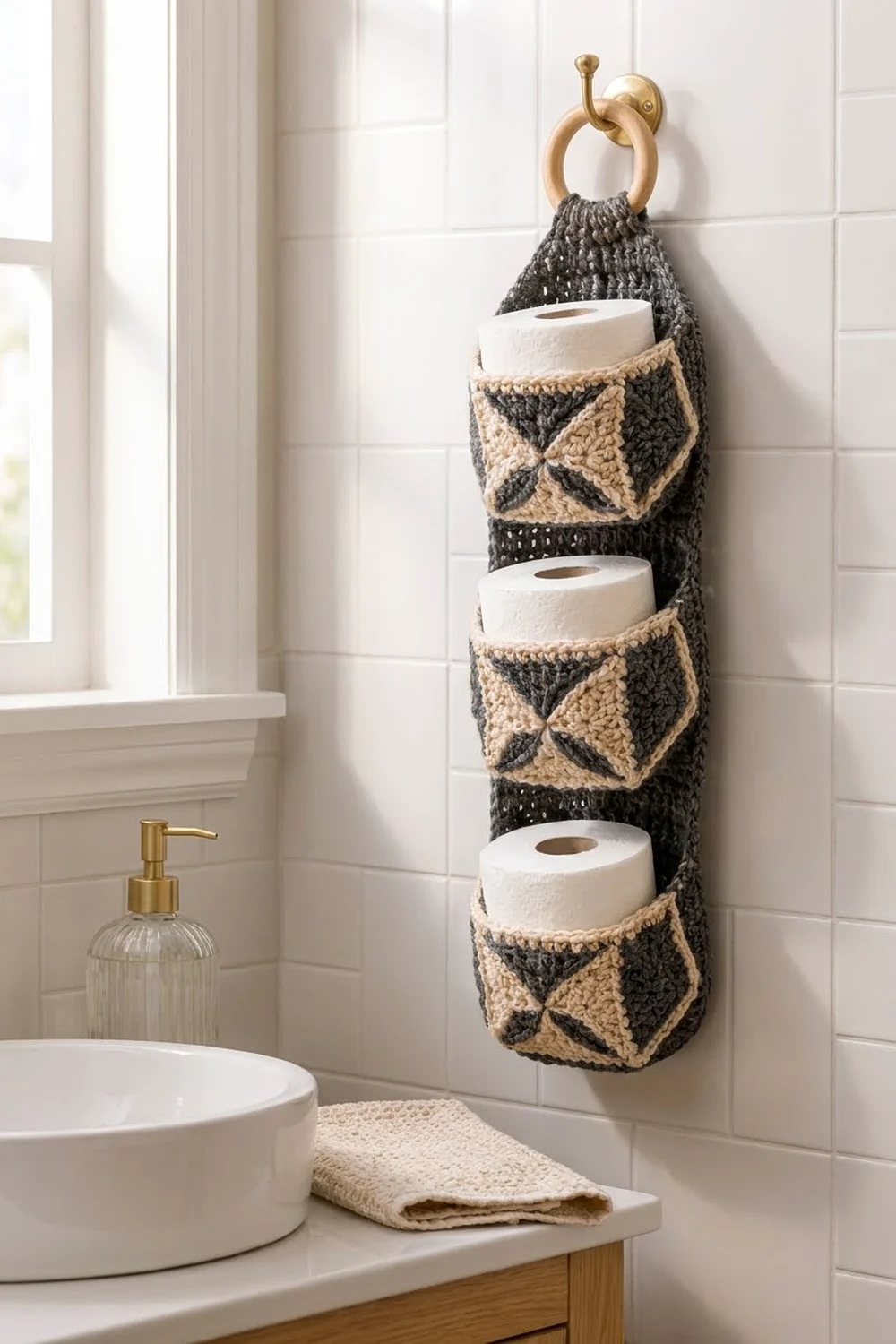
This hanging holder stores three spare toilet rolls in a narrow strip of wall or door space. A long charcoal panel tapers to a soft point at the bottom and to a narrow strap at the top that wraps around a wooden ring. Three boxy pockets are stacked down the front, and each one has a bold hourglass motif.
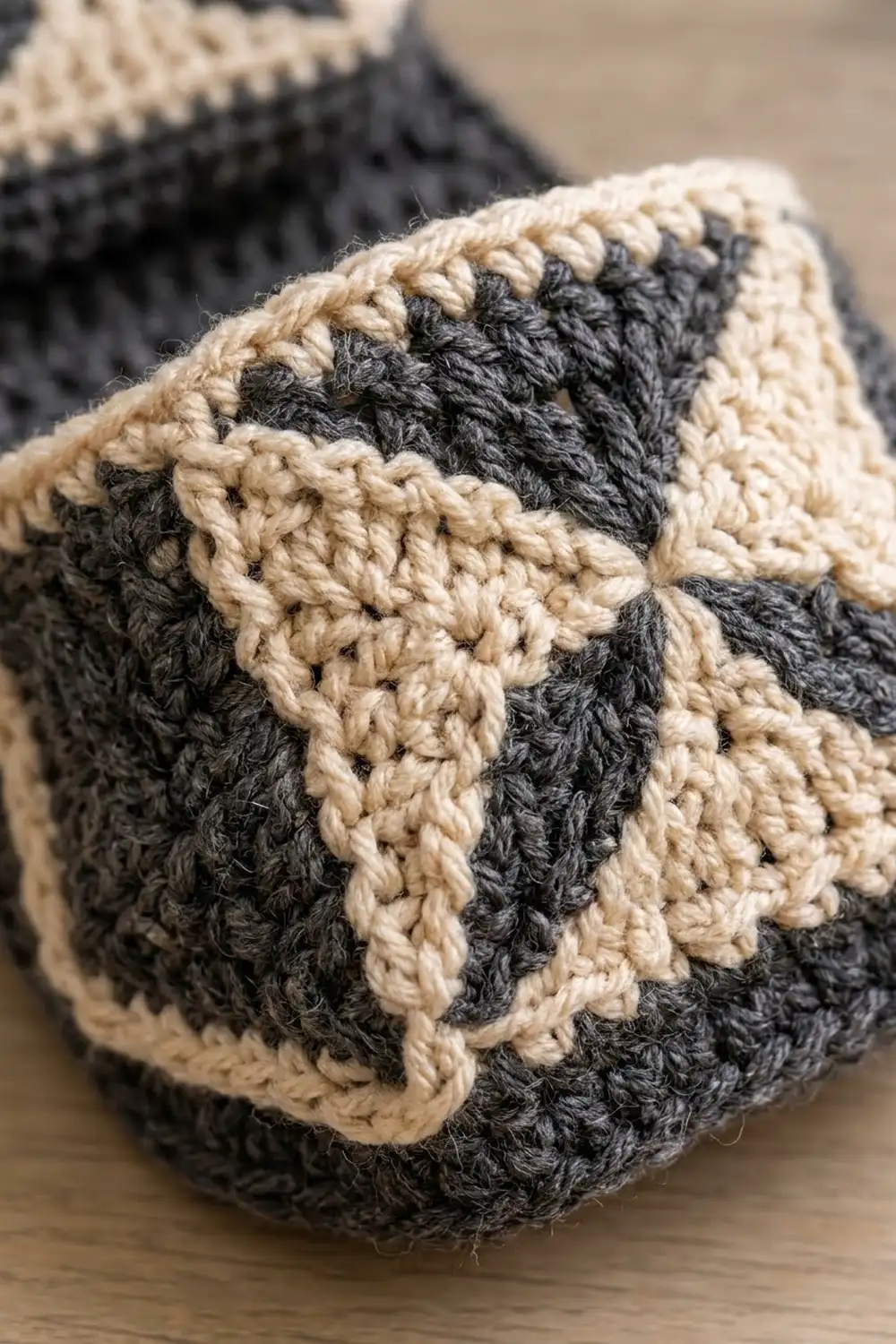
Two colors keep it calm and modern: charcoal gray for the structure and a warm cream for the motif triangles, outlines and rims. Each pocket front is worked in the round in tapestry crochet. The sides alternate color, so four triangles form naturally and meet in a crisp X at the center.
The pattern uses US crochet terms. The finished panel measures 6.5 in (16.5 cm) wide by 23.75 in (60.3 cm) long. Hanging length is about 28 in (71.1 cm) including the ring. Each pocket is 5 in (12.7 cm) wide and sticks out 3.5 in (8.9 cm) from the panel.
You’ll make one backing panel in rows, then three pockets. Each pocket is a square front motif plus a long gusset strip, joined with a cream single crochet seam. Next you sew the pockets to the panel, add a two-round border to the panel, and fold the strap over the ring.
Finished Size and Construction
- Finished size: 6.5 × 23.75 in (16.5 × 60.3 cm) panel; about 28 in (71.1 cm) hanging length with ring
- Skill level: Intermediate (tapestry color changes, seaming)
- Terminology: US
- Yarn weight: Worsted (#4)
- Hook: 5.0 mm (H-8)
- Number of pieces: 7 (1 panel, 3 motifs, 3 gussets) plus 1 wooden ring
- Layout: 3 pockets stacked vertically on 1 panel
- Pocket size: 5 in (12.7 cm) wide × 5.5 in (14.0 cm) tall × 3.5 in (8.9 cm) deep
- Panel size before border: 5.5 × 23.25 in (14.0 × 59.1 cm), strap not included
- Border depth: 0.5 in (1.3 cm), 2 rounds
Materials
Choose a smooth worsted-weight cotton or cotton blend at about 180 m per 100 g. Cotton holds the pocket shape well and copes with bathroom humidity. Avoid fuzzy yarns, because they blur the motif’s diagonal lines.
- Charcoal gray (Color A): 150 g, about 270 m
- Cream (Color B): 60 g, about 110 m
Quantities include a margin of about 15–20% for gauge swatches and carried strands.
Tools:
– 5.0 mm (H-8) crochet hook
– 3 in (7.6 cm) wooden ring
– Tapestry needle
– Stitch markers (at least 6)
– Rust-proof pins and a blocking mat
– Measuring tape
– Scissors
Abbreviations (US Terms)
- ch – chain
- sc – single crochet
- sc2tog – single crochet 2 together
- sl st – slip stitch
- sp – space
- st(s) – stitch(es)
- RS – right side
- rnd – round
Tapestry color change: Work the last stitch in the old color until 2 loops remain. Yarn over with the new color and pull through. Lay the unused color along the tops of the stitches and work over it, so it is hidden inside the new stitches.
Corner in motif rounds: In the ch-2 sp, work (sc in the outgoing color, change color, ch 2, sc in the incoming color).
Gauge and Checkpoints
Gauge: 16 sc × 16 rows = 4 in (10.2 cm) in sc rows. Work firmly, because the pockets need structure.
Make one motif first. It tests both gauge and tapestry tension.
- Motif after Rnd 4: 2.5 in (6.4 cm) square
- Motif after Rnd 8: 4.5 in (11.4 cm) square
- Motif after Rnd 9: 5 in (12.7 cm) square
- Panel after Row 9: 5.5 in (14.0 cm) wide, 2.25 in (5.7 cm) tall
- Panel after Row 85: 21.25 in (54.0 cm) tall
- Panel after Row 93: 23.25 in (59.1 cm) tall
If your motif is too big, go down a hook size. If it is too small, go up one. If the motif puckers along the diagonals, loosen your carried strand.
Backing Panel
Use Color A throughout. Ch 1 at the start of each row does not count as a stitch.
Bottom Point
Row 1: Ch 7. Sc in 2nd ch from hook and in each ch across. Turn. (6 sc)
Row 2: Ch 1, 2 sc in first st, sc in each st to last st, 2 sc in last st. Turn. (8 sc)
Rows 3–9: Repeat Row 2. Rows 3 to 9 have 10, 12, 14, 16, 18, 20 and 22 sc. (Row 9: 22 sc)
Checkpoint: 5.5 in (14.0 cm) wide.
Body
Rows 10–85: Ch 1, sc in each st across. Turn. (22 sc per row)
That is 76 rows, or 19 in (48.3 cm).
Top Taper
Row 86: Ch 1, sc2tog, sc in each st to last 2 sts, sc2tog. Turn. (20 sc)
Rows 87–93: Repeat Row 86. Rows 87 to 93 have 18, 16, 14, 12, 10, 8 and 6 sc. (Row 93: 6 sc)
Strap
Rows 94–109: Ch 1, sc in each st across. Turn. (6 sc per row)
The strap is 16 rows, or 4 in (10.2 cm). Fasten off.
Mark pocket base rows. Place markers on Rows 13, 38 and 63. These are the bottom rows of the three pockets.
Pocket Front Motif (Make 3)
The motif is worked in joined rounds with the RS always facing. The top and bottom sides are Color A and the left and right sides are Color B. Carry the unused color inside every stitch.
The ch-2 corners are not counted. “Per side” means the sc between two corner spaces.
Rnd 1: With Color A, make a magic ring. Ch 1. Work 2 sc, change to B, ch 2, 2 sc, change to A, ch 2, 2 sc, change to B, ch 2, 2 sc, change to A, ch 2. Sl st to first sc. (8 sc: 2 per side, 4 ch-2 sps)
Rnd 2: Ch 1. Sc in each sc of this side in the side’s color, then work a corner in the next ch-2 sp. Repeat from * 3 more times. Sl st to first sc. (16 sc: 4 per side)*
The second sc of each corner and the first sc of the next corner belong to the side between them. Work them in that side’s color.
Rnds 3–8: Repeat Rnd 2. Each round is 2 sc per side larger than the last.
– Rnd 3: 24 sc (6 per side)
– Rnd 4: 32 sc (8 per side)
– Rnd 5: 40 sc (10 per side)
– Rnd 6: 48 sc (12 per side)
– Rnd 7: 56 sc (14 per side)
– Rnd 8: 64 sc (16 per side)
The color boundaries now run corner to corner, forming the hourglass. Cut Color A, leaving a 6 in (15.2 cm) tail.
Rnd 9: With Color B only, ch 1. Sc in each sc and work (sc, ch 2, sc) in each corner sp. Sl st to first sc. (72 sc: 18 per side)
Fasten off. The motif should measure 5 in (12.7 cm) square.
Gusset (Make 3)
Row 1: With Color A, ch 15. Sc in 2nd ch from hook and in each ch across. Turn. (14 sc)
Rows 2–56: Ch 1, sc in each st across. Turn. (14 sc per row)
Fasten off. The gusset measures 3.5 × 14 in (8.9 × 35.6 cm).
Assemble Each Pocket
Front seam: Hold the motif and gusset wrong sides together, with the motif facing you. The gusset’s long edge lines up with the motif’s left side, bottom and right side. Match them like this:
- Left side, 18 sc → gusset Rows 1–18 (1 row-end each)
- Bottom-left corner sp → Row 19
- Bottom, 18 sc → Rows 20–37
- Bottom-right corner sp → Row 38
- Right side, 18 sc → Rows 39–56
With Color B, work 1 sc through both layers at each matched pair. (56 sc) Fasten off. This raised seam makes the cream outline around the pocket front.
Rim, Row 1: With the RS facing, join Color B at gusset Row 1. Work:
– 14 sc across the free short end of the gusset (Row 1)
– 1 sc in the top-left motif corner sp
– 18 sc across the top of the motif
– 1 sc in the top-right corner sp
– 14 sc across the gusset’s other short end (Row 56)
Turn. (48 sc)
Rim, Row 2: Ch 1, sc in each st across. (48 sc)
Fasten off and leave a 10 in (25.4 cm) tail. The pocket is now 5.5 in (14.0 cm) tall.
Make All Pieces
| Piece | Qty | Color |
|---|---|---|
| Backing panel | 1 | A |
| Motif | 3 | A + B |
| Gusset | 3 | A |
| Front seam + rim | 3 | B |
Layout (front view, top to bottom):
      [ ring ]
       strap
      /taper\
  | Pocket 3: Rows 63–83 |
  |   gap: Rows 59–62    |
  | Pocket 2: Rows 38–58 |
  |   gap: Rows 34–37    |
  | Pocket 1: Rows 13–33 |
      \point/
There are 3 rows below Pocket 1 inside the body (Rows 10–12) and 2 rows above Pocket 3 (Rows 84–85). Check the row math: 3 + 21 + 4 + 21 + 4 + 21 + 2 = 76 body rows.
Joining
Attach the pockets to the panel by whipstitching the gusset’s free long edge, using Color A. The rim is not sewn down, so the pocket stays open at the top.
Stitch-to-stitch logic for each pocket (base row R = 13, 38 or 63):
– Gusset Rows 19–38 (20 row-ends) → panel Row R, sts 2–21 (20 sts), 1 to 1
– Gusset Rows 1–18 → panel Rows R+18 down to R+1, along st 2
– Gusset Rows 39–56 → panel Rows R+1 to R+18, along st 21
This leaves 1 stitch, 0.25 in (0.6 cm), free at each edge of the panel. The rim then sits beside Rows R+19 and R+20. Tack the rim ends to the panel with 2 small stitches each.
Tension: Make each whipstitch snug, but don’t pull hard enough to dimple the panel. Pin all four corners of the U shape before you sew.
Checkpoint: Each pocket opening should measure 5 in (12.7 cm) across the front, and the panel should still lie flat.
Border
The border goes around the backing panel only, including the strap. The pockets sit 1 stitch inside the edge, so they don’t get in the way.
Border gauge: 1 sc per row-end on straight edges. On tapered edges, add 1 extra sc every third row, because a diagonal edge is longer than the rows it spans.
Rnd 1: With RS facing, join Color A in the first foundation st of Row 1.
– Bottom: 3 sc in first st (corner group), sc in next 4 sts, 3 sc in last st (corner group).
– First long side (113 sc):
– 11 sc over Rows 2–9 (2 sc in Rows 3, 6 and 9)
– 76 sc over Rows 10–85
– 11 sc over Rows 86–93 (2 sc in Rows 87, 90 and 93)
– 15 sc over Rows 94–108
– Strap top: 3 sc in first st of Row 109 (corner group), sc in next 4 sts, 3 sc in last st (corner group).
– Second long side: Work the same 113 sc in reverse order.
Sl st to first sc. (246 sc)
Counts: 4 corner groups × 3 = 12, plus 4 bottom + 4 top + 113 + 113.
Rnd 2: Ch 1. Sc in each st, working 3 sc in the center sc of each corner group. Sl st to first sc. (254 sc)
Counts: 12 in corner groups, plus 6 bottom + 6 top + 115 per long side. Fasten off.
Why the math works: Rnd 2 is a growth round. Each of the 4 corners adds 2 stitches, so 246 + 8 = 254. The side stitches stay 1-to-1, so the edges stay straight. Two rounds add 0.25 in (0.6 cm) per round to each edge. That brings the panel width from 5.5 in to 6.5 in (14.0 to 16.5 cm) and the strap from 1.5 in to 2.5 in (3.8 to 6.4 cm).
Ring: Slide the strap through the wooden ring and fold it to the back. Whipstitch the strap end to the back of Rows 90–93. About 2 in (5.1 cm) of strap shows above the taper.
Final Blocking
- Lightly mist the whole piece with water, or hover steam over it without touching it.
- Pin the panel flat, face up, to 6.5 × 23.75 in (16.5 × 60.3 cm). Keep both tapers symmetrical.
- Wrap a toilet roll in a plastic bag and set one inside each pocket. This squares the pocket walls.
- Use your fingers to straighten the diagonal lines and the cream outline of each motif.
- Leave it until completely dry, at least 24 hours.
Final Quality-Control Checklist
- Panel is 6.5 in (16.5 cm) wide along its whole length
- All three motifs are 5 in (12.7 cm) square, with the charcoal triangles at the top and bottom
- No carried yarn shows through the motifs
- Pockets are centered, level, and sit 1 st in from each edge
- The front seams form a continuous cream outline
- The rims are 2 rows deep and not sewn shut
- The strap is secure around the ring
- All ends are woven in at least 2 in (5.1 cm)
Troubleshooting
- Motif curls into a bowl: The carried strand is too tight. Spread your stitches before each color change.
- Motif ruffles: Your tension is too loose. Go down a hook size.
- Diagonal lines zigzag: Make sure each corner’s second sc is in the incoming color.
- Panel edges wave on the tapers: Remove the extra sc in one of the third rows.
- Pocket sags forward: Tighten the gusset-to-panel whipstitches and re-block over a roll.
- Panel twists when hung: Check that the strap is folded straight and centered on the ring.
Care
Hand wash in cool water, press out the water in a towel, and dry flat with a roll in each pocket. Do not tumble dry.
Final Notes
Here is the measurement chain to check against. With a 16-stitch, 4 in (10.2 cm) gauge, the motif is 5 in (12.7 cm) after Rnd 9 and the gusset is 14 in (35.6 cm). Each 56-stitch seam matches 56 gusset rows. The 22-stitch panel is 5.5 in (14.0 cm) wide, and the two-round border takes it to 6.5 × 23.75 in (16.5 × 60.3 cm). If each stage matches, the three pockets will line up neatly.
Happy crocheting!