

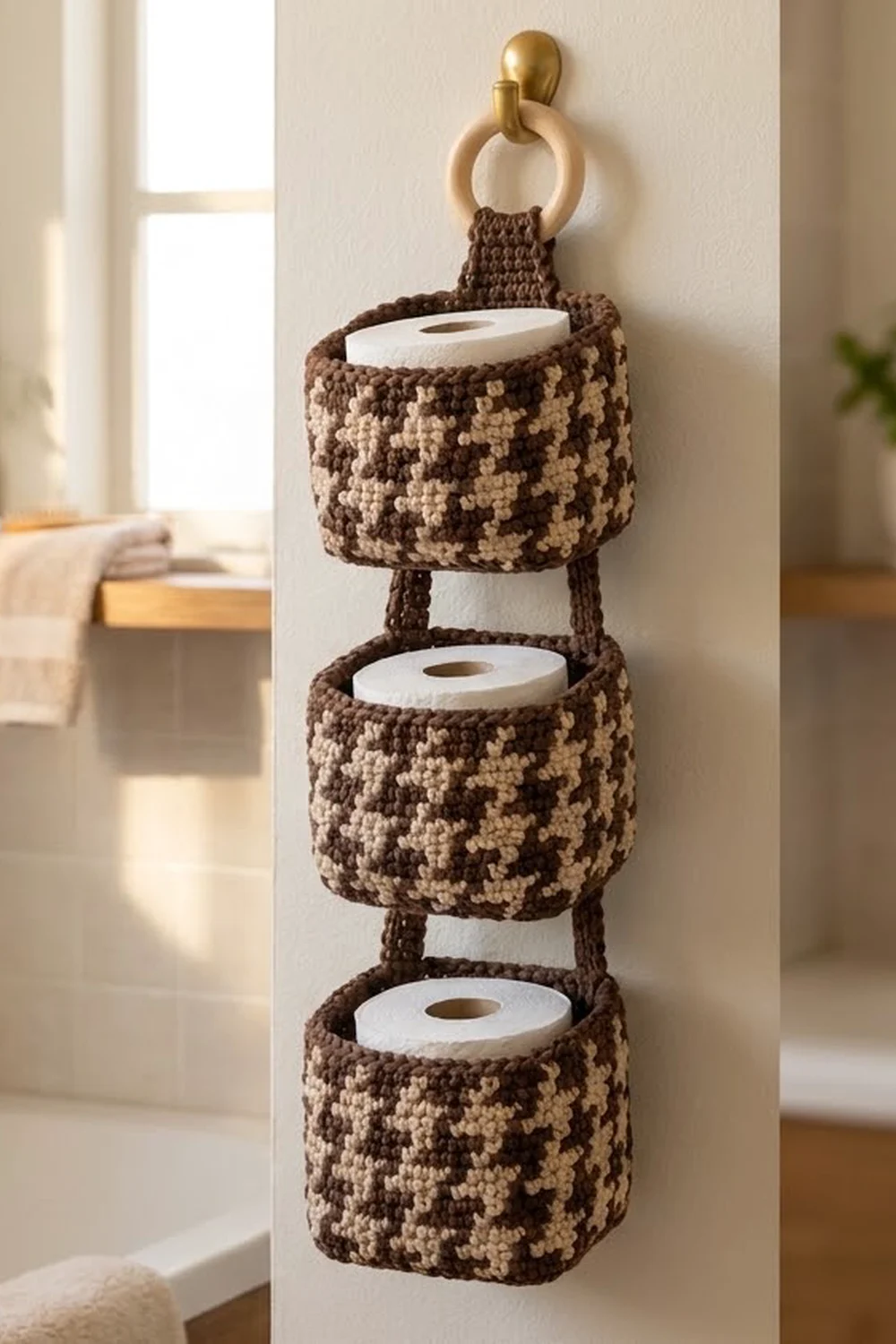
This hanging holder has three baskets stacked on one strap system and hung from a wooden ring. Each basket holds one standard toilet paper roll, so your spares stay in sight and off the floor.
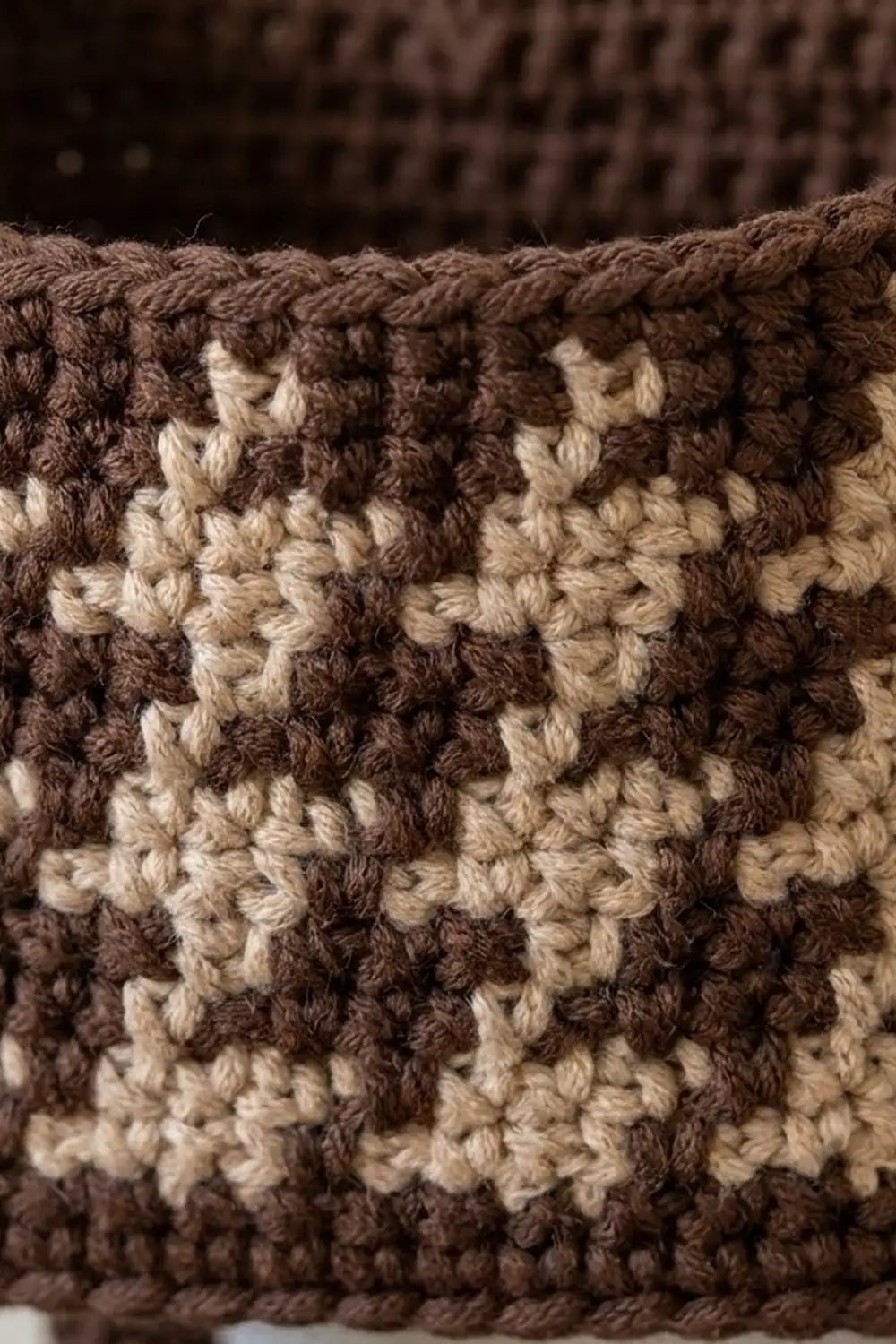
The baskets are worked in chocolate brown and warm beige single crochet tapestry, which makes a firm fabric that holds its shape. The houndstooth pattern repeats every 4 stitches and 4 rounds, so it’s easy to memorize. Each basket has a solid brown base, a brown bottom band, three bands of houndstooth and a brown rim finished with reverse single crochet.
This pattern uses US crochet terms. The finished holder is 6.5 in (16.5 cm) wide, 5 in (12.7 cm) deep and about 20 in (50.8 cm) tall from the bottom basket to the top of the ring.
You’ll make three baskets from the base up in continuous rounds, plus two flat straps and one hanging tab. The straps are sewn down the back of all three baskets, and the tab folds around the ring.
Finished Size and Construction
- Finished size: 6.5 in (16.5 cm) wide × 5 in (12.7 cm) deep × about 20 in (50.8 cm) tall including ring
- Skill level: Intermediate (tapestry color changes)
- Terminology: US
- Yarn weight: Worsted (#4) cotton or cotton blend
- Hook: 5.0 mm (H-8)
- Number of pieces: 6 (3 baskets, 2 straps, 1 tab)
- Layout: 3 baskets in one vertical column, with 1.5 in (3.8 cm) gaps
- Single basket size: 6.5 in × 5 in base (16.5 × 12.7 cm), sides 4.25 in (10.8 cm) tall
- Basket height before rim: 3.5 in (8.9 cm), after Rnd 24
- Rim depth: 0.75 in (1.9 cm), Rnds 25–27
Materials
Use a smooth, firm worsted-weight cotton or cotton blend at about 170 m per 100 g. Cotton holds the basket shape well and holds up to bathroom humidity. Avoid fuzzy yarns, because they blur the houndstooth points.
- Color A, chocolate brown: 330 g / 560 m (bases, bands, rims, straps, tab)
- Color B, beige: 120 g / 200 m (houndstooth only)
These quantities include about a 15% margin for gauge swatches and the strand you carry inside tapestry stitches.
Tools:
– 5.0 mm (H-8) crochet hook
– 1 wooden ring, 2.5 in (6.4 cm) outer diameter
– Locking stitch markers (at least 4)
– Tapestry needle
– Scissors and a measuring tape
– Rustproof pins and a spray bottle for blocking
Abbreviations (US Terms)
- ch – chain
- sc – single crochet
- sl st – slip stitch
- BLO – back loop only
- rev sc – reverse single crochet (crab stitch)
- st(s) – stitch(es)
- rnd(s) – round(s)
- A / B – brown / beige
Tapestry sc: Lay the unused color along the tops of the stitches you’re working into and work each sc over it, so the strand is hidden inside the stitch. To change color, work the last sc in the old color until 2 loops remain on the hook, then yarn over with the new color and pull through.
Gauge and Checkpoints
Gauge: 16 sts and 16 rnds = 4 in (10.2 cm) in tapestry sc worked in the round.
Make one complete basket before starting the others and check it at each of these stages:
- After Rnd 5 (42 sts): base measures 4 in × 2.5 in (10.2 × 6.4 cm).
- After Rnd 10 (72 sts): base measures 6.5 in × 5 in (16.5 × 12.7 cm).
- After Rnd 24: sides measure 3.5 in (8.9 cm) above the BLO ridge.
- After Rnd 27: sides measure 4.25 in (10.8 cm), and a roll drops in easily.
If the basket is too big, the roll will slump and the fabric will feel soft. Go down 0.5 mm in hook size. If it’s too small, the roll will jam. Go up 0.5 mm in hook size. Don’t change the stitch counts, because the houndstooth needs a multiple of 4.
Basket (Make 3)
Base
Use Color A. Work in continuous rounds and do not join. Place a marker in the first stitch of each round and move it up as you go.
Ch 9.
Rnd 1: Sc in 2nd ch from hook, sc in next 6 ch, 3 sc in last ch. Working along the other side of the foundation ch, sc in next 6 ch, 2 sc in same ch as first sc. (18 sts)
Each round from Rnd 2 to Rnd 10 follows the same structure. The value of k is the number of plain sc before each increase:
(sc in next k sc, 2 sc in next sc), sc in next 6 sc, [sc in next k sc, 2 sc in next sc] 3 times, sc in next 6 sc, [sc in next k sc, 2 sc in next sc] 2 times.
Each round adds 6 sts, 3 at each narrow end. The 6 sts along each long side stay plain.
Rnd 2: k = 0 (6 increases with no sc between them). (24 sts)
Rnd 3: k = 1. (30 sts)
Rnd 4: k = 2. (36 sts)
Rnd 5: k = 3. (42 sts). Check: 4 in × 2.5 in (10.2 × 6.4 cm).
Rnd 6: k = 4. (48 sts)
Rnd 7: k = 5. (54 sts)
Rnd 8: k = 6. (60 sts)
Rnd 9: k = 7. (66 sts)
Rnd 10: k = 8. (72 sts). Check: 6.5 in × 5 in (16.5 × 12.7 cm).
Count check: each repeat uses k + 1 sts and makes k + 2 sts. Six repeats plus 12 straight sts give 6(k + 2) + 12, which is 72 for k = 8.
Because the increases stack, they form soft corners at each end. That gives the rounded-rectangle shape you see in the photo.
Sides
Rnd 11 (turning ridge): With A, sc in BLO of each st around. This is a conversion round: 72 sts worked 1 per existing st, plus 0 added. (72 sts)
Rnd 12: With A, sc in each st around. (72 sts) In the last sc, change to B and start carrying A.
Houndstooth Band
Keep the unused color carried inside every stitch from Rnd 13 through Rnd 24. Each chart round is a 4-st repeat worked 18 times around (18 × 4 = 72).
Chart Rnd 1: B in all 4 sts — 72 B.
Chart Rnd 2: 1 A, 3 B — 18 A + 54 B = 72.
Chart Rnd 3: A in all 4 sts — 72 A.
Chart Rnd 4: 2 A, 1 B, 1 A — 54 A + 18 B = 72.
Rnds 13–16: Chart Rnds 1–4.
Rnds 17–20: Chart Rnds 1–4.
Rnds 21–24: Chart Rnds 1–4. (72 sts each round)
The stitch count stays at 72 in every round. Check: the sides measure 3.5 in (8.9 cm) above the ridge. Cut B at the end of Rnd 24, leaving a 6 in (15.2 cm) tail, and continue with A only.
Single crochet tapestry leans slightly to the right in every round. That lean is normal and gives the houndstooth points their slanted look.
Rim
Rim gauge: Same as the body, 16 sts and 16 rnds = 4 in (10.2 cm). For placing pieces later, think of the 72 sts as two sides: 36 sts on the front and 36 sts on the back, with the round’s starting point at one narrow end.
Rnd 25: With A, sc in each st around. (72 sts: 36 front + 36 back)
Rnd 26: Sc in each st around. (72 sts: 36 front + 36 back)
Rnd 27: Rev sc in each st around. This is a trim round: 72 sts worked 1 per existing st, plus 0 added. (72 sts: 36 front + 36 back) Sl st to the first rev sc and fasten off.
Why the math works: the rim keeps the same 72 sts as the houndstooth band, so it won’t flare out or pull in. Rev sc twists each stitch into a rounded cord, which makes the firm, rolled edge in the photo. The final side height is 17 rnds (Rnds 11–27) ÷ 4 rnds per in = 4.25 in (10.8 cm).
Weave in all tails on the inside, running them through stitches of the same color.
Straps (Make 2)
With A, ch 5.
Row 1: Sc in 2nd ch from hook and in each ch across. (4 sts)
Rows 2–63: Ch 1, turn, sc in each st across. (4 sts)
Fasten off and leave a 40 in (101.6 cm) tail for sewing. Each strap measures 1 in × 15.75 in (2.5 × 40.0 cm).
Hanging Tab (Make 1)
With A, ch 7.
Row 1: Sc in 2nd ch from hook and in each ch across. (6 sts)
Rows 2–28: Ch 1, turn, sc in each st across. (6 sts)
Fasten off and leave a 20 in (50.8 cm) tail. The tab measures 1.5 in × 7 in (3.8 × 17.8 cm).
Make All Pieces
- Baskets: 3, using A and B
- Straps: 2, using A
- Tab: 1, using A
Layout (back view, top to bottom):
          [ Ring ]
          [ Tab  ]
[Strap]  [Basket 1]  [Strap]
   |   1.5 in gap      |
[Strap]  [Basket 2]  [Strap]
   |   1.5 in gap      |
[Strap]  [Basket 3]  [Strap]
Joining
Strap row map (counted from the top of the strap):
– Rows 1–17: Basket 1
– Rows 18–23: gap of 6 rows, 1.5 in (3.8 cm)
– Rows 24–40: Basket 2
– Rows 41–46: gap
– Rows 47–63: Basket 3
That’s 17 + 6 + 17 + 6 + 17 = 63 rows.
Placement: Flatten each basket so the round’s starting point sits at one narrow end. Count the 36 back sts. Pin one strap over back sts 5–8 and the other over back sts 29–32, counting from the same narrow end each time. Line up all three baskets so the straps fall in the same columns.
Stitch-to-stitch logic: Each basket has 17 side rounds (Rnds 11–27), and each strap section has 17 rows. Sew them one to one: strap Row 1 meets Rnd 27, and strap Row 17 meets the Rnd 11 ridge. Do the same on Baskets 2 and 3.
Method: Using the strap tail, whipstitch both long edges of the strap to the basket, catching one strand of each strap row and the matching basket round. Also stitch across the strap at the rim and at the ridge. Don’t stitch across the gap rows.
Tension: Sew snugly but not tight. If the basket fabric puckers next to the strap, your stitches are too tight.
Tab: Slip the tab through the ring and fold it in half. Place the last 4 rows of each tab end against the back of Basket 1 over back sts 16–21, which centers it between the straps. Line them up with Rnds 24–27, matching 6 tab sts to 6 basket sts. Sew through both layers of the tab and the basket wall. The visible loop is 20 rows doubled, about 2.5 in (6.4 cm) above the rim.
Size checkpoint: From the top rim of Basket 1 to the ridge of Basket 3 should measure 15.75 in (40.0 cm).
Final Blocking
- Put a toilet paper roll in each basket, or use a slightly larger box wrapped in plastic if your fabric is tight.
- Spray each basket until it’s damp but not soaked.
- Press the bases flat and square up the stacked-increase corners with your fingers.
- Roll the rev sc rim gently between your fingers so it lies even.
- Pin the straps flat and straight on a towel, keeping the gaps at 1.5 in (3.8 cm).
- Let everything dry completely, about 24 hours, before hanging.
Final Quality-Control Checklist
- Each basket has 72 sts in every round from Rnd 10 to Rnd 27.
- The base measures 6.5 in × 5 in (16.5 × 12.7 cm).
- The sides measure 4.25 in (10.8 cm) on all three baskets.
- All 18 houndstooth repeats line up in each band.
- No beige shows through the brown rim or base.
- Both straps sit in the same columns on all three baskets.
- The gaps measure 1.5 in (3.8 cm).
- The tab is centered, sewn through both layers, and holds the ring securely.
- All tails are woven in on the inside.
Troubleshooting
Carried strand shows through: Hold the carried yarn along the tops of the stitches and keep a little tension on it. If it still shows, use a hook 0.5 mm smaller.
Base cups or ruffles: A cupping base means your gauge is too tight. A ruffled base means you’ve lost or gained stitches, so recount to 72 at Rnd 10.
Pattern drifts at round starts: That’s the spiral jog. Keep it on the back at the narrow end, where the straps and the wall hide it.
Basket leans forward: The straps are sewn too loosely, or the tab is off center. Re-sew the strap at the rim and at the ridge.
Rim flares out: You added stitches in the rev sc round. Redo Rnd 27 with exactly 72 sts.
Care
Hand wash in cool water, press out excess water in a towel, and dry flat with a roll inside each basket. Remove the wooden ring before washing.
Final Notes
All the measurements come from one gauge. At 16 sts and 16 rnds per 4 in (10.2 cm), 72 sts make a base about 6.5 in × 5 in (16.5 × 12.7 cm), and 17 side rounds make 4.25 in (10.8 cm) sides. The 63-row straps match those 17 rounds three times with two 1.5 in (3.8 cm) gaps, for a 15.75 in (40.0 cm) column. Add the tab loop and ring, and the holder hangs about 20 in (50.8 cm) tall. Check your gauge, count to 72, and the rest will line up.
Happy crocheting!