

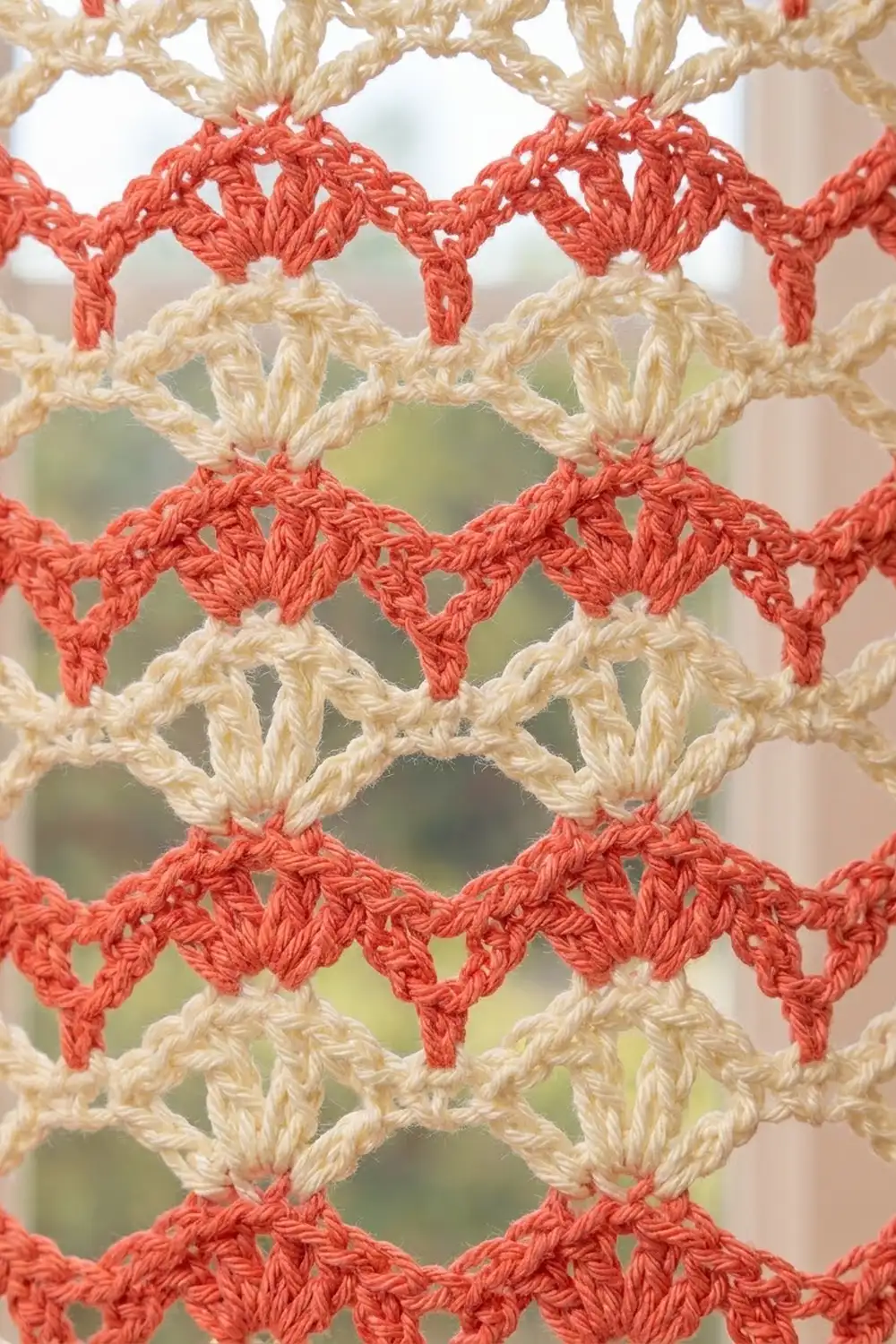
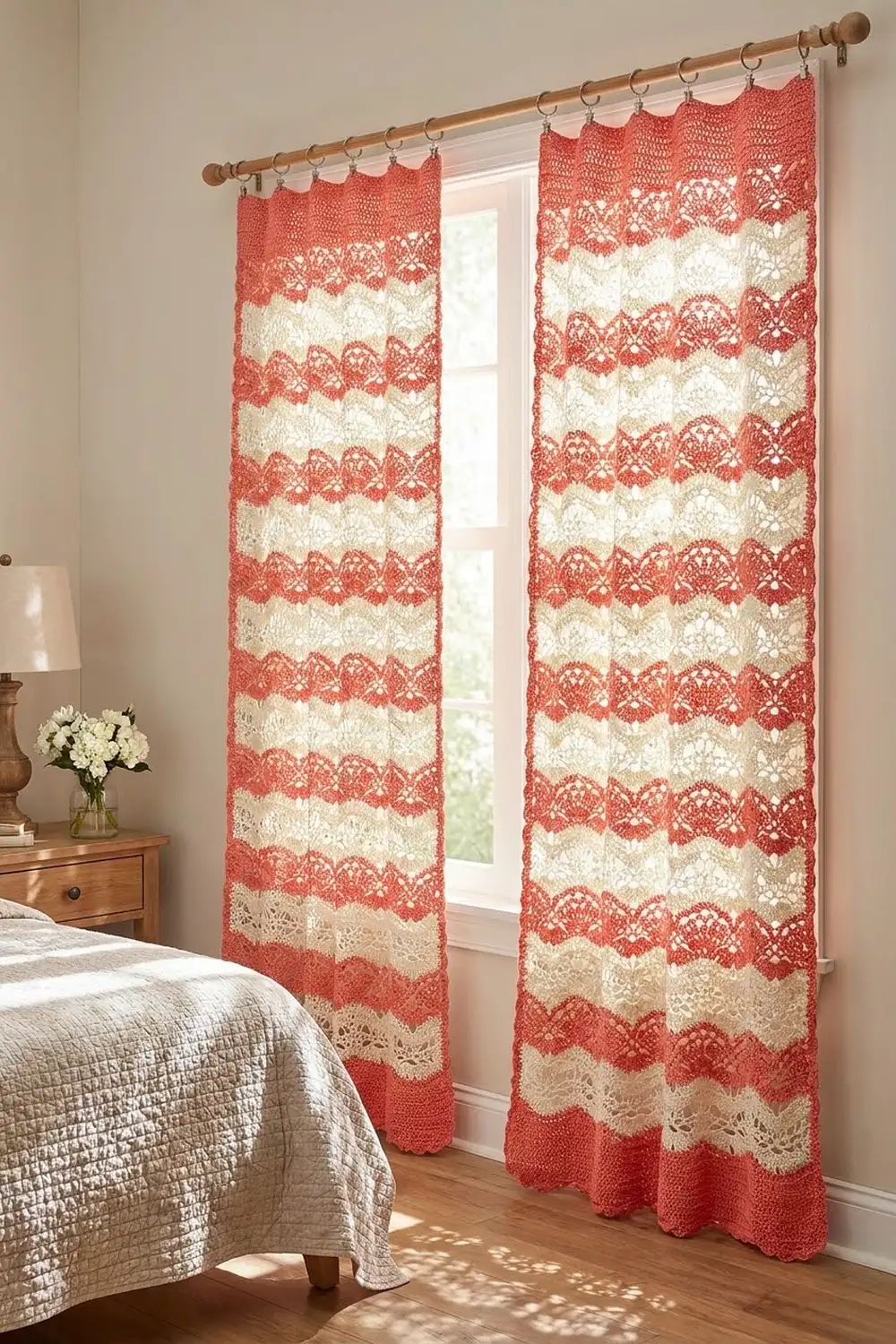
The Coral Tide curtains are a pair of airy lace panels in warm coral and soft cream. Double crochet fans alternate with open chain arches. The color changes every two rows, so with light behind them the panels look like rolling waves of coral and cream.
Each panel is one rectangle with a coral scalloped hem, a firm coral header for clip rings, and two narrow rows of single crochet down each side. You make both panels the same way. They hang separately on the rod and are not joined.
This pattern uses US crochet terms. After blocking, each panel measures 26 in (66.0 cm) wide by 81.25 in (206.4 cm) long.
You work the lace body flat in rows from the bottom up and then add a solid header. Next you crochet the scalloped hem into the foundation chain and finish with side edging. Then you make a second panel to match.
Finished Size and Construction
- Finished panel size: 26 in x 81.25 in (66.0 cm x 206.4 cm)
- Skill level: Intermediate
- Terminology: US crochet terms
- Yarn weight: DK (#3 light) cotton
- Hook: 4.0 mm (G-6)
- Number of pieces: 2 identical panels, not joined
- Layout: one panel on each side of the window
- Pattern repeat: a multiple of 10 sts + 1 wide, 4 rows tall
- Size before edging (body plus header): 25 in x 80.25 in (63.5 cm x 203.8 cm)
- Edging depth: 0.5 in (1.3 cm) on each side; the scalloped hem adds 1 in (2.5 cm) at the bottom
Materials
Choose a smooth mercerized or combed cotton DK. Cotton drapes well, shows the stitches clearly, and stands up to washing and sunlight. Avoid fuzzy yarns, which blur the open arches. The amounts below assume a DK cotton with about 115 yd (105 m) per 50 g.
Yarn for both panels:
- Coral (Color A): 650 g, about 1,495 yd (1,365 m)
- Cream (Color B): 550 g, about 1,265 yd (1,155 m)
Each panel uses about 300 g of Coral and 240 g of Cream. The totals include a margin of roughly 10% for the gauge swatch, tension differences, and weaving in ends.
Tools:
- 4.0 mm (G-6) crochet hook
- Tapestry needle
- Stitch markers
- Tape measure
- Rust-proof pins and a blocking surface big enough for a long panel (a clean floor covered with towels works)
- Spray bottle
- 22 curtain clip rings (11 per panel)
Abbreviations (US Terms)
- ch – chain
- sc – single crochet
- hdc – half double crochet
- dc – double crochet
- sk – skip
- sp(s) – space(s)
- st(s) – stitch(es)
- RS – right side
Special stitches:
- Fan: 9 dc in the same stitch or space.
- Half fan: 5 dc in the same stitch. A beginning ch 3 counts as the first dc.
- V-st: (dc, ch 1, dc) in the same stitch.
Gauge and Checkpoints
Gauge matters here. A small difference in one repeat is multiplied by 10 repeats across and 26 repeats up.
Gauge:
- One pattern repeat (10 sts) = 2.5 in (6.4 cm) wide.
- One 4-row repeat = 3 in (7.6 cm) tall.
- Fan rows are about 1 in (2.5 cm) tall and arch rows about 0.5 in (1.3 cm) tall.
- Side edging: 4 sc = 1 in (2.5 cm) along the row ends.
Test swatch: Ch 32 and work Rows 1–9 of the pattern below, using 3 repeats instead of 10 (so arch rows have 3 three-sc groups and 2 V-sts, or 2 groups and 3 V-sts). Block it lightly. It should measure 7.5 in (19.1 cm) wide by 7 in (17.8 cm) tall.
- Too big: go down to a 3.75 mm hook.
- Too small: go up to a 4.5 mm hook.
Checkpoints for each panel:
- After Row 1: 25 in (63.5 cm) wide, 1 in (2.5 cm) tall
- After Row 21: 16 in (40.6 cm) tall
- After Row 53: 40 in (101.6 cm) tall
- After Row 105: 79 in (200.7 cm) tall
- After the header: 80.25 in (203.8 cm) tall
- After the scalloped hem: 81.25 in (206.4 cm) tall
- After the side edging: 26 in (66.0 cm) wide
Lace stretches easily, so lay it flat and measure without pulling. If the length runs long or short, add or remove whole 4-row repeats, not single rows. That keeps the stripe order and the coral top correct.
Panel Body
Each fan row has 10 fans. The color changes every two rows: Row 1 is Coral, Rows 2–3 are Cream, Rows 4–5 are Coral, and so on.
- Changing color: work the last yarn over of the row’s final stitch in the new color.
- Carrying yarn: carry the unused color loosely up the side. The edging will cover it.
Foundation: With Coral, ch 102.
Row 1 (Coral, fan row): Sc in 2nd ch from hook, *sk 4 ch, fan in next ch, sk 4 ch, sc in next ch; repeat from * across. Turn. (10 fans and 11 sc; 101 sts)
Change to Cream at the end of Row 1.
Row 2 (Cream, arch row): Ch 3 (counts as dc), dc in first sc, *ch 3, sk 3 dc, sc in next 3 dc, ch 3, sk 3 dc, V-st in next sc; repeat from * 8 more times, ch 3, sk 3 dc, sc in next 3 dc, ch 3, sk 3 dc, 2 dc in last sc. Turn. (10 three-sc groups, 9 V-sts, 2 dc at each edge; 121 sts and chs)
The three sc sit on the center of each fan, and the ch-3 arches bridge its outer dc. The V-sts sit in the dips between fans.
Row 3 (Cream, fan row): Ch 3 (counts as dc), 4 dc in first dc (half fan made), *sk ch-3 sp, sc in center sc of next 3-sc group, sk ch-3 sp, fan in ch-1 sp of next V-st; repeat from * 8 more times, sk ch-3 sp, sc in center sc of last 3-sc group, sk ch-3 sp, 5 dc in top of turning ch. Turn. (9 fans, 2 half fans, 10 sc; 101 sts)
These fans sit above the dips of Row 1, which creates the offset wave.
Change to Coral at the end of Row 3.
Row 4 (Coral, arch row): Ch 1, sc in first 2 sts, ch 3, sk 3 dc, V-st in next sc, *ch 3, sk 3 dc, sc in next 3 dc, ch 3, sk 3 dc, V-st in next sc; repeat from * 8 more times, ch 3, sk 3 dc, sc in last 2 sts. Turn. (10 V-sts, 9 three-sc groups, 2 sc at each edge; 121 sts and chs)
Row 5 (Coral, fan row): Ch 1, sc in first sc, sk next sc and ch-3 sp, *fan in ch-1 sp of next V-st, sk ch-3 sp, sc in center sc of next 3-sc group, sk ch-3 sp; repeat from * 8 more times, fan in ch-1 sp of last V-st, sk ch-3 sp and next sc, sc in last sc. Turn. (10 fans, 11 sc; 101 sts)
Row 5 has the same layout as Row 1, with each fan directly above a Row 1 fan.
Change to Cream at the end of Row 5.
Rows 6–105: Repeat Rows 2–5 another 25 times, keeping the color order of two Cream rows, then two Coral rows. Row 105 is a Coral fan row with 101 sts.
The body is now Row 1 plus 26 four-row repeats, with 26 Cream stripes and 26 Coral stripes. It measures 25 in x 79 in (63.5 cm x 200.7 cm).
Header
Keep working in Coral. The header fills the dips between the top fans and gives a flat, sturdy edge for the clip rings.
Row 106: Ch 3 (counts as dc), *hdc in next 2 dc, sc in next 5 dc, hdc in next 2 dc, dc in next sc; repeat from * across. Turn. (101 sts)
Each dc lands in a dip and the sc sit on top of each fan, which levels the edge.
Rows 107–109: Ch 1, sc in each st across. Turn. (101 sts)
Fasten off. The panel now measures 25 in x 80.25 in (63.5 cm x 203.8 cm).
Make Both Panels
Make the Panel Body and Header again for the second panel. Use exactly the same stripe order so the two panels match on the window.
- Per panel: about 300 g Coral and 240 g Cream.
- Both panels: 600 g Coral and 480 g Cream, plus the margin.
Layout at the window:
[ Rod =========================================== ]
[ Panel 1 ]      [ Window ]      [ Panel 2 ]
 26 in wide                       26 in wide
The panels hang separately and are not joined.
Border
The border has two parts: a scalloped hem worked into the foundation chain and two rows of sc down each long side. Work both parts in Coral.
Border gauge: 4 sc = 1 in (2.5 cm) along the row ends.
Scalloped Hem
Turn the panel upside down so the foundation chain is at the top. Join Coral in the first free loop of the foundation chain at the right-hand corner.
Hem Row: Ch 1, sc in first ch, *sk 4 ch, fan in next ch, sk 4 ch, sc in next ch; repeat from * across. (10 fans and 11 sc; 101 sts)
Each hem fan goes into the same chain as a Row 1 fan. The two fans spread in opposite directions and form a solid coral scallop. Fasten off. The hem adds 1 in (2.5 cm) of length.
Side Edging
With RS facing, join Coral at the top corner of one long side.
Edging Row 1: Ch 1, then work 321 sc down the side:
- Header: 2 sc in the end of Row 106 and 1 sc in the end of each of Rows 107–109 (5 sc).
- Rows 105 to 2: 4 sc in the end of each fan row and 2 sc in the end of each arch row.
- Row 1: 4 sc in the end of the row.
Turn. (321 sc)
Edging Row 2: Ch 1, sc in each sc across. (321 sc) Fasten off.
Work both edging rows on the other long side the same way.
Why the math works:
- Each 4-row repeat: 2 fan rows and 2 arch rows give 4 + 2 + 4 + 2 = 12 sc over 3 in (7.6 cm). That is exactly 4 sc per inch.
- Total per side: 26 repeats take 312 sc, Row 1 takes 4, and the header takes 5, so 312 + 4 + 5 = 321 sc.
- Length check: at 4 sc per inch, 321 sc cover 80.25 in (203.8 cm). That is the exact length of the body plus header, so the edges lie flat without ruffling or pulling in.
- Width: two sc rows add 0.5 in (1.3 cm) on each side, so the panel is 25 + 0.5 + 0.5 = 26 in (66.0 cm) wide.
Final Blocking
- Weave in all ends along the side edges where colors change or inside solid stitches. Never weave across the open arches.
- Soak each panel in cool water with a little gentle wash for 15 minutes. Press the water out; do not wring.
- Roll the panel in towels to remove extra water.
- Lay it flat and pin the header straight at 26 in (66.0 cm) wide, including the edging.
- Pin the side edges straight to a total length of 81.25 in (206.4 cm).
- Pin the point of each of the 10 hem scallops so they are evenly spaced.
- Open the arches gently with your fingers and check that the stripes are level.
- Let the panel dry completely. Block the second panel the same way and compare the two side by side.
Cotton lace can stretch a little once it hangs. If the length must be exact, let the panels hang for a day before you measure.
Final Quality-Control Checklist
- Every fan row has 101 sts. Rows 3, 7, 11 and so on have 9 fans plus 2 half fans.
- Every arch row has 121 sts and chs.
- Stripes alternate two Cream rows and two Coral rows, with Coral at the top and bottom.
- The header has 101 sts and a straight top edge.
- The hem has 10 even coral scallops.
- Both edging rows on each long side have 321 sc.
- Both panels measure 26 in x 81.25 in (66.0 cm x 206.4 cm).
- Each header has 11 clip rings, one above each header dc (sts 1, 11, 21 and so on through st 101). The rings are 2.5 in (6.4 cm) apart.
Troubleshooting
Fans cup or ruffle: Your dc are too tight to fit 9 into one stitch. Loosen your tension or go up a hook size.
Arches sag: Your ch-3 spaces are too loose. Keep the chains snug and even.
Wrong count in a fan row: Make sure you skipped both ch-3 spaces around each sc and placed each fan in the ch-1 space of a V-st.
Sides wave or pull in: Recount the edging sc in each row end. Too many sc make the edge ruffle; too few make it pull in.
Panels are different lengths: Block both together to the same measurements. If they still differ by more than 1 in (2.5 cm), add or remove one 4-row repeat before the header.
Carried yarn shows at the edges: Work Edging Row 1 over the carried strands to hide them.
Care
Hand wash, or machine wash on a gentle cool cycle in a mesh bag. Reshape and dry flat; avoid hot tumble drying, which can shrink cotton and distort the lace.
Final Notes
Here is the measurement chain:
- One repeat is 2.5 in (6.4 cm) wide, so 10 repeats make 25 in (63.5 cm).
- One 4-row repeat is 3 in (7.6 cm) tall, so Row 1 plus 26 repeats makes 79 in (200.7 cm).
- The header brings the length to 80.25 in (203.8 cm), and the scalloped hem brings it to 81.25 in (206.4 cm).
- Two rows of side edging bring the width to 26 in (66.0 cm).
Check your gauge first and measure at every checkpoint, and both panels will match.
Happy crocheting!