
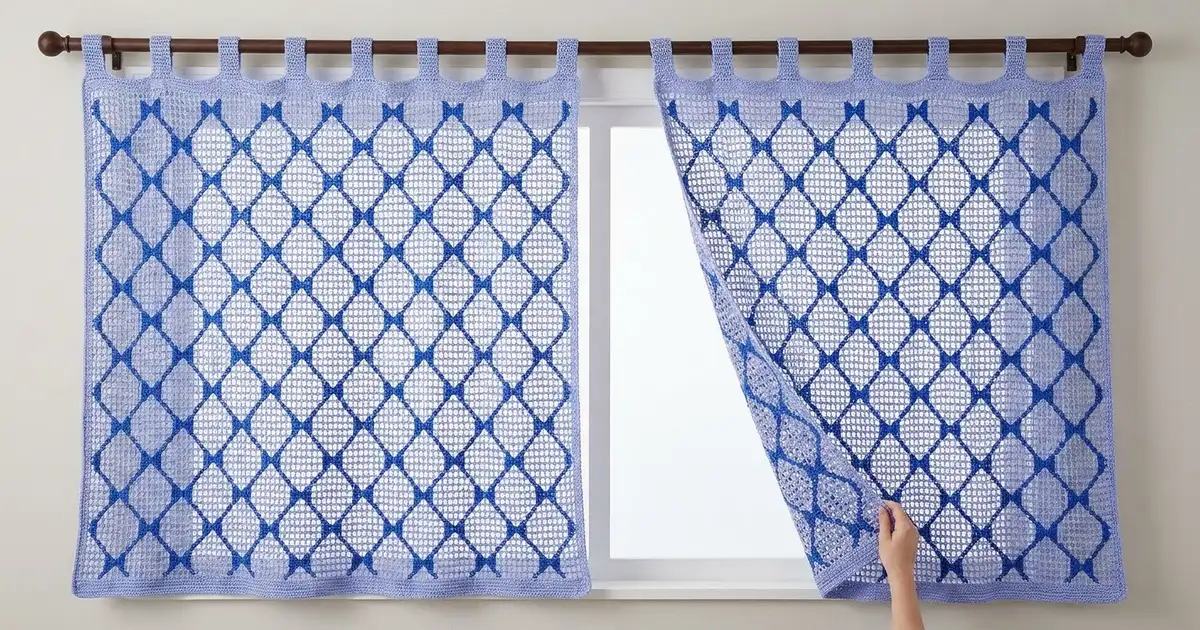
These curtain panels pair an open filet mesh with a diamond lattice you can see through. The mesh and most of the diagonal bands are a soft periwinkle. A deep royal blue fills each crossing point, so the panels read as a field of small blue X shapes linked by pale diagonals. With light behind them, the open squares glow and the diamonds stand out clearly.
The look is fresh and cottage-style, a little like blue-and-white china. Each panel hangs from seven crocheted tabs, so it slides straight onto a standard curtain rod.
This pattern uses US crochet terms. Each finished panel is 40.8 in (103.6 cm) wide and 80.4 in (204.2 cm) long, plus the tabs. The pattern makes a matching pair.
Each panel is worked flat in one piece from the bottom up in filet crochet: double crochet mesh squares and solid blocks. You follow a 12-row, 12-square diamond repeat. Then you work a solid top row, add the tabs, and finish the sides and bottom with a two-row border.
Finished Size and Construction
- Finished size (each panel): 40.8 in (103.6 cm) wide x 80.4 in (204.2 cm) long, excluding tabs
- Skill level: Intermediate
- Terminology: US
- Yarn weight: Worsted (#4) cotton
- Hook: 5.5 mm (I-9)
- Number of pieces: 2 identical panels, each worked in one piece, not joined
- Layout: Two panels hung side by side on one rod
- Panel grid: 50 squares wide x 100 rows tall, with each square 0.8 in (2.0 cm)
- Size before border: 40 in (101.6 cm) x 80 in (203.2 cm)
- Border depth: 0.4 in (1.0 cm) on the sides and bottom
- Tabs: 7 per panel, each 1.6 in (4.1 cm) wide, folded into a 2.4 in (6.1 cm) loop
Materials
Use a smooth mercerized or combed cotton in worsted weight. Cotton gives crisp squares, blocks well and resists sagging, which matters for full-length panels.
- Color A, periwinkle (mesh and pale bands): 1,100 g, about 2,090 m (550 g, about 1,045 m per panel)
- Color B, royal blue (crossings): 300 g, about 570 m (150 g, about 285 m per panel)
The meter amounts assume a yarn of about 190 m per 100 g. Both quantities include a margin of roughly 15% for the swatch, color-change tails and differences in tension.
Tools:
- 5.5 mm (I-9) hook, plus one a half size larger and one a half size smaller
- 10 small bobbins for Color B
- Tapestry needle
- Stitch markers (at least 10)
- Tape measure
- Rust-proof pins and a large blocking area
Abbreviations (US Terms)
- ch: chain
- sc: single crochet
- dc: double crochet
- rev sc: reverse single crochet (crab stitch)
- sp: space
- st(s): stitch(es)
- RS / WS: right side / wrong side
Special stitches:
- Mesh square (M): ch 2, skip the next 2 sts (or the next ch-2 sp), dc in the next dc.
- Block (Bl): 2 dc in the next ch-2 sp (or dc in each of the next 2 dc), dc in the next dc.
- Color change: work the last dc before the new color until 2 loops remain, then finish it with the new color.
Every square, mesh or block, is 3 sts wide and sits after one starting dc. A row of 50 squares therefore has 50 x 3 + 1 = 151 sts.
Gauge and Checkpoints
Gauge: 5 squares and 5 rows = 4 in (10.2 cm) in pattern, after blocking. One square is 0.8 in (2.0 cm) wide and 0.8 in (2.0 cm) tall.
Make one test piece first. Ch 47 for a 14-square swatch: 1 edge mesh square, one 12-square repeat and 1 more edge mesh square. Work Row 1 and Chart Rows 1–12, for 13 rows in all. After blocking it should measure 11.2 in (28.4 cm) wide x 10.4 in (26.4 cm) tall.
- Too big: go down a half size in hook.
- Too small: go up a half size in hook. Make sure your chains are not tighter than your dc.
- Width right, height wrong: adjust how high you pull up your dc loops, not your hook.
Checkpoints on the panel (measure flat, not stretched):
- After Row 13: 10.4 in (26.4 cm) tall
- After Row 49: 39.2 in (99.6 cm) tall
- After Row 97: 77.6 in (197.1 cm) tall
- After Row 100: 80 in (203.2 cm) tall and 40 in (101.6 cm) wide

Panel Pattern (Make 2)
Foundation and Row 1
With Color A, ch 155.
Row 1 (RS): Dc in the 8th ch from hook. The skipped chains count as a dc plus ch 2. Then ch 2, skip 2 ch, dc in the next ch; repeat from * to the end. Turn. (50 mesh squares; 151 sts)*
This row of plain mesh forms the bottom edge.
Reading the Repeat
Square 1 and square 50 are edge squares. They are always mesh. Squares 2–49 hold four 12-square repeats.
Start every row with ch 5, which counts as a dc plus ch 2 and makes edge square 1. Work the 4 repeats. Finish with ch 2, skip 2 ch, dc in the 3rd ch of the turning ch, which makes edge square 50. Turn.
Each repeat row is symmetrical, so you read it the same way on RS and WS rows.
The 12-Row Diamond Repeat
Each sequence adds up to 12 squares. The letter shows the color of that row’s blocks. Mesh squares are always Color A.
- Chart Row 1 (B): 2 Bl, 8 M, 2 Bl
- Chart Row 2 (A): 1 M, 2 Bl, 6 M, 2 Bl, 1 M
- Chart Row 3 (A): 2 M, 2 Bl, 4 M, 2 Bl, 2 M
- Chart Row 4 (A): 3 M, 2 Bl, 2 M, 2 Bl, 3 M
- Chart Row 5 (B): 4 M, 4 Bl, 4 M
- Chart Row 6 (B): 5 M, 2 Bl, 5 M
- Chart Row 7 (B): 4 M, 4 Bl, 4 M
- Chart Row 8 (A): same as Chart Row 4
- Chart Row 9 (A): same as Chart Row 3
- Chart Row 10 (A): same as Chart Row 2
- Chart Row 11 (B): same as Chart Row 1
- Chart Row 12 (B): 1 Bl, 10 M, 1 Bl
What this builds: The blocks move one square per row and form 2-block-wide diagonal bands. In Chart Rows 5–7 the bands cross mid-repeat as a 4-2-4 block bow-tie in B. In Chart Rows 11, 12 and 1, the end blocks of neighboring repeats meet at the boundary and make the same 4-2-4 bow-tie (2 + 2, then 1 + 1, then 2 + 2). At the side edges this crossing is cut in half. The A blocks in Chart Rows 2–4 and 8–10 are the pale bands between the blue crossings.
Working the Color B Blocks
Each bow-tie uses its own bobbin of B, about 2.5 m (2.7 yd) for its 3 rows. Each repeat needs 9 bobbins: 4 center crossings and 5 boundary crossings (3 full, 2 half).
- Change to B on the last dc before the group.
- Work the B blocks over the strand of A, so A travels hidden inside the solid blocks.
- Change back to A on the last yo of the final B dc.
- Leave B on the WS. On the next row, carry it loosely across no more than 1 square, catching it in the first dc of the new group.
- After the third row, cut B, leaving a 6 in (15.2 cm) tail. Work over tails in later blocks.
Rows 2–97: Pattern
Rows 2–97: Work Chart Rows 1–12 eight times. (Every row: 50 squares; 151 sts)
Mark the end of each repeat (Rows 13, 25, 37 and so on) so you can count them at a glance.
Rows 98–100: Top Band
Rows 98–99: With A only, ch 5 (counts as dc + ch 2), skip 2 ch, dc in the next dc, ch 2, skip the next ch-2 sp, dc in the next dc; repeat from * to the end. Turn. (50 mesh squares; 151 sts)*
Row 100 (conversion row): Ch 3 (counts as dc). 2 dc in the next ch-2 sp, dc in the next dc; repeat from * to the end, working the last dc in the 3rd ch of the turning ch. Fasten off. (51 dc worked 1 per existing dc + 100 dc added in the 50 spaces = 151 dc)*
This solid row firms up the top edge so the panel hangs straight.
Tabs
Number the sts of Row 100 from right to left on the RS. Each tab sits over 2 squares (7 sts), with 6 squares, 4.8 in (12.2 cm), between tabs. Mark the first st of each tab: sts 1, 25, 49, 73, 97, 121 and 145.
Tab Row 1: With RS facing, join A in a marked st, ch 3 (counts as dc), dc in each of the next 6 sts. Turn. (7 dc)
Tab Rows 2–6: Ch 3, dc in each of the next 6 sts. Turn. (7 dc)
Fasten off, leaving a 12 in (30.5 cm) tail. Make 7 tabs.
Each tab is 1.6 in (4.1 cm) wide and 4.8 in (12.2 cm) long. Fold it to the WS and whipstitch the last row to the WS of Row 100. This makes a 2.4 in (6.1 cm) loop, which fits rods up to 1.25 in (3.2 cm) across.
Make All Pieces
Make 2 identical panels: about 550 g of Color A and 150 g of Color B each, for a pair total of 1,100 g of A and 300 g of B.
[ Panel 1 ][ Panel 2 ]
  7 tabs     7 tabs
The panels are not joined. Each one hangs on its own so it can be opened or tied back.
Border
Work the border along both sides and the bottom. The tabbed top edge is left unbordered.
Border gauge: 15 sc = 4 in (10.2 cm), so 3 sc = 0.8 in (2.0 cm), which is one square wide and one row tall.
Border Row 1: With RS facing, join A at the top-left corner (the end of Row 100).
- Left side: 3 sc around each row-end dc or turning ch. (100 rows x 3 = 300 sc)
- Corner: 3 sc in the base of the first st of Row 1.
- Bottom: 1 sc in the base of each of the next 149 sts (each ch-2 sp counts as 2 sts, so work 2 sc around it).
- Corner: 3 sc in the base of the last st of Row 1.
- Right side: 300 sc up the side, 3 per row end.
Do not turn. (300 + 3 + 149 + 3 + 300 = 755 sc)
Each side has 300 sc, not counting the corner groups. The bottom has 155 sc including both 3-sc corner groups.
Border Row 2: Ch 1. Without turning, rev sc in each sc back along the whole edge, including 1 in each corner sc. Fasten off. (755 rev sc)
Why the math works: A square is 3 sts wide and 0.8 in (2.0 cm). A dc row is 0.8 in (2.0 cm) tall. At 3 sc per 0.8 in, the border matches the fabric exactly, so the edges neither ruffle nor pull in. The 3-sc corner groups let the corners turn flat. The border adds 0.4 in (1.0 cm) to each side and the bottom, bringing the panel from 40 in x 80 in (101.6 cm x 203.2 cm) to 40.8 in x 80.4 in (103.6 cm x 204.2 cm).
Final Blocking
- Weave in remaining tails through solid blocks or the border, never across open mesh.
- Soak the panel in cool water with a little mild soap for 15 minutes.
- Roll it in towels to press out the water. Do not wring.
- Lay it flat on a large protected surface. Work in halves if space is tight.
- Pin the bottom straight to 40.8 in (103.6 cm).
- Pin both sides straight to 80.4 in (204.2 cm), one pin every 4 in (10.2 cm), or 5 rows.
- Square up the mesh so the diamonds line up in straight columns.
- Pin the tabs flat and let the panel dry completely.
Final Quality-Control Checklist
- Every row has 50 squares and 151 sts.
- Edge squares 1 and 50 are mesh on every pattern row.
- There are 8 complete diamond repeats.
- The B bow-ties sit in Chart Rows 5–7 and 11–1.
- No A strand shows through the B blocks.
- Row 100 is solid: 151 dc.
- There are 7 tabs, with 6 squares between them.
- The border has 755 sts, and the corners lie flat.
- Each blocked panel measures 40.8 in x 80.4 in (103.6 cm x 204.2 cm).
Troubleshooting
- Diamonds drift: You miscounted a row. Count squares, not sts, against the chart row.
- Squares tall and narrow: Your chains are too tight. Chain more loosely.
- Pale specks in blue blocks: The carried A strand is riding up. Keep it flat along the top of the row.
- Sides wave: Use 5 sc per 2 rows instead of 3 per row.
- Sides pull in: Go up a half hook size for the border.
- Panel grows after hanging: Re-wet it, block it to size and dry it flat.
- Tabs twist: Sew each fold straight across Row 100.
Care
Hand wash cold, or machine wash gently in a mesh bag. Dry flat and re-block if needed.

Final Notes
The measurement chain is simple. One square is 0.8 in (2.0 cm), so 50 squares = 40 in (101.6 cm) and 100 rows = 80 in (203.2 cm). The border brings each panel to 40.8 in x 80.4 in (103.6 cm x 204.2 cm), and the tabs add a 2.4 in (6.1 cm) loop. Check your swatch, count squares on every row and measure at each checkpoint, and both panels will hang straight and match.
Happy crocheting!