

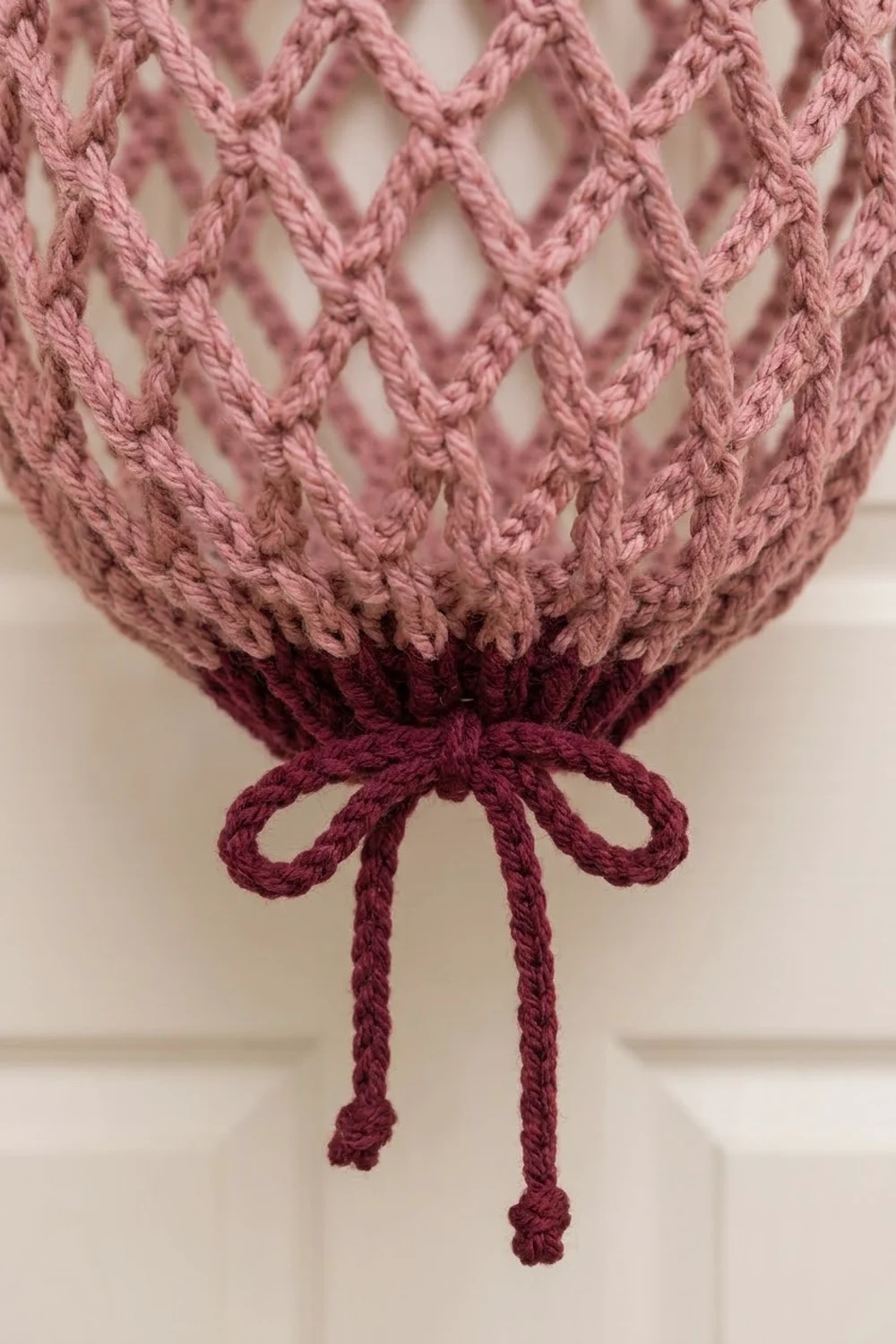
Turn your laundry routine into a game with this over-the-door basketball hoop hamper. A soft dusty-rose backboard hangs from simple door hooks, a burgundy rim holds the net open, and a diamond mesh net catches socks and shirts. When the net is full, untie the drawstring at the bottom and the laundry drops straight into your basket.
The palette is just two colors: dusty rose for the backboard and net, and deep burgundy for the target square, rim, cuff and drawstring. The style is clean and graphic, with a cozy handmade look that suits a bedroom or nursery.
This pattern uses US crochet terms. The finished backboard measures 16 x 11 in (40.6 x 27.9 cm). The rim is 12 in (30.5 cm) across, and the net plus cuff hangs about 20 in (50.8 cm) below the rim.
Here’s how it goes together. You crochet two single-crochet panels, add the target outline to the front panel, then join the panels around a plastic canvas stiffener with a two-round border. Next you cover a metal ring with burgundy single crochet, work the mesh net in a continuous spiral straight off the rim, and finish with a ribbed cuff and a drawstring.
Finished Size and Construction
- Backboard size: 16 x 11 in (40.6 x 27.9 cm)
- Rim: 12 in (30.5 cm) diameter ring
- Net + cuff length: about 20 in (50.8 cm)
- Skill level: Intermediate
- Terminology: US
- Yarn weight: Worsted (#4)
- Hook: 5.0 mm (H-8)
- Number of pieces: 7 (2 backboard panels, 2 hanger tabs, 1 rim cover, 1 net with cuff, 1 drawstring)
- Layout: backboard at the top, rim stitched across its lower section, net hanging below
- Panel size: 15 x 10 in (38.1 x 25.4 cm)
- Backboard size before border: 15 x 10 in (38.1 x 25.4 cm)
- Border depth: 0.5 in (1.3 cm) per side
Materials
Choose a smooth worsted-weight acrylic or cotton-acrylic blend, about 183 m per 100 g. Acrylic keeps the board light and holds up well to friction from laundry.
- Dusty rose: 380 g (about 695 m)
- Burgundy: 60 g (about 110 m)
These quantities include a margin of roughly 10%.
Tools and notions:
- 5.0 mm (H-8) crochet hook
- 12 in (30.5 cm) metal macramé ring
- One 12 x 18 in (30.5 x 45.7 cm) sheet of 7-count plastic canvas
- Over-the-door double hook, or two single hooks
- Tapestry needle
- 4 stitch markers
- Scissors and a measuring tape
Abbreviations (US Terms)
- ch – chain
- sl st – slip stitch
- sc – single crochet
- dc – double crochet
- fpdc – front post double crochet: yarn over, insert the hook from front to back to front around the post of the stitch, then complete as a dc
- bpdc – back post double crochet: yarn over, insert the hook from back to front to back around the post, then complete as a dc
- sp – space
- st(s) – stitch(es)
- RS – right side
Special technique – surface slip stitch: Hold the yarn behind the work. Insert the hook from the front between stitches, pull up a loop, then pull it through the loop on the hook. Repeat to “draw” a chain line on the surface.
Gauge and Checkpoints
Gauge: 16 sc and 16 rows = 4 in (10.2 cm). Work a swatch of 20 sc x 20 rows. It should measure 5 x 5 in (12.7 x 12.7 cm).
Test one panel first, before you make anything else. Every later measurement depends on it.
Checkpoints:
- Each panel: 15 x 10 in (38.1 x 25.4 cm)
- Bordered backboard: 16 x 11 in (40.6 x 27.9 cm)
- Net after Round 14: about 10.5 in (26.7 cm) below the rim
- Net after Round 26: about 17.7 in (45.0 cm) below the rim
- Net plus cuff: about 20 in (50.8 cm) below the rim
Panel too big? Go down to a 4.5 mm hook. Too small? Go up to a 5.5 mm hook. Keep the stitch counts the same, because the border, the target placement and the mesh repeat all rely on them.
Backboard Panels (make 2, dusty rose)
Ch 61.
Row 1: Sc in the 2nd ch from the hook and in each ch across, turn. (60 sc)
Rows 2–40: Ch 1 (does not count as a st), sc in each st across, turn. (60 sc)
Fasten off. Each panel measures 15 x 10 in (38.1 x 25.4 cm). Choose the neater panel as the front and mark its RS.
Target Outline (front panel)
Hold 2 strands of burgundy together so the line looks bold. Work in surface slip stitch on the RS of the front panel. Count stitches from the right edge and rows from the bottom edge.
- Mark the stitches in columns 19 and 42 on rows 12 and 37. These four markers are the corners of the outline.
- Start at the lower right marker. Work surface sl sts up between the stitches of column 19 to row 37 (26 rows).
- Work across row 37 to column 42 (24 sts).
- Work down column 42 to row 12 (26 rows).
- Work back across row 12 to the start (24 sts). Fasten off on the back.
The outline is 6 x 6.5 in (15.2 x 16.5 cm). It sits 18 sts in from each side (18 + 24 + 18 = 60), with 3 rows above it and 11 rows below it.
Hanger Tabs (make 2, dusty rose)
Ch 13.
Row 1: Sc in the 2nd ch from the hook and in each ch across, turn. (12 sc)
Rows 2–4: Ch 1, sc in each st across, turn. (12 sc)
Each tab is 3 x 1 in (7.6 x 2.5 cm). Fold each tab in half to make a 1.5 in (3.8 cm) loop. Sew the ends to the wrong side of the back panel, 1 in (2.5 cm) below the top edge and 3 in (7.6 cm) in from each side, with the loop pointing upward.
Rim (burgundy)
Round 1: Make a slip knot on the hook. Working over the 12 in (30.5 cm) ring, work 180 sc around the ring. Sl st to the first sc. (180 sc)
Push the stitches tight as you go so no metal shows. Around the 37.7 in (95.8 cm) circumference, this is about 4.8 sc per inch. Leave a 40 in (101.6 cm) tail for sewing.
Rotate the stitches so the tops (the V’s) face downward, into the center of the ring. The net is worked into these tops.
Net (dusty rose)
The net has 30 loops per round. 180 rim sts ÷ 6 = 30, so the rim fits the mesh repeat exactly.
Round 1: Join the yarn with a sl st in any rim sc. Ch 5, skip 5 sc, sc in the next sc. Repeat from * 29 more times. On the last repeat, replace the final sc with a sl st in the joining sl st. (30 ch-5 loops)
Round 2: Sl st in each of the next 3 ch to reach the center of the first loop. Ch 5, sc in the next ch-5 loop. Repeat from * 30 times. (30 ch-5 loops)
From here, work in a continuous spiral. Move a marker into the last sc of each round.
Rounds 3–14: Ch 5, sc in the next ch-5 loop 30 times. (30 ch-5 loops per round)
Checkpoint: the net hangs about 10.5 in (26.7 cm) below the rim.
Rounds 15–26: Ch 4, sc in the next loop 30 times. (30 ch-4 loops per round)
The shorter chains taper the net slightly. Checkpoint: the net hangs about 17.7 in (45.0 cm) below the rim. Sl st in the next ch to finish, then fasten off.
Cuff (burgundy)
Round 1 (conversion): Join burgundy in any ch-4 loop. Ch 1, work 2 sc in each ch-4 loop around, then sl st to the first sc. This is 30 loops x 2 sc. (60 sc)
Round 2: Ch 2 (does not count as a st). Fpdc around the next st, bpdc around the next st 30 times, then sl st to the first st. (60 sts)
Round 3 (eyelets): Ch 4 (counts as dc + ch 1), skip the next st. Dc in the next st, ch 1, skip the next st 29 times, then sl st to the 3rd ch of the beginning ch-4. (30 dc + 30 ch-1 sps = 60 sts)
Round 4: Ch 2 (does not count as a st), dc in the same st, then dc in each ch-1 sp and each dc around. Sl st to the first dc. (60 dc)
Round 5: Repeat Round 2. (60 sts)
Fasten off. The cuff is about 2.3 in (5.8 cm) tall, so the net plus cuff measures about 20 in (50.8 cm) below the rim.
Drawstring (burgundy)
Ch 121. Sl st in the back bump of the 2nd ch from the hook and in each ch across. (120 sl sts)
The finished cord is about 30 in (76.2 cm) long. Tie an overhand knot 1 in (2.5 cm) from each end.
Make All Pieces
Dusty rose: 2 backboard panels, 2 hanger tabs, 1 net
Burgundy: target outline, 1 rim cover, 1 cuff, 1 drawstring
Layout (front view):
   [hook]              [hook]
 +--------------------------+
 |      +----------+        |
 |      |  target  |        |  backboard 16 x 11 in
 |      |          |        |
 |   (=====  rim  =====)    |
 +----\----------------/----+
       \   mesh net   /
        \            /
         [cuff + bow]
Joining
Step 1 – Join the panels (worked as Border Round 1). Trim the plastic canvas to 14.5 x 9.5 in (36.8 x 24.1 cm). Place it between the two panels, wrong sides facing in, with the hanger tabs on the outside back. Line up the panels stitch for stitch, so stitch 1 of the front sits over stitch 1 of the back and row 1 sits over row 1. Every border stitch along the edges goes through one stitch (or row end) of each panel at the same time. Keep the tension even and firm; the canvas is slightly smaller than the panels, so the edges close without strain.
Step 2 – Attach the rim (after the border). Center the rim on the backboard with its back edge laid along the bottom line of the target outline. Using the burgundy tail, tack the rim’s back 5 in (12.7 cm) arc to the board. That arc is about 24 rim stitches. Stitch through all layers, including the plastic canvas, making a firm tack every 0.5 in (1.3 cm).
Step 3 – Thread the drawstring. Starting at the front center, weave the drawstring in and out of the 30 ch-1 spaces of Cuff Round 3. Pull it closed and tie a bow.
Size check: The backboard is 16 x 11 in (40.6 x 27.9 cm), and the rim sits level and centered.
Border (dusty rose)
Border gauge: Same as the panels, 16 sc = 4 in (10.2 cm). Each border round adds 0.25 in (0.6 cm) on every side.
Round 1 (joining round): Join the yarn in the top right corner, working through both panels.
- Top edge: 3 sc in the corner st, then sc in each of sts 2–59 (58 sc).
- Side: 3 sc in the corner st, then 1 sc in each row end of rows 2–39 (38 sc).
- Bottom edge (foundation ch side): 3 sc in the corner st, then sc in sts 2–59 (58 sc).
- Second side: 3 sc in the last corner, then 38 sc up the side.
- Sl st to the first sc.
That is 58 + 38 + 58 + 38 + (4 x 3) = 204 sc. Counting the corner sts at both ends, each long side has 62 sts and each short side has 42 sts. Check: 2 x 62 + 2 x 42 − 4 shared corners = 204.
Round 2: Ch 1, sc in each st around, with 3 sc in each center corner st. Sl st to the first sc. (212 sc)
Each long side now has 64 sts and each short side has 44 sts. Check: 2 x 64 + 2 x 44 − 4 = 212. Fasten off.
Why the math works: 64 sts ÷ 4 sts per inch = 16 in (40.6 cm), and 44 sts ÷ 4 = 11 in (27.9 cm). The panel’s 15 x 10 in (38.1 x 25.4 cm) grows by 0.5 in (1.3 cm) on each side, adding exactly 1 in (2.5 cm) to each dimension.
Final Blocking
- Lightly mist the backboard. Pin it flat to 16 x 11 in (40.6 x 27.9 cm) and let it dry. If you used acrylic, keep heat away from the plastic canvas.
- Hang the hamper on the hooks.
- Mist the net and gently pull it downward so the diamonds open evenly. Check the length of about 20 in (50.8 cm) below the rim.
- Smooth the cuff ribbing with your fingers and let everything air-dry while hanging.
Final Quality-Control Checklist
- Backboard is 16 x 11 in (40.6 x 27.9 cm) with crisp corners
- Target outline is square and centered, 18 sts in from each side
- No metal shows through the rim stitches
- The net has 30 loops in every round, with no twists in the spiral
- Cuff Round 3 has 30 even eyelets
- Drawstring knots are secure and the bow holds when the net is loaded
- The rim is tacked firmly across a 5 in (12.7 cm) arc
- All ends are woven in at least 2 in (5.1 cm)
Troubleshooting
- Rim stitches gap: Push them tighter. Don’t change the 180 count, because the mesh needs a multiple of 6.
- Net loops uneven: Count the chains in every loop. A ch-4 slipped into the ch-5 section shows up as a pucker.
- Net too short: Add one or two ch-4 rounds before the cuff.
- Rim tips forward when full: Re-tack it across a 7 in (17.8 cm) arc using doubled yarn.
- Board curls: Re-block it, and check that the canvas fills the panels edge to edge.
- Drawstring slips loose: Tie a double bow, or add a second knot near each end.
Care
Spot clean the backboard, since it contains plastic canvas. You can remove the net and drawstring and hand-wash them in cool water, then lay them flat to dry.

Final Notes
Everything follows from one measurement chain. A gauge of 16 sc = 4 in (10.2 cm) gives 15 x 10 in (38.1 x 25.4 cm) panels, and two border rounds bring the backboard to 16 x 11 in (40.6 x 27.9 cm). On the hoop, 180 rim stitches make 30 mesh loops, the 26-round net hangs about 17.7 in (45.0 cm), and the cuff brings the total to about 20 in (50.8 cm) below the rim. Check each stage, and your hoop will hang straight and score every time.
Happy crocheting!