

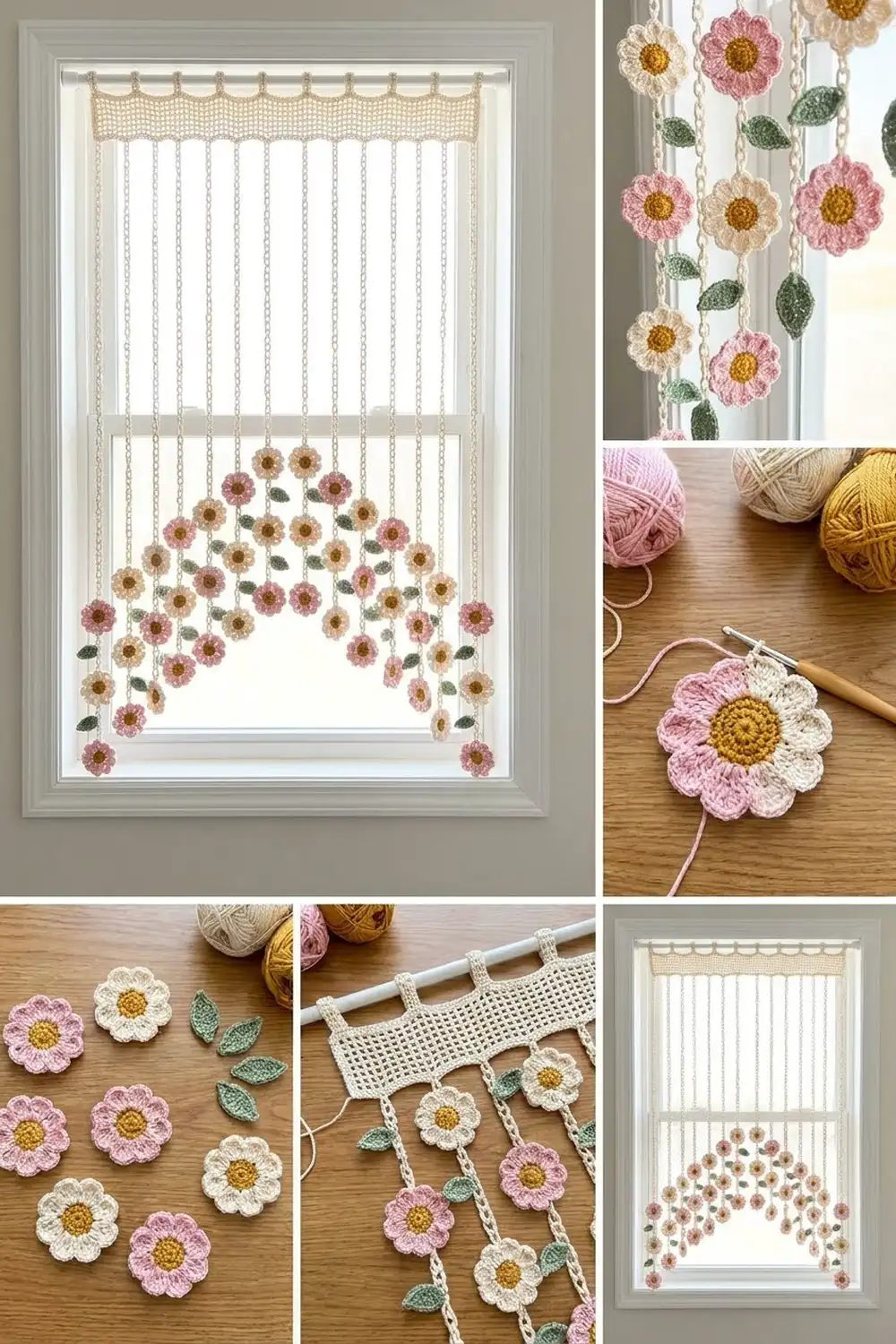
This curtain is a cheerful, airy window panel made of hanging daisy strands. Pink and cream daisies with mustard centers alternate down 13 chunky cream chains. Small sage-green leaves sit on the links between the flowers, and a simple filet-mesh header with chain tabs slides onto a standard curtain rod.
The style is light cottage décor. Light still passes through, so the curtain suits a kitchen window, a door light, or any window that needs color more than privacy. The outer strands are longest and the center strands shortest, so the bottom edge forms a soft arch.
The pattern uses US crochet terms. The finished curtain is 39 in (99.1 cm) wide. It hangs 47 in (119.4 cm) from the top of the header to the tip of the longest strand, not counting the rod tabs.
Construction is modular. First crochet all the daisies and leaves. Then chain each strand from the top down with doubled cream yarn, slip-stitching the flowers and leaves into place as you go. Finally, work the header across the tops of all 13 strands to join them and add the rod tabs.
Finished Size and Construction
- Finished size: 39 in (99.1 cm) wide × 47 in (119.4 cm) long at the outer strands
- Skill level: Intermediate
- Terminology: US
- Yarn weight: Worsted (#4) cotton
- Hooks: 4.5 mm (US 7) for the motifs and header; 5.5 mm (US I-9) for the strands
- Number of pieces: 103 daisies, 90 leaves, 13 strands, 1 header
- Layout: 13 strands side by side, 3 in (7.6 cm) apart
- Piece size: daisy 3 in (7.6 cm) tip to tip; leaf 2 in (5.1 cm) × 0.9 in (2.3 cm)
- Size before border: strands of 45 in (114.3 cm), 40 in (101.6 cm), or 35 in (88.9 cm)
- Border (header) depth: 2 in (5.1 cm), plus 13 rod tabs
Materials
Use a smooth worsted-weight cotton or cotton blend of about 150 m per 100 g. Cotton holds the petal shapes and resists stretching while the curtain hangs. Avoid very elastic acrylics, because the strands would lengthen over time.
- Cream: 550 g (825 m) for cream petals, strands, and header
- Pink: 420 g (630 m) for pink petals
- Mustard: 150 g (225 m) for the daisy centers
- Sage green: 125 g (188 m) for the leaves
Tools: 4.5 mm (US 7) and 5.5 mm (US I-9) hooks, tapestry needle, scissors, stitch markers, blocking mats, rustproof pins, spray bottle, measuring tape.
All quantities include a margin of about 15% for gauge differences and weaving in ends.
Abbreviations (US Terms)
- ch: chain
- sl st: slip stitch
- sc: single crochet
- hdc: half double crochet
- dc: double crochet
- tr: treble crochet
- fsc: foundation single crochet
- sk: skip
- sp: space
- st(s): stitch(es)
- RS: right side
Foundation single crochet (fsc): Ch 2. Insert the hook in the 2nd ch from the hook, yarn over, and pull up a loop. Yarn over and pull through 1 loop (this makes the “chain”). Yarn over and pull through 2 loops (this makes the “sc”). For each following fsc, insert the hook under the 2 loops of the previous “chain” and repeat.
Doubled yarn: Hold 2 strands of cream together and work the strands with the 5.5 mm hook.
Gauge and Checkpoints
Before you make the full set, make one test piece of each kind: 1 pink daisy, 1 leaf, and a 10 in (25.4 cm) doubled chain.
- Daisy after Round 2: center measures 1.25 in (3.2 cm) across
- Daisy after Round 4: 3 in (7.6 cm) from one petal tip to the opposite tip
- Leaf: 2 in (5.1 cm) long, including the tip
- Doubled chain: 2 ch = 1 in (2.5 cm), so a 4-ch link is 2 in (5.1 cm)
- Header: 16 sts = 4 in (10.2 cm); Rows 1–5 together = 2 in (5.1 cm)
If your daisy is larger than 3 in (7.6 cm), go down half a hook size. If it is smaller, go up half a size. Petals on neighboring strands may touch, but they should not overlap. If your chain gives fewer than 2 ch per inch, tighten your tension rather than changing the stitch count. Every strand length depends on that 2 in (5.1 cm) link.
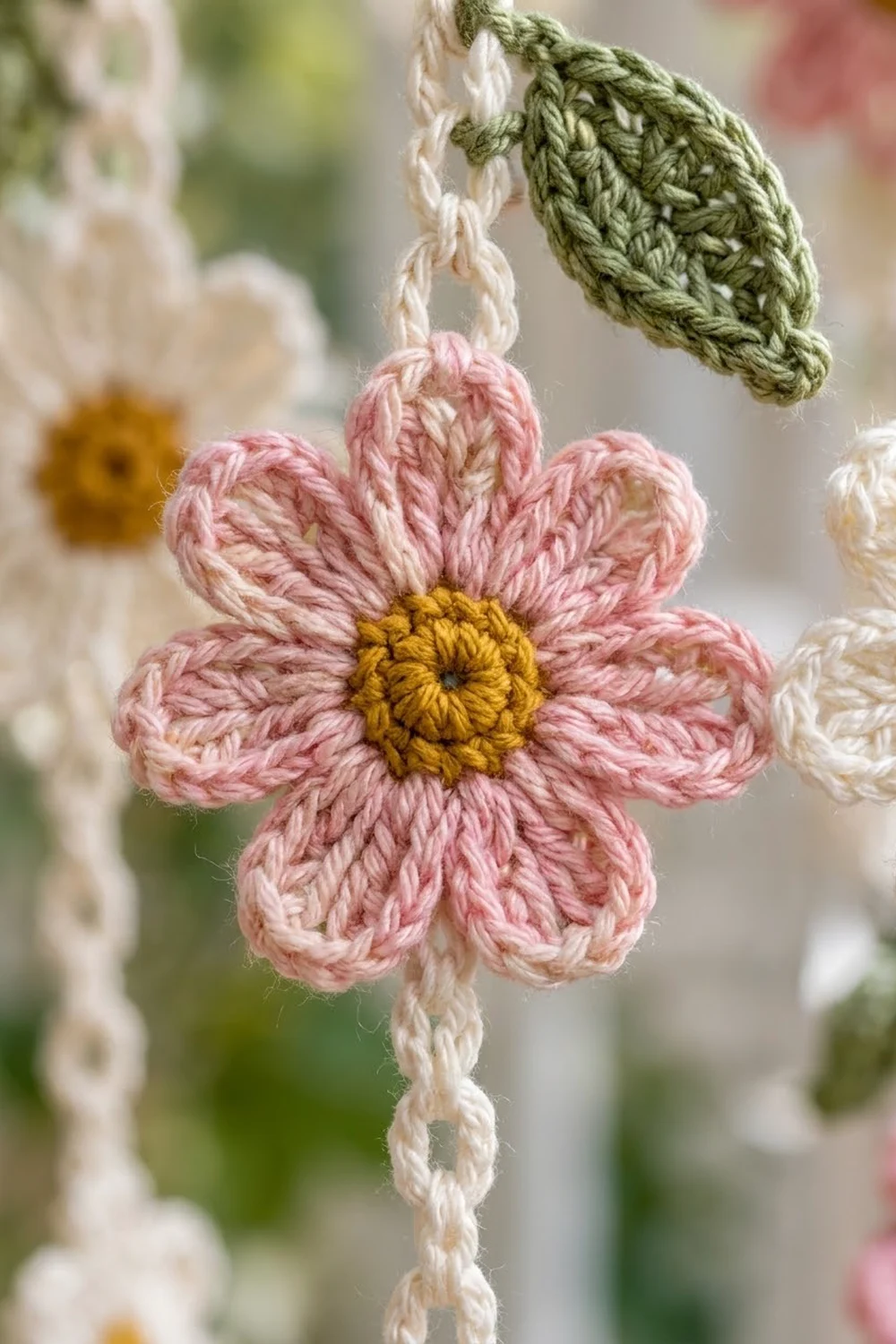
Daisy (make 103: 52 pink, 51 cream)
Round 1 (mustard): With the 4.5 mm hook, make a magic ring, ch 1, work 8 sc in the ring, and sl st to the first sc. (8 sc)
Round 2 (mustard): Ch 1, work 2 sc in each st around, and sl st to the first sc. (16 sc) Pull the ring tightly closed and fasten off.
Checkpoint: the center measures 1.25 in (3.2 cm).
Round 3 (petal color): Join pink or cream with a sl st in any st. Ch 1, sc in the same st, ch 5, sk the next st. *Sc in the next st, ch 5, sk the next st; repeat from * 6 more times. Sl st to the first sc. (8 sc + 8 ch-5 loops)
Each ch-5 loop arches over 1 skipped center st and becomes the open middle of a petal.
Round 4 (petal color): *In the next ch-5 loop, work (hdc, 2 dc, tr, ch 1, tr, 2 dc, hdc), then sl st in the next sc; repeat from * around. (8 petals of 9 sts each: 2 hdc, 4 dc, 2 tr, 1 ch-1 sp)
The ch-1 sp at the top of each petal is its tip sp. Fasten off and weave in the ends.
Checkpoint: 3 in (7.6 cm) from tip to tip, with 8 even petals lying flat.
Leaf (make 90)
Row 1 (green): With the 4.5 mm hook, ch 9. Sc in the 2nd ch from the hook, hdc in the next ch, dc in the next 3 ch, hdc in the next ch, sc in the next ch, and 3 sc in the last ch. Then work along the other side of the foundation ch: sc in the next ch, hdc in the next ch, dc in the next 3 ch, hdc in the next ch, sc in the next ch. (17 sts)
Tip: Sl st in the first sc, ch 2, and sl st in the 2nd ch from the hook. Fasten off and weave in the ends.
The center sc of the 3-sc group is the leaf base st.
Checkpoint: the leaf measures 2 in (5.1 cm) × 0.9 in (2.3 cm).
Strand (make 13)
Work each strand from the top down with doubled cream and the 5.5 mm hook. Keep the RS of every piece facing you.
Top link: Leave an 8 in (20.3 cm) tail and ch 4. The first ch (at the tail end) is the top link that the header will catch.
Daisy: Sl st in the tip sp of any petal; this is now the top petal. Ch 5, carrying the chain behind the daisy, and sl st in the tip sp of the opposite petal (4 petals away). This hidden 5-ch bridge holds the daisy upright.
Link with leaf: Ch 2, sl st in a leaf base st, ch 2. (4 ch + 1 leaf)
Repeat Daisy and Link with leaf until the strand has its full number of daisies, ending with a Daisy. Fasten off and weave the tail into the bridge.
Strand lengths:
- 9 daisies: 2 in top link + 27 in of daisies + 16 in of links = 45 in (114.3 cm), with 8 leaves
- 8 daisies: 2 + 24 + 14 = 40 in (101.6 cm), with 7 leaves
- 7 daisies: 2 + 21 + 12 = 35 in (88.9 cm), with 6 leaves
Odd-numbered strands start with pink and even-numbered strands start with cream. Attach the leaves on alternating sides, left then right.
Make All Pieces
Totals: 52 pink daisies, 51 cream daisies, and 90 leaves.
- 9-daisy strands: 1, 2, 12, 13
- 8-daisy strands: 3, 4, 10, 11
- 7-daisy strands: 5–9
Layout grid (P = pink, C = cream; strands run left to right, daisies from top to bottom):
Strand:  1  2  3  4  5  6  7  8  9 10 11 12 13
Daisy 1  P  C  P  C  P  C  P  C  P  C  P  C  P
Daisy 2  C  P  C  P  C  P  C  P  C  P  C  P  C
Daisy 3  P  C  P  C  P  C  P  C  P  C  P  C  P
Daisy 4  C  P  C  P  C  P  C  P  C  P  C  P  C
Daisy 5  P  C  P  C  P  C  P  C  P  C  P  C  P
Daisy 6  C  P  C  P  C  P  C  P  C  P  C  P  C
Daisy 7  P  C  P  C  P  C  P  C  P  C  P  C  P
Daisy 8  C  P  C  P  .  .  .  .  .  P  C  P  C
Daisy 9  P  C  .  .  .  .  .  .  .  .  .  C  P
Before chaining, count the grid: there should be 52 P and 51 C.
Joining
Method: Every join is a single sl st worked with doubled yarn, inserting the hook through a tip sp or a leaf base st from front to back.
Stitch-to-stitch logic: Each daisy uses exactly 2 tip sps, at the top and bottom; the other 6 petals stay free. Each leaf hangs from the middle of a link, with 2 ch above it and 2 ch below it.
Tension: Keep the bridge snug but relaxed so the daisy lies flat. A tight bridge makes the daisy cup, and a loose one lets it flop forward. You can switch to a ch-4 or ch-6 bridge if needed, but use the same count on every daisy.
Size checkpoint: Hang each strand from its top link. It should measure 45, 40, or 35 in (114.3, 101.6, or 88.9 cm), within 0.5 in (1.3 cm).
Border: Header
Work the header flat with single cream yarn and the 4.5 mm hook.
Border gauge: 16 sts = 4 in (10.2 cm). Each strand gets a 12-st section that is 3 in (7.6 cm) wide, so the header is 13 × 12 = 156 sts across.
Row 1 (fsc, joining): Work 156 fsc. On fsc 6, 18, 30, 42, 54, 66, 78, 90, 102, 114, 126, 138, and 150, insert the hook through the top link of the next strand (strands 1 through 13 in order) as well as the previous fsc’s chain, then complete the stitch. Turn. (156 sts; 13 strands caught)
Row 2 (mesh): Ch 3 (counts as dc). *Ch 1, sk the next st, dc in the next st; repeat from * 76 more times. Dc in the last st. Turn. (79 dc + 77 ch-1 sps = 156 sts)
Row 3: Ch 3 (counts as dc), dc in the next dc. *Ch 1, sk the ch-1 sp, dc in the next dc; repeat from * 76 more times, working the last dc in the top of the turning ch. Turn. (156 sts)
Row 4: Ch 3 (counts as dc). *Ch 1, sk the ch-1 sp, dc in the next dc; repeat from * 76 more times. Dc in the top of the turning ch. Turn. (156 sts)
Row 5: Ch 1, then sc in each dc and each ch-1 sp across. Turn. (79 + 77 = 156 sc)
Checkpoint: the header measures 39 in (99.1 cm) × 2 in (5.1 cm).
Row 6 (tabs): Ch 1. *Sc in the next 3 sts, ch 12, sk 6 sts, sc in the next 3 sts; repeat from * 12 more times. (78 sc + 13 ch-12 tabs) Fasten off.
Why the math works: Rows 1–5 each have 156 sts, which is exactly 13 sections of 12 sts. Each ch-1 sp counts as 1 st, and no stitches are added at the strand joins. In Row 6, each section uses 3 + 6 + 3 = 12 sts, which centers one 3 in (7.6 cm) tab over each strand. Each tab fits a rod up to 1 in (2.5 cm) thick.
Final Blocking
- Lay the curtain RS up on the blocking mats.
- Pin the header to 39 in × 2 in (99.1 cm × 5.1 cm), with the mesh squared.
- Straighten the strands so they hang 3 in (7.6 cm) apart.
- Pin each daisy flat, with its top and bottom tips in line with the chain.
- Pin each leaf out at about 45 degrees.
- Mist the curtain until damp, but don’t soak it.
- Let it dry completely, then hang it and check the arch.
Final Quality-Control Checklist
- [ ] 52 pink and 51 cream daisies, each 3 in (7.6 cm)
- [ ] 90 leaves, each 2 in (5.1 cm)
- [ ] Colors alternate down every strand and across every daisy row
- [ ] Strands measure 45, 40, and 35 in (114.3, 101.6, and 88.9 cm)
- [ ] Bridges are hidden behind the daisies, and every daisy lies flat
- [ ] Header has 156 sts and is 39 in (99.1 cm) wide
- [ ] 13 tabs, each centered over a strand
- [ ] All ends woven in
Troubleshooting
Petals cup: Keep the Round 3 loops at exactly 5 ch with even tension.
Center hole too big: Tighten the magic ring before weaving in the tail.
Daisy twists sideways: The bridge was joined to the wrong petal. Count 4 petals down from the top.
Strand too long: The chain is loose. Rechain it with firmer links.
Header narrower than 39 in (99.1 cm): Redo the fsc with a larger hook, keeping 156 sts.
Strand hangs between tabs: Catch the strands only on fsc 6, 18, 30, and so on (every 12th st from 6).
Care
Hand wash in cool water, roll the curtain in a towel to remove excess water, and dry it flat with the daisies reshaped. Don’t hang it while wet, because the weight of the water will stretch the strands.
Final Notes
The measurements build on each other. A 1.25 in (3.2 cm) center grows into a 3 in (7.6 cm) daisy. Daisies and 2 in (5.1 cm) links make strands of 45, 40, and 35 in (114.3, 101.6, and 88.9 cm). Thirteen strands at 3 in (7.6 cm) spacing set a 156-st header that is 39 in (99.1 cm) wide. If you check each stage as you go, the finished curtain will hang straight and even.
Happy crocheting!