
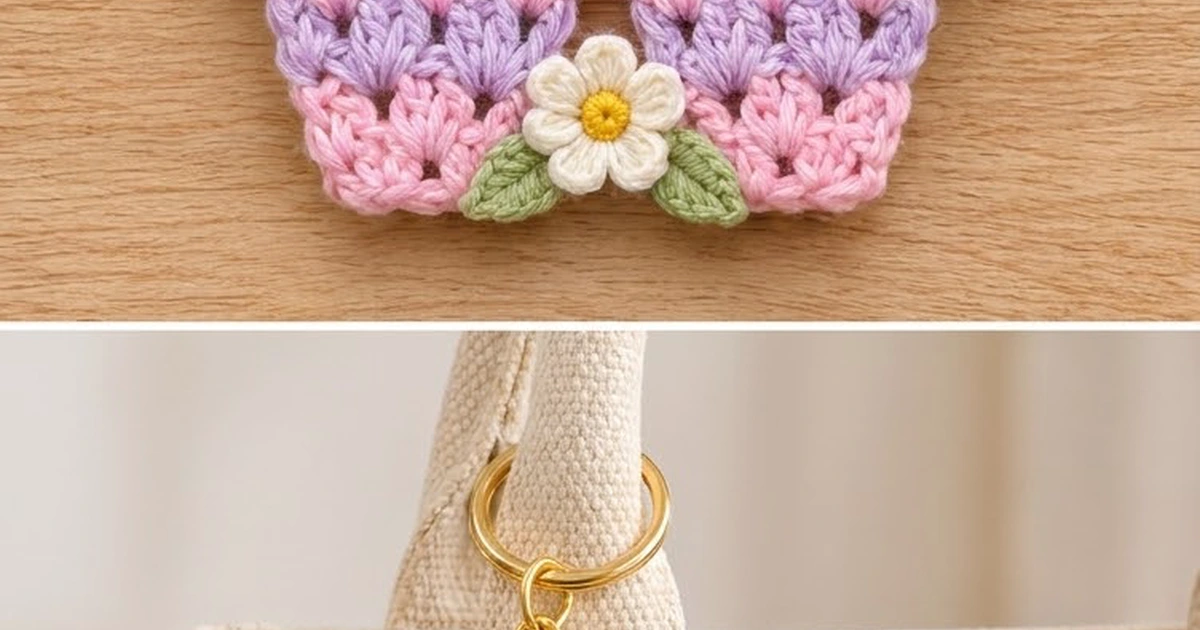
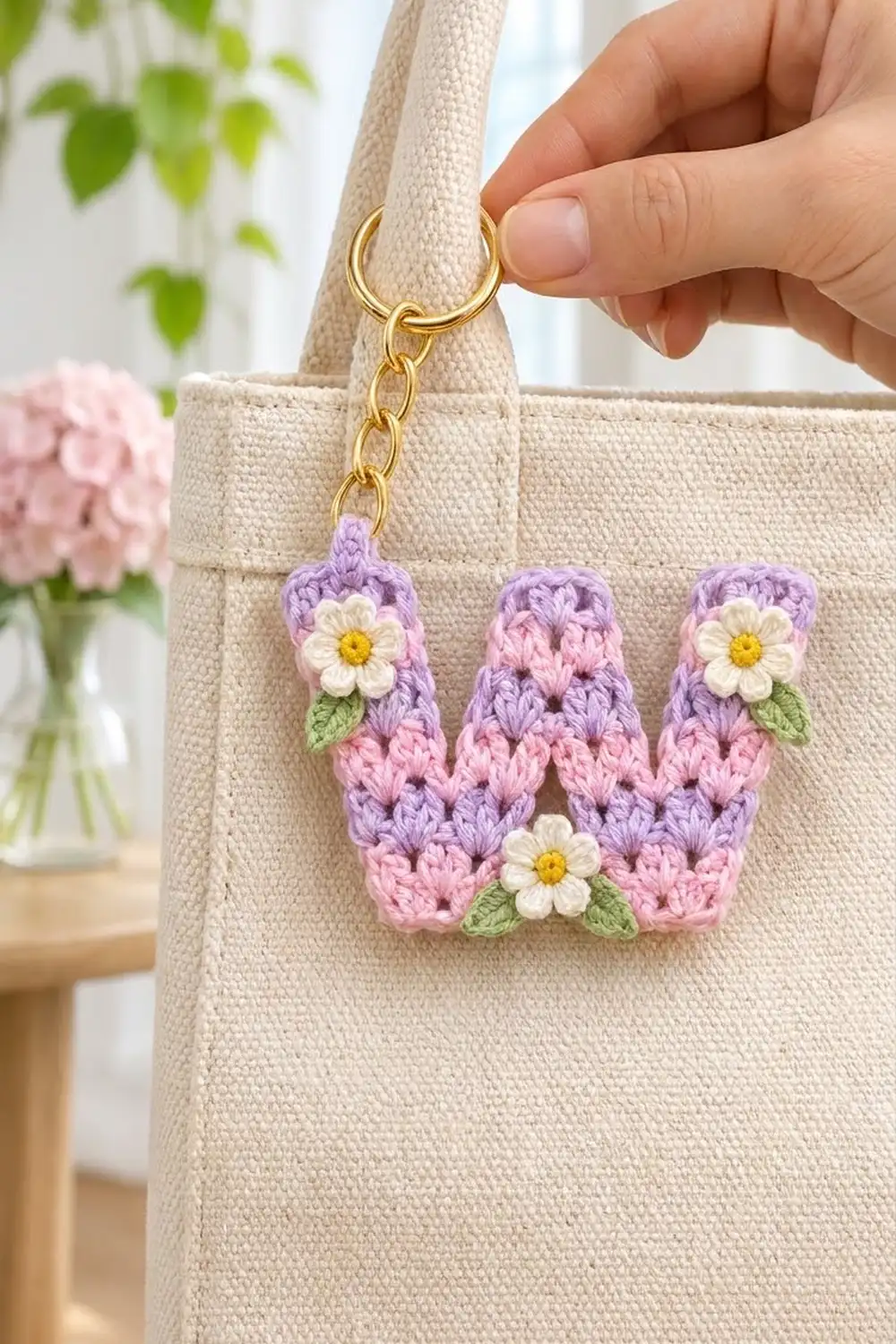
This little letter W is a pastel keychain made in soft pink and lavender granny stripes. Each stripe is one row of 3-dc clusters, which gives the surface a cozy, fan-like texture.
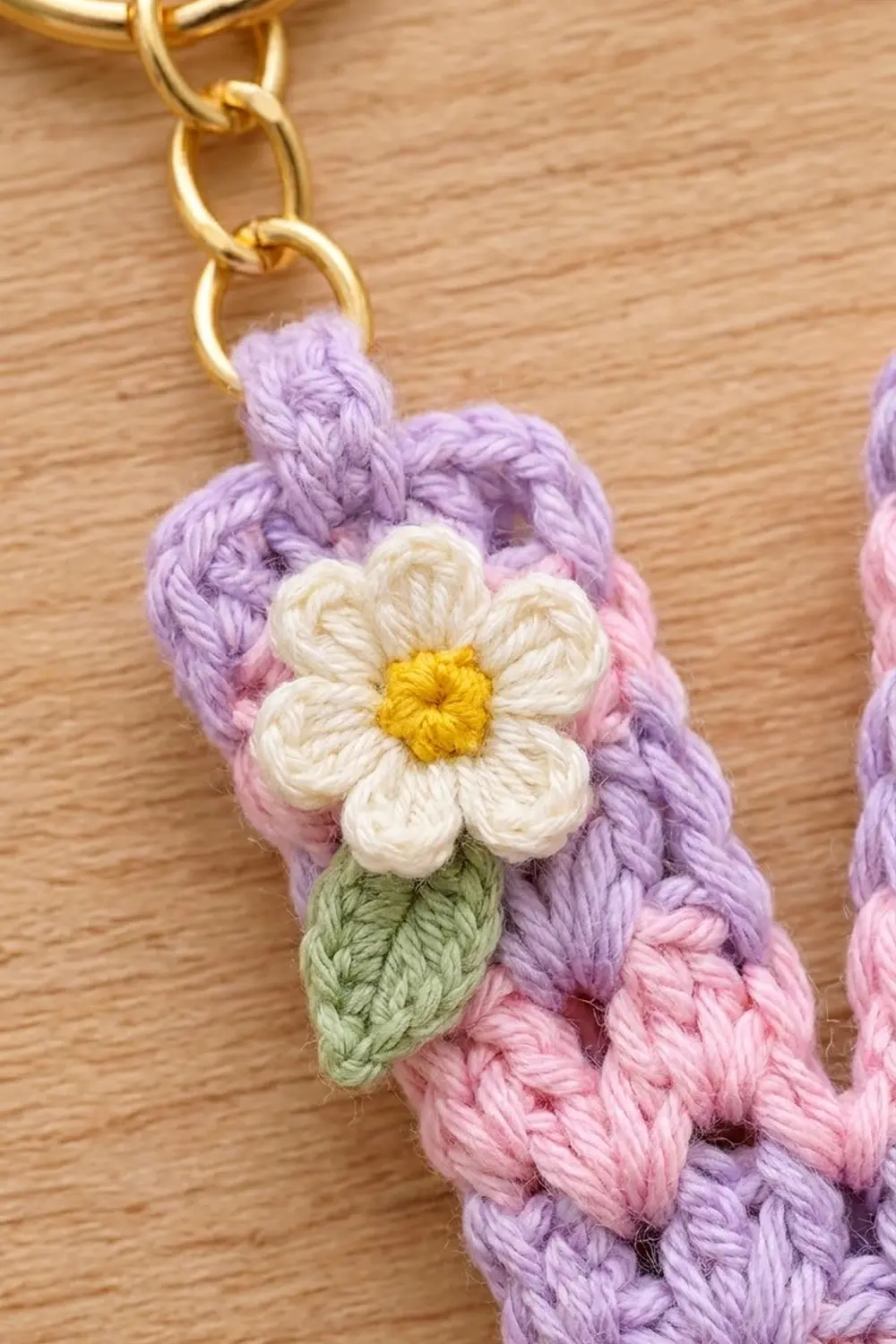
A lavender single crochet trim outlines the whole letter and keeps the edges crisp. Three tiny cream daisies with yellow centers and sage green leaves sit on the top of the left arm, the top of the right arm, and the bottom center. A small lavender tab at the top of the left arm holds a gold chain and split ring, so the W can hang from a bag handle or a set of keys.
The pattern uses US crochet terms. The finished letter measures about 4.8 in wide x 3.5 in tall (12.2 x 8.9 cm), not counting the tab.
Construction is simple and flat. You work the letter from the bottom up in rows: first two separate feet, then one row that bridges them into a single body, then three separate arms on top. One round of trim goes all the way around, and the appliqués and hardware go on last.
Finished Size and Construction
- Finished size: 4.8 in wide x 3.5 in tall (12.2 x 8.9 cm), plus tab
- Skill level: Advanced beginner
- Terminology: US terms
- Yarn weight: DK (#3), cotton or cotton blend
- Hook: 3.5 mm (E-4)
- Number of pieces: 1 letter body, plus 3 flowers and 4 leaves sewn on
- Layout: Single letter worked flat in 8 rows; no separate motifs are joined
- Body size before trim: 4.5 in x 3.2 in (11.4 x 8.1 cm)
- Trim depth: about 0.15 in (0.4 cm) per side, adding 0.3 in (0.8 cm) to each dimension
Materials
Use a smooth cotton or cotton-blend DK yarn (about 115 m per 50 g). Cotton shows the clusters clearly and holds its shape through daily handling.
- Light pink: about 6 g / 14 m (rows 1, 3, 5, 7)
- Lavender: about 8 g / 18 m (rows 2, 4, 6, 8, trim, tab)
- Cream: about 2 g / 5 m (flower petals)
- Yellow: about 1 g / 2 m (flower centers)
- Sage green: about 1 g / 2 m (leaves)
Quantities include a margin of about 20% for tails and checking your gauge.
Tools:
- 3.5 mm (E-4) crochet hook
- Tapestry needle
- Scissors
- Gold split ring, about 1 in (2.5 cm) across
- Short gold chain, about 1 in (2.5 cm), with 2 jump rings
- Flat-nose pliers
- Rust-proof pins and a foam blocking mat
Abbreviations (US Terms)
- ch – chain
- sl st – slip stitch
- sc – single crochet
- hdc – half double crochet
- dc – double crochet
- sp – space
- st(s) – stitch(es)
- tch – turning chain
- RS / WS – right side / wrong side
Special stitch – group: 3 dc worked into the same space.
Half group: 2 dc at the edge of a row (the beginning ch-3 plus 1 dc, or 2 dc in the last st).
Unit: one group’s width, about 0.5 in (1.3 cm). The letter is planned on a grid 9 units wide and 8 rows tall.
Gauge and Checkpoints
Gauge: 2 groups = 1 in (2.5 cm) wide, and 5 rows = 2 in (5.1 cm) tall, so 1 row = 0.4 in (1.0 cm).
You don’t need a separate swatch. Make Foot 1 first and measure it.
Checkpoints:
- After Foot 1, Row 3: 2 in wide x 1.2 in tall (5.1 x 3.0 cm)
- After Row 5: 4.5 in wide x 2 in tall (11.4 x 5.1 cm)
- After Row 8: 4.5 in wide x 3.2 in tall (11.4 x 8.1 cm)
- After trim: 4.8 in x 3.5 in (12.2 x 8.9 cm)
If your foot is too big, go down to a 3.25 mm hook. If it is too small, go up to a 3.75 mm hook. A 0.25 in (0.6 cm) error across one foot becomes about 0.5 in (1.3 cm) across the full letter.
Pattern
Color notes: Odd rows are pink and even rows are lavender. Each color ends up on the opposite edge after every row, so you can’t carry yarn up the side. Change colors on the last yarn over of the row before. Cut the old color, leaving a 3 in (7.6 cm) tail, and lay the tails along the edge so the trim covers them.
Two row types repeat throughout:
- A-row (odd rows): ch 3 (counts as dc), dc in first st, group in each sp between groups, 2 dc in top of tch. Count = 3 x (full groups) + 4.
- B-row (even rows): ch 3 (counts as dc), group in each sp, dc in top of tch. Count = 3 x (groups) + 2.
Foot 2 (make first, right foot)
With pink, ch 16.
Row 1 (RS, pink): Dc in 4th ch from hook (skipped ch count as dc), [skip 2 ch, group in next ch] 3 times, skip 2 ch, 2 dc in last ch. Change to lavender. (3 groups + 2 half groups = 13 sts)
Row 2 (lavender): Turn, ch 3, group in each of the 4 sps, dc in top of tch. Change to pink. (4 groups = 14 sts)
Row 3 (pink): Turn, ch 3, dc in first st, group in each of the 3 sps between groups, 2 dc in top of tch. (13 sts)
Fasten off, leaving a 3 in (7.6 cm) tail. Foot 2 measures 2 in x 1.2 in (5.1 x 3.0 cm).
Foot 1 (left foot)
Work Rows 1–3 exactly as for Foot 2, but don’t fasten off. At the end of Row 3, change to lavender.
Joining the Feet
Lay Foot 2 to the right of Foot 1 with the same side facing. The end of Foot 2’s Row 3 (the 2-dc half group) should sit next to Foot 1.
Row 4 (lavender): Turn, ch 3 (counts as dc), group in each of the 4 sps across Foot 1, ch 3 (bridge), group in each of the 4 sps across Foot 2, dc in top of the beginning ch-3 of Foot 2 Row 3. Change to pink. (8 groups + ch-3 bridge + 2 edge dc = 26 dc and 3 ch)
The ch-3 bridge spans a gap of about 0.5 in (1.3 cm), which becomes the bottom notch of the W. Keep the chain relaxed so it lies flat.
Row 5 (pink): Turn, ch 3, dc in first st, group in each of the 3 sps between groups on Foot 2, 2 groups in the ch-3 bridge sp, group in each of the 3 sps between groups on Foot 1, 2 dc in top of tch. Fasten off pink. (8 groups + 2 half groups = 28 sts)
Why the bridge takes two groups: normally one group sits between two neighboring groups. The bridge widens that spot by one unit, so it needs one extra group. The body is now 9 units, or 4.5 in (11.4 cm) wide.
The Three Arms
With the RS facing, Row 5 has 9 sps. Number them 1 to 9 from left to right, and number the 8 full groups G1 to G8 from left to right. Sp 1 is between the left half group and G1, and sp 9 is between G8 and the right half group.
The left arm uses sps 1–2, the middle arm uses sps 4–6, and the right arm uses sps 8–9. Skip sps 3 and 7; they form the two top notches.
Left arm, Row 6 (lavender): Join lavender with sl st in top of the left-edge st, ch 3, group in sp 1, group in sp 2, dc in center dc of G2. (2 groups = 8 sts)
Row 7 (pink): Turn, ch 3, dc in first st, group in sp between groups, 2 dc in top of tch. (7 sts)
Row 8 (lavender): Turn, ch 3, group in each of the 2 sps, dc in top of tch. Fasten off. (8 sts)
Middle arm, Row 6 (lavender): Join lavender with sl st in center dc of G3, ch 3, group in each of sps 4, 5 and 6, dc in center dc of G6. (3 groups = 11 sts)
Row 7 (pink): Turn, ch 3, dc in first st, group in each of the 2 sps between groups, 2 dc in top of tch. (10 sts)
Row 8 (lavender): Turn, ch 3, group in each of the 3 sps, dc in top of tch. Fasten off. (11 sts)
Right arm, Row 6 (lavender): Join lavender with sl st in center dc of G7, ch 3, group in sp 8, group in sp 9, dc in top of the last st. (8 sts)
Rows 7–8: Work as for left arm Rows 7–8. (7 sts, then 8 sts) Fasten off.
Checkpoint: the outer arms are 1 in (2.5 cm) wide and the middle arm is 1.5 in (3.8 cm) wide. All three arms are 1.2 in (3.0 cm) tall. The full body is 4.5 in x 3.2 in (11.4 x 8.1 cm).
Flowers (make 3)
Center: With yellow, make a magic ring, ch 1, 5 sc in ring, sl st to first sc. Pull the ring closed. Fasten off. (5 sc)
Petals: Join cream in any sc. *(Sl st, ch 2, 2 dc, ch 2, sl st) in same sc, move to next sc; repeat from * 4 more times. (5 petals) Fasten off, leaving an 8 in (20.3 cm) tail for sewing.
Each flower is about 0.9 in (2.3 cm) across.
Leaves (make 4)
With sage green, ch 6. Sc in 2nd ch from hook, hdc in next ch, dc in next ch, hdc in next ch, sc in last ch, ch 1. Rotate and work along the opposite side of the chain: sc, hdc, dc, hdc, sc. Sl st to first sc. Fasten off, leaving a long tail. (10 sts)
Each leaf is about 0.75 in (1.9 cm) long.
Border
The border is one round of lavender sc.
Border gauge: 1 sc per st along the tops and the foundation chain, 2 sc per dc row end along the sides, and 3 sc in each outside corner. Add no extra stitches at the inside corners of the notches.
Join lavender at the bottom-left corner of Foot 1 and work counterclockwise. Corners are listed separately from the side counts.
- Foot 1 bottom: 3 sc in first ch, sc in next 11 ch, 3 sc in last ch. (11 + 2 corners)
- Bottom notch: 6 sc up the inner edge of Foot 1 (rows 1–3), 1 sc in each of the 3 bridge ch, 6 sc down the inner edge of Foot 2. (15)
- Foot 2 bottom: 3 sc in first ch, sc in next 11 ch, 3 sc in last ch. (11 + 2 corners)
- Right outer side: 16 sc up the edge (rows 1–8).
- Right arm top: 3 sc in first st, sc in next 6 sts, 3 sc in last st. (6 + 2 corners)
- Right top notch: 6 sc down the right arm’s inner edge, sc in the remaining dc of G7, sc in sp 7, sc in the remaining dc of G6, 6 sc up the middle arm. (15)
- Middle arm top: 3 sc in first st, sc in next 9 sts, 3 sc in last st. (9 + 2 corners)
- Left top notch: 6 sc down the middle arm, then 3 sc across G3, sp 3 and G2 as before, then 6 sc up the left arm. (15)
- Left arm top: 3 sc in first st, sc in next 6 sts, 3 sc in last st. (6 + 2 corners)
- Left outer side: 16 sc down the edge, sl st to first sc. Fasten off.
Totals: 10 corners x 3 sc = 30; foot bottoms 22; notches 45; outer sides 32; arm tops 21. Total = 150 sc.
Why the math works: Each foot bottom has 13 foundation ch, and 1 corner ch + 11 + 1 corner ch = 13. Each arm top matches its own Row 8 count: 1 + 6 + 1 = 8 for the outer arms and 1 + 9 + 1 = 11 for the middle arm. The 3-sc corners turn the edge without adding width. Each notch bottom gets only 3 sc, matching the 3 bridge ch below and the 3 exposed spots in Row 5 above, so the slots stay open.
Keychain Tab
With the RS facing, join lavender in the 2nd of the 6 top sc on the left arm.
Row 1: Ch 1, sc in same st and next 3 sts. (4 sc)
Rows 2–5: Ch 1, turn, sc in each st. (4 sc) Fasten off.
The tab is about 0.7 in wide x 0.75 in tall (1.8 x 1.9 cm).
Final Blocking
- Weave in all tails along the WS of the trim, not across the front of a stripe.
- Lightly mist the letter and the appliqués until damp.
- Pin the letter flat, RS up, to 4.8 in x 3.5 in (12.2 x 8.9 cm).
- Pin each arm straight: the outer arms at 1 in (2.5 cm) and the middle arm at 1.5 in (3.8 cm), plus trim.
- Pin each notch open with one pin so it dries as a clean slot.
- Pin the flowers round and the leaves pointed, and let everything dry completely.
- Sew the leaves first: one at the lower left of the left-arm flower spot, one at the lower right of the right-arm flower spot, and two angled outward under the bottom-center flower spot.
- Sew each flower on top, overlapping the leaf base by about 1/4 in (0.6 cm). Stitch only through the yellow center and the bases of the petals.
- Open a jump ring, pass it through the top row of the tab, add the chain, and close it. Attach the split ring to the chain with the second jump ring.
Final Quality-Control Checklist
- Stripes alternate pink and lavender, starting pink at the bottom and ending lavender on top.
- Each foot started with 13 sts; Row 5 has 28 sts.
- All three arms are 3 rows tall and end in lavender.
- The trim has 150 sc and lies flat.
- All three notches are open, about 0.5 in (1.3 cm) wide before trim.
- Flowers sit on the left arm top, the right arm top and the bottom center.
- Jump rings are fully closed.
- No tails show on the RS.
Troubleshooting
Feet splay apart at the bridge: The ch-3 is too loose. Redo Row 4 with a firmer chain.
Bottom notch closes up: You worked extra sc into the bridge. Use exactly 3.
Arms are uneven widths: Check that you skipped sps 3 and 7, not sps 2 and 8.
Edges ripple: Work 2 sc per row end, not 3. If they still ripple, go down one hook size for the trim only.
Edges pull in: Check that every corner has 3 sc and each foot bottom has 11 sc between corners.
Care
Remove the metal hardware, hand wash in cool water with mild soap, reshape, and dry flat.
Final Notes
The measurement chain is short. With 2 groups = 1 in (2.5 cm) and 1 row = 0.4 in (1.0 cm), each foot is 2 in (5.1 cm) wide, the body is 4.5 in (11.4 cm) wide, and 8 rows give 3.2 in (8.1 cm) of height. The trim then brings the letter to 4.8 in x 3.5 in (12.2 x 8.9 cm). Check the first foot, trust the counts, and the rest follows.
Happy crocheting!