
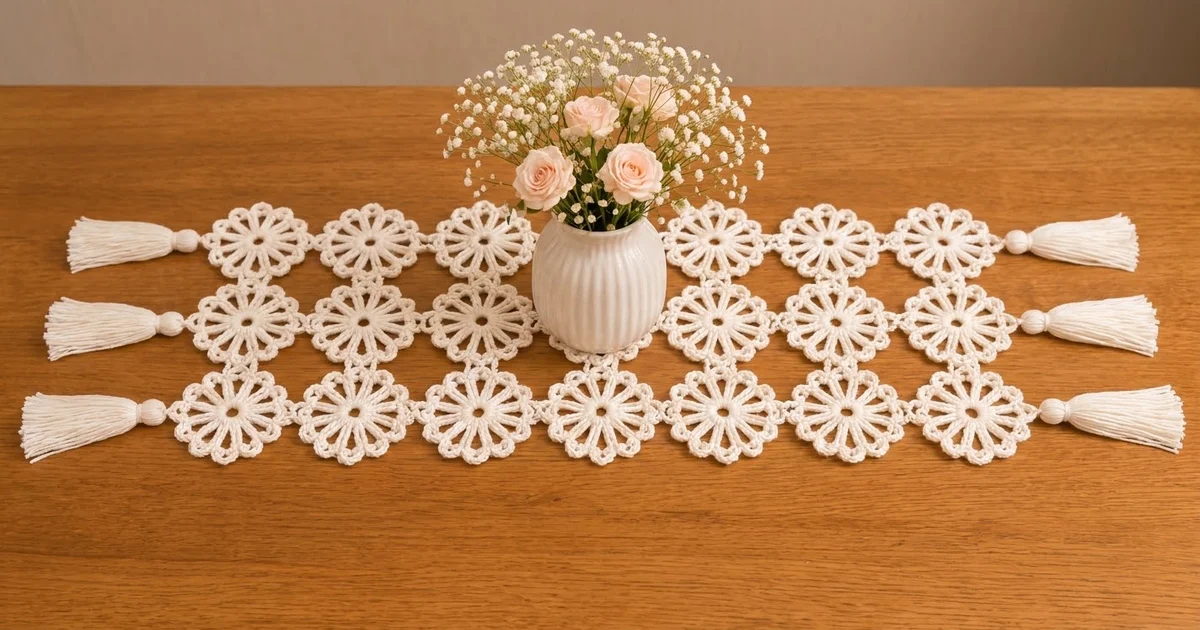
This lace runner is made of round flower motifs set three across. Each motif has a small open center ring and twelve pairs of tall spokes, and the outer edge is a ring of soft scalloped petals. Short chain bridges join the motifs at their petal tips, so the finished runner reads as an airy lattice of wheels with little open diamonds between them.
It is worked in one color: a clean, warm white. That keeps the look classic, a bit vintage and very easy to style, whether you use it on a dining table, sideboard or dresser. Each short end has three plump tassels that hang over the table edge.
The pattern uses US crochet terms. The finished runner measures 13 in (33.0 cm) wide by 44.5 in (113.0 cm) long without the tassels. Each 4 in (10.2 cm) tassel adds length at both ends, so the total length is 52.5 in (133.4 cm).
You make one motif, check its size, and then work the other 29 with join-as-you-go in the last round. No separate seaming is needed, and no border is added. The scalloped petals already finish the edge. The last step is to attach six tassels.
Finished Size and Construction
- Finished size: 13 in x 44.5 in (33.0 cm x 113.0 cm), not counting tassels
- Length with tassels: 52.5 in (133.4 cm)
- Skill level: Easy-intermediate
- Terminology: US crochet terms
- Yarn weight: DK (light #3) mercerized or matte cotton
- Hook: 3.5 mm (E-4)
- Number of pieces: 30 motifs + 6 tassels
- Layout: 3 motifs wide x 10 motifs long
- Motif size: 4 in (10.2 cm) across, measured petal tip to petal tip
- Gap between motifs (bridge): 0.5 in (1.3 cm)
- Size before border: 13 in x 44.5 in (33.0 cm x 113.0 cm). There is no added border, so this is also the finished size.
- Border depth: 0 in (0 cm). The petal scallops form the edge.
Materials
Yarn: Use a smooth DK cotton or cotton blend. Cotton gives crisp stitch definition and holds the petal shapes after blocking. Pick a yarn with about 115 m (126 yd) per 50 g ball.
- White: 200 g / 460 m (503 yd), which is 4 balls
The runner uses about 150 g / 345 m (377 yd): about 4 g per motif for the 30 motifs, plus about 30 g for the six tassels. The quantity above includes a margin for your gauge check, tails and dye-lot safety.
Tools:
- 3.5 mm (E-4) crochet hook
- Tapestry needle
- Scissors
- Stiff cardboard, 4.5 in (11.4 cm) tall, for winding tassels
- Rust-proof pins and a blocking mat or folded towels
- Spray bottle
- Measuring tape
Abbreviations (US Terms)
- ch – chain
- sl st – slip stitch
- sc – single crochet
- hdc – half double crochet
- dc – double crochet
- tr – treble crochet
- sk – skip
- sp – space
- st(s) – stitch(es)
- rep – repeat
Special stitch – Petal scallop: (sc, hdc, 2 dc, ch 2, 2 dc, hdc, sc) all in the same ch-6 loop. That makes 8 sts plus one ch-2 tip.
Special stitch – Bridge tip (joining): Work in place of the ch-2 tip. Ch 2, sl st in the ch-2 tip of the neighboring motif, ch 2.
Gauge and Checkpoints
Make one complete motif first and block it before you go on. Gauge in lace is about distances, so measure at each checkpoint:
- After Rnd 1: The ring of dc measures 1.25 in (3.2 cm) across.
- After Rnd 2: The spokes measure 2.5 in (6.4 cm) across, tip to tip.
- After Rnd 3: The chain loops measure 3.25 in (8.3 cm) across.
- After Rnd 4 (blocked): 4 in (10.2 cm) across, petal tip to petal tip.
A motif between 3.75 in (9.5 cm) and 4.25 in (10.8 cm) is acceptable, but every motif must match the first one.
If your motif is too big: Go down to a 3.25 mm hook, or tighten your tr so the spokes don’t flare.
If your motif is too small: Go up to a 3.75 mm hook. Also check that you are drawing up the first loop of each tr to the full height of the stitch.
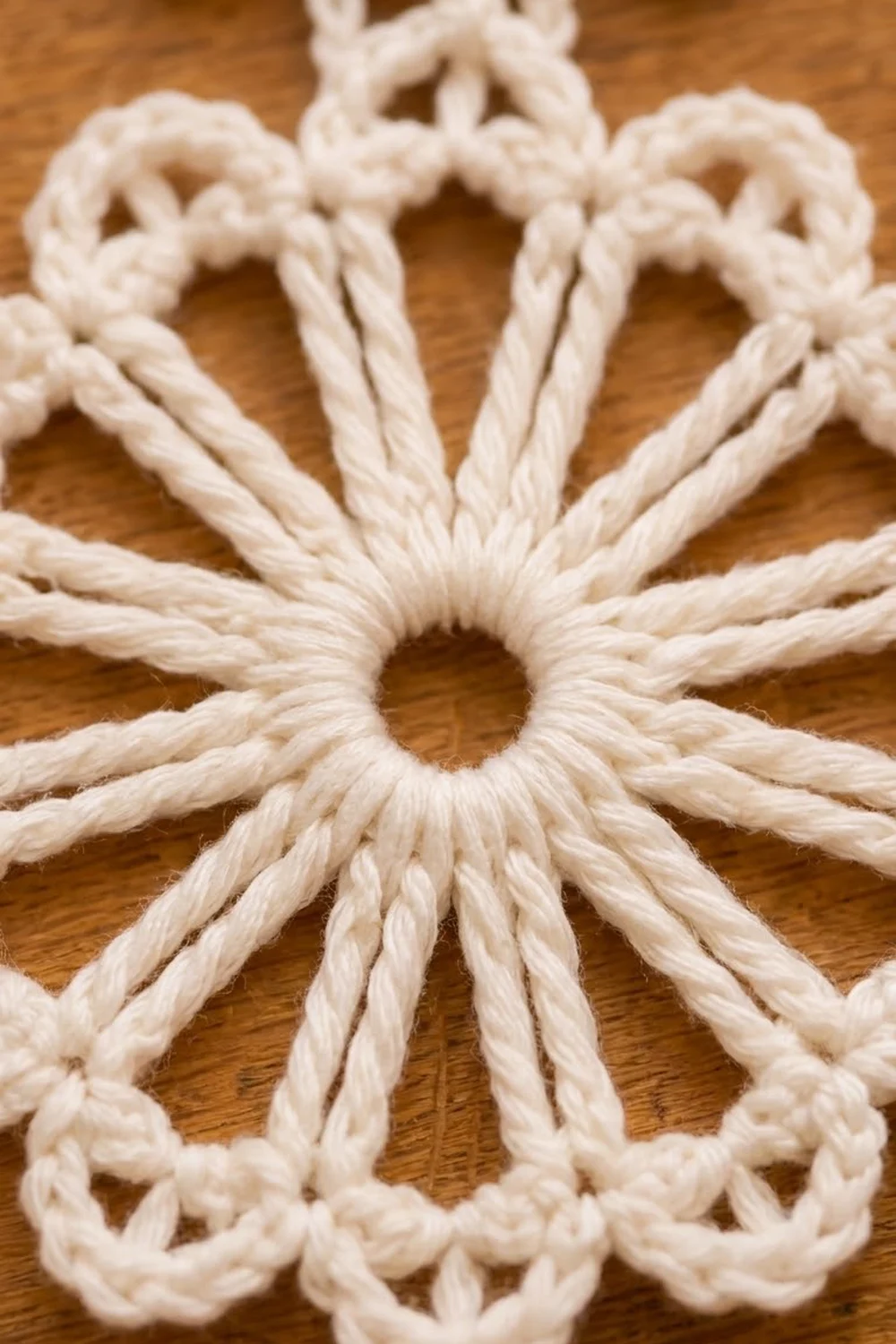
Motif (Make 30)
Rnd 1 – Center Ring
Ch 6 and sl st to the first ch to form a ring.
Ch 3 (counts as dc), then work 23 dc in the ring. Join with a sl st to the top of the beginning ch-3.
(24 dc)
Pull the starting tail gently so the ring closes to a small, round opening of about 0.25 in (0.6 cm).
Rnd 2 – Spokes
Ch 4 (counts as tr), tr in the next dc, ch 3. *Tr in each of the next 2 dc, ch 3; rep from * 10 more times. Join with a sl st to the top of the beginning ch-4.
(24 tr in 12 pairs, 12 ch-3 sps)
Each pair of tr is one spoke. The ch-3 spaces between the pairs open into the gaps you see between the spokes.
Rnd 3 – Loops
Sl st in the next tr and in the next ch-3 sp. Ch 1, sc in the same ch-3 sp, ch 6. *Sc in the next ch-3 sp, ch 6; rep from * 10 more times. Join with a sl st to the first sc.
(12 sc, 12 ch-6 loops)
Each ch-6 loop arches over one pair of tr. This sets up one petal per spoke.
Rnd 4 – Petal Scallops
Sl st in the next ch-6 loop. Work one petal scallop in each ch-6 loop around: (sc, hdc, 2 dc, ch 2, 2 dc, hdc, sc). Join with a sl st to the first sc and fasten off.
(12 scallops: 96 sts + 12 ch-2 tips)
To count it as a check, the round is 12 scallops x 8 sts = 96 sts, and each scallop has one ch-2 tip. For the first motif, every tip is a plain ch-2. For all other motifs, some tips become bridge tips (see Joining).
Tip numbering: With the fastened-off motif lying flat, call the tip at the top Tip 1 and number clockwise to Tip 12. Tip 4 points right, Tip 7 points down and Tip 10 points left. Joining uses only these four directions.
Make All Pieces
All pieces are white:
- Motifs: 30, in a grid 3 wide x 10 long
- Tassels: 6, three for each short end
Layout grid (M = motif, Row 1 is one short end and Row 10 is the other):
Row 1:   M  M  M   (tassels below)
Row 2:   M  M  M
Row 3:   M  M  M
Row 4:   M  M  M
Row 5:   M  M  M
Row 6:   M  M  M
Row 7:   M  M  M
Row 8:   M  M  M
Row 9:   M  M  M
Row 10:  M  M  M   (tassels above)
Work row by row from left to right. Motif 1 is a complete stand-alone motif. You join every later motif while working its Rnd 4.
Joining (Join-As-You-Go)
Method: Work Rnds 1–3 of the new motif as normal. On Rnd 4, work each scallop as written until you reach a tip that faces a finished neighbor. Work that tip as a bridge tip instead: ch 2, sl st in the neighbor’s facing ch-2 tip, ch 2. Then finish the scallop with (2 dc, hdc, sc).
Stitch-to-stitch logic:
- Joining to the left neighbor: Use the new motif’s Tip 10 and the neighbor’s Tip 4.
- Joining to the neighbor above: Use the new motif’s Tip 1 and the neighbor’s Tip 7.
- Each joined pair is connected by exactly one bridge. No sts are added to the scallops themselves, so each scallop stays at 8 sts.
- In the first row, motifs 2 and 3 have one bridge each. In later rows, the left motif has 1 bridge (up), and the middle and right motifs have 2 bridges each (up and left).
- The diagonal tips (Tips 2–3, 5–6, 8–9 and 11–12) stay free. Where four motifs meet, they frame the little open diamond.
Tension advice: Keep the bridge chains the same size as your normal chains. If they are tight, the runner puckers at the joins. If they are loose, the motifs drift apart and the grid looks wobbly. Insert the hook from front to back of the neighbor’s tip for every join so all the bridges lie the same way.
Size checkpoint:
- Two joined motifs measure 8.5 in (21.6 cm) across: 4 in + 0.5 in + 4 in.
- One full row of three measures 13 in (33.0 cm).
- After 5 rows, the length is 22 in (55.9 cm): 5 x 4 in + 4 x 0.5 in.
- After 10 rows, the length is 44.5 in (113.0 cm).
Border (Edge Finish)
This runner has no added crochet border. The petal scallops from Rnd 4 already form a finished, decorative edge. A border would hide the scallops and change the look.
Border gauge: Since there is no border, the edge gauge is the motif gauge: one scallop is about 1 in (2.5 cm) wide along its arc.
Edge counts per side:
- Each long side: 10 edge motifs x 5 free scallops facing outward (Tips 8–12 on the left column, Tips 2–6 on the right column) = 50 free scallops. The center one of each 5 is the outward tip, which is unjoined (Tip 10 on the left, Tip 4 on the right).
- Each short end: 3 end motifs, and each has its end tip free (Tip 7 on Row 1, Tip 1 on Row 10). That gives 3 tassel points per end.
Tassel loops (6 total): Join white yarn with a sl st in the free end tip. Ch 1, sc in the same ch-2 tip, ch 6, sl st in the sc. Fasten off and leave a 6 in (15.2 cm) tail.
Count: each loop is 1 sc + ch 6.
Why the math works: No sts are added along the sides, so the width stays exactly 3 x 4 in + 2 x 0.5 in = 13 in (33.0 cm). The tassels hang from loops, so the body length stays 44.5 in (113.0 cm). Only the tassels add length, at 4 in (10.2 cm) per end.
Tassels (Make 6)
- Wrap yarn 40 times around the 4.5 in (11.4 cm) cardboard.
- Slide a 12 in (30.5 cm) strand under the wraps at the top, thread it through a tassel loop on the runner, and tie it tightly so the tassel is attached.
- Cut the wraps open at the bottom.
- About 0.75 in (1.9 cm) below the top, wrap a separate 12 in (30.5 cm) strand 6–8 times around all the strands to form the neck. Tie it off and bury the ends inside the tassel.
- Trim the tassel to 4 in (10.2 cm) long.
Final Blocking
- Weave in all the ends, following the direction of the stitches. Leave the tails on until after blocking.
- Soak the runner in cool water for 10 minutes, then press the water out in a towel. Don’t wring it.
- Lay the runner flat on a mat and smooth it to 13 in x 44.5 in (33.0 cm x 113.0 cm).
- Pin the center of each motif’s ring lightly, then pin each petal tip outward so every motif opens to 4 in (10.2 cm).
- Pin each bridge straight, so all the gaps are 0.5 in (1.3 cm).
- Keep the tassels off the pins. Comb them straight with your fingers.
- Let the runner dry completely, then trim any loose tails.
Final Quality-Control Checklist
- 30 motifs, all 4 in (10.2 cm) across, within ±0.25 in (0.6 cm)
- Each motif has 24 dc, 12 spoke pairs, 12 ch-6 loops and 12 scallops
- Every bridge links a Tip 4 to a Tip 10, or a Tip 7 to a Tip 1
- No diagonal tips joined by mistake
- Width is 13 in (33.0 cm) along the whole length
- Body length is 44.5 in (113.0 cm)
- 6 tassels, each 4 in (10.2 cm), three per end, centered on the end tips
- All ends woven in and secure
Troubleshooting
Center ring won’t close: Pull the starting tail firmly before Rnd 2. If the ring still gapes, work Rnd 1 into a ch-5 ring instead of ch-6.
Motif cups like a bowl: Your tr are short or tight. Go up a hook size for Rnd 2 only.
Motif ruffles: Your ch-6 loops are too loose. Try ch 5 loops on Rnd 3, keeping the scallop the same.
Grid is skewed: One bridge is probably on a diagonal tip. Count the tips from Tip 1 and redo that join.
Runner narrower at one end: Bridge tension has changed as you went. Re-block that section, and keep the chain size consistent from now on.
Tassels look thin: Add 10 more wraps per tassel. Make all six the same way.
Care
Hand wash in cool water with mild soap and lay flat to dry, re-pinning the petal tips if needed. Press lightly with a warm iron through a cloth to refresh the scallops.
Final Notes
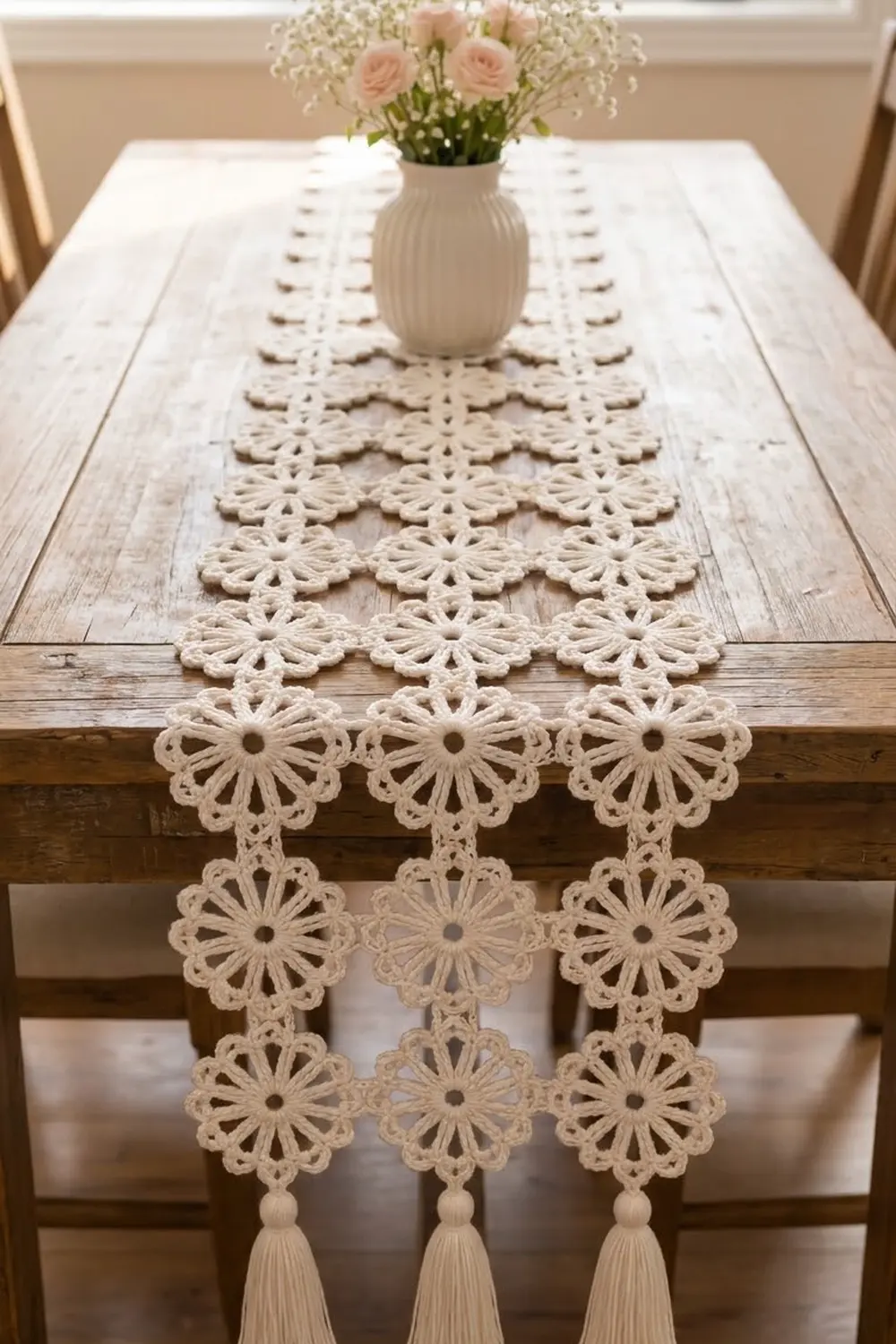
The measurement chain is simple. One motif is 4 in (10.2 cm). Each bridge adds 0.5 in (1.3 cm). Three motifs across make 13 in (33.0 cm), and ten rows make 44.5 in (113.0 cm). Tassels add 4 in (10.2 cm) at each end, for a total of 52.5 in (133.4 cm). Check your first motif, keep your bridges even, and the whole runner will line up neatly.
Happy crocheting!