

This panel looks like strips of fabric woven together. Medium denim-blue columns run from top to bottom, and short cream bars cross them in alternating rows, so each cream bar seems to pass over one blue column and under the next. Plain blue rows separate the cream bars, which makes the over-and-under look easy to read.
There are only two colors, denim blue and cream, and the result is a calm, cottage-style piece. It works as a placemat, a small table mat, a trivet cover, or a stitch sampler you keep for reference. The fabric is dense and flat because the unused color is carried inside every stitch.
The pattern uses US crochet terms. The finished panel measures 8 in wide x 11.5 in tall (20.3 cm x 29.2 cm), including the border.
Construction is simple. You work one rectangle flat in rows of tapestry single crochet, following written color counts. Then you add a two-round blue border: one round of single crochet, then one round of crab stitch (reverse single crochet) for a beaded edge. There is no joining and no sewing.
Finished Size and Construction
- Finished size: 8 in x 11.5 in (20.3 cm x 29.2 cm)
- Skill level: Intermediate (tapestry color changes)
- Terminology: US crochet terms
- Yarn weight: Worsted (#4)
- Hook: 5.0 mm (H-8)
- Number of pieces: 1
- Layout: One single rectangular panel worked flat in rows
- Piece size before border: 7 in x 10.5 in (17.8 cm x 26.7 cm), 28 stitches x 42 rows
- Border depth: 0.5 in (1.3 cm) on each side, 2 rounds
Materials
Yarn: Choose a smooth worsted-weight yarn in a cotton, cotton blend, or soft acrylic. Cotton gives crisp stitch definition and holds up to washing if you plan to use the panel as a placemat. Avoid fuzzy or heavily textured yarns, because they blur the edges of the cream bars.
The amounts below assume a yarn of about 100 g per 170 m:
- Color A, denim blue: 50 g (about 85 m)
- Color B, cream: 30 g (about 51 m)
These quantities include a margin of about 15 percent for your gauge swatch and small tension differences. Carrying the unused color uses more yarn than plain single crochet, and the amounts already account for that.
Tools:
- 5.0 mm (H-8) crochet hook
- Tapestry needle
- Scissors
- 2 locking stitch markers
- Measuring tape or ruler
- Blocking mat and rust-proof pins
- Spray bottle with clean water
Abbreviations (US Terms)
- ch – chain
- sc – single crochet
- rev sc – reverse single crochet (crab stitch)
- st(s) – stitch(es)
- sp – space
- A – Color A (denim blue)
- B – Color B (cream)
- RS / WS – right side / wrong side
Special technique: tapestry single crochet. Lay the unused color along the tops of the stitches in the row below. Work each sc over it so the carried strand is hidden inside the stitch. To change color, work the last sc of the old color until you have 2 loops on the hook. Then yarn over with the new color and pull it through both loops. Keep the old color resting along the top of the row and continue working over it.
Reverse single crochet (rev sc): Working from left to right (right-handed), insert the hook into the next stitch to the right, yarn over, pull up a loop, yarn over, and pull through both loops.
Gauge and Checkpoints
Gauge: 16 sts and 16 rows = 4 in (10.2 cm) in tapestry sc, with the second color carried throughout.
Tapestry single crochet is close to square, so both counts are the same. All the measurements in this pattern depend on that.
Test first. Before you start the panel, make a gauge swatch. Ch 21. Sc in the 2nd ch from the hook and in each ch across (20 sc). Work 19 more rows of 20 sc, carrying B inside the stitches. Change color every 4 sts on some rows so you practice the technique. The swatch should measure 5 in x 5 in (12.7 cm x 12.7 cm).
- Swatch too big: Go down to a 4.5 mm hook.
- Swatch too small: Go up to a 5.5 mm hook.
- Width correct but rows too tall: Check that you are not pulling up tall loops. Keep each loop level with the hook shaft.
Checkpoints during the panel:
- After Row 1: 7 in (17.8 cm) wide
- After Row 12: 3 in (7.6 cm) tall
- After Row 22: 5.5 in (14.0 cm) tall
- After Row 32: 8 in (20.3 cm) tall
- After Row 42: 7 in x 10.5 in (17.8 cm x 26.7 cm)
- After the border: 8 in x 11.5 in (20.3 cm x 29.2 cm)
Measure on a flat surface without stretching. If you are off by more than 0.25 in (0.6 cm) at any checkpoint, fix your tension before you continue.
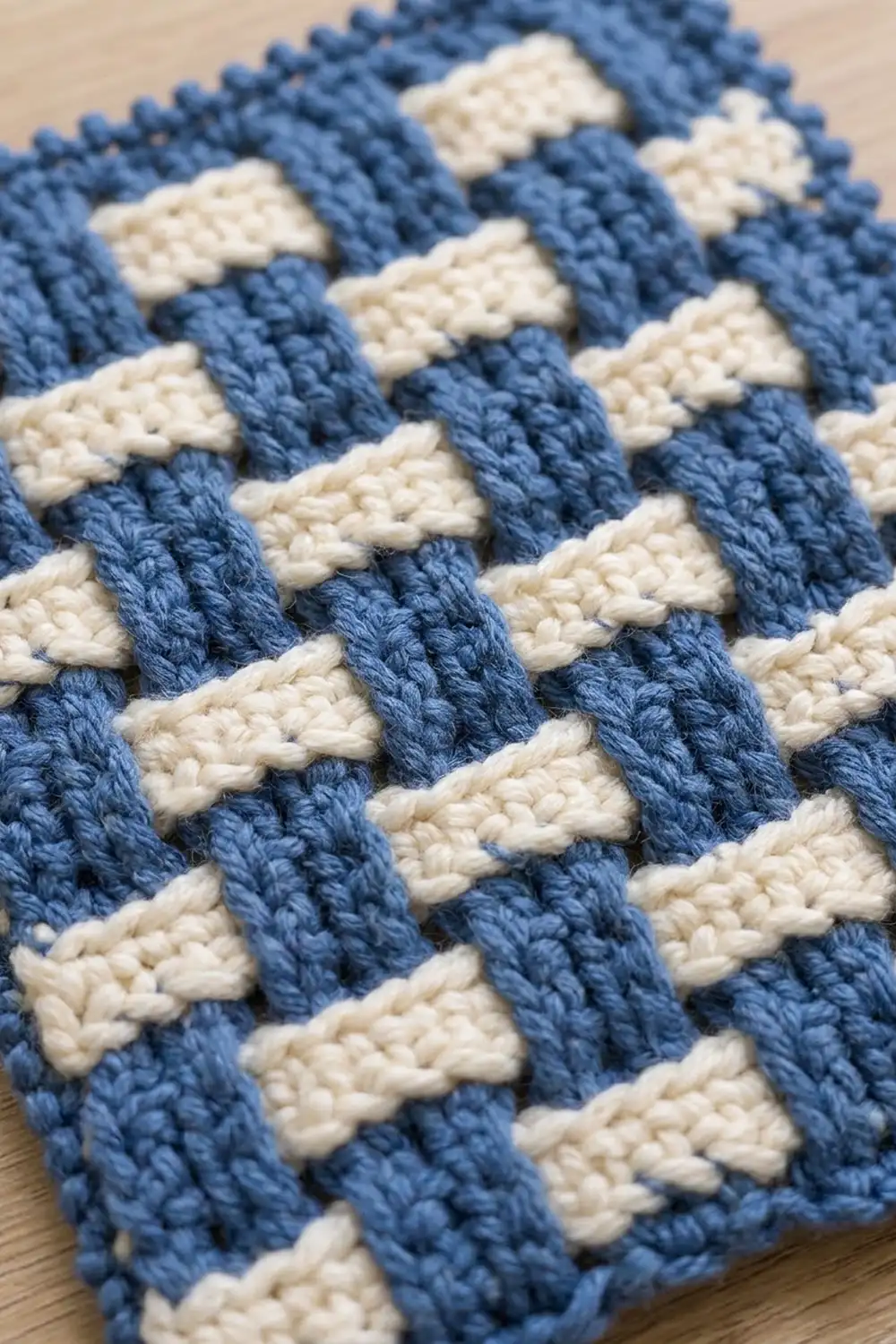
The Panel
How the pattern works. Across the row there are 5 blue columns, each 4 sts wide, with a 2-st gap between neighboring columns. That gives 5 x 4 + 4 x 2 = 28 sts.
- In a Band A row, columns 1, 3, and 5 show in blue. Columns 2 and 4 are covered by cream bars 8 sts wide (2 + 4 + 2).
- In a Band B row it is the other way around. Columns 2 and 4 show in blue, and cream covers columns 1, 3, and 5.
- Spacer rows are all blue.
Each band row reads the same from both ends, so RS and WS rows use the same counts. You never need to reverse a chart.
Carry B inside every stitch from Row 1 to Row 42, including the all-blue spacer rows. This keeps the fabric the same thickness all over and hides any color changes. The ch 1 at the start of each row does not count as a stitch.
Foundation: With A, ch 29.
Row 1 (RS, spacer): Lay B along the chain. With A, sc in the 2nd ch from the hook and in each ch across, working over B. Ch 1, turn. (28 sc: 28 A)
Place a marker on the RS to keep track of it.
Row 2 (spacer): With A, sc in each st across, carrying B. Ch 1, turn. (28 sc: 28 A)
Rows 3–5 (Band A): 4 A, 8 B, 4 A, 8 B, 4 A. Ch 1, turn at the end of each row. (28 sc per row: 12 A + 16 B)
The cream bars sit in sts 5–12 and 17–24.
Rows 6–7 (spacer): With A, sc in each st across, carrying B. Ch 1, turn. (28 sc per row: 28 A)
Rows 8–10 (Band B): 6 B, 4 A, 8 B, 4 A, 6 B. Ch 1, turn. (28 sc per row: 8 A + 20 B)
The cream sits in sts 1–6, 11–18, and 23–28. The blue in sts 7–10 and 19–22 should line up exactly with the cream bars of Band A below.
Rows 11–12 (spacer): With A, sc in each st across, carrying B. Ch 1, turn. (28 sc per row: 28 A)
Checkpoint: The panel is 28 sts wide and 12 rows tall, measuring 7 in x 3 in (17.8 cm x 7.6 cm).
Rows 13–42: Repeat Rows 3–12 three more times.
Rows 3–12 make up one 10-row repeat, and you work it 4 times in total (Rows 3–42). Each repeat contains one Band A, one spacer, one Band B, and one more spacer.
At the end of Row 42, do not ch 1. Cut B, leaving a 4 in (10.2 cm) tail, and weave it into the stitches of the last row. Keep A attached.
Panel totals: 42 rows, with 28 sc in every row. There are 8 rows of cream bars in total: 4 Band A and 4 Band B. Both the first and the last band are blue spacers, so the top and bottom edges are blue.
Measurement: 7 in x 10.5 in (17.8 cm x 26.7 cm).
Border
Border gauge: The border keeps the main gauge of 4 sts per inch (2.5 cm). Along the top and bottom, work 1 sc per stitch. Along the sides, work 1 sc per row end. Each border round adds 0.25 in (0.6 cm) on every side.
Corner rule: The corner ch-1 spaces are not counted in the per-side counts below. Each side count is just the sc worked along that edge.
Round 1 (A): With A still attached at the end of Row 42, ch 1. Do not turn.
- Top: Sc in each st across the top. (28 sc)
- Ch 1 for the corner.
- Left side: Rotate the panel. Work 1 sc in each row end down the side, inserting the hook under 2 strands of the edge stitch. (42 sc)
- Ch 1 for the corner.
- Bottom: Sc in the free loop of each foundation chain. (28 sc)
- Ch 1 for the corner.
- Right side: Work 1 sc in each row end up the side. (42 sc)
- Ch 1 for the corner.
Sl st to the first sc. Round total: 28 + 42 + 28 + 42 = 140 sc, plus 4 corner ch-1 sps.
Round 2 (A, crab stitch): Ch 1. Do not turn. Work rev sc from left to right all the way around:
- 1 rev sc in each sc (140 sts)
- 2 rev sc in each corner ch-1 sp (8 extra sts)
Sl st to the first rev sc and fasten off. Round total: 140 + 8 = 148 rev sc. Per side, that is 28 / 42 / 28 / 42 worked one into each sc, plus 2 rev sc at each of the 4 corners.
Why the math works: The panel is 28 sts wide at 4 sts per inch, which gives 7 in (17.8 cm). It is 42 rows tall at 4 rows per inch, which gives 10.5 in (26.7 cm). Because stitch gauge and row gauge match, 1 sc per stitch and 1 sc per row end fill each edge without stretching or ruffling. The 2 border rounds add 0.5 in (1.3 cm) to each side, so the finished size is 7 + 1 = 8 in (20.3 cm) wide and 10.5 + 1 = 11.5 in (29.2 cm) tall. The extra stitches at the corners let the edge turn flat instead of cupping.
Final Blocking
- Weave in all remaining tails along same-color stitches. Weave cream tails behind cream bars and blue tails behind blue columns.
- Lay the panel RS up on a blocking mat.
- Mist it evenly with water until damp but not soaked. For acrylic yarn, steam lightly instead, holding the iron above the fabric without touching it.
- Pin the four corners to an 8 in x 11.5 in (20.3 cm x 29.2 cm) rectangle.
- Add pins every 1 in (2.5 cm) along each side, keeping the crab stitch edge straight.
- Gently straighten the blue columns so they run perfectly vertical. Make sure the cream bars sit level.
- Let it dry completely, then unpin.
Final Quality-Control Checklist
- The panel measures 8 in x 11.5 in (20.3 cm x 29.2 cm).
- Every row of the panel has 28 sts.
- There are 5 blue columns, each 4 sts wide, running the full height.
- There are 8 rows of cream bars, alternating Band A and Band B.
- Band B blue columns line up exactly between Band A cream bars.
- No carried cream shows through the blue spacer rows.
- Border Round 1 has 140 sc, and Round 2 has 148 rev sc.
- The corners lie flat, and the edges do not ruffle or pull in.
- All tails are woven in invisibly.
Troubleshooting
Cream shows through blue stitches. Keep the carried strand snug against the top of the row, and work each sc fully over it. Slightly firmer tension on the carried yarn helps.
The panel slants or skews. Tapestry single crochet can lean slightly. Block it firmly. On your next panel, keep your tension even and avoid twisting the carried strand.
The color edges look jagged. Always change color on the last yarn-over of the stitch before the new color starts, not at the start of the new stitch.
The columns don’t line up. Count each band row against the written counts. A single missed stitch shifts every color block after it.
The sides ruffle. You probably worked more than 1 sc per row end. Undo the round and work exactly 42 sc per side.
The edges pull in. You may have skipped row ends. Count them again and check that your border tension matches your panel tension.
Care
Hand wash or machine wash on a gentle cycle in cool water, then reshape and lay flat to dry. Avoid high heat, especially with acrylic yarn.

Final Notes
Everything in this pattern follows one measurement chain. A gauge of 16 sts and 16 rows per 4 in (10.2 cm) gives a panel of 28 sts x 42 rows. That panel measures 7 in x 10.5 in (17.8 cm x 26.7 cm). Two border rounds add 0.5 in (1.3 cm) per side, for a finished size of 8 in x 11.5 in (20.3 cm x 29.2 cm). If your swatch matches, every checkpoint will too. Enjoy watching the weave appear row by row.
Happy crocheting!