

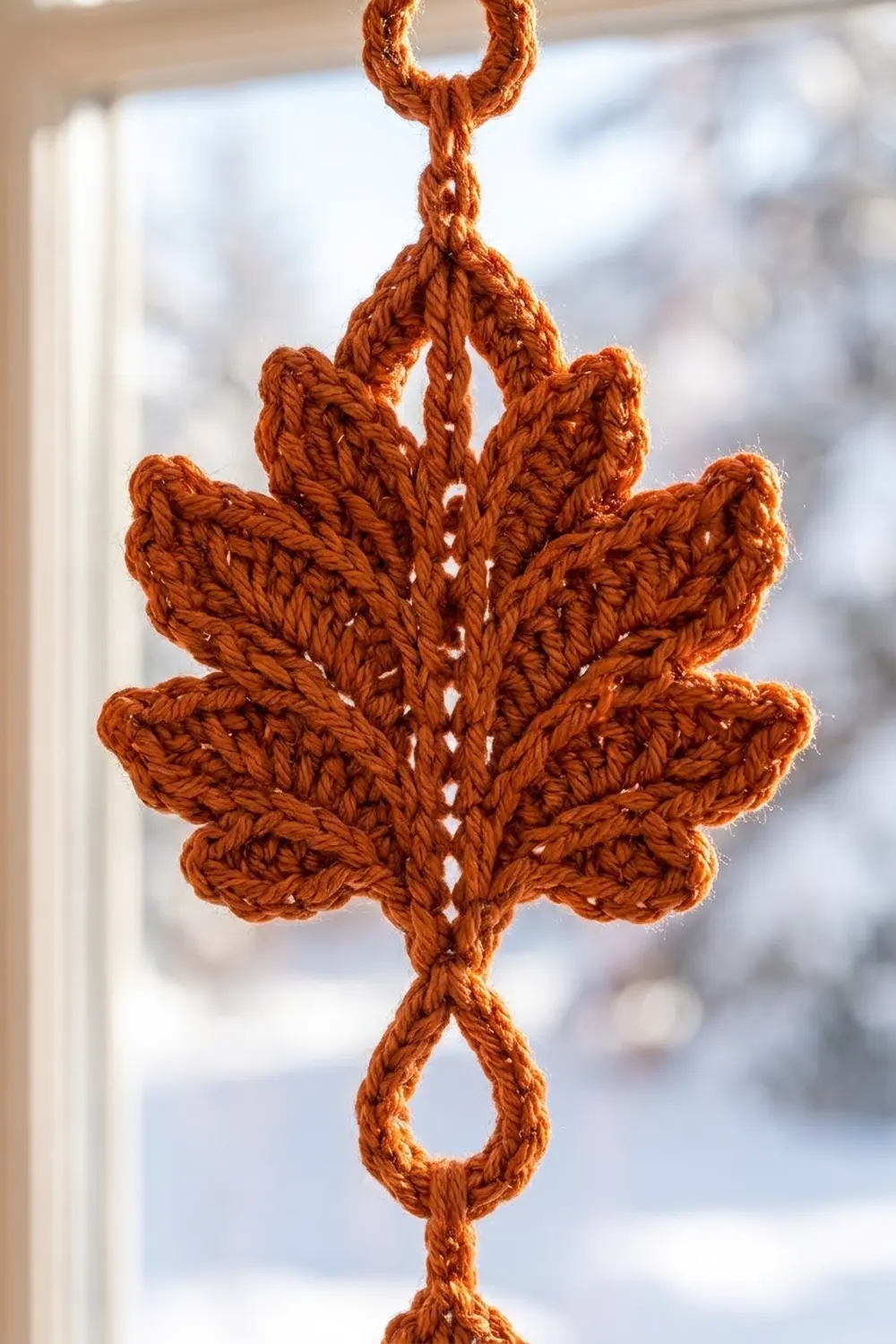
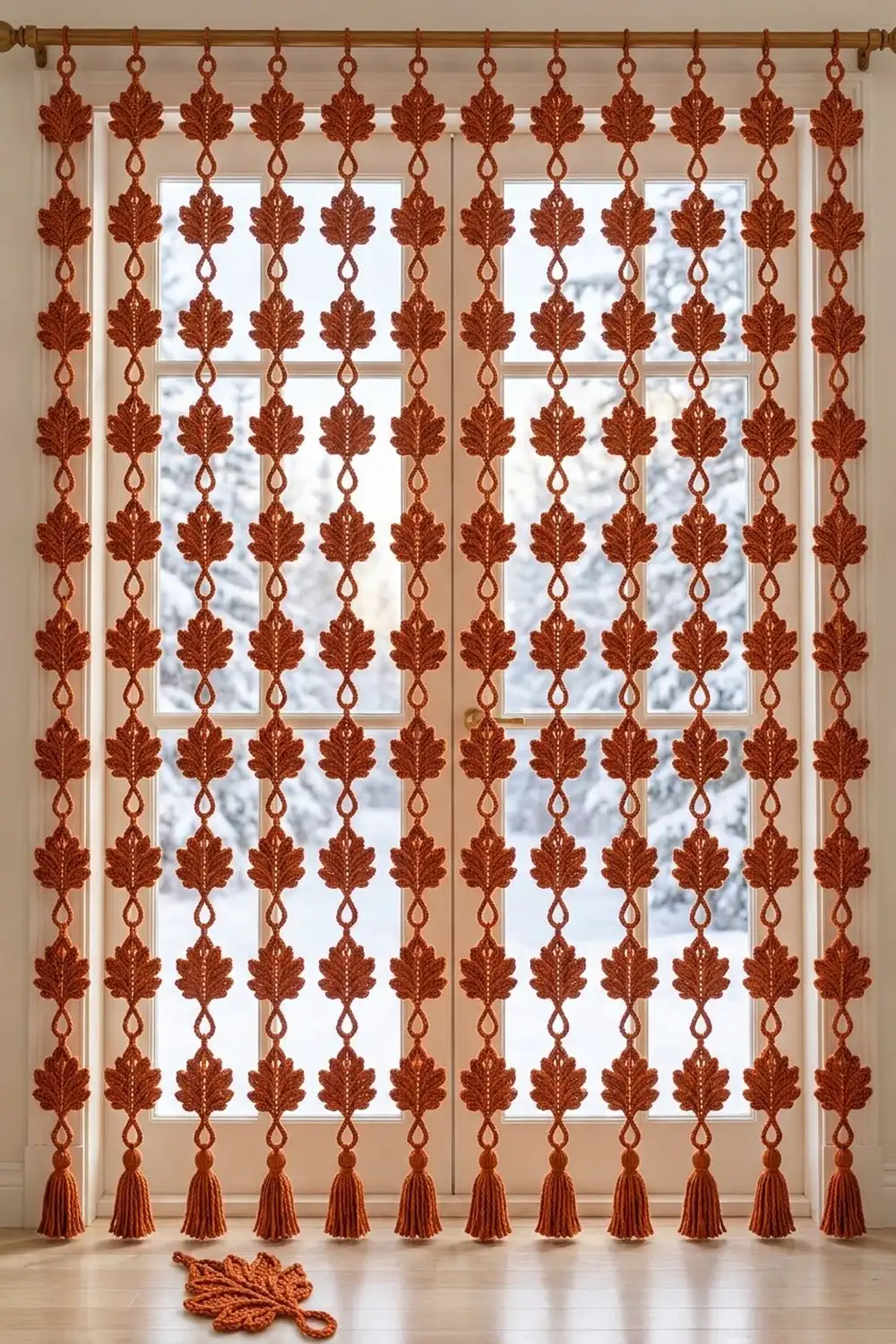
The Ember Leaf Strand Curtain is a row of vertical crochet strands hanging from a rod, with a stack of lobed leaves running down each one. Short chain cords and small teardrop loops link each leaf to the next, and every strand ends in a full, wrapped tassel. In front of a sunny window it filters the light and casts leaf-shaped shadows on the floor.
The sample uses one warm rust shade, close to burnt orange. With a single color, the texture does the work: every leaf has a raised center vein and three pairs of pointed leaflets that get smaller toward the tip. The look suits autumn, but it also fits a cozy winter room with greenery and candlelight.
This pattern uses US crochet terms. The finished curtain is 69.5 in (176.5 cm) wide and 79 in (200.7 cm) long including the tassels. Each leaf is about 3.5 in (8.9 cm) tall and 3.5 in (8.9 cm) wide.
Each strand is worked in one continuous piece from the top down. You chain a hanging ring, then repeat one “unit” twelve times: a chain stem, a leaf worked around its own chain spine, and a teardrop loop. After that you fasten off and tie on a tassel. The thirteen strands are never joined to each other. They each hang separately from the rod.
Finished Size and Construction
- Finished size: 69.5 in (176.5 cm) wide x 79 in (200.7 cm) long
- Skill level: Intermediate (simple stitches, lots of repetition, careful counting)
- Terminology: US crochet terms
- Yarn weight: Worsted (#4)
- Hook: 5.0 mm (US H-8)
- Number of pieces: 13 separate strands, plus 13 tassels
- Layout: 13 strands side by side, spaced 5.5 in (14.0 cm) center to center
- Piece size: one strand is 3.5 in (8.9 cm) wide and 74 in (188.0 cm) long without its tassel
- Size before border: 69.5 in (176.5 cm) x 74 in (188.0 cm)
- Border depth: a tassel edge 5 in (12.7 cm) deep
Materials
Yarn: Choose a smooth worsted-weight yarn with good stitch definition. Cotton or a cotton-acrylic blend holds the leaflet points well and doesn’t stretch much as it hangs. Fuzzy or very splitty yarns blur the center vein, so avoid them.
- Rust (burnt orange): 700 g, about 1,280 m (1,400 yd), based on 100 g / 183 m (200 yd) skeins
One strand uses about 82 m (90 yd), tassel included. The quantity above includes a margin of about 10% for swatching, gauge differences, and tassel trimming.
Tools:
- 5.0 mm (US H-8) crochet hook
- Tapestry needle
- Sharp scissors
- A piece of stiff card 5.5 in (14.0 cm) wide, for tassels
- 2 stitch markers
- Spray bottle, blocking mat, and rust-proof pins
- A curtain rod up to 1.25 in (3.2 cm) in diameter
Abbreviations (US Terms)
- ch – chain
- sl st – slip stitch
- sc – single crochet
- hdc – half double crochet
- dc – double crochet
- tr – treble crochet
- st(s) – stitch(es)
Special stitch – picot: ch 3, sl st in the 3rd ch from the hook.
Special term – leaflet: a short chain worked straight out from the spine, then worked back toward the spine with stitches that get taller and then shorter again. Each leaflet is pointed at its tip and widest near its middle.
Gauge and Checkpoints
Chain gauge: 9 ch = 2 in (5.1 cm), measured relaxed and not stretched.
Test one unit first. Chain the hanging ring and work one complete unit (stem, leaf, and teardrop). Then check:
- Leaf: 3.5 in (8.9 cm) from the tip picot to the base, and 3.5 in (8.9 cm) across the tips of the largest leaflet pair, lightly pressed flat.
- Hanging ring: it drops about 2 in (5.1 cm) when hung over the rod.
- One unit: 6 in (15.2 cm) when it hangs, from the top of the stem to the lowest point of the teardrop.
Why 6 in (15.2 cm)? One unit hangs over 27 ch lengths: 5 stem ch + 1 tip ch + 15 spine ch + 1 base ch + 5 ch for half the teardrop. At 9 ch per 2 in, 27 ch = 6.0 in (15.2 cm).
If the unit is too long, go down to a 4.5 mm (US 7) hook. If it’s too short, go up to a 5.5 mm (US I-9) hook. Tight chains are the most common cause of a short unit. Chain loosely and evenly, and pull each chain up to the full width of the hook shaft.
The Pattern: One Strand
Each strand has a hanging ring, 12 units, and a tassel. Read the unit section once before you start. The spine positions are named so you can track them easily.
Spine names (counted from the base of the leaf up):
- B – base ch (the one right next to the hook, skipped at first)
- S1–S15 – the 15 spine ch
- T – tip ch, just above S15
- The 5 ch above T are the stem.
Hanging Ring
Ch 18, sl st in the first ch to make a ring.
Ring count: 18 ch. Hung over the rod, it drops 2 in (5.1 cm).
Unit (Repeat 12 Times)
Step 1 – Stem and spine. Ch 22. That breaks down as 5 stem ch + T + S15 down to S1 + B (5 + 1 + 15 + 1 = 22).
Step 2 – Side 1 (up the spine). Work into the back bump of each spine ch.
- Sl st in the 2nd ch from the hook (S1). Sl st in S2.
- Leaflet L1 (large): ch 8; sc in the 2nd ch from the hook, hdc in next ch, dc in next ch, tr in next 2 ch, dc in next ch, hdc in next ch. That’s 7 sts.
- Sl st in S3, S4, S5, and S6.
- Leaflet L2 (medium): ch 7; sc in the 2nd ch from the hook, hdc in next ch, dc in next 3 ch, hdc in next ch. That’s 6 sts.
- Sl st in S7, S8, S9, and S10.
- Leaflet L3 (small): ch 5; sc in the 2nd ch from the hook, hdc in next ch, dc in next ch, hdc in next ch. That’s 4 sts.
- Sl st in S11, S12, S13, S14, and S15.
Side 1 count: 15 sl st + 7 + 6 + 4 leaflet sts = 32 sts.
Step 3 – Tip. In T, work (hdc, dc, picot, dc, hdc).
Tip count: 4 sts + 1 picot.
Step 4 – Side 2 (down the spine). Rotate the work. You’ll now go down the spine, working into the two loops left free on the other side of each spine ch.
- Sl st in S15, S14, S13, S12, S11, and S10.
- Make an L3 leaflet as before (4 sts).
- Sl st in S9, S8, S7, and S6.
- Make an L2 leaflet as before (6 sts).
- Sl st in S5, S4, S3, and S2.
- Make an L1 leaflet as before (7 sts).
- Sl st in S1.
Side 2 count: 15 sl st + 17 leaflet sts = 32 sts.
Step 5 – Base. Sl st in B.
Leaf total: 32 + 4 + 32 + 1 = 69 worked sts, plus 1 picot. Each side has 3 leaflets, which mirror each other in pairs across the vein. The two rows of sl sts sit back to back on the spine and form the raised center vein.
Step 6 – Teardrop loop. Ch 10, then sl st in B again to close the loop. Sl st in each of the first 5 ch of the loop. You’re now at its lowest point.
Teardrop count: 10 ch + 1 joining sl st + 5 travelling sl st.
Step 7 – For units 1 to 11, go straight back to Step 1. The new stem grows out of the bottom of the teardrop.
After unit 12, don’t start a new stem. Fasten off and leave an 8 in (20.3 cm) tail. Weave it into the teardrop chain.
Strand checkpoint: 2 in (5.1 cm) ring drop + 12 units x 6 in (15.2 cm) = 74 in (188.0 cm) hanging length before the tassel.
Make All Pieces
Make 13 strands in rust, each with 12 leaves. That’s 156 leaves in total. Make 13 tassels in rust.
All strands are the same, so the layout is just the order they hang in, left to right:
ROD:    O  O  O  O  O  O  O  O  O  O  O  O  O
STRAND: 1  2  3  4  5  6  7  8  9  10 11 12 13
ROW 1:  RUST RUST RUST RUST RUST RUST RUST RUST RUST RUST RUST RUST RUST
ROWS 2–12: same as Row 1 (one leaf per strand per row)
The leaves on neighboring strands line up in horizontal rows, so the curtain reads as a neat leaf grid.
Joining: Hanging the Strands
The strands aren’t sewn or crocheted to each other. Each one hangs from the rod by its own ring, and the leaves are already linked into strands through the continuous chain.
Method: Slide the 13 rings onto the rod in order. On a closed rod, take off the finial, thread the rings on, and put it back.
Spacing logic: 13 strands make 12 gaps. Set the strands 5.5 in (14.0 cm) apart center to center: 12 x 5.5 in = 66 in (167.6 cm) between the centers of the outer strands. Add half a leaf on each side (3.5 in / 8.9 cm in total) to get the full width of 69.5 in (176.5 cm). To keep the spacing even and stop it drifting, mark the rod every 5.5 in (14.0 cm) with removable tape.
Tension advice: Let each strand hang freely for 24 hours before you judge the length. Cotton relaxes a little. If one strand ends up noticeably longer, re-block it rather than pulling the others to match.
Size checkpoint: All 13 teardrop bottoms should sit level at 74 in (188.0 cm) below the top of the rod, within 0.5 in (1.3 cm).
Border: The Tassel Edge
This curtain doesn’t have a crocheted border. Its bottom edge is the row of 13 tassels, one at the lowest point of each final teardrop.
Border gauge: each tassel is 5 in (12.7 cm) long below the teardrop. It has a 0.75 in (1.9 cm) wrapped head and 40 ends.
Per tassel:
- Wrap yarn 20 times around the 5.5 in (14.0 cm) card. Cut along one edge to get 20 lengths of 11 in (27.9 cm).
- Thread all 20 lengths through the bottom of the final teardrop and fold them in half. That gives 40 ends.
- Cut a 36 in (91.4 cm) length for wrapping. Wrap it 8 times around all the ends, 0.75 in (1.9 cm) below the teardrop, and tie it tight. Use the tapestry needle to bury the ends of the wrap inside the tassel.
- Trim the tassel to exactly 5 in (12.7 cm) from the teardrop to the cut ends.
Edge count: 13 tassels x 40 ends = 520 ends across the bottom edge.
Why the math works: Every strand has the same 12 units and the same 2 in (5.1 cm) ring drop. So every teardrop bottom sits at 74 in (188.0 cm). Every tassel adds exactly 5 in (12.7 cm), which puts every tip at 79 in (200.7 cm) and gives a level hem. The card makes 5.5 in (14.0 cm) ends, which leaves 0.5 in (1.3 cm) for trimming.
Final Blocking
- Lay one strand flat on the blocking mat in sections. Work on four leaves at a time.
- Mist the leaves until they’re damp, not soaked.
- Pin the center vein straight.
- Pin each leaflet’s sc point so it angles up and out at about 45 degrees. Match each L1, L2, and L3 to its mirror partner.
- Pin the tip picot straight up, and pin each teardrop into a neat drop shape.
- Check that each leaf measures 3.5 in x 3.5 in (8.9 cm x 8.9 cm).
- Let it dry completely, then move on to the next section.
- Steam the tassels lightly and comb them straight before the final trim.
Final Quality-Control Checklist
- 13 strands, each with 12 leaves (156 leaves in total)
- Each leaf has 32 sts per side, 4 sts plus a picot at the tip, and 1 base sl st, for 69 sts in all
- The 3 leaflet pairs mirror each other (L1 7 sts, L2 6 sts, L3 4 sts)
- Each stem is 5 ch long and each teardrop is 10 ch long
- Each strand hangs 74 in (188.0 cm) without its tassel
- 13 tassels, each 5 in (12.7 cm) long with 40 ends
- Strands spaced 5.5 in (14.0 cm) apart, 69.5 in (176.5 cm) wide in total
- All tails woven in, with nothing poking out at the leaflet tips
Troubleshooting
Leaflets curl toward the spine. Your chain is tighter than your stitches. Chain the leaflets more loosely, or go up 0.5 mm only for the leaflet chains.
Leaflets don’t line up across the vein. You’ve skipped or doubled a spine sl st. Count the sl sts between leaflets. Going up side 1, the groups are 2, 4, 4, and 5. Coming down side 2, they’re 6, 4, 4, and 1.
The leaf twists along the spine. Side 1 must go into the back bumps only. If side 1 went into the top loops, the leaf will twist. Frog it and work into the back bumps.
Strands come out different lengths. Measure one unit on each strand. Check that the stems are 5 ch and the teardrops are 10 ch.
The tassel head is lopsided. Rewrap it with even tension, and keep the folded loop centered on the teardrop.
Care
Hand wash in cool water with mild soap. Squeeze out the water gently, then lay each strand flat in its blocked shape to dry. Shake out and dust the curtain every few weeks while it’s hanging.
Final Notes
The measurement chain is simple. 9 ch = 2 in (5.1 cm), so one leaf is 3.5 in (8.9 cm) square and one unit is 6 in (15.2 cm). Twelve units plus the 2 in (5.1 cm) ring drop make 74 in (188.0 cm). The 5 in (12.7 cm) tassels bring the curtain to 79 in (200.7 cm) long. Thirteen strands at 5.5 in (14.0 cm) spacing make it 69.5 in (176.5 cm) wide. Check the unit before you commit, count every side to 32, and the whole curtain falls into place.
Happy crocheting!