
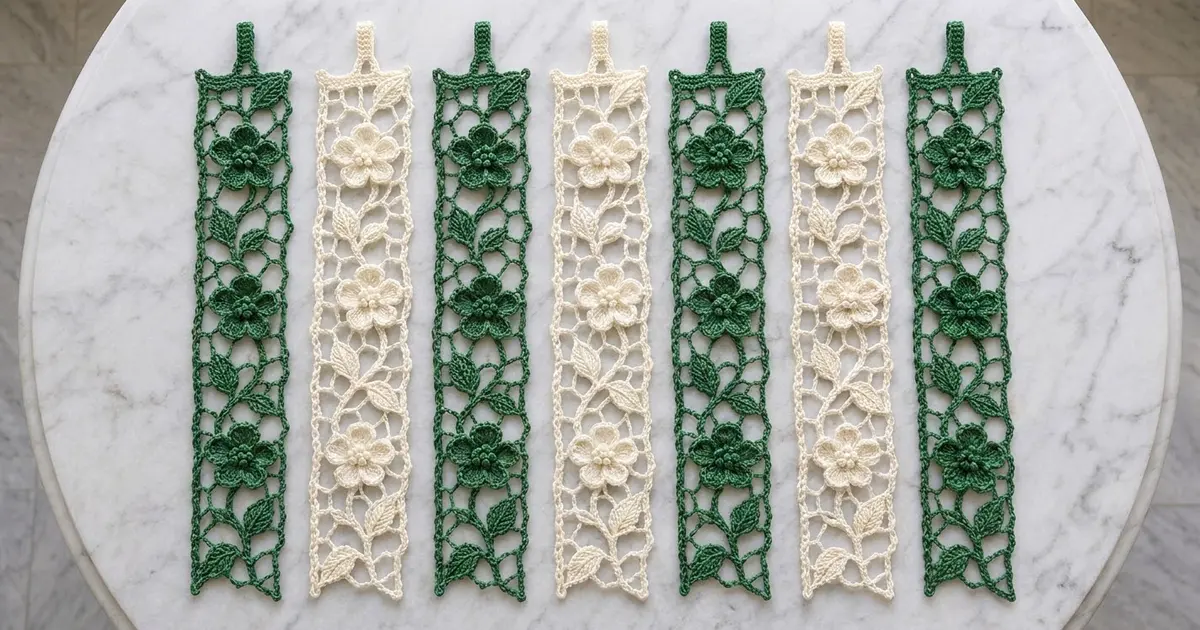
This door curtain is made of seven tall lace strips that hang side by side from a rod. Each strip is an open chain-loop net with a raised five-petal flower every 10 in (25.4 cm), joined by a curving vine with pointed leaves. Light passes through the mesh, and the flowers give each strip a soft, dimensional look.
The colors alternate between deep emerald green and cream: four green strips and three cream strips. Each strip’s flowers, leaves, and vines match the strip itself, so the texture comes from the layering instead of from color contrast. The style is close to traditional Irish crochet but much simpler to work.
Each finished strip measures 4.5 in × 82.5 in (11.4 cm × 209.6 cm), not counting its hanging tab. All seven strips hung with 0.75 in (1.9 cm) gaps span 36 in (91.4 cm). The pattern uses US crochet terms.
For each strip you crochet a mesh base, add a solid top row, work a 2-round border, and add a hanging tab. You then make the flowers, leaves, and vines separately and sew them on.
Finished Size and Construction
- Strip size: 4.5 in × 82.5 in (11.4 cm × 209.6 cm), plus a 2 in (5.1 cm) loop tab
- Skill level: Intermediate
- Terminology: US
- Yarn weight: Sport (2, fine) mercerized cotton
- Hook: 2.75 mm (US C-2)
- Number of pieces: 7 strips. Each strip has 8 flowers, 16 leaves, and 7 vines.
- Layout: 7 strips × 1 row, hung side by side and not joined
- Mesh size before border: 4 in × 82 in (10.2 cm × 208.3 cm)
- Border depth: 0.25 in (0.6 cm) per side
- Full curtain width: 36 in (91.4 cm) with gaps
Materials
Use a smooth mercerized cotton. It gives clean stitch definition, holds the bobbles firmly, and hangs straight without stretching. Avoid fuzzy blends, which blur the mesh.
- Emerald green: 280 g (840 m), for 4 strips
- Cream: 210 g (630 m), for 3 strips
These amounts allow about 65 g (200 m) per strip and include a margin of roughly 10% for gauge swatches and sewing.
Tools:
– 2.75 mm (US C-2) hook
– Tapestry needle with a sharp tip
– Rust-proof pins
– Blocking mat or towel
– Measuring tape
– Stitch markers
– Spray bottle
– A curtain rod up to 1.25 in (3.2 cm) in diameter
Abbreviations (US Terms)
- ch: chain
- sl st: slip stitch
- sc: single crochet
- hdc: half double crochet
- dc: double crochet
- tr: treble crochet
- sp: space
- st(s): stitch(es)
- rep: repeat
Bobble (3-dc bobble): (Yarn over, insert hook, pull up a loop, yarn over, pull through 2 loops) 3 times in the same place. Yarn over and pull through all 4 loops on the hook.
Gauge and Checkpoints
Mesh gauge: 5 ch-5 loops = 4 in (10.2 cm) wide, and 26 mesh rows = 10 in (25.4 cm), measured after light blocking.
Border gauge: 6.5 sc = 1 in (2.5 cm).
Before starting the curtain, work one test section of the first 27 rows and pin it out. It should measure 4 in (10.2 cm) wide and about 10.3 in (26.2 cm) tall.
Checkpoints:
– After Row 26, the mesh is 4 in × 10 in (10.2 cm × 25.4 cm).
– After Row 107, the mesh is about 41.2 in (104.6 cm) long, roughly half the length.
– After Row 214, the mesh is 4 in × 82 in (10.2 cm × 208.3 cm).
– After the border, the strip is 4.5 in × 82.5 in (11.4 cm × 209.6 cm).
– Each finished flower is 2.75 in (7.0 cm) across.
If your mesh is too wide, go down to a 2.5 mm hook. If it is too narrow, go up to a 3.0 mm hook. Recheck the width after changing hooks; the row length will usually come out right once the width is correct. Also check that the ch-5 loops sit evenly and aren’t pulled tight.
Mesh Base (Make 1 per Strip)
Foundation: Ch 27.
Row 1: Sc in the 2nd ch from the hook. Ch 5, skip 4 ch, sc in the next ch. Rep from * 4 more times. Turn. (6 sc, 5 ch-5 loops)*
Row 2: Ch 5 (counts as dc + ch 2), sc in the first ch-5 loop. Ch 5, sc in the next loop. Rep from * 3 more times. Ch 2, dc in the last sc. Turn. (1 dc + turning ch, 5 sc, 4 ch-5 loops, 2 ch-2 sps)*
Row 3: Ch 1, sc in the first dc. Ch 5, sc in the next ch-5 loop. Rep from * 3 more times. Ch 5, sc in the 3rd ch of the turning ch. Turn. (6 sc, 5 ch-5 loops)*
Rows 4–213: Rep Rows 2–3 another 105 times, ending with a Row 3 row.
That gives 213 mesh rows: 107 sc-type (odd) rows and 106 dc-type (even) rows. Each pair of rows measures 10/13 in (2.0 cm).
Row 214 (solid top row): Ch 1, sc in the first sc. 4 sc in the next ch-5 loop, sc in the next sc. Rep from * 4 more times. (26 sc)*
This firm top row supports the hanging tab, and its 26 sts match the 26 foundation ch at the bottom edge. Do not fasten off.
Border
The border uses a gauge of 6.5 sc = 1 in (2.5 cm). Corners are ch-2 spaces. The per-side counts below do not include those ch-2 corner spaces.
Round 1: Ch 1, then turn to work down the first long side, starting at the end of Row 214.
– Long side: 1 sc in the end of Row 214, 2 sc in the end of each sc-type row, and 3 sc in the end of each dc-type row.
– Count: 1 + (107 × 2) + (106 × 3) = 533 sc.
– Corner: Ch 2.
– Bottom edge: Sc in each of the 26 foundation ch. (26 sc)
– Corner: Ch 2.
– Second long side: Work as the first, from Row 1 up to Row 214. (533 sc)
– Corner: Ch 2.
– Top edge: Sc in each sc of Row 214. (26 sc)
– Corner: Ch 2. Sl st to the first sc.
Round 1 total: 1,118 sc and 4 ch-2 corners.
Why the math works: 533 ÷ 6.5 = 82 in (208.3 cm), and 26 ÷ 6.5 = 4 in (10.2 cm). Both match the mesh exactly, so the edges don’t ruffle or pull. The dc-type rows are taller, so they get 3 sc. The shorter sc-type rows get 2.
Round 2: Ch 1. Sc in each sc. Work (sc, ch 2, sc) in each ch-2 corner. Sl st to the first sc.
– Long sides: 533 sc worked one per st + 2 corner sc = 535 sc each
– Short sides: 26 sc worked one per st + 2 corner sc = 28 sc each
– Round 2 total: 1,126 sc and 4 ch-2 corners
Fasten off. The 2 rounds together are 0.25 in (0.6 cm) deep, so the strip now measures 4.5 in × 82.5 in (11.4 cm × 209.6 cm).
Hanging Tab
Count across the 28 sc of the top edge. Skip the first 9 sc and join the yarn in the 10th sc.
Row 1: Ch 1, sc in the same st and in the next 9 sts. (10 sc) This leaves 9 sc unworked on each side: 9 + 10 + 9 = 28.
Rows 2–26: Ch 1, turn, sc in each sc. (10 sc)
The tab is about 1.5 in × 4 in (3.8 cm × 10.2 cm). Fold it to the back and sew the last row across the back of the border, directly behind Row 1. This makes a loop 2 in (5.1 cm) tall.
Flower (Make 8 per Strip)
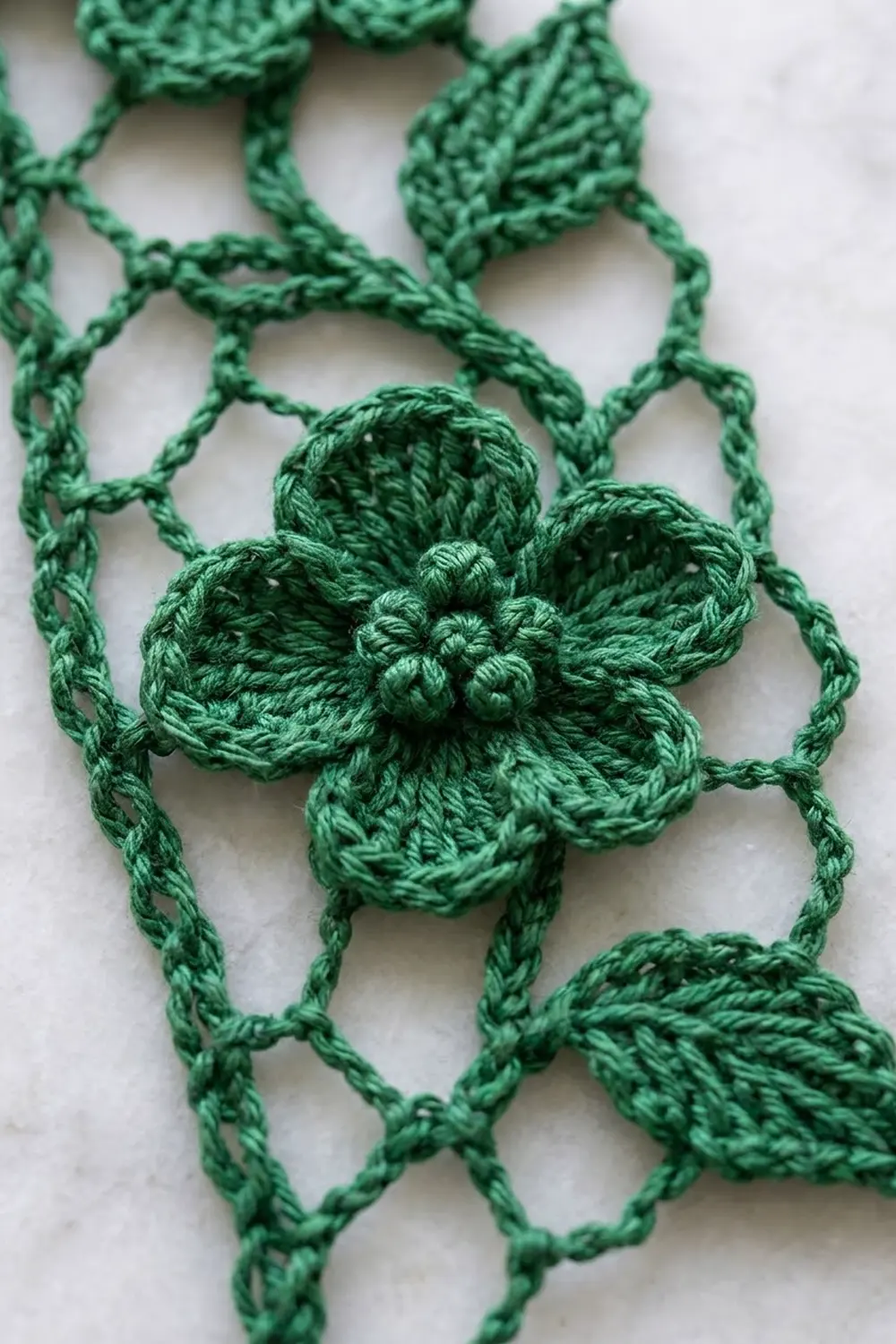
Round 1: Make a magic ring. Ch 1. Sc in the ring, bobble in the ring. Rep from * 4 more times. Pull the ring closed tightly and sl st to the first sc. (10 sts: 5 sc, 5 bobbles)* The bobbles crowd together into a raised center cluster.
Round 2: Ch 1, sc in the first sc, ch 4, skip the bobble. Sc in the next sc, ch 4, skip the bobble. Rep from * 3 more times. Sl st to the first sc. (5 sc, 5 ch-4 sps)*
Round 3: In each ch-4 sp, work (sc, hdc, 3 dc, tr, 3 dc, hdc, sc). Sl st to the first sc. (55 sts, 11 per petal)
Fasten off and leave a 12 in (30.5 cm) tail for sewing. The flower measures 2.75 in (7.0 cm) across.
Leaf (Make 16 per Strip)
Foundation: Ch 10.
Round 1:
– First side: Sc in the 2nd ch from the hook, hdc in the next ch, dc in the next 4 ch, hdc in the next ch, sc in the next ch.
– Tip: (Sc, ch 2, sc) in the last ch.
– Second side: Rotate and work along the other side of the foundation ch: sc in the next ch, hdc in the next ch, dc in the next 4 ch, hdc in the next ch, sc in the last ch.
– Sl st to the first sc.
(18 sts and a ch-2 tip)
The foundation chain stays visible down the middle as the leaf’s center ridge. Fasten off and leave a 10 in (25.4 cm) tail. The leaf is 1.75 in × 0.75 in (4.4 cm × 1.9 cm).
Vine (Make 7 per Strip)
Ch 49. Sl st in the back bump of the 2nd ch from the hook and in each back bump across. (48 sl sts)
This makes a firm cord about 8 in (20.3 cm) long, long enough to curve in an S-shape across a 7.25 in (18.4 cm) gap. Fasten off and leave long tails at both ends.
Make All Pieces
Per strip: 1 mesh base, 8 flowers, 16 leaves, 7 vines
| Color | Strips | Flowers | Leaves | Vines |
|---|---|---|---|---|
| Emerald green | 4 | 32 | 64 | 28 |
| Cream | 3 | 24 | 48 | 21 |
Hanging layout, left to right:
[G] [C] [G] [C] [G] [C] [G]
 1   2   3   4   5   6   7
Here G = green and C = cream. Gaps are 0.75 in (1.9 cm).
Joining: Appliqué and Hanging
The strips stay separate. Joining here means sewing the appliqués onto each strip.
Flower placement: Measure from the bottom of the mesh, inside the border. Center the flowers on the strip at 6, 16, 26, 36, 46, 56, 66, and 76 in. In cm, that is 15.2, 40.6, 66.0, 91.4, 116.8, 142.2, 167.6, and 193.0 cm. This leaves 6 in (15.2 cm) of mesh at each end.
Sewing the flowers: Use the tail and tack through the back loops of Round 2 only, catching a mesh strand every 0.25 in (0.6 cm). Leave the petals free so they stay raised.
Vines: Each vine runs from the bottom edge of one flower to the top edge of the next, curving in an S-shape. Whipstitch it down every 0.5 in (1.3 cm), stitching into the mesh strands, not through the loops.
Leaves: Sew 2 leaves to each vine, on opposite sides, with the base of each leaf touching the vine. Sew 1 more leaf below the lowest flower and 1 above the highest flower. That makes 7 × 2 + 2 = 16 leaves per strip.
Tension: Keep the sewing stitches snug but not tight. If the mesh puckers under an appliqué, loosen the stitches until the strip lies flat.
Size checkpoint: After sewing, the strip should still measure 4.5 in × 82.5 in (11.4 cm × 209.6 cm). Slide the strips onto the rod in layout order and space them 0.75 in (1.9 cm) apart, for a total width of 36 in (91.4 cm).
Final Blocking
- Wet each strip in cool water and press out the water in a towel. Don’t wring it.
- Lay the strip flat in sections and pin the long edges straight at 4.5 in (11.4 cm) wide.
- Open each ch-5 loop evenly with your fingers.
- Shape the petals and leaf tips by hand. Don’t pin through the flowers.
- Check the length: 82.5 in (209.6 cm).
- Let it dry completely before unpinning.
- Hang the strips for 24 hours so they settle into their final drape.
Final Quality-Control Checklist
- [ ] The mesh has 5 even loops across and 214 rows.
- [ ] Border Round 1 has 533/26/533/26 sc, and Round 2 has 535/28/535/28 sc.
- [ ] Each strip measures 4.5 in × 82.5 in (11.4 cm × 209.6 cm).
- [ ] Each flower has 55 sts on Round 3 and a tight bobble center.
- [ ] There are 8 flowers, 16 leaves, and 7 vines on every strip, placed at the listed heights.
- [ ] The tab is centered, with 9 sc on each side, and sewn securely.
- [ ] All ends are woven into solid stitches, not into loops.
- [ ] The strips hang in G-C-G-C-G-C-G order.
Troubleshooting
- Strip is narrower at the top: The chain loops tightened as you worked. Count 5 chains per loop on every row and keep the chains relaxed.
- Edges wave: You worked too many border sc per row end. Use exactly 2 per sc-type row and 3 per dc-type row.
- Edges pull in: You skipped row ends. Count each side in 50-st sections.
- Bobble center is flat: Pull the magic ring tighter, and push the bobbles to the right side of the flower.
- Leaf curls: Steam it lightly and pin it flat while it dries.
- Strips hang unevenly: Check each strip’s length after blocking and re-block any strip that is longer than the others.
Care
Hand wash in cool water with mild soap and dry flat. Don’t put the strips in a dryer, and dust them gently between washes.
Final Notes
The measurements build on each other:
– Five ch-5 loops make the 4 in (10.2 cm) width.
– 214 rows give 82 in (208.3 cm) of mesh.
– At 6.5 sc per inch, the border Round 1 counts of 533 and 26 sc match the mesh exactly.
– Round 2 adds 2 corner sc per side, and the border brings the strip to 4.5 in × 82.5 in (11.4 cm × 209.6 cm).
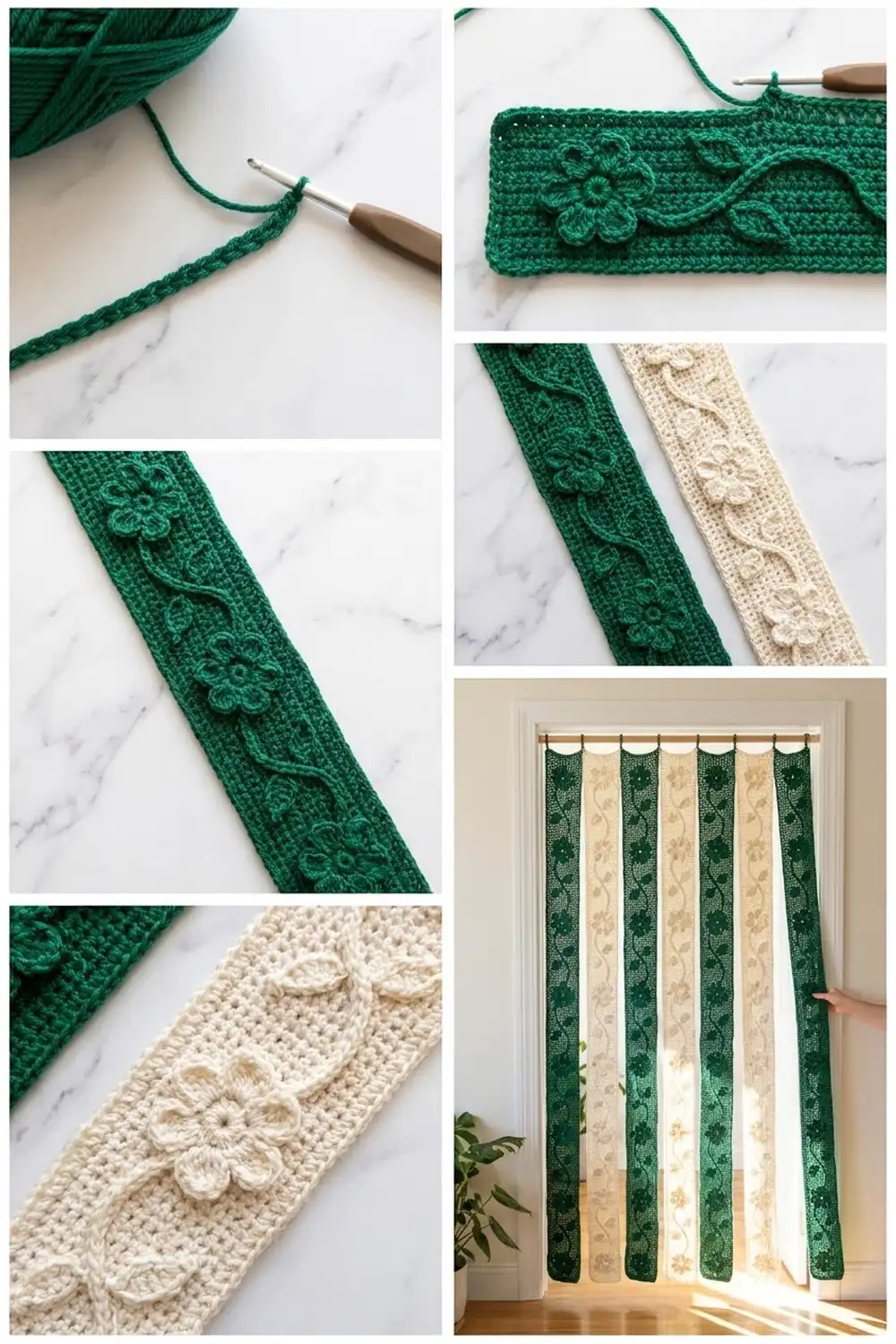
– Seven strips with 0.75 in (1.9 cm) gaps fill a 36 in (91.4 cm) doorway.
Check each stage against these numbers, and the curtain will hang straight and even. Happy crocheting!