

This hanging holder stores three spare toilet rolls on the wall in a column. Each pocket is covered in overlapping crocodile-stitch scales and finished with a cream rim. The pockets are sewn to a long back panel that hangs from a wooden ring, and a cream tassel hangs from the bottom.
The colors are deep emerald teal and soft cream. Together they look calm and modern but still handmade, and they suit a bathroom with natural wood, brass or marble.
The pattern uses US crochet terms. The finished panel is 4.5 in (11.4 cm) wide and 22 in (55.9 cm) long. Each pocket is about 8 in (20.3 cm) wide, 4.5 in (11.4 cm) deep and 4 in (10.2 cm) tall.
To build it, you make three pockets from the bottom up. Each one has an oval single crochet base, a crocodile-stitch wall and a cream rim. Next you work the tapered back panel in rows, add a one-round border, and work a tab that wraps around the ring. Last, you sew the pockets to the panel and tie on the tassel.
Finished Size and Construction
- Finished size: panel 4.5 x 22 in (11.4 x 55.9 cm). The total drop from the top of the tab loop to the tip of the tassel is about 29 in (73.7 cm).
- Skill level: Intermediate
- Terminology: US
- Yarn weight: worsted (#4) cotton
- Hook: 5.0 mm (H-8)
- Number of pieces: 4 crocheted pieces (3 pockets and 1 panel), plus a tassel and a ring
- Layout: one vertical column of 3 pockets
- Pocket size: 8 x 4.5 in (20.3 x 11.4 cm) base, 4 in (10.2 cm) tall
- Panel size before border: 4 x 21.5 in (10.2 x 54.6 cm)
- Border depth: 0.25 in (0.6 cm) on every edge
Work order: pockets, then the panel rows, then the panel border, then the tab, then joining, then the tassel.
Materials
Use a smooth, firm worsted-weight cotton or cotton blend. Cotton holds the scales up and keeps the pockets in shape. Avoid fuzzy or very stretchy yarn, because the scales will droop.
- Color A (emerald teal): 200 g, about 340 m
- Color B (cream): 50 g, about 85 m (rims and tassel)
Both quantities include a margin of about 15% for your gauge swatch and tails.
Tools:
– 5.0 mm (H-8) crochet hook
– One wooden ring, 2.75 in (7.0 cm) outer diameter
– Stitch markers (at least 6)
– Tapestry needle
– Scissors
– Measuring tape
– A piece of card 5.5 in (14.0 cm) long, for the tassel
Abbreviations (US Terms)
- ch: chain
- sl st: slip stitch
- sc: single crochet
- dc: double crochet
- sc2tog: single crochet 2 together
- BLO / FLO: back loop only / front loop only
- sp: space
- st(s): stitch(es)
- RS: right side
Pair: 2 dc worked into the same stitch or space.
Centre of a pair: the gap between its 2 dc. On a pair that has a scale worked around it, this is the gap at the top of the scale.
Scale: Turn the work so the posts of the pair lie sideways. Work 5 dc around the post of the first dc, from the top of the post down to the bottom. Ch 1. Work 5 dc around the post of the second dc, from the bottom up to the top. You now have 10 dc in a fan that hangs downward and covers the round below.
Gauge and Checkpoints
Gauge: 16 sc x 16 rows = 4 in (10.2 cm) in sc rows, worked firmly. This square gauge lets the border work 1 sc into each row end, and the sizes in this pattern depend on it.
Make one complete pocket before you make the others, and check it at each stage:
- Base after Rnd 4: 2 x 5.5 in (5.1 x 14.0 cm)
- Base after Rnd 9: 4.5 x 8 in (11.4 x 20.3 cm)
- Each scale tier: about 0.75 in (1.9 cm) tall
- Finished pocket: 4 in (10.2 cm) tall, and a roll should slide in easily
If your base is too big, go down 0.5 mm in hook size. If it is too small, go up 0.5 mm. Do not add or remove rounds, because the wall stitch count depends on Rnd 9 having 82 stitches.
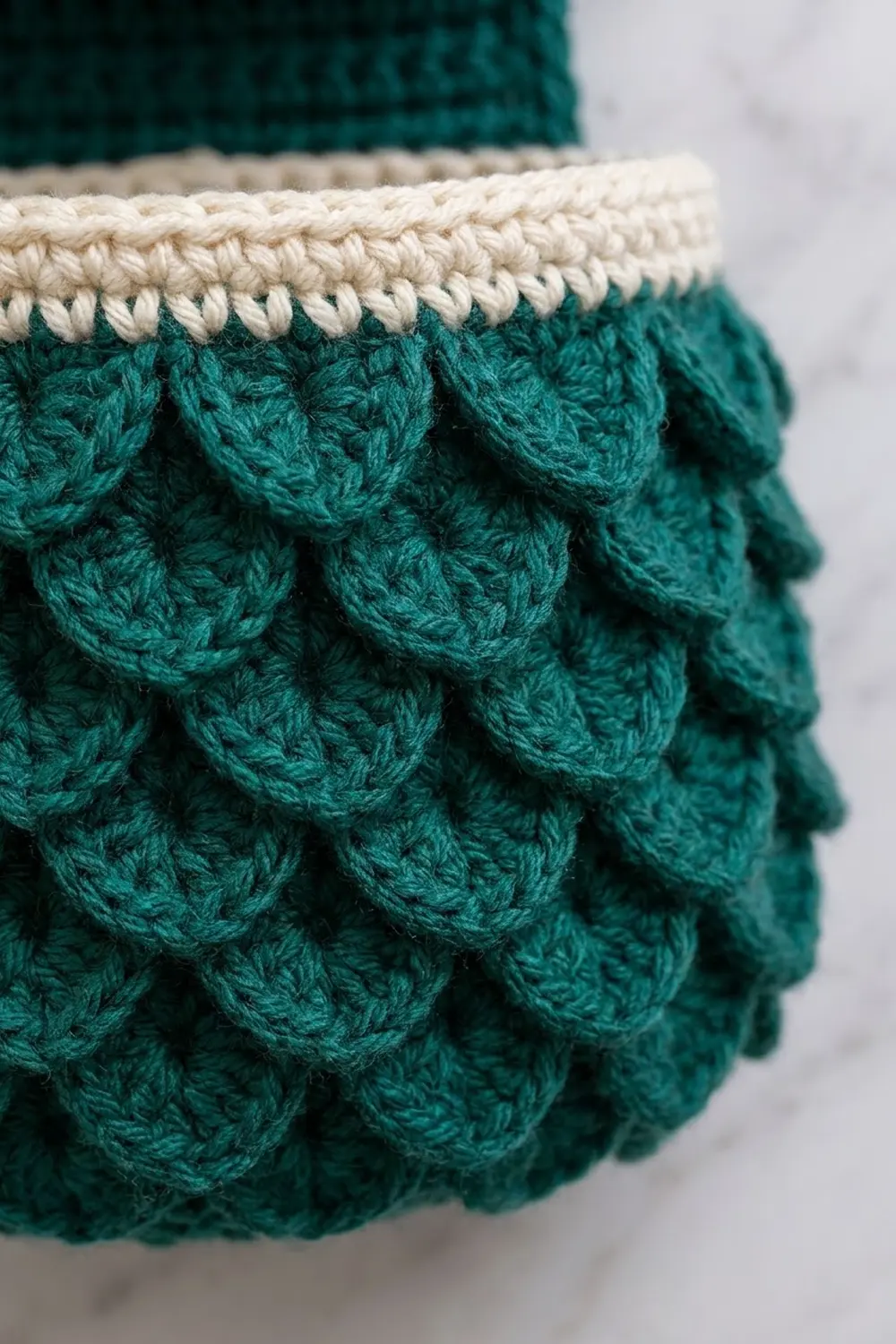
Pocket (Make 3)
Base
Use Color A. Work in joined rounds and do not turn.
Rnd 1: Ch 17. Work 3 sc in the 2nd ch from the hook, sc in the next 14 ch, and 3 sc in the last ch. Rotate the piece and work along the other side of the foundation chain: sc in the next 14 ch. Join with a sl st to the first sc. (34 sts)
Each end now has 3 sts and each straight side has 14 sts.
Rnd 2: Ch 1. Work 2 sc in each of the next 3 sts, sc in the next 14, 2 sc in each of the next 3 sts, sc in the next 14. Join. (40 sts)
Rnds 3–9: For each round, let n be the round number. Ch 1. Work (sc in the next n–2 sts, 2 sc in the next st) 3 times, sc in the next 14, then (sc in the next n–2 sts, 2 sc in the next st) 3 times, sc in the next 14. Join.
Each round is a growth round with 28 + 6n stitches in total:
| Round | 3 | 4 | 5 | 6 | 7 | 8 | 9 |
|---|---|---|---|---|---|---|---|
| Total sts | 46 | 52 | 58 | 64 | 70 | 76 | 82 |
After Rnd 9, place a marker in the first and last of the last 14 sts. This straight side is the back of the pocket.
Wall
Rnd 10 (conversion): Ch 1. Working in BLO: (sc in the next 40 sts, 2 sc in the next st) twice. Join. (82 worked 1-per-st + 2 extra = 84 sts)
The unused front loops form a ridge around the edge of the base.
Rnd 11 (pair round): Ch 3 (counts as dc), dc in the same st, ch 1, skip 2 sts. 2 dc in the next st, ch 1, skip 2 sts. Repeat from * around. Join to the top of the ch-3. (28 pairs: 56 dc + 28 ch-1 sps)
Rnd 12 (scale round A): Work a scale over the first pair. Sl st in the next ch-1 sp, sl st in the centre of the next pair (this pair is skipped), sl st in the next ch-1 sp, work a scale over the next pair. Repeat from * around, ending with a sl st in the centre of the last pair and a sl st in the last ch-1 sp. Join to the top of the first scale. (14 scales)
Rnd 13 (pair round): Sl st to the centre of the first pair. Ch 3, dc in the same centre, ch 1. 2 dc in the centre of the next pair, ch 1. Repeat from * around. Join. (28 pairs)
Each new pair sits directly above an old one, so the next tier of scales lines up in the gaps.
Rnd 14 (scale round B): Sl st across the first pair and into the next ch-1 sp. Scale over the next pair, sl st in the next ch-1 sp, sl st in the centre of the next pair (skipped), sl st in the next ch-1 sp. Repeat from * around. Join. (14 scales, offset by one pair)
Rnd 15: Repeat Rnd 13. (28 pairs)
Rnd 16: Repeat Rnd 12. (14 scales)
Rnd 17: Repeat Rnd 13. (28 pairs)
Rnd 18: Repeat Rnd 14. (14 scales)
You now have 4 tiers of scales, which should measure about 3 in (7.6 cm) from the ridge. Fasten off Color A and leave a 24 in (61.0 cm) tail for sewing.
Rim
Rnd 19 (conversion): With the RS facing, join Color B in the top of the first dc of the pair above the back marker. Work into the tops of the Rnd 17 pairs, behind the Rnd 18 scales. Ch 1. Sc in each of the next 2 dc, sc in the next ch-1 sp. Repeat from * 28 times. Join. (56 worked 1-per-st + 28 in sps = 84 sts)
Rnds 20–21: Ch 1, sc in each st around. Join. (84 sts)
Mark the 14 rim sts that sit directly above the back markers, then fasten off.
Pocket checkpoint: 4 in (10.2 cm) tall, with a rim 0.75 in (1.9 cm) deep.
Back Panel
Use Color A. Work in rows and turn at the end of every row.
Row 1: Ch 7, sc in the 2nd ch from the hook and in each ch across. (6)
Rows 2–6: Ch 1, 2 sc in the first st, sc across to the last st, 2 sc in the last st. (8, 10, 12, 14, 16)
Checkpoint: 4 in (10.2 cm) wide and 1.5 in (3.8 cm) tall.
Rows 7–81: Ch 1, sc in each st across. (16)
Rows 82–86: Ch 1, sc2tog, sc across to the last 2 sts, sc2tog. (14, 12, 10, 8, 6)
Checkpoint: 4 x 21.5 in (10.2 x 54.6 cm). Do not fasten off. Go straight on to the border.
Make All Pieces
- Color A: 3 pocket bases and walls, plus 1 panel with its border and tab
- Color B: 3 rims, plus 1 tassel
Layout (one column):
        [ ring ]
        [ tab  ]
     /  top taper  \     Rows 82–86
 [ Pocket 3 ]            base Row 57, rim Row 73
 [ Pocket 2 ]            base Row 33, rim Row 49
 [ Pocket 1 ]            base Row 9,  rim Row 25
     \ bottom taper /    Rows 1–5
        [ tassel ]
Border
Border gauge: the same 16 sc = 4 in (10.2 cm). Because the gauge is 16 sts and 16 rows per 4 in, each row end is as long as one sc is wide.
Border Rnd (Color A): Ch 1 and continue around the panel as follows. Join to the first sc at the end. (196 sts)
- Top edge (Row 86, 6 sts): 2 sc in the first st, sc in the next 4, 2 sc in the last st. (8)
- First long side:
- Row ends of Rows 86–82: 1 sc in each, with 2 sc in the row ends of Rows 85 and 83. (7)
- Rows 81–6: 1 sc in each row end. (76)
- Rows 5–1: 1 sc in each row end, with 2 sc in the row ends of Rows 4 and 2. (7)
- Side total: 90
- Bottom edge (foundation chain, 6 sts): 2 sc, sc 4, 2 sc. (8)
- Second long side: work it the same as the first. (7 + 76 + 7 = 90)
Why the math works: each straight side has 76 row ends, 19 in (48.3 cm) long, and gets 76 sc. Each diagonal edge rises 5 rows (1.25 in) and moves in 5 sts (1.25 in), so it is about 1.77 in long. That length needs 7 sc, not 5. The 2 sc at each end of the short edges turn the obtuse corners.
The total is 8 + 90 + 8 + 90 = 196 sts. Including the border, the panel is now 18 sts wide, or 4.5 in (11.4 cm), and 22 in (55.9 cm) long.
Tab
Row 1: Ch 1. Working into the top-edge border, sc in sts 2–7. (6)
Rows 2–16: Ch 1, sc across. (6)
The tab is 4 in (10.2 cm) long. Pass it through the ring from front to back, fold it in half, and whipstitch Row 16 to the back of Row 1. This makes a 2 in (5.1 cm) loop.
Joining
Method: whipstitch with the Color A tail.
Base: Lay the panel flat with the RS up. Hold the back of a pocket base against the panel row given in the layout. Sew the 14 marked front loops of the Rnd 10 ridge to the 14 sts in that row, using sts 2–15 of the 16 body sts. That leaves 1 st free on each side, inside the border. Make one whipstitch for each pair of stitches: one base loop to one panel st.
Rim: Fold the pocket wall up against the panel. Using a Color B length, sew the 14 marked Rnd 21 sts to sts 2–15 of the rim row in the same way.
Middle of the wall: Add 3 tacks through the back pair of scales at mid-height, so the wall cannot tip forward.
Tension: Make the stitches snug but not tight. The panel should stay flat and should not pucker between the base row and the rim row.
Checkpoint: The panel still measures 4.5 x 22 in (11.4 x 55.9 cm). From one pocket base to the next is 24 rows, or 6 in (15.2 cm), and the gap between a rim and the next base is 2 in (5.1 cm).
Tassel: Wrap Color B 30 times around the card. Tie the loops at the top, then wrap the neck 0.75 in (1.9 cm) below the tie. Cut the bottom loops and trim the tassel to 5 in (12.7 cm). Tie it to the centre of the bottom border.
Final Blocking
- Lightly mist the panel and pin it to 4.5 x 22 in (11.4 x 55.9 cm), keeping the edges straight.
- Steam the tapers flat with the iron held above the fabric. Never press down on it.
- Put a toilet roll in each pocket to shape it.
- Use your fingers to tilt each scale so it points down and overlaps the tier below. Do not press the scales.
- Mist the rims and smooth them level.
- Let everything dry completely, then take out the rolls and pins.
Final Quality-Control Checklist
- [ ] Each base has 82 sts and measures 4.5 x 8 in (11.4 x 20.3 cm).
- [ ] Each pocket has 4 tiers of 14 scales, and the tiers are offset.
- [ ] Each rim has 84 sts and is 0.75 in (1.9 cm) deep.
- [ ] The border has 196 sts: 8 + 90 + 8 + 90.
- [ ] The panel measures 4.5 x 22 in (11.4 x 55.9 cm).
- [ ] The pockets are centred and level, and are sewn at the correct rows.
- [ ] The tab loop is secure, and the tassel is tied firmly.
Troubleshooting
- The base cups upward: your gauge is too tight. Go up a hook size.
- The base ruffles: go down a hook size.
- The scales lean sideways: you worked around the posts in the wrong direction. Go down the first post and up the second.
- The scales line up in columns instead of offsetting: Rnd 14 or Rnd 18 started on the first pair. Skip the first pair on B rounds.
- The rim flares: work Rnd 19 only into the pairs and spaces of Rnd 17, never into the scales.
- The panel edge waves: keep exactly 1 sc per row end on the straight sides.
- The pocket sags forward: add more tacks at mid-wall.
Care
Hand wash in cool water and press out the water in a towel. Reshape the holder and dry it flat with a roll inside each pocket.

Final Notes
The measurements build on each other. The gauge of 16 sc and 16 rows to 4 in (10.2 cm) gives an 82-st base of 4.5 x 8 in (11.4 x 20.3 cm), which converts to 84 wall sts and 28 pairs, making 14 scales per tier. Four tiers and a rim make a pocket 4 in (10.2 cm) tall. The panel is 16 sts by 86 rows, and the 196-st border brings it to 4.5 x 22 in (11.4 x 55.9 cm). The three pockets sit 6 in (15.2 cm) apart, and the whole holder hangs from a 2 in (5.1 cm) tab loop.
Happy crocheting!